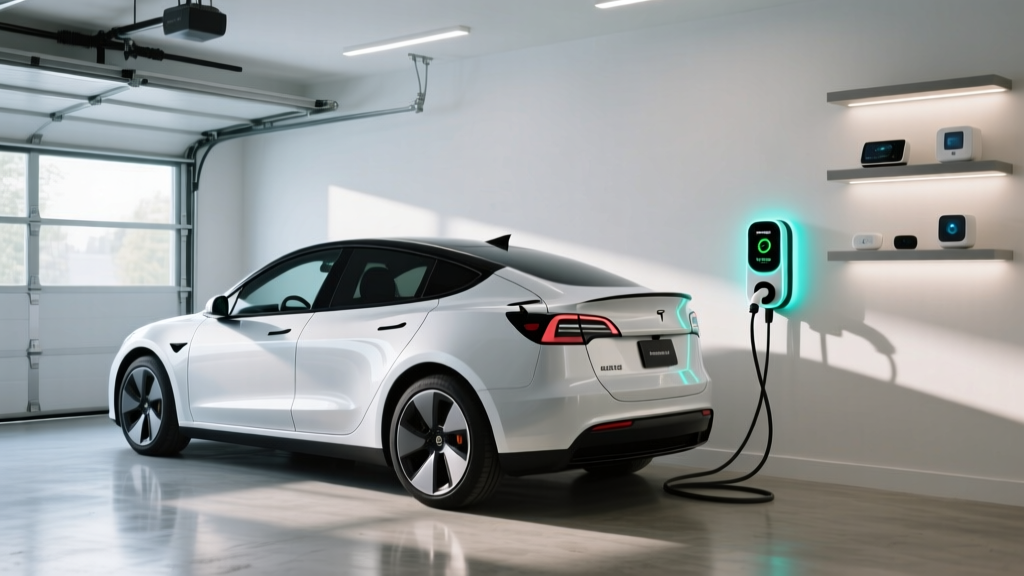
If you're asking how do I charge my electric car at home, the short answer is: plug into a standard 120V outlet for slow Level 1 charging (adding ~3–5 miles of range per hour), or install a 240V Level 2 home charger to add 20–40 miles per hour — enough to fully replenish most EV batteries overnight. Most EV owners do 80–90% of their charging at home, making it the cornerstone of practical EV ownership. Below, we break down exactly what equipment you need, what installation costs in 2026, and how home charging compares to fueling a gas car.
Quick Answer: Home EV Charging Basics
- Level 1 (120V): Uses any standard household outlet. Adds 3–5 miles/hour. No installation needed. Best for PHEVs or low-mileage drivers.
- Level 2 (240V): Requires a dedicated 40A–60A circuit and a wall-mounted or plug-in charger (NACS or CCS). Adds 20–40 miles/hour. Professional installation typically $500–$2,500.
- Cost per mile: Home charging averages $0.03–$0.05/mile vs. $0.12–$0.18/mile for gas (at $3.50/gal and 28 MPG combined).
Understanding Home Charging Levels: kW vs. kWh Explained
Before buying equipment, you need to understand the single most common point of confusion in EV charging: the difference between kW (kilowatts) and kWh (kilowatt-hours).
kW measures power — how fast energy flows into your car, like water pressure from a hose. kWh measures energy — the total amount stored in your battery, like the size of the bucket. A 75 kWh battery charged at 7.2 kW takes roughly 10 hours from empty to full. The same battery at 11.5 kW takes about 6.5 hours.
| Level | Voltage | Power (kW) | Miles Added/Hour | Full Charge Time (75 kWh) | Install Needed? |
|---|---|---|---|---|---|
| Level 1 | 120V | 1.2–1.4 kW | 3–5 mi | 50–60 hours | No (standard outlet) |
| Level 2 (32A) | 240V | 7.2–7.7 kW | 20–25 mi | 10–11 hours | Yes (dedicated circuit) |
| Level 2 (48A) | 240V | 11.5 kW | 32–40 mi | 6–7 hours | Yes (60A circuit) |
Most modern EVs have batteries between 58 kWh (e.g., base Tesla Model 3 RWD) and 100+ kWh (e.g., Ford F-150 Lightning Extended Range). If you drive 30–40 miles per day — the U.S. average commute — even Level 1 can keep up overnight for many drivers. But Level 2 is the standard for comfortable, stress-free ownership.
Level 2 Home Charger Installation: What It Actually Costs
Installation costs vary widely based on your home's electrical panel capacity, the distance from the panel to your garage or driveway, and local permit requirements. Here's a realistic 2026 breakdown based on national averages and electrician surveys:
| Component | Low End | High End | Notes |
|---|---|---|---|
| Level 2 Charger (hardware) | $300 | $700 | Wallbox, ChargePoint, Emporia, Tesla Wall Connector |
| Electrician labor (new 60A circuit) | $400 | $1,200 | Depends on panel proximity and conduit run |
| Electrical panel upgrade (if needed) | $1,500 | $3,500 | Older homes with 100A panels may need 200A upgrade |
| Permit and inspection | $50 | $300 | Varies by municipality; some waive for EV chargers |
| Total (no panel upgrade) | $750 | $2,200 | Most homes with modern 200A panels |
| Total (with panel upgrade) | $2,250 | $5,700 | Older homes, large conduit runs |
The biggest variable is your electrical panel. If your home already has a 200A panel with spare breaker slots, you're looking at the lower range. Homes built before 1990 often have 100A or 150A panels that may need upgrading — especially if you're also running electric heat, a dryer, and an EV charger simultaneously. Always get a licensed electrician to assess your panel capacity before purchasing equipment.
Federal incentive note: The IRS §30C Alternative Fuel Vehicle Refueling Property Credit covers 30% of home charger hardware and installation costs, up to $1,000, for eligible taxpayers in qualifying census tracts. This is separate from the §30D new-vehicle tax credit. Check your eligibility on the IRS website or with a tax professional, as census tract requirements and income limits apply.
Home Charging Cost vs. Gas: The Real Savings Breakdown
One of the strongest arguments for home charging is fuel cost savings. Let's compare real numbers using the national average electricity rate of $0.17/kWh (per EIA data) and gasoline at $3.50/gallon.
| Vehicle Type | Efficiency | Energy Cost | Annual Fuel/Energy Cost | Cost Per Mile |
|---|---|---|---|---|
| EV (home charging, 3.5 mi/kWh avg) | 285 Wh/mi | $0.17/kWh | $583 | $0.049 |
| EV (with solar, $0.08/kWh effective) | 285 Wh/mi | $0.08/kWh | $274 | $0.023 |
| Gas sedan (28 MPG combined) | 28 MPG | $3.50/gal | $1,500 | $0.125 |
| Gas SUV/truck (20 MPG combined) | 20 MPG | $3.50/gal | $2,100 | $0.175 |
At 12,000 miles per year, a typical EV owner charging at home saves $900–$1,500 annually compared to a gas sedan, and even more versus a truck or large SUV. Over five years, that's $4,500–$7,500 in fuel savings alone — often enough to offset the higher purchase price of an EV.
For PHEV owners, the savings depend on how much you drive on electric-only mode. A Toyota RAV4 Prime with 42 miles of electric range can cover most daily commutes without burning gas, then switches to hybrid mode (38 MPG combined) for longer trips.
What First-Time EV Buyers Should Know About Home Charging
If you're transitioning from a gas car, home charging involves a few practical considerations that aren't always obvious:
Connector Compatibility: NACS vs. CCS
As of 2026, the North American Charging Standard (NACS), pioneered by Tesla, has become the dominant connector. Ford, Rivian, GM, Volvo, and others now ship vehicles with NACS ports. Legacy CCS1 vehicles (Hyundai Ioniq 5 pre-2025, VW ID.4 pre-2025) may need a CCS-to-NACS adapter (~$150–$250) for Tesla Supercharger access. When buying a home charger, confirm it matches your vehicle's port — or buy a dual-standard unit.
Charge Scheduling and Battery Health
Most EVs and smart chargers let you schedule charging to off-peak hours (typically 11 PM – 6 AM) when utility rates are lowest. Some utilities offer time-of-use (TOU) plans with EV-specific rates as low as $0.06–$0.10/kWh overnight. Additionally, limiting daily charge to 80% State of Charge (SoC) — rather than 100% — extends long-term battery health, particularly for NMC chemistry batteries. LFP batteries (found in base Tesla Model 3/Y and some BYD models) tolerate regular 100% charges better.
Cold Weather Realities
EV batteries charge slower in cold temperatures and lose 15–30% of range below freezing. If you live in a cold climate, preconditioning — warming the battery while still plugged in — is essential. Most EVs let you schedule preconditioning via their app, ensuring the battery is at optimal temperature before you leave. This preserves range and enables faster DC fast charging on the road.
Common Home Charging Myths vs. Facts
| Myth | Fact |
|---|---|
| "I need a special outlet to charge at home." | Level 1 uses any standard 120V outlet. Level 2 requires a 240V circuit — the same type your dryer or oven uses. |
| "Home charging will overload my electrical panel." | A licensed electrician can calculate your panel's available capacity. Most 200A panels handle a 48A Level 2 charger with room to spare. |
| "Charging overnight is dangerous." | EV chargers and vehicles have multiple safety layers — ground fault protection, thermal monitoring, and automatic shutoff. UL-listed chargers meet rigorous safety standards. |
| "Level 1 is too slow to be useful." | If you drive under 40 miles/day and park for 10+ hours overnight, Level 1 adds 30–50 miles — enough for most daily commutes. |
| "I'll save money buying a cheap, no-name charger." | Budget chargers may lack UL certification, Wi-Fi scheduling, or warranty support. Stick with UL-listed units from reputable brands. |
Decision Framework: Which Home Charging Setup Is Right for You?
Choose Your Setup Based on Your Situation
Choose Level 1 (120V, no install) if:
- You drive fewer than 40 miles per day
- You own a PHEV with a small battery (10–18 kWh)
- You rent and cannot modify electrical systems
- You're testing EV ownership before committing to a Level 2 install
Choose Level 2 (240V, 32A–48A) if:
- You drive 40+ miles per day or regularly take road trips
- You own a BEV with a 60+ kWh battery
- You want to precondition your battery in cold climates
- You plan to use time-of-use utility rates for off-peak savings
- You want to maximize home value — Level 2 chargers are a selling point
Consider a panel upgrade + Level 2 if:
- Your home has a 100A panel and you plan to add solar, heat pumps, or a second EV
- You want a 48A (11.5 kW) charger for large-battery vehicles like the F-150 Lightning or Rivian R1T
Explore alternatives to home charging if:
- You live in an apartment or condo without dedicated parking (ask about workplace or community charging options)
- Your utility panel cannot be upgraded cost-effectively
- You drive fewer than 10,000 miles/year and have reliable DC fast charging nearby
Recommended Level 2 Chargers for 2026
Based on reliability, features, and value, these are the home chargers we recommend for most EV owners:
- Tesla Wall Connector ($475): 48A, NACS native, Wi-Fi, load sharing for multi-charger setups. Best for Tesla and NACS-equipped vehicles.
- ChargePoint Home Flex ($599): Up to 50A, NACS or CCS configurable, excellent app with scheduling and energy tracking.
- Emporia Vue Level 2 ($399): 48A, NACS, budget-friendly with real-time energy monitoring. Great value pick.
- Wallbox Pulsar Plus ($549): 48A, compact design, NACS or J1772 options, Power Sharing feature for homes with limited panel capacity.
All of these are UL-listed, support charge scheduling, and carry 2–3 year warranties. Avoid unbranded Amazon chargers lacking UL or ETL certification — the savings aren't worth the fire risk.
Frequently Asked Questions
Can I charge my EV from a regular wall outlet?
Yes. Every EV comes with a Level 1 charging cable that plugs into a standard 120V household outlet. It adds 3–5 miles of range per hour, which is sufficient for PHEVs and low-mileage BEV drivers. For a 75 kWh battery, a full Level 1 charge takes 50–60 hours, so it works best as a top-up rather than a primary charging method for large-battery EVs.
Do I need a permit to install a Level 2 charger?
Most jurisdictions require an electrical permit for a new 240V circuit. Your electrician typically handles this. Permit costs range from $50–$300 and include an inspection to ensure the work meets code. Skipping the permit can void home insurance claims and cause issues when selling your home.
How much does it cost to charge an EV at home per month?
At the national average of $0.17/kWh and driving 1,000 miles/month in a vehicle averaging 3.5 miles/kWh, you'll use about 286 kWh per month — roughly $49 added to your electric bill. With a TOU plan charging overnight at $0.09/kWh, that drops to about $26/month. Compare that to $125/month in gas at 28 MPG and $3.50/gallon.
Will charging at home damage my EV battery?
No. Modern EVs have sophisticated battery management systems that prevent overcharging and manage thermal loads. For NMC batteries, setting a daily charge limit of 80% SoC extends long-term battery health. LFP batteries (Tesla Model 3/Y RWD, some BYD models) are fine at 100% daily. Federal law mandates battery warranties of at least 8 years/100,000 miles with a minimum 70% capacity retention threshold.
What if I live in an apartment and can't install a charger?
You have options: workplace charging, public Level 2 networks (ChargePoint, EVgo, Blink), and DC fast chargers along your commute. Some states now require new multifamily construction to include EV-ready wiring. Talk to your landlord or HOA — many are installing shared charging stations to attract tenants. If none of these work, a PHEV may be a better fit since it doesn't depend on frequent charging.
Is a smart charger worth the extra cost?
Yes, for most owners. Smart chargers ($400–$650) offer Wi-Fi connectivity, charge scheduling, energy usage tracking, and integration with utility TOU rates. A basic non-smart charger costs $250–$350 but lacks scheduling — meaning you might charge during peak-rate hours. The $100–$200 premium for a smart charger typically pays for itself within a year through off-peak savings.