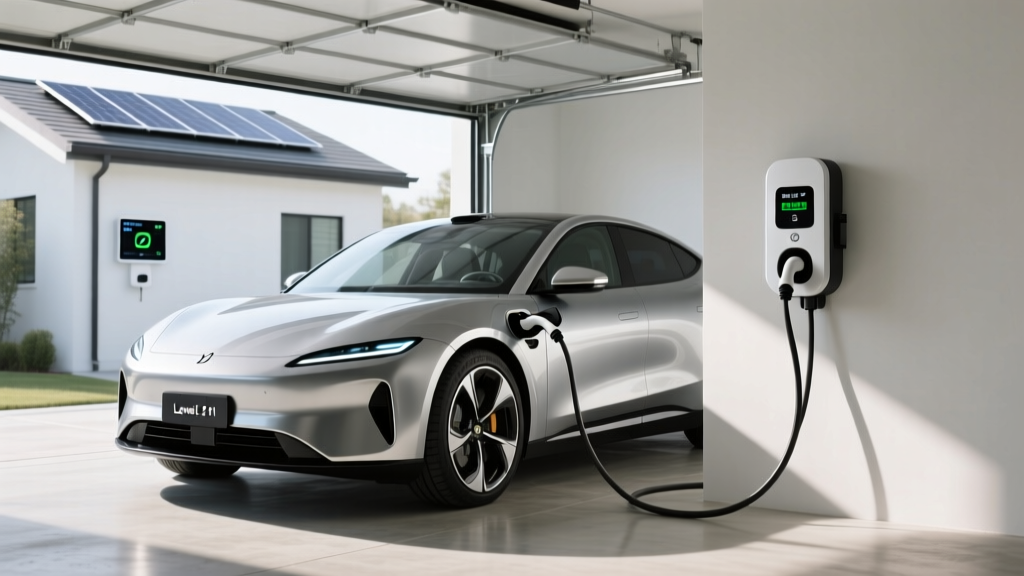
If you're asking how to charge your electric car at home, the short answer is straightforward: plug into a standard 120V outlet for Level 1 charging (adding 3–5 miles of range per hour), or install a 240V Level 2 wall charger that adds 25–44 miles per hour and fully replenishes most EV batteries overnight. For daily driving of 30–40 miles, Level 1 technically works—but Level 2 is what makes EV ownership genuinely effortless, eliminating trips to gas stations and public chargers for most routines.
Quick Answer: Home Charging in 3 Steps
- Assess your electrical panel: Most homes need a 200-amp panel for a 48-amp Level 2 charger. Older homes with 100-amp service may need a panel upgrade ($1,500–$3,000).
- Choose your charging level: Level 1 (120V, included cord) or Level 2 (240V, wall-mounted unit $300–$700).
- Hire a licensed electrician: Get 2–3 quotes. A straightforward Level 2 install near the panel costs $500–$1,200; longer runs or panel upgrades push totals to $2,000–$4,000+.
Level 1 vs Level 2: The Numbers That Actually Matter
The single most common mistake new EV owners make is confusing kW (power, or how fast energy flows) with kWh (energy, or how much the battery holds). A 60 kWh battery charged at 7.2 kW takes roughly 8.3 hours from empty to full. Here's how each level breaks down in practice:
| Charging Level | Voltage | Max Power (kW) | Miles Added/Hour | Full Charge Time (75 kWh battery) | Equipment Cost |
|---|---|---|---|---|---|
| Level 1 | 120V AC | 1.2–1.4 kW | 3–5 mi/hr | 53–63 hours | $0 (included cord) |
| Level 2 | 240V AC | 7.2–11.5 kW | 25–44 mi/hr | 6.5–10.5 hours | $300–$700 + install |
Most Level 2 home chargers deliver between 32 and 48 amps on a dedicated 40- or 60-amp circuit. A 48-amp charger on a 60-amp circuit (the National Electrical Code requires circuits rated at 125% of continuous load) outputs 11.5 kW. That's the sweet spot for vehicles like the Hyundai Ioniq 5 (77.4 kWh usable, EPA 305 mi) or Tesla Model Y Long Range (75 kWh usable, EPA 310 mi)—both recharge from 10% to 80% in about 6–7 hours overnight.
Home Charger Installation: What It Actually Costs
Installation costs vary enormously based on your home's electrical infrastructure, the distance from your panel to the charging location, and local permit requirements. Here's a realistic breakdown based on 2026 national averages:
| Cost Component | Low End | Typical | High End |
|---|---|---|---|
| Level 2 charger hardware (hardwired, 48A) | $300 | $500 | $700 |
| Electrician labor (short run, <30 ft from panel) | $400 | $700 | $1,200 |
| Permit & inspection fees | $50 | $150 | $400 |
| Panel upgrade (100A → 200A, if needed) | $1,500 | $2,500 | $4,000 |
| Total (no panel upgrade) | $750 | $1,350 | $2,300 |
| Total (with panel upgrade) | $2,250 | $3,850 | $6,300 |
The biggest cost driver most buyers overlook: panel capacity. If your home has a 100-amp main panel already running central AC, an electric dryer, and an electric oven, adding a 60-amp EV circuit may exceed your panel's capacity. A licensed electrician will perform a load calculation per NEC Article 220 to determine if an upgrade is necessary.
Some utilities offer rebates of $250–$1,000 for Level 2 installations, and certain states provide additional incentives. Check your local utility's EV program page before scheduling work. Additionally, the federal Residential Clean Energy Credit does not cover EV chargers as of 2026 (the alternative fuel vehicle refueling property credit expired for most residential installations), so budget accordingly.
Charging at Home vs Fueling a Gas Car: The Real Cost Comparison
Home charging is where EV ownership economics shine brightest. Using the national average residential electricity rate of $0.16/kWh (EIA, early 2026) and regular unleaded at $3.40/gallon, here's how the math works for a typical midsize EV versus a comparable gas sedan:
| Metric | EV (e.g., Tesla Model 3 RWD, 132 MPGe) | Gas Sedan (e.g., Toyota Camry LE, 32 MPG combined) |
|---|---|---|
| Energy cost per mile | $0.048/mi (28 kWh/100mi × $0.16) | $0.106/mi ($3.40 ÷ 32 MPG) |
| Annual fuel/energy (12,000 mi/yr) | $576 | $1,275 |
| 5-year fuel/energy total | $2,880 | $6,375 |
| 5-year savings (EV vs gas) | $3,495 | |
Source: Efficiency figures via fueleconomy.gov; electricity rates from EIA state averages.
That $3,495 savings over five years doesn't include the EV's lower maintenance burden—no oil changes, no transmission fluid, fewer brake replacements thanks to regenerative braking. The total cost of ownership advantage grows further if your utility offers time-of-use (TOU) rates, where overnight charging can drop to $0.06–$0.09/kWh, cutting your per-mile cost to $0.02–$0.03.
5-Year Ownership Cost Snapshot (12,000 mi/yr)
| Category | EV (Model 3 RWD) | Gas Sedan (Camry LE) |
|---|---|---|
| Purchase price (base MSRP) | $38,990 | $28,400 |
| Federal tax credit (§30D, if eligible) | −$3,750 to −$7,500* | $0 |
| Fuel/energy (5 years) | $2,880 | $6,375 |
| Maintenance (5 years) | ~$1,800 | ~$3,200 |
| Insurance (5 years, avg) | ~$9,500 | ~$7,200 |
| Net 5-year cost | ~$45,670–$49,420 | ~$45,175 |
*§30D credit eligibility depends on MSRP caps ($55,000 sedans), buyer income limits ($150K single / $300K joint), and battery component/critical mineral sourcing. Verify at IRS.gov or with a tax professional.
Choosing the Right Home Charger: What to Buy
Not all Level 2 chargers are equal. Here's what separates a reliable unit from a frustrating one:
- Amperage: 48-amp units on a 60-amp circuit deliver 11.5 kW—the practical maximum for most homes. Lower-cost 32-amp units (7.7 kW) are adequate for smaller batteries or shorter commutes.
- Connector: As of 2026, the NACS (North American Charging Standard, aka Tesla's connector) is becoming the dominant standard. Ford, GM, Rivian, Hyundai, and others have adopted NACS on new vehicles. If your EV uses CCS1 (most pre-2025 non-Tesla EVs), buy a CCS charger or use a NACS-to-CCS adapter ($100–$200).
- Hardwired vs plug-in: Hardwired units (no plug, wired directly to the circuit) support 48 amps and avoid the $50–$100 cost of a NEMA 14-50 outlet. Plug-in units offer portability if you move.
- Smart features: Wi-Fi-connected chargers let you schedule charging during off-peak TOU hours, monitor energy use, and receive firmware updates. Budget units ($300–$400) are "dumb" but functional.
- Cable length: 18–25 feet is standard. If your charge port and outlet are far apart, verify length before buying.
Top-rated 2026 units include the ChargePoint Home Flex (up to 50A, adjustable, NACS or J1772, ~$550), the Tesla Wall Connector (48A, NACS native, ~$450), and the Emporia Level 2 (48A, budget-friendly at ~$350 with smart scheduling).
Common Home Charging Myths vs Facts
| Myth | Fact |
|---|---|
| "I need a special electrical upgrade for any EV charger." | Level 1 uses a standard 120V household outlet—no upgrade needed. Level 2 requires a 240V circuit, which many homes already have for dryers or ovens. |
| "Home charging will spike my electric bill massively." | Charging a 75 kWh battery from empty costs ~$12 at $0.16/kWh. Most drivers use 10–15 kWh daily (~$1.60–$2.40), less than a gallon of gas. |
| "I should always charge to 100%." | For NMC batteries, daily charging to 80% extends longevity. LFP batteries (Tesla Model 3 RWD, some BYD models) can be charged to 100% daily without harm. Check your owner's manual. |
| "Charging in the rain or garage is dangerous." | EV chargers and vehicle inlets are weather-sealed (IP65+ rated). Charging in rain, snow, or an unheated garage is safe per UL and NEC standards. |
| "Fast charging at home damages the battery." | Home Level 2 charging (7–11.5 kW) is far gentler than DC fast charging (50–350 kW). Level 2 is actually the ideal charge rate for long-term battery health. |
Real-World Ownership: What First-Time EV Buyers Should Know
Home charging convenience is the biggest satisfaction driver in EV ownership surveys, but practical realities deserve honest treatment:
Cold-weather impact: In sub-freezing temperatures, battery efficiency drops 15–30%. An EV rated at 300 miles EPA may deliver 210–255 real-world miles in winter. Home charging mitigates this: preconditioning your EV while it's still plugged in warms the battery using grid power rather than battery energy, preserving range for your commute.
Apartment and condo living: If you don't have a dedicated garage or driveway, home charging becomes significantly harder. Some states have "right to charge" laws preventing HOAs from blocking installations, but shared electrical infrastructure in multi-unit buildings adds complexity and cost. If home charging isn't feasible, rely on workplace charging or public DC fast chargers—and factor that inconvenience into your purchase decision.
Utility rate plans: Contact your electric provider about EV-specific TOU rates before your charger is installed. Many utilities offer dramatically cheaper overnight rates (11 PM–6 AM), cutting your effective cost per mile by 40–60%. Smart chargers automate this scheduling.
Decision Framework: What's Your Best Charging Setup?
- Choose Level 1 only if: Your daily driving is under 30 miles, you park for 10+ hours nightly, and your EV battery is 60+ kWh. You'll save the install cost but accept slower replenishment.
- Choose Level 2 (standard install) if: You drive 30+ miles daily, want overnight full charges, or live in a cold climate where preconditioning matters. Budget $1,000–$2,500 total.
- Choose Level 2 + panel upgrade if: Your home has a 100-amp panel with high existing loads. Budget $3,500–$6,000+ and plan for 2–3 days of electrical work.
- Rely on public/workplace charging if: You can't install at home (apartment, no dedicated parking). Confirm reliable DC fast charging access within 2 miles of home before buying an EV.
Frequently Asked Questions
Can I install a Level 2 charger myself?
Technically possible for licensed electricians, but strongly discouraged for DIY. A 240V/60-amp circuit carries lethal current and must meet NEC requirements for wire gauge, breaker sizing, and grounding. Most jurisdictions require a permit and inspection. Improper installation voids your charger warranty and homeowner's insurance coverage.
How long does a home charger installation take?
A straightforward install (panel nearby, no upgrade needed) takes 2–4 hours. Installations requiring conduit runs through walls, sub-panel additions, or panel upgrades can take 1–3 days including inspection scheduling.
Will a Level 2 charger increase my home's value?
Studies suggest EV-ready homes command a modest premium, particularly in markets with high EV adoption (California, Pacific Northwest, Northeast). A hardwired Level 2 charger signals move-in readiness, though it won't recoup the full install cost at resale.
Do I need a Tesla Wall Connector for a Tesla?
No. Any Level 2 charger with a NACS connector (or J1772 with adapter for older Teslas) will charge a Tesla. The Tesla Wall Connector is well-priced and integrates with Tesla's app, but third-party units like the ChargePoint Home Flex work identically.
What's the difference between kW and kWh?
kW (kilowatts) measures power—the rate at which energy flows, like water pressure from a hose. kWh (kilowatt-hours) measures energy—the total amount stored or consumed, like gallons in a bucket. Your charger's kW rating determines charging speed; your battery's kWh capacity determines how far you can drive.