Changing Your Tesla's Display Color — and Everything Else You Need to Know About the 2026 Model 3
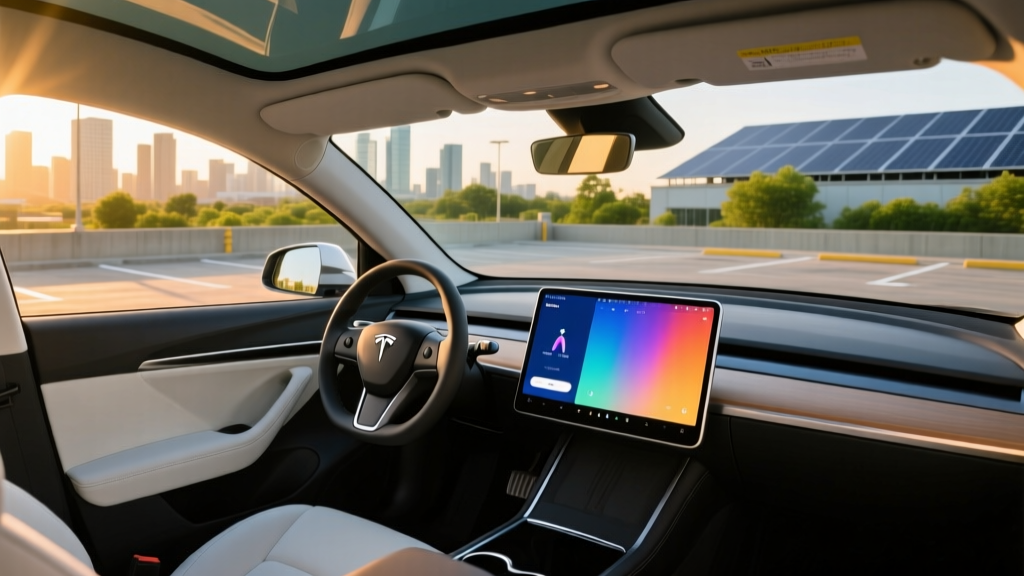
If you've just taken delivery of a Tesla Model 3 (or are shopping for one), you've probably noticed the minimalist interior revolves almost entirely around the 15.4-inch center touchscreen. One of the first personalization tweaks new owners search for is how to change color of Tesla on screen — specifically the ambient lighting and display accent colors. We'll walk through that process below, but we'll also give you the full data-driven breakdown of the 2026 Tesla Model 3: real-world range, charging speeds, tax-credit eligibility, and whether it still holds the crown in the midsize electric sedan segment.
How to Change Color of Tesla on Screen: Step-by-Step
Tesla does not offer a full custom RGB color picker for the main driving display, but you can adjust the ambient light bar color (on models equipped with the interior ambient lighting strip) and toggle display themes. Here's how:
- Tap the car icon at the bottom-left of the touchscreen to open Controls.
- Select Lights from the left-side menu.
- Scroll to Ambient Lights. You'll see a color spectrum slider — drag it to choose from preset hues (blue, green, purple, red, orange, white, and off).
- You can also toggle Auto mode, which adjusts brightness based on time of day.
For the display theme itself (dark vs. light mode), go to Controls > Display and toggle between Day, Night, or Auto. The Auto setting uses the ambient light sensor to switch automatically. Note that Tesla removed the ability to change the navigation map color scheme or speedometer accent color as of the 2025 software refresh — those elements remain fixed based on your dark/light selection.
2026 Tesla Model 3: EPA Range, Battery, and Real-World Efficiency
The 2026 Model 3 continues with two main powertrain configurations in the US market: the Long Range RWD and the Long Range AWD. The Performance variant returns with track-focused tuning.
| Spec | Long Range RWD | Long Range AWD | Performance AWD |
|---|---|---|---|
| EPA Range | 363 mi | 346 mi | 315 mi |
| Battery (usable) | ~75 kWh (NMC) | ~75 kWh (NMC) | ~75 kWh (NMC) |
| EPA Efficiency | 132 MPGe / 25 kWh/100mi | 125 MPGe / 27 kWh/100mi | 118 MPGe / 29 kWh/100mi |
| 0-60 mph | 5.8 sec | 4.2 sec | 2.9 sec |
| Horsepower | 271 hp | 366 hp | 510 hp |
| Drivetrain | RWD (single motor) | AWD (dual motor) | AWD (dual motor) |
| Base MSRP | $42,380 | $47,380 | $54,630 |
All 2026 Model 3 trims use NMC (nickel manganese cobalt) lithium-ion chemistry in a structural battery pack. Tesla moved away from the LFP (lithium iron phosphate) battery in the US-market Model 3 after the 2024 refresh, prioritizing energy density for the longer-range configurations. LFP cells are still used in the base Model 3 RWD sold in some international markets.
Charging Speed: DC Fast Charging and Home Level 2
Charging speed is where the refreshed Model 3 shows meaningful improvement over pre-2024 models. The peak DC fast-charge rate is now 170 kW on the Long Range trims (up from 150 kW on older versions), and the charge curve holds near peak longer before tapering.
| Charging Level | Power / Rate | Time / Miles Added |
|---|---|---|
| DC Fast Charge (peak) | 170 kW | 10-80% in ~25 min |
| DC Fast Charge (sustained avg) | ~120 kW avg (10-80%) | ~170 mi added in 15 min |
| Level 2 (Tesla Wall Connector) | 11.5 kW (48A) | ~44 mi/hr of charge |
| Level 2 (standard 240V/32A) | 7.7 kW | ~30 mi/hr of charge |
| Level 1 (120V household) | ~1.4 kW | ~5 mi/hr of charge |
The Model 3 uses the NACS (North American Charging Standard) connector natively — no adapter needed at Tesla Superchargers. With the broader Supercharger network now open to other brands, Tesla owners still enjoy the most seamless plug-and-charge experience, though peak stalls (250 kW V3 and newer V4) exceed what the Model 3 can accept, meaning you won't bottleneck the car.
Charge-curve reality check: The 170 kW peak only holds roughly between 10-30% state of charge. Above 50%, the rate tapers to ~100 kW, and above 80% it drops below 40 kW. If you're road-tripping, plan stops around the 10-80% window for the fastest turnaround.
Pricing, Tax Credits, and Total Cost
The 2026 Model 3 starts at $42,380 for the Long Range RWD (including destination fee). The Long Range AWD is $47,380, and the Performance sits at $54,630. All trims fall under the IRS §30D MSRP cap of $55,000 for sedans.
| Trim | Base MSRP | Est. §30D Credit | Effective Price |
|---|---|---|---|
| Long Range RWD | $42,380 | Up to $7,500 | ~$34,880 |
| Long Range AWD | $47,380 | Up to $7,500 | ~$39,880 |
| Performance AWD | $54,630 | Up to $7,500 | ~$47,130 |
Eligibility caveats (IRS §30D, 2026 rules):
- Income caps: Modified AGI must not exceed $150,000 (single), $225,000 (head of household), or $300,000 (joint).
- MSRP cap: $55,000 for sedans — all Model 3 trims qualify at base, but adding options that push MSRP above $55,000 on the Performance can disqualify it.
- Battery sourcing: The credit splits into two halves ($3,750 for critical minerals + $3,750 for battery component assembly). Tesla's US-built battery packs meet the component requirement, but critical-mineral sourcing rules tighten annually. Verify current eligibility at IRS.gov or via the dealer's point-of-sale transfer process.
- Point-of-sale transfer: As of 2024, you can transfer the credit to the dealer at purchase, reducing your out-of-pocket cost immediately rather than waiting for tax filing.
Interior, Cargo, Tech, and Daily Livability
The "Highland" refresh that debuted for the 2024 model year carries into 2026 with refinements. The cabin is quieter (acoustic glass all around), materials are upgraded with ventilated front seats on Long Range and Performance trims, and the rear passengers now get their own 8-inch touchscreen for climate and media control.
Cargo and passenger dimensions:
- Rear trunk: 23 cu ft (649 L)
- Front trunk (frunk): 3.1 cu ft (88 L) — enough for a charging cable bag and small items
- Front legroom: 42.2 in
- Rear legroom: 35.3 in
- Seating: 5 passengers (though the rear middle seat is narrow and firm)
Standout tech:
- 15.4-inch center touchscreen with Tesla's latest UI, Netflix/YouTube streaming while parked
- Tesla Autopilot (SAE Level 2) standard — adaptive cruise + lane centering
- Full Self-Driving (Supervised) available as a $8,000 add-on or $99/month subscription — still Level 2, requiring active driver supervision
- Sentry Mode dashcam recording, Dog Mode climate control
- Over-the-air software updates that regularly add features
Pros and Cons: The Honest Verdict
Pros
- Best-in-class Supercharger network access (native NACS)
- 363-mi EPA range on Long Range RWD — top of the segment
- Low running costs: ~$0.04-0.06/mi on home charging
- OTA updates continuously improve the car
- Excellent 0-60 performance across all trims
- Minimalist interior with premium materials post-refresh
Cons
- No physical buttons — all controls on touchscreen (including glovebox, mirror adjust)
- Turn signals on steering wheel buttons (no stalk) take adjustment
- Rear visibility is limited; reliance on cameras
- Insurance costs 20-40% higher than comparable gas sedans
- 170 kW peak DC charge rate trails Hyundai Ioniq 6 (350 kW capable)
- FSD (Supervised) is a $8,000 upsell for a Level 2 system
Model 3 vs. Competitors: Is It Still the One to Beat?
The midsize electric sedan segment has grown. Here's how the 2026 Model 3 Long Range AWD stacks up against its key rivals:
| Spec | Tesla Model 3 LR AWD | Hyundai Ioniq 6 SEL AWD | BMW i4 xDrive40 |
|---|---|---|---|
| EPA Range | 346 mi | 316 mi | 282 mi |
| Peak DC Charge | 170 kW | 350 kW | 205 kW |
| 0-60 mph | 4.2 sec | 5.1 sec | 4.6 sec |
| Base MSRP | $47,380 | $46,700 | $58,295 |
| Federal Credit | Up to $7,500 | Up to $7,500 | Up to $7,500 |
| Charging Network | Native NACS / Supercharger | NACS adapter / CCs + SC access | NACS adapter / CCS + SC access |
The Ioniq 6 charges significantly faster (350 kW peak on 800V architecture — 10-80% in ~18 min vs. the Model 3's ~25 min), but the Tesla wins on range, Supercharger seamlessness, and software. The BMW i4 offers a more traditional luxury interior with physical controls but costs substantially more and trails on range.
Warranty and Long-Term Ownership
- Basic vehicle warranty: 4 years / 50,000 miles
- Battery & drive unit warranty: 8 years / 120,000 miles (Long Range & Performance), with a minimum 70% capacity retention guarantee
- Expected battery degradation: Tesla's fleet data shows ~10-12% degradation at 150,000 miles for NMC packs. Most owners report retaining 90%+ state of health at 100,000 miles with normal charging habits (avoiding consistent 100% charges and deep discharges).
Tesla's warranty is competitive but not class-leading — Hyundai offers 10 years/100,000 miles on the battery. However, Tesla's over-the-air diagnostics and mobile service fleet reduce dealership hassles.
Who Should Buy the 2026 Tesla Model 3?
Decision Framework
Choose the Model 3 if:
- You want maximum range per dollar in a premium sedan
- Road trips are frequent and you value Supercharger reliability
- You're comfortable with a touchscreen-only interface
- You want OTA updates that keep the car current for years
Look elsewhere if:
- You need the fastest possible DC charging (Ioniq 6's 800V system wins)
- You prefer physical buttons and a traditional cockpit layout
- You need a hatchback or more cargo versatility (consider Model Y or Ioniq 5)
- Insurance costs in your area are prohibitive for Teslas
Frequently Asked Questions
What is the real-world range of the 2026 Tesla Model 3?
The EPA rates the Long Range RWD at 363 miles, but expect 290-310 miles on highway road trips at 70-75 mph, and 240-270 miles in sub-freezing weather. City driving with regen braking can meet or exceed the EPA estimate.
How fast does the Model 3 charge at home and on the road?
On a Tesla Wall Connector (11.5 kW Level 2), you'll add ~44 miles per hour of charging — a full overnight session easily replenishes a day's driving. On DC fast charging, the Model 3 peaks at 170 kW and charges 10-80% in about 25 minutes at a V3 or V4 Supercharger.
Does the 2026 Model 3 qualify for the $7,500 federal EV tax credit?
All trims fall under the $55,000 MSRP cap for sedans. Eligibility depends on your income (AGI caps: $150K single / $300K joint), the vehicle's battery sourcing compliance, and whether you've reached the per-manufacturer limit (removed in 2023). Verify at IRS.gov or through your dealer's point-of-sale transfer process.
How do I change the ambient light color on my Tesla?
Go to Controls > Lights > Ambient Lights on the center touchscreen. Use the color spectrum slider to select from preset hues. You can also set brightness and toggle Auto mode. Display dark/light theme is under Controls > Display.
Is the Tesla Model 3 worth buying over the Hyundai Ioniq 6 or BMW i4?
The Model 3 wins on range (363 mi EPA), Supercharger network access, and software ecosystem. The Ioniq 6 charges nearly twice as fast on 800V infrastructure and offers a more conventional interior. The BMW i4 delivers a luxury driving experience but at a significant price premium with less range. For most buyers prioritizing range and charging convenience, the Model 3 remains the default choice.
What's the battery warranty on the 2026 Model 3?
Tesla covers the battery and drive unit for 8 years or 120,000 miles (whichever comes first) on Long Range and Performance trims, guaranteeing a minimum of 70% capacity retention over that period. Real-world fleet data suggests NMC packs retain ~88-90% capacity at 100,000 miles under normal use.