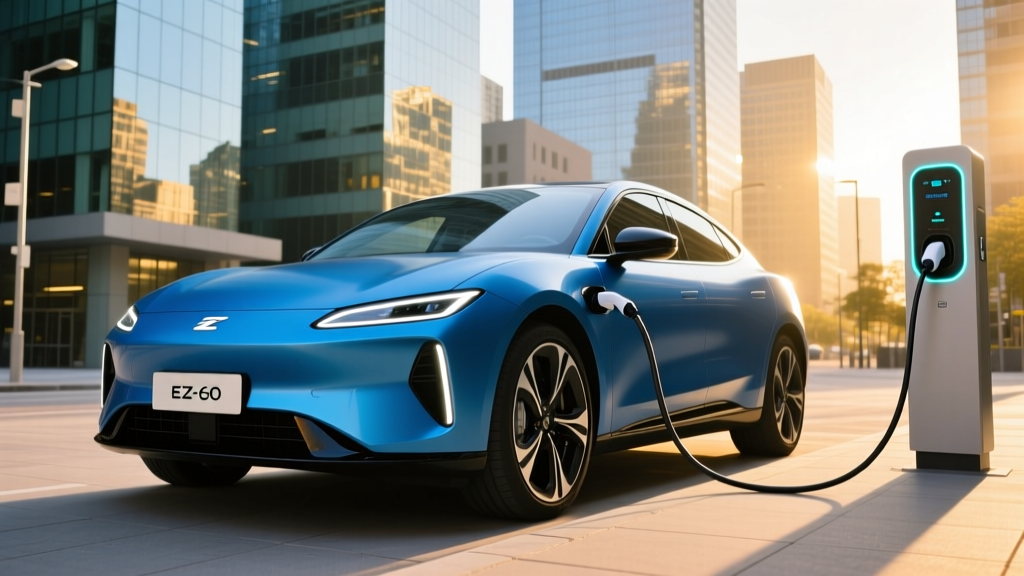
Bottom line on the EZ-60 EV: The Changan EZ-60 (also marketed under the Deepal brand) is a compact-to-midsize electric crossover targeting international markets. Based on announced specifications, it pairs an LFP battery of approximately 66.8 kWh with a single rear-mounted motor producing around 190 kW (255 hp). CLTC range figures top out near 370 miles, though a realistic EPA-equivalent estimate lands between 280–310 miles. Pricing in export markets is expected to start near the low $30,000s before incentives. The EZ-60 is a strong value proposition if it reaches your market with CCS/NACS charging compatibility and qualifies for local incentives — but availability, service network depth, and parts supply outside China remain the key variables to watch.
What Is the EZ-60 EV?
The EZ-60 is an all-electric crossover from Changan Automobile, one of China's largest automakers. It sits on Changan's EPA1 platform, which also underpins the Deepal S7 and SL03 models sold in China. In some markets, Changan uses the Deepal sub-brand, and you may see this vehicle badged as the Deepal S07 or Deepal E07 depending on the region and body style.
The EZ-60 slots into the hotly contested compact electric SUV segment — competing against vehicles like the Hyundai Ioniq 5, Kia EV6, Tesla Model Y, and Volkswagen ID.4. Its primary differentiator is aggressive pricing paired with competitive range and a feature-heavy cabin.
| Spec | Standard Range | Long Range |
|---|---|---|
| Battery (usable) | ~52.4 kWh (LFP) | ~66.8 kWh (LFP) |
| Motor output | 175 kW (235 hp) | 190 kW (255 hp) |
| Drivetrain | Rear-wheel drive | Rear-wheel drive |
| CLTC range | ~280 mi (450 km) | ~370 mi (600 km) |
| Est. EPA-equivalent range | ~210–230 mi | ~280–310 mi |
| 0–60 mph (est.) | ~7.5 sec | ~6.8 sec |
| Peak DC fast charge | ~130 kW | ~160 kW |
| 10–80% DC charge time | ~30 min | ~32 min |
| Level 2 AC charge rate | ~7.2 kW | ~11 kW |
| Est. starting MSRP (USD) | ~$28,000–$30,000 | ~$33,000–$36,000 |
Note: CLTC (China Light-Duty Vehicle Test Cycle) range figures are typically 15–25% higher than EPA estimates. We've applied a correction factor based on observed discrepancies in comparable Chinese-market EVs. Final EPA numbers will depend on the market-specific variant. Source: Changan Automobile official site.
Real-World Range: What to Actually Expect
EPA-estimated range (Long Range, est.): ~295 miles
Real-world highway (70 mph, moderate climate): ~250–270 miles
Cold-weather (below 32°F / 0°C, highway): ~200–230 miles
City/mixed driving (mild climate): ~280–300 miles
The EZ-60's LFP (lithium iron phosphate) battery chemistry is a deliberate choice. LFP cells trade some energy density for longer cycle life, better thermal stability, and lower cost. In practice, this means:
- Degradation advantage: LFP packs typically retain 90%+ capacity after 1,000 full charge cycles — potentially 200,000+ miles of driving before meaningful range loss.
- 100% charging tolerance: Unlike NMC batteries, LFP chemistry tolerates regular charging to 100% without accelerated degradation. Changan and other LFP-equipped manufacturers often recommend periodic full charges to help the battery management system (BMS) recalibrate cell balancing.
- Cold-weather penalty: LFP cells are more sensitive to low temperatures than NMC. Expect 25–35% range reduction in sustained sub-freezing driving, especially without a heat pump. Whether the EZ-60 includes a heat pump in all markets remains unconfirmed — this is a critical spec to verify for cold-climate buyers.
At highway speeds of 70+ mph, aerodynamic drag dominates energy consumption. The EZ-60's crossover profile creates more drag than a sedan like the Deepal SL03, so highway efficiency will likely fall in the 3.0–3.5 miles/kWh range (roughly 100–115 MPGe equivalent), depending on tire choice and ambient temperature.
Charging Speed and Infrastructure
| Level | Power | Miles Added per Hour | Use Case |
|---|---|---|---|
| Level 1 (120V outlet) | ~1.4 kW | ~4–5 mi/hr | Overnight top-up, emergency |
| Level 2 (240V home) | 7.2–11 kW | ~22–35 mi/hr | Daily home charging |
| DC Fast Charge | Up to 160 kW peak | ~150–180 mi in 15 min | Road trips |
The EZ-60's peak DC fast-charge rate of approximately 160 kW (Long Range) is respectable but not class-leading. Competitors like the Hyundai Ioniq 5 (up to 240 kW on 800V architecture) and the Tesla Model Y (up to 250 kW) charge noticeably faster. However, the EZ-60's LFP battery has a flatter charge curve than many NMC packs, meaning it may sustain closer to its peak rate for a longer portion of the session.
Charge curve reality check: Peak kW is not sustained kW. Expect the EZ-60 Long Range to charge from 10% to roughly 50% at or near 160 kW, then taper to ~100 kW through 70%, and drop further to ~50–60 kW above 80%. The 10–80% time of approximately 32 minutes assumes a well-preconditioned battery at a compatible charger.
Connector compatibility is a critical unknown for US buyers. If Changan brings the EZ-60 to North America, it will need either CCS1 or the increasingly dominant NACS (Tesla) connector to access the broadest charging networks. In Europe, CCS2 is standard. In China, the GB/T connector is used. Verify the connector for your specific market before committing.
EZ-60 EV vs. Gas and Hybrid Alternatives
At a projected starting price around $30,000, the EZ-60 competes not only with other EVs but also with gas and hybrid crossovers. Here's how the numbers stack up over a typical 5-year ownership period (75,000 miles):
| Cost Category | EZ-60 EV (LR) | Gas Crossover (e.g., Toyota RAV4) | Hybrid (e.g., RAV4 Hybrid) |
|---|---|---|---|
| Purchase price (MSRP) | $34,000 | $30,000 | $33,000 |
| Federal tax credit (§30D)* | $0–$7,500 | $0 | $0 |
| Effective purchase price | $26,500–$34,000 | $30,000 | $33,000 |
| Fuel/energy (75k mi) | $2,100–$3,200 | $8,500–$9,800 | $5,800–$6,500 |
| Maintenance (5 yr) | $1,200–$1,800 | $3,500–$4,500 | $3,200–$4,000 |
| Insurance (5 yr est.) | $7,500–$9,500 | $6,000–$7,500 | $6,200–$7,800 |
| Estimated 5-yr total | $37,300–$48,500 | $48,000–$51,800 | $48,200–$51,300 |
* The IRS §30D clean vehicle credit provides up to $7,500, but eligibility depends on MSRP caps ($55,000 for SUVs), buyer income limits ($150K single / $300K joint), battery component sourcing, and critical mineral requirements. As of 2026, Chinese-manufactured battery components face restrictions that may disqualify many China-built EVs from the full credit. Confirm eligibility with a tax professional before purchasing.
Key takeaway: The EZ-60's fuel savings over gas are substantial — roughly $5,500–$7,000 over five years at current electricity and gas prices. But the tax credit is uncertain for a China-built vehicle, insurance may run 15–25% higher than a comparable gas crossover, and home charging access is essential to capturing those savings. Public-only charging erases much of the cost advantage.
Ownership Costs and Considerations
Home Charging Setup
If you have access to a garage or dedicated parking spot, a Level 2 home charger is the single best investment for EV ownership. For the EZ-60 with its ~11 kW onboard charger (Long Range), a 48-amp Level 2 unit on a 60-amp circuit will deliver a full overnight charge in roughly 6–7 hours from near-empty.
Typical home Level 2 installation costs:
- Charger hardware: $400–$700 (quality smart charger like ChargePoint Home Flex or Wallbox Pulsar Plus)
- Electrician labor (240V circuit, 50–60 ft run): $800–$2,000
- Panel upgrade (if needed, 100A → 200A): $1,500–$3,500
- Permit and inspection: $100–$300
- Total: $1,300–$6,500 depending on your electrical panel and wiring distance
Maintenance
EVs have dramatically fewer moving parts than internal combustion vehicles. The EZ-60 will need:
- Cabin air filter replacement: every 15,000–20,000 miles (~$30–$50)
- Tire rotation: every 5,000–7,500 miles (EVs wear tires faster due to instant torque and higher weight)
- Brake fluid check: every 2 years (regenerative braking significantly extends pad life)
- Coolant system service: per manufacturer schedule (typically 60,000–100,000 miles)
- No oil changes, no spark plugs, no transmission fluid, no exhaust system repairs
Insurance
EV insurance premiums typically run 15–25% higher than equivalent gas vehicles due to higher repair costs (specialized body shop equipment, battery replacement risk, and limited collision repair data for newer Chinese brands). Get quotes from at least three insurers before purchasing. Some companies offer EV-specific discounts.
Depreciation
This is the wildcard. Chinese-brand EVs have limited resale history in Western markets. If Changan establishes a strong dealer and parts network, depreciation could track with mainstream brands (50–55% retained value at 5 years). Without that infrastructure, expect steeper depreciation (35–45% retained). Buying with the intention of driving the car 8–10+ years mitigates this risk significantly.
Common Misconceptions About the EZ-60 EV
| Myth | Fact |
|---|---|
| "The 370-mile range means I'll get 370 miles." | That's CLTC, a generous Chinese test cycle. Real-world EPA-equivalent range is closer to 280–310 miles (Long Range). Highway and cold-weather driving reduce this further to 200–270 miles. |
| "It charges as fast as a Tesla." | The EZ-60's peak ~160 kW is solid but below Tesla's 250 kW V3 Supercharger rate and Hyundai's 240 kW on 800V architecture. Expect ~32 minutes for 10–80%, vs. ~18 minutes for an Ioniq 5. |
| "I'll definitely get the $7,500 tax credit." | The §30D credit has strict battery sourcing rules. China-manufactured battery components face restrictions under current IRS rules. Verify before relying on the credit in your budget. |
| "LFP batteries don't last." | LFP actually has superior cycle life compared to NMC — often 2,000–3,000+ cycles before significant degradation. That's potentially 300,000+ miles. The trade-off is lower energy density and worse cold-weather performance. |
| "I can charge it anywhere." | Connector compatibility matters. If the EZ-60 ships with CCS in your market, you'll need an adapter for Tesla Superchargers (where permitted). Verify connector type and network access before buying. |
Who Should Buy the EZ-60 EV — and Who Shouldn't?
Choose the EZ-60 EV if:
- You have reliable home charging (garage or dedicated 240V outlet)
- Your daily commute is under 60 miles round-trip
- You live in a mild-to-moderate climate (less cold-weather range penalty)
- Changan has established a dealer/service network in your area
- You want maximum range-per-dollar and don't need the fastest DC charging
- You plan to own the vehicle 7+ years (mitigating depreciation uncertainty)
Look elsewhere if:
- You rely exclusively on public charging (the ~160 kW peak rate and uncertain network compatibility make this less convenient)
- You regularly drive in sub-freezing conditions (LFP's cold-weather penalty is real — consider an NMC-equipped alternative or verify heat pump inclusion)
- You need a proven resale value track record in your market
- You want access to Tesla's Supercharger network without an adapter
- Local service infrastructure for Chinese-brand EVs is nonexistent in your region
Battery Warranty and Longevity
Changan typically offers an 8-year/100,000-mile battery warranty (or 8 years/160,000 km in some markets) with a capacity retention threshold of 70% — meaning they'll repair or replace the pack if it degrades below 70% of original capacity within that window. Some Chinese-market variants have been offered with lifetime battery warranties for the first owner, though export warranty terms may differ.
LFP battery replacement costs are generally lower than NMC due to cheaper raw materials, but exact pricing for the EZ-60 pack is not yet published for export markets. Based on comparable LFP packs in this size range, a full replacement would likely cost $8,000–$12,000 out of warranty — though the likelihood of needing one within the vehicle's practical lifespan is low given LFP's cycle-life advantages.
Frequently Asked Questions
Is the EZ-60 EV available in the United States?
As of early 2026, Changan has not officially launched the EZ-60 in the US market. The vehicle is available in China and select international markets (Southeast Asia, Middle East, parts of South America). If Changan enters the US, the vehicle would need to meet NHTSA and EPA certification requirements. Monitor NHTSA.gov for any homologation filings.
How does the EZ-60 compare to the Tesla Model Y?
The Model Y Long Range AWD offers 320 miles of EPA range, 250 kW peak DC charging, and access to the Supercharger network — all for a higher starting price (~$44,000). The EZ-60 trades charging speed and network access for a significantly lower purchase price. If the EZ-60 reaches your market near $33,000, it undercuts the Model Y by over $10,000 before incentives, making it compelling for budget-focused buyers who can charge at home.
Can I charge the EZ-60 at Tesla Superchargers?
Only if the EZ-60 is equipped with a NACS connector (unlikely in most markets) or if you use a CCS-to-NACS adapter and the Supercharger station supports non-Tesla vehicles via Tesla's "Open Supercharging" program. In Europe, many Superchargers with CCS2 connectors are open to non-Tesla EVs. Check the Tesla app for station compatibility in your area.
What's the real cost per mile to drive the EZ-60?
At the US average residential electricity rate of ~$0.16/kWh and an efficiency of ~3.2 miles/kWh, the EZ-60 costs approximately $0.05 per mile to fuel at home. A comparable gas crossover at 28 MPG combined and $3.40/gallon costs ~$0.12 per mile. That's a 58% fuel cost reduction. Public DC fast charging at $0.35–$0.50/kWh raises the EV cost to $0.11–$0.16/mile, erasing most of the advantage.
Does the EZ-60 have autonomous driving features?
The EZ-60 is expected to offer Level 2 driver-assistance features (adaptive cruise control, lane centering, automated emergency braking) under Changan's ADAS suite. Per SAE automation levels, Level 2 requires the driver to remain fully engaged and supervising at all times. This is not self-driving — it's an advanced cruise control and lane-keeping system similar to Toyota Safety Sense or Honda Sensing.
How long does a full home charge take?
On a Level 2 charger at 11 kW (Long Range model), a full 0–100% charge takes approximately 6–7 hours. On a standard 120V household outlet (Level 1, ~1.4 kW), a full charge takes 40–48 hours — practical only for overnight top-ups of 30–50 miles, not full recharges.