The CarPlay Problem Every Tesla Buyer Faces
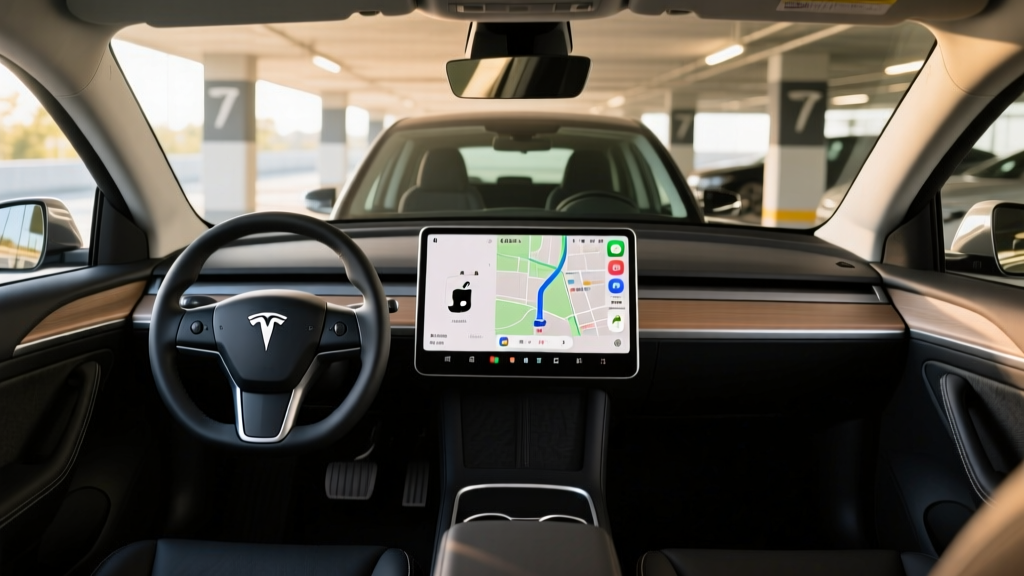
Tesla does not offer Apple CarPlay or Android Auto in any of its vehicles. The company's vertically integrated infotainment system — a 15.4-inch center touchscreen in the refreshed Model Y — handles navigation, media, phone calls, and vehicle controls through Tesla's proprietary software. For buyers deeply embedded in Apple's ecosystem, this is the single most common dealbreaker we hear about.
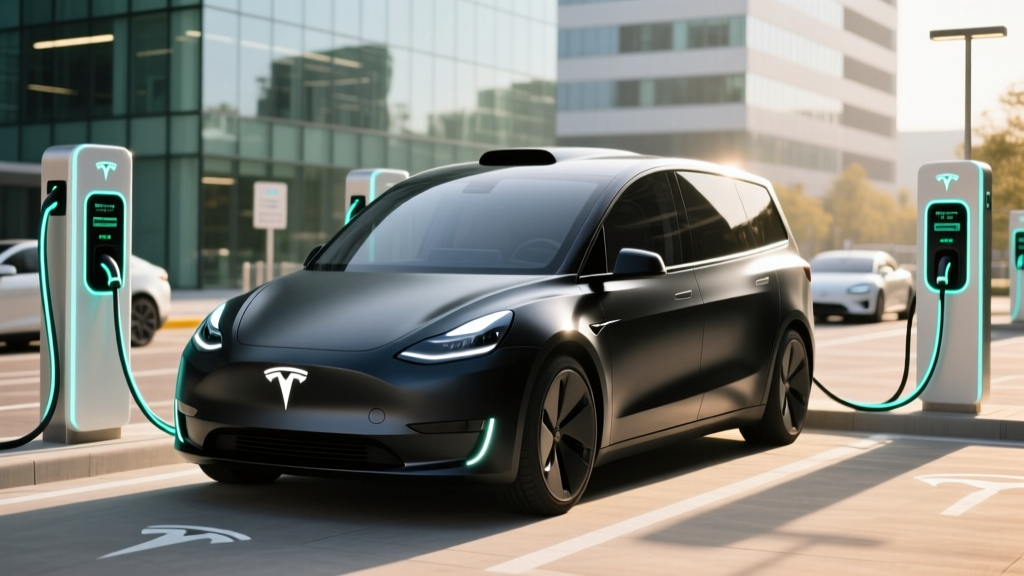
But the workaround landscape has matured significantly. Third-party CarPlay adapters now plug into the Tesla's USB-C port or connect via Bluetooth, bridging your iPhone to the Tesla screen. In this review, we'll evaluate whether these solutions are worth it, then give you the full 2026 Tesla Model Y breakdown — range, charging, pricing, tax credits, and how it stacks up against competitors that offer native CarPlay.
2026 Tesla Model Y: Complete Spec Overview
| Spec | Long Range RWD | Long Range AWD | Performance |
|---|---|---|---|
| EPA Range | 320 mi | 310 mi | 277 mi |
| Battery (usable) | ~75 kWh, NMC | ~75 kWh, NMC | ~75 kWh, NMC |
| Peak DC Fast Charge | 250 kW | 250 kW | 250 kW |
| 10–80% DCFC Time | ~25 min | ~25 min | ~25 min |
| Level 2 Home Charge | 11.5 kW (~44 mi/hr) | 11.5 kW (~44 mi/hr) | 11.5 kW (~44 mi/hr) |
| 0–60 mph | 5.8 sec | 4.8 sec | 3.5 sec |
| Horsepower | ~346 hp | ~384 hp | ~510 hp |
| Drivetrain | RWD (single motor) | AWD (dual motor) | AWD (dual motor) |
| MPGe (combined) | 123 MPGe | 117 MPGe | 111 MPGe |
| Base MSRP | $44,990 | $47,990 | $52,490 |
| Cargo Volume | 30.2 cu ft (rear seats up) / 72.0 cu ft (folded) + 4.1 cu ft frunk | ||
| Battery Warranty | 8 years / 120,000 miles (70% capacity retention) | ||
Source: EPA fueleconomy.gov and Tesla.com. Specs reflect the Juniper-refreshed Model Y for the 2026 model year.
Real-World Range: What the EPA Number Doesn't Tell You
The Model Y's efficiency is among the best in its class. The Long Range RWD consumes roughly 27 kWh per 100 miles, which translates to about $0.04–$0.06 per mile at the national average residential electricity rate of $0.16/kWh. That's roughly one-third the per-mile fuel cost of a comparable gas-powered SUV at $3.40/gallon.
One nuance that catches new Tesla owners off guard: the battery management system reserves a small buffer at the top and bottom of the pack. The ~75 kWh usable capacity is less than the total pack capacity. Tesla recommends daily charging to 80% for NMC chemistry to maximize long-term battery health — which means your practical daily range is closer to 248 miles (Long Range AWD), not the full 310.
Charging Speed and the Supercharger Advantage
| Charging Level | Power | Speed | Best For |
|---|---|---|---|
| Level 1 (120V household) | ~1.4 kW | ~4 mi/hr | Emergency / overnight top-up |
| Level 2 (240V, 48A home charger) | 11.5 kW | ~44 mi/hr | Daily home charging |
| DC Fast Charge (V3 Supercharger) | 250 kW peak | 10–80% in ~25 min | Road trips |
| DC Fast Charge (V4 Supercharger) | 250 kW (Model Y limited) | 10–80% in ~25 min | Newer Supercharger stations |
The Model Y's 400-volt architecture caps its peak charge rate at 250 kW — not the 350 kW some competitors support. However, Tesla's charge curve is well-managed. The car sustains close to peak power from 10% to roughly 50% SoC, then tapers progressively. You'll add approximately 175 miles of range in the first 15 minutes at a V3 Supercharger.
The Tesla Supercharger network remains the most reliable DC fast-charging ecosystem in the U.S., with over 20,000 stalls nationally. The Model Y uses the NACS (North American Charging Standard) connector natively — no adapter needed at Tesla stations. For Electrify America or other CCS networks, you'll need Tesla's CCS adapter ($175 from Tesla's shop), though reliability on non-Tesla networks varies.
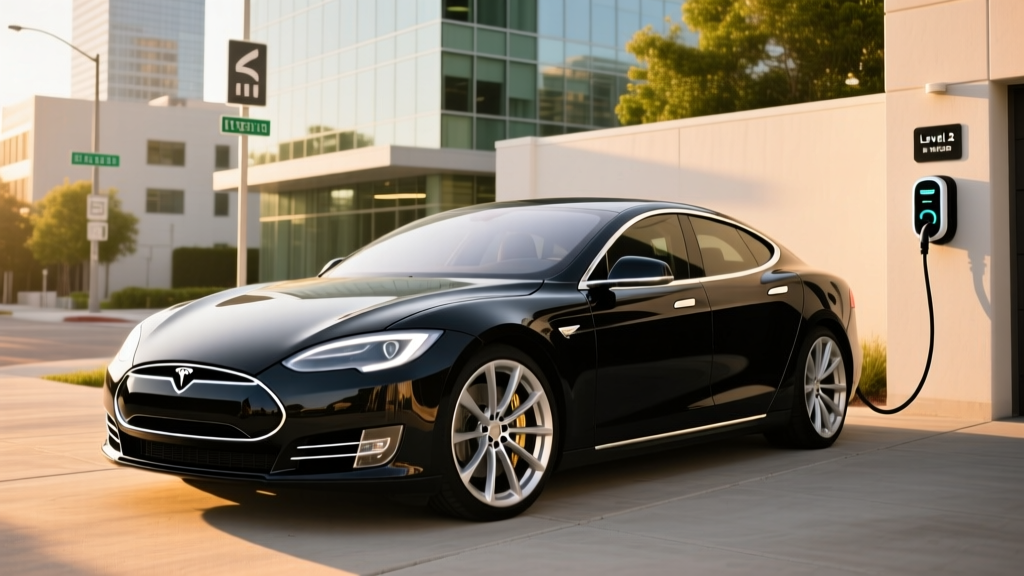
Home charging note: The onboard charger accepts up to 11.5 kW (48 amps). To unlock this, you need a Tesla Wall Connector or equivalent 60-amp circuit installed by a licensed electrician. Expect $500–$1,500 for installation depending on your panel capacity and conduit run. On a standard 40-amp circuit (common in older homes), you'll get 9.6 kW (~37 mi/hr) — still sufficient for overnight charging.
Tesla's Infotainment vs. CarPlay: The Adapter Reality
Tesla's native infotainment is genuinely capable. The Juniper-refreshed Model Y features a 15.4-inch touchscreen with responsive navigation, Spotify/Apple Music integration, a built-in web browser, Netflix/YouTube (while parked), and over-the-air updates that regularly add features. The voice assistant handles navigation and phone calls adequately.
But CarPlay brings things Tesla's software doesn't: your familiar iPhone interface, Siri integration that actually works well, your curated podcast/audiobook apps, and Waze for real-time traffic. If these are non-negotiable, here's what the adapter market looks like in 2026:
- Carlinkit T2C Plus (~$160): Wireless CarPlay via Bluetooth to the Tesla screen. Connects through the Tesla's Bluetooth audio stream and renders a CarPlay-like interface. Input lag of ~200ms. Works but feels slightly behind native CarPlay responsiveness.
- Hansshow Tesla CarPlay Box (~$250): Hardwired via USB-C. More stable connection than Bluetooth-only options. Supports both CarPlay and Android Auto. Occasional firmware update required via a companion app.
- CarPlay AI Box (various brands, ~$180–$300): These run a full Android system on a box that outputs CarPlay to the Tesla screen. More feature-rich but more complex to set up.
The honest assessment: adapter-based CarPlay in a Tesla is about 85% as good as native CarPlay in a Hyundai Ioniq 5 or Ford Mustang Mach-E. If CarPlay is your top infotainment priority, competitors with native support may serve you better. If you're buying the Model Y for its range, Supercharger network, and efficiency, an adapter is a workable compromise.
Pricing, Trims, and Federal Tax Credit Eligibility
| Trim | MSRP | Est. After §30D Credit | Under MSRP Cap? |
|---|---|---|---|
| Long Range RWD | $44,990 | ~$37,490 | Yes ✓ |
| Long Range AWD | $47,990 | ~$40,490 | Yes ✓ |
| Performance | $52,490 | ~$44,990 | Yes ✓ (SUV cap: $80,000) |
The Model Y qualifies as an SUV under IRS §30D rules, which means the MSRP cap is $80,000 (vs. $55,000 for sedans). All three current trims fall well under this limit.
However, qualifying for the full $7,500 federal tax credit depends on several factors beyond the vehicle:
- Buyer income caps: Modified adjusted gross income must not exceed $150,000 (single), $225,000 (head of household), or $300,000 (married filing jointly).
- Battery sourcing requirements: As of 2026, both critical-minerals and battery-component sourcing thresholds must be met. Tesla sources battery cells from multiple suppliers including CATL (LFP for Standard Range) and Panasonic (NMC for Long Range/Performance). The Long Range and Performance trims with Panasonic NMC cells have historically met the sourcing requirements, but the specific credit amount can shift between $3,750 and $7,500 depending on annual sourcing updates.
- Point-of-sale transfer: You can elect to transfer the credit to the dealer at purchase, reducing your out-of-pocket cost immediately rather than waiting for tax filing.
- One credit per VIN: The credit applies once per vehicle. Used Model Y purchases fall under a separate §25E credit (up to $4,000, different eligibility rules).
Verify before you buy: Check the current eligibility status on fueleconomy.gov and consult a tax professional. Sourcing rules have tightened annually and credit amounts for specific VIN configurations can change.
Performance, Interior, and Standout Tech
The Juniper refresh brought meaningful updates to the Model Y's driving experience. Ride quality is noticeably improved with revised damper tuning — the harshness over sharp bumps that plagued pre-2025 models is largely resolved. Cabin noise levels dropped significantly thanks to acoustic glass and additional insulation.
Performance highlights by trim:
- Long Range RWD: 5.8-second 0–60 is brisk for daily driving. Single-motor simplicity means fewer components to maintain.
- Long Range AWD: 4.8 seconds and dual-motor traction in rain/snow. The most popular configuration for good reason.
- Performance: 3.5 seconds, track mode, larger brakes. Enthusiast-oriented but range drops to 277 miles.
Interior and cargo: The minimalist cabin uses vegan leather and recycled materials. Front legroom is generous at 41.8 inches; rear legroom measures 38.4 inches — adequate for adults but tighter than a Hyundai Ioniq 5's 39.4 inches rear. Cargo space is excellent: 30.2 cubic feet behind the second row, expanding to 72.0 cu ft when folded, plus a 4.1 cu ft front trunk (frunk).
Tech features:
- Autopilot (standard): Lane centering, adaptive cruise, automatic emergency braking. This is SAE Level 2 — you must keep hands on the wheel and eyes on the road at all times.
- Full Self-Driving (Supervised) — $8,000 option: Adds automatic lane changes, navigate-on-autopilot, traffic light/stop sign recognition, and a supervised city-streets feature. Still Level 2 — not self-driving despite the name. You remain fully responsible.
- Sentry Mode dashcam recording, Dog Mode climate control, and phone-as-key via Bluetooth.
- Over-the-air updates continue to add features post-purchase.
Model Y vs. CarPlay-Native Competitors
| Feature | Tesla Model Y LR AWD | Hyundai Ioniq 5 Limited AWD | Ford Mustang Mach-E Premium AWD |
|---|---|---|---|
| EPA Range | 310 mi | 290 mi | 290 mi |
| DC Fast Charge (peak) | 250 kW | 350 kW (800V) | 150 kW |
| 10–80% Time | ~25 min | ~18 min | ~36 min |
| Apple CarPlay | No (adapter needed) | Yes (wireless) | Yes (wireless) |
| Charging Network | NACS (Supercharger native) | NACS (Supercharger access) | NACS (Supercharger access) |
| Base MSRP (AWD) | $47,990 | $54,950 | $52,975 |
| Battery Warranty | 8 yr / 120,000 mi | 10 yr / 100,000 mi | 8 yr / 100,000 mi |
The Ioniq 5's 800-volt architecture delivers faster charging (18 min 10–80%) and native wireless CarPlay, but at a higher price point and with 20 fewer miles of range. The Mach-E offers CarPlay but lags significantly in charging speed. The Model Y's combination of range, Supercharger access, and price remains compelling — if you can accept the CarPlay adapter workaround.
Pros, Cons, and Who Should Buy
Pros
- Best-in-class EPA range (310 mi AWD)
- Supercharger network — most reliable DC fast-charging in the U.S.
- Excellent efficiency (117 MPGe combined AWD)
- Strong cargo capacity (72 cu ft max)
- Competitive pricing after §30D credit
- OTA updates continuously improve the vehicle
- Juniper refresh fixed ride quality issues
Cons
- No native Apple CarPlay or Android Auto
- 250 kW peak charge rate trails 800V competitors
- FSD (Supervised) is expensive ($8,000) and still Level 2
- Minimalist interior lacks physical buttons for climate/media
- Tight rear headroom for tall passengers
- No spare tire — tire repair kit only
- Insurance premiums run 15–25% higher than comparable gas SUVs
Who the Model Y is for:
- Choose the Model Y if: You prioritize range, Supercharger reliability, and value after tax credits — and you're willing to use a CarPlay adapter or live with Tesla's native infotainment.
- Choose the Ioniq 5 if: Native wireless CarPlay, faster 800V charging, and physical controls matter more to you than 20 miles of extra range.
- Choose the Mach-E if: You want CarPlay, prefer Ford's dealer network for service, and don't mind slower charging speeds.
Frequently Asked Questions
Can I get Apple CarPlay in a 2026 Tesla Model Y?
Not natively. Tesla does not support CarPlay in any model. You can use a third-party adapter (Carlinkit T2C Plus, Hansshow, or similar) that connects via Bluetooth or USB-C and renders a CarPlay-like interface on the Tesla screen. Expect ~$150–$300 for the adapter and minor input lag compared to native CarPlay.
Does the Tesla Model Y qualify for the $7,500 federal tax credit?
All Model Y trims are under the $80,000 SUV MSRP cap. However, your personal eligibility depends on income limits ($150K single / $300K joint) and the specific battery sourcing of your VIN. The Long Range and Performance trims with Panasonic cells have historically qualified for the full $7,500, but verify at fueleconomy.gov before purchasing, as sourcing requirements tighten annually.
What is the real-world highway range of the Model Y Long Range AWD?
Expect approximately 260–280 miles at 70–75 mph in moderate temperatures. In cold weather (below 32°F), plan for 220–245 miles. The EPA's 310-mile rating reflects mixed driving at moderate speeds — sustained highway use and extreme temperatures reduce range by 10–25%.
How long does it take to charge a Model Y at home?
On a 48-amp Level 2 home charger (11.5 kW), a full charge from 10% to 80% takes about 5–6 hours, adding roughly 44 miles of range per hour. Most owners plug in nightly and charge from ~30% to 80%, which takes 3–4 hours — easily done while you sleep.
Is the Tesla Supercharger network still better than other DC fast-charging networks?
For reliability and uptime, yes. Tesla's Supercharger network has the highest percentage of functional stalls and the most seamless plug-and-charge experience. With NACS now adopted by Ford, Hyundai, GM, and others, Superchargers are getting busier — but Tesla continues to expand the network. The Model Y connects natively without an adapter.
What's the battery warranty and expected degradation?
Tesla warrants the Model Y battery for 8 years or 120,000 miles, whichever comes first, with a minimum 70% capacity retention. Real-world data from Tesla's fleet shows average degradation of approximately 12% after 150,000 miles for NMC packs. Charging to 80% daily (rather than 100%) and avoiding frequent DC fast charging can extend long-term battery health.
Is FSD (Supervised) worth the $8,000 cost?
For most buyers, no. FSD (Supervised) is an SAE Level 2 system — it assists with lane changes, navigation, and some city-street driving, but you must remain fully engaged. The standard Autopilot (included) handles highway lane centering and adaptive cruise well. Unless you have a long highway commute where the extra automation features reduce fatigue, the $8,000 premium is hard to justify over the included system.