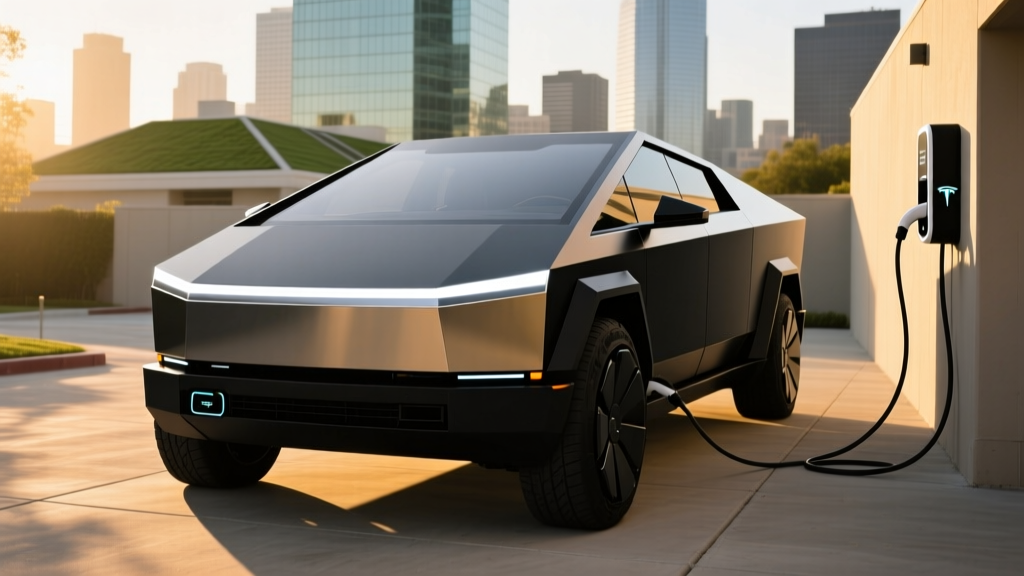
The Tesla Cybertruck has drawn polarized reactions since deliveries began, but one nickname has stuck in EV forums and social media threads: the cardboard Cybertruck. The moniker stems from early viral videos demonstrating the truck's stainless-steel exoskeleton denting under relatively light impacts, panel-gap inconsistencies, and build-quality concerns from initial production runs. Now well into the 2026 model year, we've spent extended time with the Cybertruck to separate legitimate engineering critique from internet hyperbole — and to answer whether this angular electric pickup actually holds up as a daily driver, a work truck, and a long-term ownership proposition.
2026 Cybertruck Trim Lineup and Pricing
Tesla streamlined the Cybertruck lineup for 2026 after the controversial Foundation Series pricing backlash of 2024-2025. The current trims reflect a more competitive posture, though prices remain premium for the electric truck segment.
| Trim | Drivetrain | Base MSRP | As-Tested (Typical Config) |
|---|---|---|---|
| Long Range AWD | Dual-Motor AWD | $79,990 | $83,490 (with FSD transfer) |
| Performance (Cyberbeast) | Tri-Motor AWD | $99,990 | $104,490 |
The rear-wheel-drive $60,990 variant originally announced has been pushed to a projected 2027 availability and remains unreleased as of this writing. Buyers should verify current pricing on Tesla's official Cybertruck page, as the company adjusts pricing periodically without traditional model-year changeovers.
Range, Battery, and the Real-World Efficiency Question
The Cybertruck's angular stainless-steel body creates a drag coefficient that works against highway efficiency. Here's what the EPA says versus what we observed.
Real-World Expectation: Plan for 270-295 miles on highway road trips at 70-75 mph. In cold weather (below 32°F), expect a further 20-30% reduction, bringing effective range to roughly 210-240 miles for the Long Range variant. City driving with regenerative braking recovers closer to EPA figures, typically 310-330 miles.
| Spec | Long Range AWD | Cyberbeast (Tri-Motor) |
|---|---|---|
| Usable Battery Capacity | ~123 kWh (estimated) | ~123 kWh (estimated) |
| Battery Chemistry | NMC (Nickel Manganese Cobalt) | NMC |
| EPA MPGe (Combined) | 67 MPGe | 63 MPGe |
| Energy Consumption | ~50 kWh/100 mi | ~53 kWh/100 mi |
| Heat Pump | Standard | Standard |
Tesla has not officially published the Cybertruck's exact usable kWh capacity, but teardown analysis and charging-session data point to approximately 123 kWh usable from a gross pack estimated near 130+ kWh. The NMC chemistry prioritizes energy density over the cycle-life longevity of LFP (lithium iron phosphate) packs found in the Model 3 RWD — a trade-off typical for trucks requiring maximum range from a large, heavy vehicle.
Per fueleconomy.gov, the Long Range AWD's combined 67 MPGe translates to roughly 50 kWh per 100 miles. For context, the Ford F-150 Lightning Extended Range achieves 70 MPGe combined, and the Rivian R1T Dual-Motor Large Pack lands at 70 MPGe. The Cybertruck's bluff-front aerodynamics and heavy stainless-steel panels cost it efficiency versus smoother-skinned competitors.
Charging Speed: DC Fast, Level 2, and the Supercharger Advantage
The Cybertruck uses the NACS (North American Charging Standard) connector natively — no adapter needed at Tesla Superchargers. Its 800-volt-class architecture enables strong DC fast-charging performance, though the massive battery means absolute charge times are longer than smaller-battery EVs.
| Charging Method | Power (kW) | Speed / Time |
|---|---|---|
| DC Fast Charge (Peak) | Up to 250 kW at V3 Superchargers; up to ~350 kW at V4 stalls (where available) | 10-80% in approximately 28-32 minutes (V3); ~22-26 minutes (V4) |
| DC Fast Charge (Sustained Avg.) | ~170-190 kW average 10-80% | Charge curve tapers significantly above 70% SoC |
| Level 2 Home (Tesla Wall Connector) | 11.5 kW (48A on 60A circuit) | ~30-33 miles of range per hour; full charge in ~11-12 hours |
| Level 2 (Standard 240V/40A outlet) | 9.6 kW | ~25-28 miles per hour |
| Level 1 (120V standard outlet) | ~1.4 kW | ~3-4 miles per hour — emergency use only |
The critical detail for road-trippers: peak kW is not sustained kW. The Cybertruck's charge curve holds near peak rate only between roughly 10-40% State of Charge, then progressively tapers. If you arrive at a Supercharger at 15% and charge to 80%, expect roughly 30 minutes at a V3 stall. Charging from 80-100% adds another 40+ minutes — plan your stops to stay in the 10-80% window for efficiency.
At home, a professionally installed Tesla Wall Connector on a 60-amp dedicated circuit delivers 11.5 kW, replenishing the Cybertruck's large pack from empty in about 11-12 hours. Most owners charging overnight from 30-80% daily will find this more than adequate. Budget $800-$2,000 for professional Level 2 installation depending on your electrical panel's capacity and distance from the panel to the charger location — a 200-amp panel upgrade can add $1,500-$3,000 if your home needs it.
Performance: 0-60, Towing, and Drivetrain Capability
The Cybertruck's performance numbers remain genuinely impressive for a 6,800+ pound vehicle, particularly in Cyberbeast trim.
| Metric | Long Range AWD | Cyberbeast (Tri-Motor) |
|---|---|---|
| Horsepower | 600 hp | 845 hp |
| 0-60 mph | 3.9 seconds | 2.6 seconds |
| Top Speed | 112 mph | 130 mph |
| Drivetrain | Dual-Motor AWD | Tri-Motor AWD (torque vectoring rear) |
| Max Towing Capacity | 11,000 lbs | 11,000 lbs |
| Payload Capacity | 2,500 lbs | 2,500 lbs |
The 2.6-second 0-60 time in the Cyberbeast is supercar territory, and it's genuinely startling in a vehicle this size. However, real-world truck buyers should focus on the 11,000-pound towing rating. Important caveat: towing at maximum capacity will cut range roughly in half — plan for 150-170 miles of effective range when towing heavy, and charge stops will be frequent. The Rivian R1T and F-150 Lightning offer comparable or slightly higher tow ratings with more established towing-infrastructure compatibility.
Cargo Space, Interior, and Daily Practicality
The Cybertruck's 6-foot bed (vault) is enclosed by a powered tonneau cover that Tesla rates to support significant weight. However, the bed's dimensions and the sloping geometry limit certain cargo configurations versus traditional open-bed pickups.
- Bed Volume: ~67 cubic feet (with tonneau closed)
- Bed Length: 72 inches (6 feet)
- Front Trunk (Frunk): ~7.1 cubic feet — useful for charging cables and small bags
- Rear Seat Legroom: ~38.5 inches (adequate for adults on shorter trips, tighter than an F-150 SuperCrew)
- Seating: 6-passenger capacity (3-across front bench, 3-across rear bench)
- Steering: Steer-by-wire with 4-wheel steering — dramatically tight turning radius for a full-size truck
The steer-by-wire system eliminates the mechanical connection between the steering yoke and the wheels. It enables the Cybertruck's remarkably tight turning circle (roughly equivalent to a midsize sedan), but some drivers report an adjustment period to the lack of traditional steering feedback. The yoke-style steering wheel remains controversial — some owners adapt quickly, others find it frustrating during low-speed maneuvering and parking.
Technology, Driver Assistance, and the 'Cardboard' Build Question
The Cybertruck's 18.5-inch front touchscreen runs Tesla's latest vehicle software, and rear passengers get a dedicated 9.4-inch screen. The UI is responsive and feature-rich, though Tesla's decision to route nearly all vehicle controls through the touchscreen (including turn-signal buttons on the yoke rather than a traditional stalk) continues to divide opinion.
Tesla's FSD (Supervised) remains an optional add-on at $8,000 purchase or $99/month subscription as of 2026. Its capabilities have expanded with neural-network-based vision processing, but it requires constant supervision and is not a substitute for an attentive driver.
Regarding the "cardboard Cybertruck" reputation: early-production units (late 2023 through mid-2024) exhibited panel-gap inconsistencies, trim-adhesion failures, and stainless-steel panels that showed dents and scratches more easily than marketing materials suggested. Tesla has made incremental manufacturing improvements through 2025 and into 2026, and most new units show tighter panel alignment. However, the ultra-hard 30X cold-rolled stainless steel, while resistant to minor dings, can be difficult and expensive to repair if significantly damaged — traditional paintless dent repair techniques don't apply, and body shops familiar with the material remain scarce.
- Stainless-steel body repair network is extremely limited — collision damage may require panel replacement rather than repair
- Bed geometry and powered tonneau limit traditional truck cargo configurations (no easy access to oversized items sticking above bed height)
- Energy consumption (50+ kWh/100 mi) is among the highest of any mainstream EV — charging costs add up on road trips
- Visibility is compromised by the thick A-pillars, small rear window, and angular geometry
- Yoke steering and screen-based controls require significant adaptation for drivers accustomed to traditional layouts
Federal Tax Credit and Ownership Cost Reality
The Cybertruck's eligibility for the §30D federal EV tax credit is one of the most common buyer questions — and the answer is nuanced.
- MSRP Cap: The §30D credit applies to trucks/vans/SUVs with MSRP up to $80,000. The Long Range AWD at $79,990 qualifies on MSRP. The Cyberbeast at $99,990 does not qualify.
- Buyer Income Cap: Modified AGI must not exceed $150,000 (single), $225,000 (head of household), or $300,000 (joint filing).
- Battery Sourcing Requirements: Critical minerals and battery component sourcing must meet escalating annual thresholds. Per IRS guidance, these requirements tighten each year, and Tesla's supply chain compliance should be verified at point of sale.
- Point-of-Sale Transfer: Eligible buyers can transfer the credit to the dealer at purchase, reducing the out-of-pocket price immediately rather than waiting for tax filing.
| Scenario | Price |
|---|---|
| MSRP (Long Range AWD) | $79,990 |
| With Full $7,500 §30D Credit (if eligible) | ~$72,490 |
| With Partial $3,750 Credit (sourcing phase-out risk) | ~$76,240 |
| Cyberbeast — No §30D Credit (MSRP exceeds $80K cap) | $99,990+ |
Consult a tax professional before relying on credit eligibility — rules change, and individual circumstances vary. The Cyberbeast's ineligibility for the federal credit is a significant cost factor that pushes its effective price well above $100,000 after taxes and fees.
Warranty Coverage
| Coverage Area | Terms |
|---|---|
| Basic Vehicle Limited Warranty | 4 years / 50,000 miles |
| Battery & Drive Unit Warranty | 8 years / 120,000 miles (minimum 70% battery capacity retention) |
The 8-year/120,000-mile battery warranty is competitive and reflects Tesla's confidence in its NMC pack longevity. The 70% retention threshold is industry standard — if your battery degrades below 70% of original capacity within the warranty period, Tesla will repair or replace it. Real-world data from Model S/X vehicles suggests Tesla NMC packs typically retain 85-90% capacity at 100,000 miles under normal charging habits (avoiding frequent 100% charges and extended storage at extreme SoC levels).
Pros and Cons: The Honest Assessment
- Class-leading performance (2.6s 0-60 in Cyberbeast)
- Steer-by-wire gives sedan-like turning radius
- Supercharger network access (NACS native) — the most reliable DC network in the US
- 800V architecture enables fast DC charging at V4 stalls
- 11,000-lb towing capacity is legitimate for boat and trailer duty
- Stainless exoskeleton resists minor scratches and door-dings
- Frunk adds secure, weatherproof storage
- High energy consumption (~50 kWh/100 mi) drives up charging costs
- Real-world highway range significantly below EPA sticker
- Cyberbeast ineligible for $7,500 federal tax credit
- Stainless body repair infrastructure is very limited
- Bed practicality compromised vs. conventional pickups
- Yoke steering and screen-only controls polarize drivers
- Rear seat legroom tighter than competing crew-cab trucks
- Insurance premiums run 20-40% above segment average
Who Should Buy the Cybertruck — And Who Shouldn't
- You want a high-performance electric truck and prioritize acceleration and tech over traditional truck utility
- You have reliable home Level 2 charging and mostly drive within 200 miles daily
- You value Supercharger network reliability for road trips
- The stainless-steel aesthetic and polarizing design appeal to you
- You need maximum bed utility and traditional truck cargo flexibility
- You tow frequently and need maximum real-world range while towing
- You want a conventional steering wheel and physical controls
- Body repair accessibility in your region matters for long-term peace of mind
Frequently Asked Questions
What is the real-world range of the Cybertruck?
The EPA rates the Long Range AWD at 340 miles, but highway driving at 70-75 mph yields approximately 270-295 miles in moderate temperatures. Cold weather (below freezing) reduces this further to roughly 210-240 miles. City driving with regenerative braking recovers closer to the EPA figure, typically 310-330 miles.
How fast does the Cybertruck charge at home and on the road?
On a DC fast charger, the Cybertruck peaks at 250 kW (V3 Supercharger) and can reach ~350 kW at V4 stalls, achieving 10-80% in approximately 28-32 minutes or 22-26 minutes respectively. At home on a Level 2 Tesla Wall Connector (11.5 kW), expect about 30-33 miles of range per hour of charging, or a full overnight charge in roughly 11-12 hours.
Does the Cybertruck qualify for the $7,500 federal EV tax credit?
The Long Range AWD at $79,990 MSRP falls under the $80,000 truck/SUV MSRP cap for §30D eligibility. However, buyer income limits ($150K single / $300K joint) and battery-sourcing requirements must also be met. The Cyberbeast at $99,990 exceeds the MSRP cap and does not qualify. Verify current eligibility on IRS.gov and consult a tax professional.
Is the Cybertruck worth buying over the F-150 Lightning or Rivian R1T?
It depends on your priorities. The Cybertruck wins on raw performance and Supercharger access. The F-150 Lightning offers a more traditional truck experience with better bed practicality and competitive range. The Rivian R1T excels in build quality, off-road capability, and adventure-oriented design. None of the three is universally "best" — the right choice depends on whether you prioritize speed, utility, or refinement.
Why do people call it the 'cardboard Cybertruck'?
The nickname originated from early-production build-quality issues in 2024, including visible panel gaps, trim pieces detaching, and stainless-steel panels showing damage more easily than expected. Tesla has improved manufacturing consistency through 2025-2026, but the reputation persists online. The stainless steel is genuinely hard and resists minor scratches, but significant impact damage is difficult and expensive to repair due to a limited body-shop network trained on the material.
How long will the Cybertruck battery last?
Tesla warranties the battery for 8 years or 120,000 miles with a minimum 70% capacity retention threshold. Based on historical Tesla NMC pack data, most owners can expect 85-90% capacity retention at 100,000 miles with reasonable charging habits — avoiding daily 100% charges, minimizing extended storage at very low or very high SoC, and using DC fast charging in moderation rather than as the primary charging method.