The Honest Answer on Car Conversion to Electric
Bottom line: Converting a gas car to electric in 2026 typically costs $15,000 to $40,000+ in parts and labor, yields 60–150 miles of real-world range depending on battery size, and requires a donor vehicle with a manual transmission or compatible drivetrain. For most buyers, purchasing a factory-built EV like a used Chevrolet Bolt ($15,000–$22,000) or a new Nissan Leaf ($29,000 base MSRP) delivers better range, reliability, safety, and charging infrastructure at a comparable or lower total cost. Conversions make sense primarily for classic car restomods, specialty vehicles, or dedicated hobbyists with fabrication skills — not as a budget path to daily EV driving.
A car conversion to electric — swapping an internal combustion engine for a battery pack, electric motor, and power electronics — has captured the imagination of DIYers and classic car enthusiasts for over a decade. YouTube builds and startup kits make the process look accessible. But the gap between a running prototype and a safe, reliable, street-legal daily driver is enormous, and the economics rarely favor a conversion over simply buying a production EV.
This guide breaks down what a conversion actually involves, what it costs in 2026, the real range and charging limitations, and provides a decision framework so you can determine whether a conversion project or a factory EV is the right move.
What a Car Conversion to Electric Actually Requires
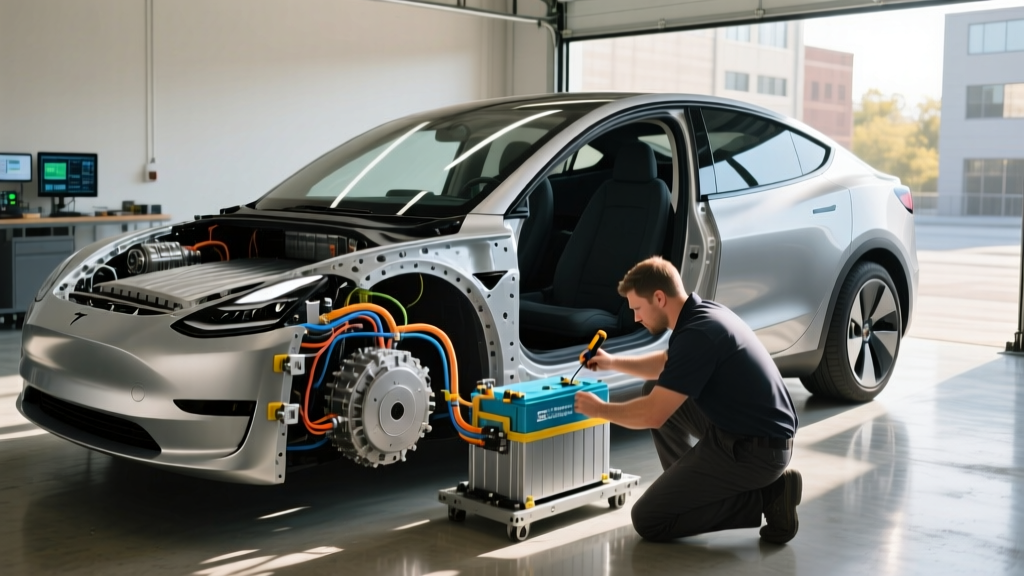
An EV conversion replaces the engine, fuel tank, and exhaust system with an electric powertrain. Here are the major components and what they cost at current 2026 market rates:
| Component | Typical Spec | Estimated Cost (2026) |
|---|---|---|
| Electric motor (AC induction or PMAC) | 50–150 kW (67–201 HP) | $1,500–$5,000 |
| Motor controller / inverter | Matched to motor kW | $1,500–$4,000 |
| Battery pack (modules or cells) | 20–60 kWh usable, NMC or LFP | $4,000–$15,000 |
| Battery management system (BMS) | Cell-level monitoring, thermal | $500–$2,000 |
| Onboard charger (Level 2) | 3.3–7.2 kW | $400–$1,200 |
| DC-DC converter (12V system) | 1.5–3.0 kW | $200–$500 |
| Throttle controller & wiring | Pedal sensor, harness | $300–$800 |
| Fabrication (motor mounts, battery boxes) | Custom steel/aluminum | $1,000–$5,000+ |
| Instrumentation / display | SoC, voltage, temp | $200–$600 |
| Heating & A/C (electric) | PTC heater, electric compressor | $500–$2,000 |
Parts total: $10,000–$36,000. Professional labor, if you're not doing the work yourself, adds $5,000–$15,000 or more depending on the vehicle's complexity and your region.
Critically, this component list doesn't include the donor car, safety testing, registration inspections (required in most states for a rebuilt/specially constructed vehicle), or the hundreds of hours of fabrication time. Many conversion projects also require upgrading brakes and suspension to handle the added weight of battery modules, which typically add 300–800 lbs to a vehicle originally designed around a lighter engine and fuel tank.
Range, Charging, and Performance: Realistic Expectations
Factory EVs benefit from purpose-built battery architectures, advanced thermal management, and DC fast charging hardware. Conversions almost never match these capabilities.
| Metric | Typical EV Conversion | 2026 Chevy Bolt EV (Factory) | 2026 Tesla Model 3 RWD (Factory) |
|---|---|---|---|
| Battery capacity | 20–60 kWh (often salvaged modules) | 65 kWh usable, NMC | 60 kWh usable, LFP |
| EPA-equivalent range | 60–150 mi (no official EPA rating) | 259 mi EPA | 272 mi EPA |
| Real-world range (highway) | 40–110 mi | ~220–235 mi | ~230–250 mi |
| Cold-weather range (20°F) | 30–80 mi (no heat pump, minimal thermal mgmt) | ~175–195 mi | ~190–210 mi |
| DC fast charging | Rarely available; most are Level 2 only | 55 kW peak, 10-80% in ~45 min | 170 kW peak, 10-80% in ~25 min |
| Level 2 charging | 3.3–7.2 kW (25–50 mi/hr) | 11.5 kW (~44 mi/hr) | 11.5 kW (~44 mi/hr) |
| 0–60 mph | 8–14 seconds (varies widely) | 6.5 seconds | 5.8 seconds |
| Regenerative braking | Basic or none on many builds | One-pedal capable | One-pedal capable |
Range reality: A conversion with 40 kWh of usable battery in a 3,500-lb sedan will deliver roughly 3.0–3.5 miles per kWh, or about 120–140 miles in ideal city driving. Highway speeds above 65 mph reduce that by 15–25%. In cold weather below freezing, expect a further 20–35% loss due to battery chemistry limitations and cabin heating draw — putting real winter range at 75–100 miles for a typical build.
Charging limitation: Most conversions use a basic onboard charger (3.3 kW or 7.2 kW) and lack DC fast charging entirely. A 40 kWh pack at 7.2 kW takes roughly 5.5 hours for a full charge. At 3.3 kW, it takes over 12 hours. This means road trips are impractical — conversions are commuter and errand vehicles only unless you invest heavily in a CHAdeMO or CCS retrofit kit ($3,000–$7,000 additional), which is complex and rarely done.
Conversion Cost vs. Buying a Factory EV: The Full Breakdown
The financial case for a conversion almost always collapses when compared to the used and new EV market in 2026.
| Cost Category | DIY EV Conversion (VW Beetle donor) | Used 2022 Chevy Bolt EV | New 2026 Nissan Leaf S |
|---|---|---|---|
| Vehicle / donor car | $3,000–$5,000 | $14,000–$18,000 | $29,090 MSRP |
| Parts & components | $12,000–$25,000 | — | — |
| Labor (if professional) | $5,000–$15,000 | — | — |
| Registration / inspection | $200–$1,500 (varies by state) | ~$150 | ~$150 |
| Total acquisition cost | $20,200–$46,500 | $14,150–$18,150 | $29,390 |
| Range (real-world) | 60–120 mi | 200–240 mi | 149 mi EPA (214 mi SV Plus) |
| Federal tax credit (§30D) | Not eligible (not a new qualifying vehicle) | Used EV credit up to $4,000 (income limits apply) | Up to $7,500 if eligible (MSRP & sourcing rules apply) |
| Warranty | None (self-insured risk) | Remaining factory / CPO | 3yr/36k basic, 8yr/100k battery |
| Annual insurance | $1,200–$2,500 (specialty/collector policies) | $1,100–$1,800 | $1,200–$1,900 |
| Maintenance (annual) | $500–$2,000 (custom parts, troubleshooting) | $300–$600 | $200–$500 |
The IRS §30D clean vehicle credit applies only to new or qualifying used EVs purchased from a dealer — a home-built conversion does not qualify. A used Bolt EV buyer, by contrast, may claim up to $4,000 under the used clean vehicle credit (30% of sale price, capped at $4,000) if they meet income limits ($75,000 single / $150,000 joint) and the vehicle is purchased from a licensed dealer. A new Leaf buyer may qualify for up to $7,500 depending on battery sourcing, MSRP caps, and income thresholds.
Charging cost savings are real but modest. At the U.S. average electricity rate of ~$0.17/kWh and a conversion consuming ~300 Wh/mile, fueling costs about $0.051/mile. A comparable gas car at 28 MPG and $3.20/gallon costs $0.114/mile. That's roughly $630/year in fuel savings at 10,000 miles — meaningful, but it takes 20+ years to recoup a $15,000 conversion premium.
Common Misconceptions About EV Conversions
| Myth | Fact |
|---|---|
| "Converting my car saves money versus buying an EV." | Total conversion cost ($20K–$46K) typically exceeds a used Bolt ($14K–$18K) or a new Leaf ($29K) while delivering less range, no warranty, no DC fast charging, and no tax credit eligibility. |
| "Any car can be converted." | Conversions work best on lighter, simpler vehicles with manual transmissions (the motor can couple to the existing gearbox). Modern cars with complex CAN-bus systems, electric power steering tied to the ECU, and integrated safety systems are extremely difficult or impossible to convert cleanly. |
| "I'll get 200+ miles of range." | Achieving 200 miles requires 60–70+ kWh of battery, which adds 800–1,000 lbs and costs $10,000–$18,000 for cells alone. Most conversions use 20–40 kWh packs for weight and cost reasons, yielding 60–140 miles. |
| "It'll charge at any public station." | Most conversions only support Level 1 (120V, ~1.4 kW) or Level 2 (240V, 3.3–7.2 kW) via a J1772 inlet. DC fast charging (CCS or NACS) requires expensive, complex retrofit hardware that most builds skip. You cannot use Tesla Superchargers or Electrify America DC stalls. |
| "It's street-legal everywhere." | Registration requirements for converted vehicles vary significantly by state. Some states require a special inspection, a rebuilt title, or a specially constructed vehicle (SPCNS) process. Emissions-exempt registration is available in many states but requires documentation. Check your state DMV before starting a build. |
| "Electric motors need zero maintenance." | The motor itself is nearly maintenance-free, but the battery pack, BMS, contactors, cooling system, and custom wiring all require monitoring. Salvaged battery modules degrade unpredictably, and replacement cells can be expensive or unavailable. |
Real-World Ownership Considerations
Home Charging Access Is Mandatory
Without DC fast charging, a conversion depends entirely on home Level 2 charging. You'll need a 240V outlet (NEMA 14-50 or hardwired EVSE) on a dedicated 40A or 50A circuit. Installation costs range from $500–$2,500 depending on panel capacity and wiring distance, per a DOE home charging guide. If you live in an apartment or lack garage access, a conversion is essentially impractical.
Climate Matters More Than You Think
Conversion battery packs rarely have active thermal management (liquid heating/cooling). In sub-freezing climates, NMC cells lose 20–35% of usable capacity, and charging speeds drop dramatically. LFP cells are even more cold-sensitive. In hot climates above 95°F, battery longevity degrades faster without active cooling. Factory EVs like the Tesla Model 3 and Hyundai Ioniq 5 use sophisticated heat pump and liquid-cooling systems that conversions almost never replicate.
Safety Is a Serious Concern
Production EVs undergo NHTSA crash testing, have engineered battery enclosures with crush zones, and include high-voltage disconnect systems tied to airbag deployment. A home conversion relies on the builder's fabrication skill for battery protection. In a collision, improperly secured battery modules pose fire and electrocution risks. Most conversions will never be crash-tested, and first responders have no emergency response guide for your specific build.
Insurance and Resale
Insuring a converted vehicle typically requires a specialty or collector-car policy. Standard insurers may decline coverage or offer only liability. Resale value is highly uncertain — the market for converted vehicles is small and buyer confidence is low, meaning you may recover only 20–40% of your investment at sale time.
Decision Framework: Should You Convert or Buy?
Choose an EV conversion if:
- You're converting a classic or collector car (e.g., 1960s–80s Porsche 911, VW Bus, DeLorean) where the vehicle's value and character justify the investment as a restomod
- You have metalworking, electrical, and fabrication skills and view the project as a hobby, not a budget shortcut
- You need only 40–80 miles of daily range and have reliable home Level 2 charging
- You understand the safety, registration, and insurance implications and accept them
- Budget is $25,000–$50,000+ and you're not counting on recouping the investment
Choose a factory-built EV if:
- You need a reliable daily driver with 200+ miles of range
- You want DC fast charging for road trips (10–80% in 18–35 minutes)
- You want a warranty (8-year/100,000-mile battery coverage is standard on most new EVs)
- You want to qualify for federal or state tax credits ($4,000 used EV credit or up to $7,500 new EV credit)
- You need NHTSA safety ratings, modern ADAS (automatic emergency braking, lane keeping), and standard insurance
- Your total budget is under $35,000
The used EV market in 2026 offers compelling options that undercut conversions on price and outperform them on every measurable metric. A 2021–2023 Chevrolet Bolt EV sells for $14,000–$18,000 with 238–259 miles of EPA range, DC fast charging capability, and potential eligibility for the $4,000 used EV tax credit. A used Tesla Model 3 (2021–2022) runs $20,000–$26,000 with 263–333 miles of range and full Supercharger network access. Even a new 2026 Nissan Leaf at $29,090 MSRP delivers 149 miles (S trim) or 214 miles (SV Plus) with a full warranty and available tax credit.
EV Conversion FAQ
How much does it cost to convert a gas car to electric in 2026?
A basic conversion using salvaged components runs $15,000–$25,000 in parts, plus donor car cost ($3,000–$5,000) and potential labor ($5,000–$15,000). A high-quality conversion with new LFP or NMC modules, a proper BMS, and professional fabrication typically costs $30,000–$46,000 total. This is comparable to or more expensive than purchasing a capable used factory EV.
Can I convert any car to electric?
Technically, most vehicles can be converted, but practicality varies enormously. Lightweight cars with manual transmissions (VW Beetle, Porsche 944, Mazda Miata, classic trucks) are the best candidates. Modern vehicles with drive-by-wire systems, integrated CAN-bus networks, and electric power steering dependent on the ECU are extremely difficult to convert without triggering constant fault codes and disabling safety systems.
How long does an EV conversion battery last?
It depends on cell chemistry and sourcing. New LFP cells can last 3,000–5,000 charge cycles (potentially 15+ years). Salvaged NMC modules from a wrecked Tesla or Nissan Leaf may have unknown degradation history and could lose 3–5% capacity per year or more. Factory EV batteries carry 8-year/100,000-mile warranties guaranteeing 70%+ capacity retention — a conversion has no such protection.
Is a converted EV street-legal?
It can be, but the process varies by state. Most states require a special inspection for a vehicle with a modified powertrain. Some issue a "specially constructed vehicle" title. You'll need to document the conversion, pass a safety inspection, and potentially obtain a brake and light certification. Check your state DMV requirements before beginning any project.
Can I use public charging stations with a converted EV?
Only Level 2 (J1772) stations, and only if your conversion includes a J1772 inlet and compatible onboard charger. Most conversions cannot use DC fast chargers (CCS, NACS, or CHAdeMO) without a costly and complex retrofit. Tesla Superchargers are not accessible to conversions.
Does a car conversion to electric qualify for a tax credit?
No. The federal §30D clean vehicle credit applies only to new or qualifying pre-owned EVs purchased from a licensed dealer that meet battery sourcing, MSRP, and buyer income requirements. A privately converted vehicle does not qualify for any federal EV tax incentive. Some states offer conversion rebates — check your state energy office.