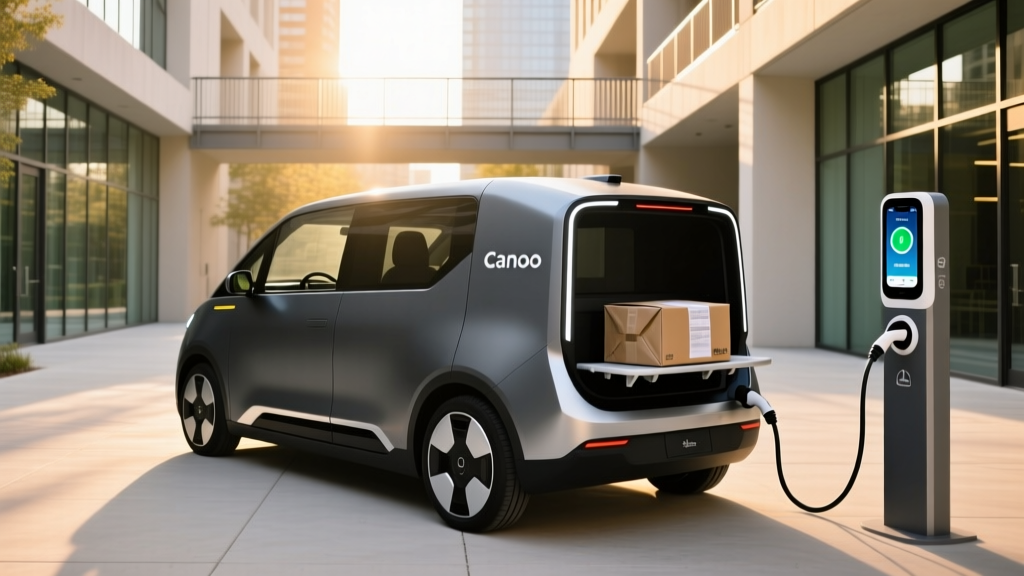
The electric vehicle startup landscape has always been volatile, and few companies exemplify this more than Canoo. While retail investors search for "canoo stocks" hoping to find the next Tesla success story, the real question for EV enthusiasts and potential fleet buyers is whether Canoo's vehicles actually deliver on their promises. This review examines the Canoo Lifestyle Delivery Vehicle (LDV) — the company's flagship commercial van — to help you understand what's actually rolling off the production line versus what remains vaporware.
Canoo LDV: Real-World Range and Battery Specs
The Canoo LDV comes equipped with an 80 kWh battery pack using NMC (nickel-manganese-cobalt) chemistry, which prioritizes energy density over the longer cycle life you'd find in LFP packs. The EPA estimated range sits at 230 miles for the standard delivery configuration.
For last-mile delivery fleets operating in urban environments, the 230-mile EPA figure is actually practical — most delivery routes cover 80-120 miles daily, leaving buffer for detours and climate control. But if you're considering this for longer regional routes, range anxiety becomes a legitimate operational concern.
Charging Speed: DC Fast and Level 2 Reality
| Charging Level | Power (kW) | Time/Miles Added |
|---|---|---|
| DC Fast Charge (Peak) | 150 kW | 10-80% in ~32 minutes |
| DC Fast Charge (Sustained) | 80-100 kW avg | 10-80% in ~45 minutes |
| Level 2 (240V, 48A) | 11.5 kW | ~35 miles per hour |
| Level 1 (120V) | 1.4 kW | ~4 miles per hour |
The 150 kW peak DC fast-charge rate is respectable but not class-leading — the Ford E-Transit peaks at 115 kW but sustains it better, while the BrightDrop Zevo 600 hits 120 kW with a more aggressive charge curve. Canoo's taper above 80% state-of-charge is pronounced, meaning that final 20% takes nearly as long as the first 80%. For fleet operators, this means scheduling 45-minute charging windows rather than the marketing-friendly 32-minute claim.
Level 2 charging at 11.5 kW adds about 35 miles per hour of charging, which works out to a full 0-100% charge in roughly 7 hours — ideal for overnight depot charging if your facility has the electrical infrastructure.
Performance and Drivetrain Specifications
| Specification | Canoo LDV |
|---|---|
| 0-60 mph | 7.8 seconds (estimated) |
| Horsepower | 300 hp (rear motor) |
| Torque | 350 lb-ft |
| Drivetrain | Rear-wheel drive (single motor) |
| Payload Capacity | 1,800 lbs |
| Cargo Volume | 500 cu ft (high-roof config) |
The single-motor RWD setup delivers adequate performance for urban delivery work. The 300 hp figure sounds impressive on paper, but with a curb weight around 5,500 lbs, the 7.8-second 0-60 time feels more like a loaded cargo van than a performance vehicle. That's fine — delivery drivers need low-end torque for stop-and-go traffic, not quarter-mile times.
The rear-wheel-drive layout is a deliberate choice for commercial use: simpler, cheaper to maintain, and sufficient for most climates. If you're operating in snow-belt regions, you'll want winter tires and possibly a heated steering wheel option, as Canoo doesn't offer AWD on the LDV.
Pricing, Tax Credits, and Total Cost
| Configuration | MSRP | After §30D Credit |
|---|---|---|
| LDV Standard (130 kWh cargo) | $58,000 | $50,500* |
| LDV High-Volume (500 cu ft) | $65,000 | $57,500* |
| LDV Premium (w/ advanced ADAS) | $72,000 | $64,500* |
*Tax credit eligibility requires meeting IRS §30D rules: commercial vehicles over 14,000 lbs GVWR have different sourcing requirements than passenger vehicles. Consult a tax professional — the IRS clean vehicle credit page details current-year requirements including battery component sourcing and critical mineral thresholds.
The pricing puts Canoo in direct competition with the Ford E-Transit (starting around $51,000) and BrightDrop Zevo 600 (~$78,000). The tax credit math gets complicated for commercial fleets — businesses can't claim the §30D credit directly but may qualify under the commercial clean vehicle credit (§45W) or pass savings through leasing structures. This is where Canoo stocks analysis gets murky: the company's revenue depends heavily on fleet sales, which are price-sensitive and credit-dependent.
Efficiency and Operating Costs
The Canoo LDV achieves an EPA-rated 2.1 kWh per mile (roughly 160 MPGe equivalent) in mixed driving. For context, that's slightly less efficient than the E-Transit's 2.0 kWh/mile but better than larger Class 4 electric trucks.
At the national average commercial electricity rate of $0.14/kWh (as of early 2026), you're looking at about $0.29 per mile in energy costs. Compare that to a gas-powered Ford Transit getting 15 mpg at $3.50/gallon — that's $0.23 per mile. The EV advantage shrinks when you factor in the higher upfront cost, though maintenance savings (no oil changes, fewer brake replacements due to regen) typically close the gap within 3-4 years of heavy use.
Warranty and Long-Term Reliability
Canoo offers an 8-year/100,000-mile warranty on the battery pack and powertrain, with a guaranteed 70% capacity retention threshold. This is competitive with Ford's 8-year/100,000-mile coverage but falls short of the 8-year/150,000-mile warranties some commercial fleet operators prefer.
The bigger concern is Canoo's financial stability and parts availability. As a startup with limited production volume, you're taking on supply-chain risk that established OEMs like Ford or GM don't present. If Canoo faces production delays or financial distress (which has happened multiple times since 2022), your fleet could be grounded waiting for replacement components.
Tech Features and Drawbacks
Standout Features
- Modular skateboard platform allows future body-style swaps
- Over-the-air updates for fleet management integration
- Low load floor (18 inches) reduces driver fatigue
- 180-degree rear doors for pallet-jack access
- Optional Level 2 ADAS with lane-keeping and adaptive cruise
Notable Drawbacks
- Limited service network — mostly mobile technicians
- No AWD option for snow/ice regions
- Charging taper above 80% is aggressive
- Company financial instability creates long-term risk
- Cargo volume trails E-Transit high-roof by 50 cu ft
The tech package is solid but not revolutionary. The infotainment system is a 12-inch touchscreen with Android Automotive OS, which means Google Maps and Google Assistant are built-in — useful for delivery drivers navigating unfamiliar routes. The optional ADAS package includes lane-keeping assist, adaptive cruise control, and automatic emergency braking, but this is SAE Level 2 driver assistance, not autonomous driving. The driver must remain engaged at all times.
Who Should Consider the Canoo LDV?
Choose the Canoo LDV if: You operate a last-mile delivery fleet in urban/suburban areas, need a low load floor for frequent stops, and can absorb the startup risk for potential long-term cost savings.
Look at competitors if: You need proven reliability, extensive dealer service networks, AWD capability, or you're risk-averse about backing a financially volatile company.
Frequently Asked Questions
What is the real-world range of the Canoo LDV?
Expect 180-200 miles in urban delivery use, 160-175 miles on highways, and 120-150 miles in cold weather (below 32°F). The 230-mile EPA estimate assumes ideal conditions.
How fast does the Canoo LDV charge?
Peak DC fast charging hits 150 kW, but sustained rates average 80-100 kW, resulting in 10-80% charges taking 32-45 minutes depending on battery temperature and state of charge.
How much does the Canoo LDV cost after tax credits?
Base models start at $58,000 MSRP, potentially dropping to $50,500 after federal credits — but commercial fleet buyers need to navigate §45W commercial vehicle credits or lease structures, not the standard §30D consumer credit.
Is the Canoo LDV worth buying vs Ford E-Transit?
The E-Transit offers lower starting price ($51,000), established dealer network, and proven reliability. The Canoo LDV provides a lower load floor and modular platform but carries higher financial risk and limited service infrastructure.
Does the Canoo LDV qualify for federal EV tax credits?
It may qualify under the §45W commercial clean vehicle credit (up to $7,500 for vehicles under 14,000 lbs GVWR), but eligibility depends on battery sourcing requirements that change annually. Verify current-year rules on IRS.gov before purchasing.
What are the biggest pros and cons?
Pros: Low load floor, modular platform, decent range for urban delivery, OTA updates. Cons: Company financial risk, limited service network, no AWD, aggressive charging taper, smaller cargo volume than some competitors.