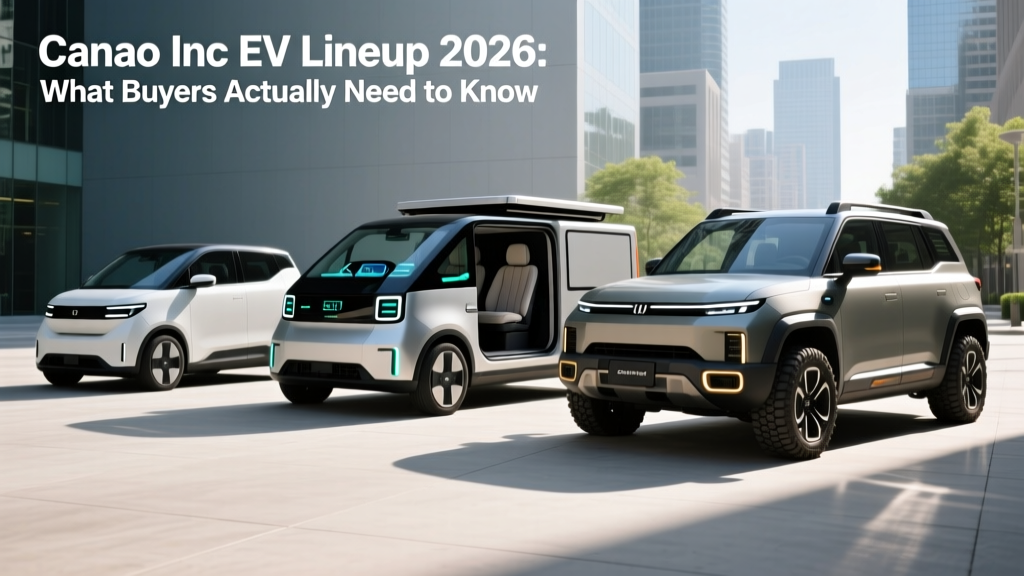
If you have been following the electric-vehicle startup space, Canoo Inc likely sits somewhere between curiosity and caution on your radar. The company has promised a suite of unconventional EVs — a cab-forward Lifestyle Vehicle, a modular Pickup Truck, and a purpose-built Lifestyle Delivery Vehicle (LDV) — wrapped in a skateboard-platform architecture that attracted early investment from Hyundai and even a NASA contract. But translating concepts into drivable, purchasable, warrantied vehicles has proven far harder than Canoo's early pitch decks suggested.
As of early 2026, Canoo Inc has not delivered a production vehicle to a retail customer. The company has faced repeated production delays, executive departures, liquidity concerns, and a reverse stock split to maintain its Nasdaq listing. This article takes a hard, data-driven look at where Canoo's announced EVs stand, what the preliminary specifications suggest, and whether waiting for Canoo makes sense compared to EVs you can actually buy and charge today.
Canoo Inc Status: Announced, Not Available
Availability Warning: As of 2026, no Canoo vehicle is available for retail purchase or lease. The Lifestyle Delivery Vehicle, Lifestyle Vehicle (passenger), and Pickup Truck remain in pre-production or limited pilot phases. All specifications below are announced/preliminary and subject to change. Canoo has not published EPA-certified range, MPGe, or crash-test data. Treat every figure as an estimate until the company begins volume production and submits vehicles to EPA and NHTSA testing.
Canoo's trajectory illustrates a common pattern among EV startups: a compelling skateboard chassis concept, high-profile partnerships, and SPAC-era funding that proved insufficient to scale manufacturing. The company's Bentonville, Oklahoma factory was intended to produce up to 20,000 vehicles annually, but output has remained negligible. Fleet customers like NASA (which contracted LDVs for Artemis program crew transport) and Zeeba (a van leasing company) have received pilot units, but these are not homologated production vehicles in the regulatory sense.
For any buyer researching Canoo Inc as a potential purchase, the honest answer in 2026 is: there is nothing to buy yet. What we can analyze are the announced specifications and how they compare to EVs already on the road.
Announced Specifications: Lifestyle Vehicle, Pickup, and LDV
Canoo has published preliminary targets for its three-vehicle lineup. Because these have not been EPA-certified, we present them as manufacturer claims alongside the closest available competitors for context.
| Specification | Lifestyle Vehicle (Passenger) | Pickup Truck | Lifestyle Delivery Vehicle (LDV) |
|---|---|---|---|
| Battery Capacity (announced) | 80 kWh (est.) | 80 kWh (est.) | 80 kWh (est.) |
| Battery Chemistry | Not disclosed | Not disclosed | Not disclosed |
| EPA Range (target) | ~250 miles | ~200 miles | ~250 miles |
| Horsepower | 300 hp (single motor RWD) / 500 hp (dual motor AWD) | 500+ hp (dual motor AWD) | 300 hp (single motor RWD) |
| 0–60 mph (target) | ~6.3 sec (RWD) | Not published | Not published |
| Drivetrain | RWD or AWD | AWD | RWD |
| Max DC Fast Charge (claimed) | Not published | Not published | Not published |
| Cargo Volume | 140 cu ft (behind front row) | ~64 cu ft bed + frunk | 200+ cu ft (LDV cargo) |
| Towing Capacity | Not published | ~4,500 lbs (target) | N/A |
| Base MSRP (announced target) | ~$34,750 | ~$34,750 | Fleet pricing only |
The gaps in this table are themselves significant. Canoo has not published DC fast-charging power (kW), Level 2 charge rates, MPGe efficiency, or warranty terms — data points that any production-ready EV manufacturer provides as standard. Without battery chemistry disclosure (LFP vs. NMC), buyers cannot assess long-term degradation expectations or charging best practices.
Real-World Range Reality: What to Expect if Specs Hold
Announced EPA Target: ~250 miles (Lifestyle Vehicle / LDV)
Real-World Expectation (if produced): ~200–220 miles highway at 70 mph; ~160–180 miles in freezing temperatures with cabin heat. The cab-forward, high-frontal-area design of the Lifestyle Vehicle and LDV will likely hurt highway efficiency compared to sleeker crossovers. Expect ~3.0–3.5 kWh/mile in mixed driving, which would be competitive with the Ford E-Transit but below the Tesla Model Y's ~2.8 kWh/mile.
Range estimates for Canoo's vehicles must be treated with extreme caution. The company's boxy, cab-forward architecture maximizes interior volume but creates aerodynamic drag that punishes highway efficiency. For comparison, the Ford E-Transit (a similarly shaped commercial van with a 68 kWh usable battery) achieves an EPA-estimated 126 miles in its low-roof, short-wheelbase cargo configuration. Canoo's larger 80 kWh battery target could yield better range, but only if the powertrain and thermal management prove efficient.
Cold-weather range loss affects all EVs, typically reducing usable range by 20–35% at freezing temperatures depending on whether the vehicle uses a heat pump (more efficient) or resistive cabin heating. Canoo has not disclosed its thermal management architecture. Without a confirmed heat pump, cold-climate buyers should budget for significant winter range reduction.
Charging Speed: The Biggest Unknown
Charging performance is arguably the most critical specification Canoo has not published. For context on what modern EV buyers should expect:
| Vehicle | Max DC Fast Charge (kW) | 10–80% Time | Level 2 Home Charge (kW) | Miles Added per Hour (L2) |
|---|---|---|---|---|
| Ford E-Transit (cargo van) | 115 kW | ~45 min | 11.5 kW | ~30 mi/hr |
| Rivian EDV (Amazon delivery) | ~150 kW | ~30 min | 11.5 kW | ~28 mi/hr |
| Tesla Model Y (Long Range) | 250 kW | ~18 min | 11.5 kW | ~44 mi/hr |
| Hyundai Ioniq 5 (Long Range) | 240 kW (800V) | ~18 min | 10.9 kW | ~40 mi/hr |
| Canoo Lifestyle Vehicle (announced) | Not published | Not published | Not published | Not published |
The absence of charging specifications is a red flag for any EV startup. DC fast-charge capability depends on battery cell selection, pack voltage architecture (400V vs. 800V), and thermal management — all of which require significant engineering validation. Canoo's skateboard platform was originally designed with an 800V-capable architecture in mind, but the company has not confirmed whether production vehicles will use that or a more conventional 400V system.
For fleet buyers considering the LDV, depot charging (overnight Level 2) may be sufficient for daily routes under 150 miles. But retail buyers of the Lifestyle Vehicle or Pickup will need DC fast-charging performance in the 150+ kW range to make road trips practical. Without published charge curves or peak/sustained kW data, this remains an unanswerable question.
Pricing, Tax Credits, and the Value Proposition
Canoo initially targeted a base MSRP of approximately $34,750 for both the Lifestyle Vehicle and Pickup Truck — a price point that, if achieved, would undercut most EVs in their respective segments. However, production delays and inflation since the original announcement make that figure uncertain. Startup EV manufacturers typically see final MSRPs land 15–30% above initial targets as supply chain realities set in.
| Vehicle | Base MSRP | Federal Tax Credit (§30D) | Effective Price (if credit applies) |
|---|---|---|---|
| Canoo Lifestyle Vehicle (target) | ~$34,750 (announced) | Unknown — battery sourcing unconfirmed | $27,250–$34,750 |
| Ford E-Transit Cargo Van | $45,895 | Up to $7,500 (if sourcing rules met) | ~$38,395 |
| Tesla Model Y (Long Range) | $44,990 | Up to $7,500 (point-of-sale transfer available) | ~$37,490 |
| Rivian R1S (Dual Motor) | $75,900 | $0 (exceeds $80,000 SUV MSRP cap for some trims) | $75,900 |
| Chevrolet Silverado EV (Work Truck) | $39,900 | Up to $7,500 (if sourcing rules met) | ~$32,400 |
Federal Tax Credit Caveats (§30D): The IRS requires that qualifying vehicles meet battery component manufacturing and critical mineral sourcing thresholds that tighten annually. As of 2026, both the battery components and critical minerals requirements are in full effect. Canoo has not disclosed its battery cell supplier or whether its pack assembly will satisfy domestic-content rules. Buyers should consult the IRS Clean Vehicle Credits page for the current list of qualifying vehicles before assuming credit eligibility. Additionally, the §30D credit phases out for buyers exceeding income caps ($150,000 single / $300,000 joint) and for SUVs/pickups/vans with MSRPs above $80,000.
The Skateboard Platform: Canoo's Core Engineering Bet
Canoo's differentiator has always been its flat, modular skateboard chassis — a structural battery pack integrated into a low-profile platform that allows multiple body styles to ride on the same underpinnings. The concept is sound and mirrors the architecture that made companies like Rivian and the Hyundai Motor Group's E-GMP platform successful. Canoo's skateboard was designed to house between 80 and 120 kWh of battery cells depending on vehicle configuration, with the battery pack serving as a stressed structural member.
However, a skateboard architecture is only as good as its manufacturing execution. Canoo's early prototypes used a mix of cylindrical and pouch cells from undisclosed suppliers. The company has referenced partnerships with battery suppliers but has not committed to a specific cell format or chemistry (LFP vs. NMC) in public filings. This ambiguity matters: LFP chemistry offers longer cycle life and lower fire risk but sacrifices energy density; NMC delivers more range per kilogram but degrades faster if regularly charged to 100%.
For fleet operators who would charge to 80–90% daily and prioritize longevity, LFP would be the ideal choice for the LDV. For the Pickup and passenger Lifestyle Vehicle where range is a selling point, NMC would likely be necessary to hit the 250-mile target in a package this size. Canoo's silence on this question leaves a significant gap in any buyer's due diligence.
Who Should Consider Canoo — and Who Should Look Elsewhere
The honest answer is that no retail buyer should plan a purchase around Canoo Inc vehicles in 2026. The company has not demonstrated the ability to deliver production vehicles at scale, and its financial position remains precarious. Here is a practical breakdown:
Consider waiting for Canoo if:
- You are a fleet operator with a 3+ year procurement timeline and can absorb risk
- You specifically need a compact, cab-forward delivery van and have depot charging
- You are tracking Canoo's financial filings and production milestones quarterly
Buy an available EV now if:
- You need a vehicle in the next 12 months
- You require confirmed EPA range, warranty coverage, and dealer/service support
- You want to use the §30D tax credit with certainty on a qualifying vehicle
- You need DC fast-charging performance validated by independent testing
Canoo Inc vs. Competitors You Can Actually Buy
Canoo (If Produced) — Potential Pros:
- Cab-forward design maximizes interior volume in a compact footprint
- Targeted $34,750 MSRP would be highly competitive
- Skateboard platform allows multi-body flexibility
- Purpose-built for commercial delivery and urban use cases
Canoo — Confirmed Cons:
- No production vehicles delivered to retail customers
- No EPA-certified range, MPGe, or crash-test data
- Charging specs (kW, 10–80% time) unpublished
- Battery chemistry and warranty terms undisclosed
- Company financial stability remains uncertain
- No dealer network, service infrastructure, or parts supply chain confirmed
For buyers who like the idea of a Canoo-style vehicle, the market already offers proven alternatives:
- Ford E-Transit: EPA-estimated 126 miles, 115 kW DC charging, $45,895 base, available now with dealer service network. Best for commercial fleet routes under 100 miles.
- Rivian EDV / R1T: The Rivian Electric Delivery Van is fleet-only (Amazon contract), but the R1T pickup starts at $69,900 with EPA ranges up to 352 miles and validated 200+ kW charging.
- Chevrolet Silverado EV: Starting at $39,900 for the Work Truck trim with up to 450 miles of EPA range on higher trims. GM's Ultium platform is proven and widely serviced.
- Hyundai Ioniq 5 / Kia EV6: For passenger buyers who want a cab-forward feel with 800V fast charging (240 kW peak, 10–80% in ~18 min), starting under $45,000.
Frequently Asked Questions About Canoo Inc
What is the real-world range of Canoo EVs?
There is no verified real-world range data. Canoo's announced target is ~250 miles for the Lifestyle Vehicle and LDV, and ~200 miles for the Pickup. Without EPA certification or independent testing, real-world highway and cold-weather figures cannot be confirmed. Expect 15–30% below sticker in highway or freezing conditions, consistent with industry norms for boxy vehicle shapes.
How fast does a Canoo vehicle charge?
Canoo has not published DC fast-charging power (kW), 10–80% charge times, or Level 2 home-charging rates. This is a critical missing specification. Until Canoo validates charge curves on public DC infrastructure, buyers cannot assess road-trip viability.
How much does a Canoo EV cost after tax credits?
The announced target is ~$34,750 before incentives. Whether Canoo vehicles will qualify for the §30D federal tax credit (up to $7,500) depends on battery sourcing and critical mineral requirements that Canoo has not addressed publicly. Do not assume credit eligibility until the IRS lists the vehicle on its qualifying vehicles page.
Is Canoo Inc worth waiting for vs. buying a competitor?
For most buyers, no. The company has not delivered production vehicles, and its financial stability is uncertain. Established competitors like the Ford E-Transit, Chevrolet Silverado EV, and Hyundai Ioniq 5 offer confirmed specs, warranties, service networks, and tax-credit eligibility today.
What are the biggest pros and cons of Canoo's approach?
Pros: innovative cab-forward packaging, modular skateboard platform, competitive target pricing. Cons: no production, no published charging or battery data, no service network, unproven financial viability.
Does Canoo qualify for the federal EV tax credit?
Unknown. The §30D credit requires vehicles to meet battery component and critical mineral sourcing thresholds. Canoo has not disclosed its battery supply chain in sufficient detail to determine eligibility. Check irs.gov for the current qualifying vehicle list.
What battery chemistry does Canoo use — LFP or NMC?
Canoo has not publicly disclosed its battery cell chemistry. This is a significant omission: LFP and NMC have different degradation profiles, charging best practices, and energy densities. Buyers should demand this information before committing to a reservation.
What warranty would Canoo offer?
No warranty terms have been published. Industry standard for EV battery and powertrain coverage is 8 years / 100,000 miles, with some manufacturers (Hyundai, Kia) offering 10 years / 100,000 miles. Canoo's ability to honor long-term warranties depends on the company's survival — a meaningful risk for a startup in this financial position.
The Bottom Line on Canoo Inc in 2026
Canoo Inc represents an ambitious engineering vision that has not yet materialized into a purchasable product. The skateboard platform concept, cab-forward design language, and targeted pricing are genuinely compelling on paper. But EV buyers need more than concepts — they need EPA-certified range, validated charging speeds, disclosed battery chemistry, warranty backing, service infrastructure, and a company financially stable enough to support the vehicle for its useful life.
Canoo delivers none of those things today. Until the company can demonstrate sustained production, publish complete specifications, and establish a dealer or direct-service network, the prudent move is to purchase from manufacturers who have already crossed those thresholds. The EV market in 2026 offers no shortage of proven vehicles at competitive prices — there is no compelling reason to gamble on a startup that has yet to ship.