Quick Verdict: The Canoo EV Story in 2026
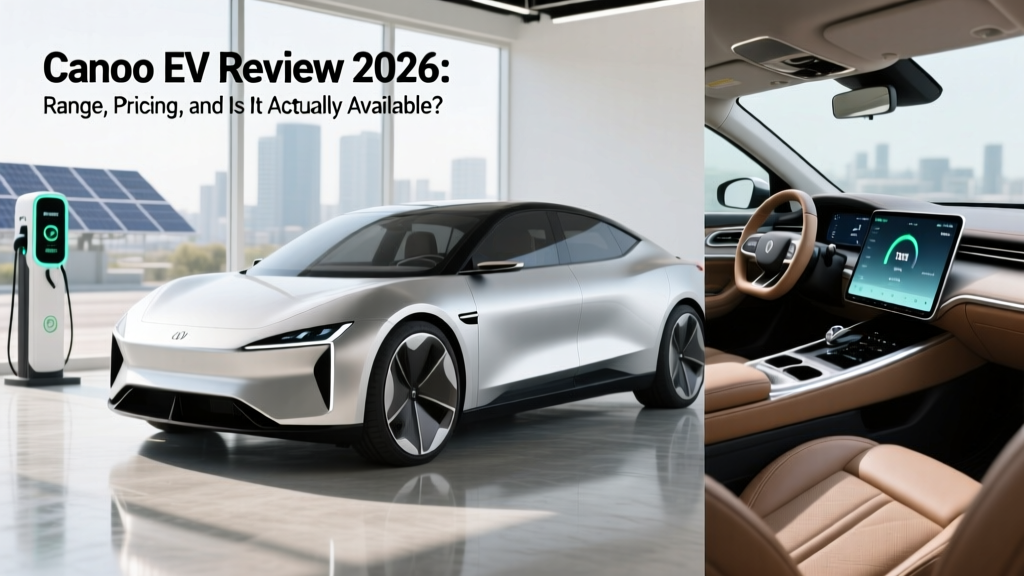
The Canoo EV lineup — anchored by the boxy, space-maximizing Lifestyle Vehicle and the compact Pickup — has been one of the most talked-about entries in the electric vehicle space since the company first unveiled its skateboard platform concept. But for buyers doing real purchase research in 2026, the central question is less about futuristic design and more about whether you can actually buy one, what the real-world range looks like, and how it stacks up against established competitors like the Rivian R1S, Volkswagen ID.4, or Hyundai Ioniq 5.
This review consolidates everything we know about the Canoo EV as of 2026: announced specifications, production status, battery and charging data, pricing estimates, and federal tax credit eligibility under current IRS §30D rules. Where figures are preliminary or manufacturer-estimated, we flag them clearly. Where Canoo has not released data, we note the gap — because an informed buyer needs to know what's confirmed versus what's marketing.
Canoo EV Models: Lifestyle Vehicle and Pickup Overview
Canoo's product strategy centers on two consumer vehicles built on a shared multi-purpose platform (the "skateboard" architecture that houses the battery, motors, and suspension below a flat floor):
- Canoo Lifestyle Vehicle (LV): A pod-shaped, cab-forward people-mover designed for maximum interior volume in a compact footprint. Seating for up to seven in some configurations, with a distinctive windshield-forward driving position.
- Canoo Pickup: A compact electric truck targeting urban and light-duty use, shorter than a Ford Maverick but with modular bed accessories.
Both models were designed around a subscription-first sales model, though Canoo has signaled retail purchase options as production scales. As of 2026, the company has faced well-documented financial and production challenges, including restructuring announcements and delayed timelines. Buyers should verify current production and delivery status directly with Canoo before committing funds.
| Specification | Lifestyle Vehicle | Pickup |
|---|---|---|
| Battery Capacity (usable) | ~80 kWh (estimated) | ~80 kWh (estimated) |
| Battery Chemistry | NMC (nickel manganese cobalt) | NMC |
| EPA Est. Range | Up to 250 mi (est.) | Up to 200+ mi (est.) |
| Horsepower | Up to 300 hp (dual-motor AWD) | Up to 500+ hp (dual-motor AWD) |
| 0–60 mph | ~6.3 seconds (est.) | ~5.5 seconds (est.) |
| Drivetrain | RWD or AWD (dual-motor) | AWD (dual-motor) |
| Max DC Fast Charge | ~150 kW (est.) | ~150 kW (est.) |
| 10–80% DC Charge Time | ~30 min (est.) | ~30 min (est.) |
| Level 2 Home Charging | 11.5 kW (~35 mi/hr) | 11.5 kW (~35 mi/hr) |
| Cargo Volume | ~100 cu ft (max, seats folded) | ~48 cu ft bed + frunk |
| Base MSRP (est.) | $34,750–$49,950 | $39,950–$54,950 |
| Warranty (battery/powertrain) | TBD — not yet published | TBD — not yet published |
Note: All specifications above are manufacturer-estimated or preliminary as of early 2026. Canoo has not published finalized EPA-certified figures. Verify current specs at canoo.com before making purchase decisions.
Battery, Range, and Efficiency: What the Numbers Mean
Canoo's skateboard platform uses an estimated 80 kWh usable battery pack with NMC (nickel manganese cobalt) chemistry. NMC offers higher energy density than LFP (lithium iron phosphate), which translates to more range in a smaller, lighter package — but with trade-offs in cycle life longevity and thermal stability compared to LFP packs used by competitors like Tesla's base Model 3 and BYD's lineup.
The targeted 250-mile EPA range for the Lifestyle Vehicle would place it in a competitive middle ground: shorter than the Hyundai Ioniq 5 Long Range (304 mi EPA) or Tesla Model Y Long Range (310+ mi EPA), but comparable to the base Volkswagen ID.4 (206–275 mi depending on trim). For the compact Pickup, a 200+ mile target is modest by truck standards — the Rivian R1T achieves 270+ miles and the Ford F-150 Lightning targets 240–320 miles depending on pack size.
Efficiency figures (MPGe and kWh/100mi) have not been formally published by Canoo or certified by the EPA. For reference, EVs in this size class typically achieve 90–110 MPGe combined (roughly 30–37 kWh/100mi). The Canoo LV's boxy, high-drag profile may push it toward the lower end of that range, particularly at highway speeds where aerodynamic losses dominate.
Charging Speed: DC Fast Charging and Home Level 2
Charging speed is where early-stage EV companies often face scrutiny, because peak kW ratings tell only part of the story. The charge curve — how quickly a battery accepts power across the 10–80% state-of-charge window, and how steeply it tapers above 80% — determines your actual road-trip downtime.
| Charging Level | Power (kW) | Miles Added per Hour | Typical Use Case |
|---|---|---|---|
| Level 1 (120V household) | ~1.4 kW | ~4–5 mi/hr | Emergency/overnight trickle |
| Level 2 (240V home) | 11.5 kW | ~35 mi/hr | Daily home charging (~7 hr for full) |
| DC Fast Charge (CCS/NACS) | ~150 kW peak | N/A (time-based) | Road trips: 10–80% in ~30 min |
The estimated 150 kW peak DC fast-charge rate is serviceable but not class-leading. Competitors like the Hyundai Ioniq 5 (peak 240 kW on 800V architecture, 10–80% in ~18 minutes) and the Porsche Macan Electric (peak 270 kW) demonstrate what faster-charging platforms can achieve. At 150 kW, the Canoo's ~30-minute 10–80% window is comparable to older CCS-era vehicles like the Ford Mustang Mach-E or early Volkswagen ID.4.
For home Level 2 charging, the 11.5 kW onboard charger is solid and consistent with segment norms. A full charge from near-empty to 100% would take approximately 7 hours — easily achievable with overnight charging on a standard 48-amp Level 2 home station. Home charger installation costs typically range from $800–$2,500 depending on panel capacity and run length; consult a licensed electrician for a site-specific quote.
Canoo has not confirmed whether the vehicle will ship with a NACS (Tesla-style) connector or CCS1. As the industry shifts toward NACS adoption across Ford, GM, Rivian, Volvo, and others through 2025–2026, connector compatibility is worth verifying before purchase — it affects which public charging networks you can access natively without adapters.
Performance, Drivetrain, and Interior Space
The Canoo Lifestyle Vehicle's dual-motor AWD configuration targets up to 300 horsepower with an estimated 0–60 mph time around 6.3 seconds. That's adequate for highway merging and city driving but trails sportier EVs in the price range (the Tesla Model Y Long Range hits 60 mph in ~5.0 seconds with 384 hp). The Pickup variant, with a claimed 500+ hp and ~5.5-second 0–60 time, would be competitive with the Rivian R1T dual-motor and Ford F-150 Lightning Extended Range.
Where the Canoo LV genuinely differentiates itself is interior packaging. The cab-forward, flat-floor skateboard design pushes the windshield far forward and eliminates the traditional hood, creating an estimated 100+ cubic feet of cargo volume with rear seats folded — rivaling full-size SUVs in a vehicle with a footprint closer to a compact crossover. Canoo has also showcased a "loft on wheels" interior concept with street-facing bench seating and fold-out tables, though production-trim interiors may be more conventional.
Legroom and headroom figures have not been published in standard SAE measurement format. Given the vehicle's tall roofline and flat floor, expect generous headroom (likely 40+ inches front and rear) and competitive rear legroom, but confirm exact dimensions once production specs are finalized.
On the technology front, Canoo has referenced a minimal, screen-centric dashboard with over-the-air update capability and a steer-by-wire system (no mechanical linkage between steering wheel and wheels). Steer-by-wire enables the compact, yoke-style steering control and contributes to the spacious cabin, but it's a technology that has faced regulatory scrutiny and consumer skepticism — verify production implementation and NHTSA compliance status.
Pricing, Tax Credits, and Total Cost of Ownership
Canoo initially targeted an aggressive price point for the Lifestyle Vehicle, with early announcements suggesting a base MSRP around $34,750 and higher trims reaching approximately $49,950. The Pickup was positioned in the $39,950–$54,950 range. However, given production delays, inflation, and supply-chain realities through 2024–2025, final retail pricing may differ from early estimates. Always confirm current MSRP directly with the manufacturer.
| Trim / Configuration | Est. MSRP | Est. After §30D Credit | Credit Eligibility |
|---|---|---|---|
| LV Base (RWD) | $34,750 | ~$27,250* | Pending — sourcing rules apply |
| LV Premium (AWD) | $44,950 | ~$37,450* | Pending — sourcing rules apply |
| Pickup Base (AWD) | $39,950 | ~$32,450* | Pending — sourcing rules apply |
| Pickup Premium (AWD) | $54,950 | ~$47,450* | Pending — sourcing rules apply |
*Tax credit estimates assume full $7,500 eligibility under IRS §30D. Actual eligibility depends on buyer income limits (AGI caps: $150K single / $225K head of household / $300K joint filers), vehicle MSRP caps ($55,000 for sedans/wagons; $80,000 for SUVs/trucks), and battery component + critical mineral sourcing requirements that tighten annually through 2032. The credit can be transferred to the dealer at point of sale as a purchase-price reduction. Consult a tax professional for personal eligibility.
A significant unknown for Canoo is battery and critical mineral sourcing compliance. The §30D rules require increasing percentages of battery components manufactured or assembled in North America and critical minerals sourced from the U.S. or free-trade-agreement partners. As a startup with global supply-chain dependencies, Canoo's eligibility for the full credit is not guaranteed and may vary by model year and production batch. Always check the official fueleconomy.gov tax credit database for the specific VIN you're considering.
Who Should Consider the Canoo EV — And Who Shouldn't
✓ Pros
- Exceptional interior volume relative to exterior footprint — cab-forward design maximizes cabin and cargo space
- Unique, head-turning design that stands out in a sea of crossover clones
- Flat skateboard platform allows flexible interior configurations (bench seating, loft-style layouts)
- Competitive base pricing target if MSRP holds at ~$34,750
- AWD dual-motor option available across the lineup
- Steer-by-wire and OTA update architecture signal modern tech ambitions
✗ Cons
- Production delays and financial uncertainty — company has faced restructuring and missed timelines
- No EPA-certified range, efficiency, or crash-test data available as of early 2026
- Charging speed (est. 150 kW peak) trails segment leaders like Ioniq 5 and Porsche Macan EV
- Battery warranty terms not yet published — a critical gap for a startup
- Federal tax credit eligibility uncertain due to battery-sourcing compliance
- Steer-by-wire technology carries regulatory and consumer-trust risk
- Limited service center network compared to established OEMs
Best for: Urban and suburban drivers who prioritize interior space and unique design over maximum range or proven reliability. The Lifestyle Vehicle's compact footprint with SUV-level cargo volume appeals to city dwellers who need versatility without a large vehicle. Early adopters comfortable with startup risk may find the Canoo compelling.
Think twice if: You need a proven, readily available EV with established service infrastructure, certified range data, and a published battery warranty. Buyers who can't afford to be early adopters — or who need guaranteed §30D tax credit eligibility — should cross-shop the Hyundai Ioniq 5, Tesla Model Y, Volkswagen ID.4, or Ford Mustang Mach-E, all of which offer confirmed specs, widespread dealer networks, and clearer credit eligibility.
Canoo EV vs. Key Competitors
Stacking the Canoo Lifestyle Vehicle against established alternatives reveals where it wins and where it falls short:
- vs. Hyundai Ioniq 5 (275–304 mi EPA, $42,600+): The Ioniq 5 offers certified longer range, 240 kW ultra-fast charging (10–80% in ~18 min), IIHS Top Safety Pick+ rating, and a robust dealer/warranty network. The Canoo LV offers more interior volume and a lower target base price, but lacks the Ioniq 5's proven track record.
- vs. Volkswagen ID.4 (206–275 mi EPA, $39,735+): The ID.4 is a known quantity with EPA-certified specs and broad availability. The Canoo's design is more distinctive and potentially more spacious, but the ID.4's reliability data and service network are established advantages.
- vs. Tesla Model Y (300+ mi EPA, $44,990+): The Model Y dominates on range, Supercharger network access, and proven production scale. The Canoo offers a radically different interior experience and lower target base price, but Tesla's infrastructure and resale value are significant moats.
- vs. Rivian R1S (321–410 mi EPA, $75,900+): Different price segment entirely. The R1S offers vastly more range, towing capacity, and off-road capability but at roughly double the Canoo's target price.
Ownership Considerations: Warranty, Service, and Longevity
Perhaps the most significant gap in Canoo's buyer information is warranty coverage. As of 2026, the company has not published finalized battery or powertrain warranty terms. For context, the industry standard for EV battery warranties is 8 years / 100,000 miles with a minimum 70% capacity retention guarantee (per NHTSA guidance and typical OEM practice). Tesla, Hyundai, and Ford all offer 8-year/100,000-mile battery warranties; Hyundai extends its powertrain coverage to 10 years/100,000 miles.
For a startup automaker, warranty terms carry extra weight: they signal confidence in battery longevity and define your financial risk if degradation exceeds expectations. Before committing to a Canoo purchase or reservation, insist on written warranty documentation covering:
- Battery capacity retention threshold (e.g., 70% at 8 years/100,000 miles)
- Powertrain component coverage (motors, inverter, reduction gear)
- Bumper-to-bumper limited warranty duration
- Roadside assistance terms
- Service center locations and mobile service availability in your region
The absence of published warranty data is not necessarily a red flag — it may simply reflect the company's pre-production status — but it is a gap that must be closed before any purchase commitment.
Frequently Asked Questions
What is the real-world range of the Canoo EV?
Canoo targets up to 250 miles EPA-estimated for the Lifestyle Vehicle and 200+ miles for the Pickup. These are manufacturer estimates, not EPA-certified figures. In real-world highway driving (70+ mph), expect approximately 200–220 miles from the LV. In cold weather (below 32°F), NMC battery chemistry typically loses 20–30% range, potentially reducing usable range to 150–175 miles. A heat pump (if equipped) could mitigate cold-weather losses to 15–20%.
How fast does the Canoo EV charge?
Canoo estimates a peak DC fast-charge rate of approximately 150 kW, with a 10–80% charge time around 30 minutes. At home on a Level 2 (240V, 48A) station, the 11.5 kW onboard charger adds roughly 35 miles of range per hour, meaning a full overnight charge takes about 7 hours. The 150 kW peak is serviceable but trails competitors like the Hyundai Ioniq 5 (240 kW) and Kia EV6 (239 kW). Actual charge times depend on battery temperature, state of charge, and charger capability — peak kW is not sustained across the full charge curve.
How much does the Canoo EV cost after tax credits?
Estimated base pricing starts around $34,750 for the Lifestyle Vehicle and $39,950 for the Pickup. If the full $7,500 federal §30D tax credit applies, effective prices could drop to approximately $27,250 (LV base) and $32,450 (Pickup base). However, credit eligibility depends on buyer income caps ($150K/$225K/$300K AGI), MSRP caps ($55K sedans/$80K trucks), and battery component/critical mineral sourcing requirements. Canoo's compliance with sourcing rules has not been independently confirmed — check fueleconomy.gov and consult a tax professional before relying on credit estimates.
Is the Canoo EV worth buying versus key competitors?
The Canoo EV offers genuinely innovative packaging and a compelling target price, but it carries startup risk that established competitors do not. If you need a vehicle today with certified range data, a published battery warranty, a robust service network, and confirmed tax credit eligibility, the Hyundai Ioniq 5, Tesla Model Y, or Volkswagen ID.4 are safer choices. If you're willing to wait for production, accept early-adopter risk, and prioritize unique design and maximum interior space, the Canoo is worth monitoring — but do not commit funds until production vehicles are shipping with finalized specs.
Does the Canoo EV qualify for the federal EV tax credit?
Eligibility is not yet confirmed. Under IRS §30D rules for 2026, the vehicle must meet MSRP caps ($55,000 for cars/wagons, $80,000 for SUVs/trucks/pickups), the buyer must fall within income limits, and the battery must meet escalating domestic-content and critical-mineral sourcing thresholds. Canoo's base pricing appears to fall within MSRP caps, but battery sourcing compliance is the key unknown. The credit can be applied as a point-of-sale price reduction at participating dealers. Always verify eligibility for your specific VIN and tax situation before purchasing.
Can I actually buy a Canoo EV right now?
As of early 2026, Canoo has faced significant production and financial challenges, including restructuring announcements and delayed delivery timelines. The company has accepted reservations but widespread retail availability has not been confirmed. Before placing a deposit or committing to a purchase, contact Canoo directly to verify current production status, delivery timelines for your region, and refund policies for reservations. Treat any pre-production vehicle as speculative until you have a confirmed delivery date and finalized purchase agreement.
Sources: Manufacturer specifications via canoo.com; IRS §30D tax credit rules via irs.gov; EPA range and efficiency data via fueleconomy.gov. All Canoo specifications cited are manufacturer-estimated and subject to change pending EPA certification and production finalization. This article reflects information available as of early 2026.