The Quick Answer: Chinese EVs Are Effectively Priced Out of Canada
Bottom line: Canada imposed a 100% surtax on all Chinese-made electric vehicles effective October 2024, and as of 2026 it remains fully in force. That means a BYD Seagull with a factory price of ~$18,000 USD lands in Canada at roughly $36,000+ before freight, dealer fees, and GST/HST — eliminating the price advantage that made Chinese EVs disruptive globally. If you're shopping for an EV in Canada right now, Chinese-brand vehicles are not a realistic option. Your practical alternatives are EVs assembled in North America or South Korea, many of which still qualify for federal and provincial incentives.
The tariff landscape has redrawn the map for Canadian EV buyers. What began as a policy response to a flood of subsidized Chinese exports has created a market where the most affordable new EVs start around $43,000 CAD — far above the sub-$20,000 price points Chinese automakers like BYD, NIO, and MG offer in Europe, Southeast Asia, and Latin America. Understanding exactly how this affects your wallet, which models are blocked, and what the alternatives cost is essential before you step into a dealership.
What the 100% Tariff Actually Covers
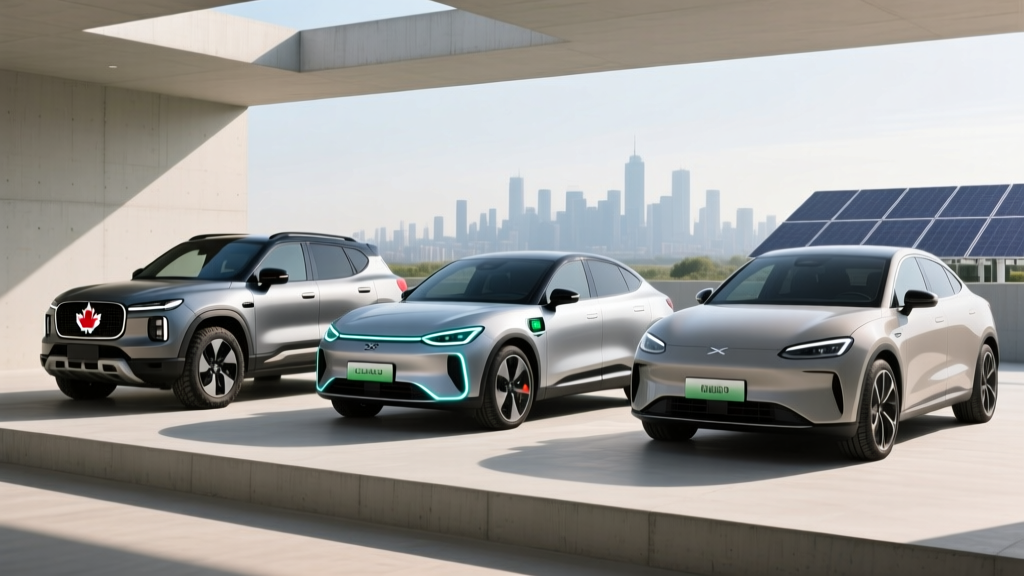
Canada's surtax applies to all electric vehicles manufactured in China, regardless of the brand badge on the hood. This catches more than just Chinese-owned companies:
- Chinese brands: BYD (Seagull, Dolphin, Atto 3, Seal), NIO, Xpeng, MG (MG4 EV), Zeekr, Leapmotor, GWM Ora
- Western brands built in China: Tesla Model 3 and Model Y from Giga Shanghai, Volvo EX30 and EX40 (China-assembled trims), Polestar 2 (Luqiao, China plant), Dacia Spring (Renault, China-sourced)
- Commercial EVs: Electric vans and light trucks from Chinese OEMs are also caught by the tariff
The tariff is applied on top of the standard 6.1% auto import duty. So a vehicle with a declared customs value of $25,000 CAD faces $2,500 in standard duty plus $25,000 in surtax — totaling $27,500 in duties alone. Freight, pre-delivery inspection, and provincial sales tax stack on top.
As of early 2026, the Canadian government has shown no indication of reducing or removing the surtax. Trade negotiations with China remain strained, and domestic automakers (including the Stellantis/LG battery plant in Windsor and the VW PowerCo facility in St. Thomas, Ontario) are counting on continued protection while they ramp up North American battery and vehicle production.
The Real Cost: Chinese EVs Landed in Canada vs. Alternatives
To make this concrete, here's what a few popular Chinese-market EVs would cost Canadian buyers under the current tariff regime, compared to the most affordable EVs actually available in Canada in 2026:
| Vehicle | Global MSRP (approx. USD) | Canadian Landed Price (est. CAD) | EPA-Equiv. Range | Battery |
|---|---|---|---|---|
| BYD Seagull (China export) | $12,000 | ~$38,000–$42,000 | ~250 mi (CLTC 405 km) | 44.9 kWh LFP |
| BYD Dolphin | $18,000 | ~$52,000–$56,000 | ~265 mi (WLTP 427 km) | 60.5 kWh LFP |
| MG4 EV (Long Range) | $22,000 | ~$58,000–$62,000 | ~280 mi (WLTP 452 km) | 77 kWh NMC |
| Tesla Model 3 RWD (Shanghai-built, if imported) | $28,000 | ~$72,000+ | ~272 mi (EPA) | 60 kWh LFP |
| — vs. Canadian-market alternatives — | ||||
| Hyundai Ioniq 5 Preferred (Korea-built) | — | $55,499 | 361 km (EPA ~224 mi) | 63 kWh NMC (Std Range) |
| Chevrolet Equinox EV 2LT (Mexico-built) | — | $48,998 | 513 km (EPA ~319 mi) | 85 kWh NMC |
| Tesla Model 3 RWD (Fremont/Austin-built) | — | $54,990 | 438 km (EPA ~272 mi) | 60 kWh LFP |
| Volkswagen ID.4 Pro (Chattanooga-built) | — | $52,995 | 443 km (EPA ~275 mi) | 82 kWh NMC |
The math is stark. A BYD Seagull that sells for the equivalent of $12,000 USD in Thailand or Brazil becomes a $40,000+ CAD proposition in Canada — right in the same ballpark as a Chevrolet Equinox EV that offers double the range, a mature dealer network, and full Canadian safety certification. The tariff doesn't just make Chinese EVs more expensive; it makes them uncompetitive against the very vehicles it was designed to protect.
EV vs. Gas in Canada: The Ownership Math Still Favors Electric
Even without access to cheap Chinese EVs, the total cost of ownership for a Canadian-market EV still beats a comparable gas car over five years in most provinces — especially where electricity is cheap and gas is expensive.
| Cost Category (5-Year / 100,000 km) | Chevy Equinox EV 2LT | Honda CR-V EX-L AWD (Gas) |
|---|---|---|
| Purchase Price (MSRP + freight) | $50,500 CAD | $43,500 CAD |
| Federal iZEV Rebate (if eligible) | –$5,000 | $0 |
| Provincial Rebate (QC example) | –$7,000 | $0 |
| Net Purchase | $38,500 | $43,500 |
| Fuel / Electricity (QC hydro at $0.07/kWh; gas at $1.65/L) | $1,400 | $11,550 |
| Maintenance (oil, filters, brakes, etc.) | $1,200 | $3,800 |
| Insurance (avg. Ontario/Quebec) | $9,500 | $7,800 |
| Total 5-Year Cost | $50,600 | $66,650 |
The Equinox EV comes out roughly $16,000 ahead over five years in Quebec, where hydro rates are among the cheapest in North America and provincial rebates are generous. In Alberta or Ontario, where electricity costs more and provincial rebates are smaller or nonexistent, the gap narrows to $6,000–$10,000 — still meaningful, but less dramatic.
Key caveats: EV insurance premiums run 15–25% higher on average (repair costs for battery and structural components are steeper), and EV depreciation remains less predictable than for established gas models. If you drive fewer than 15,000 km/year, the fuel savings shrink and the higher purchase price takes longer to recoup.
What About the "Cheaper Chinese EVs Are Coming" Myth?
| Myth | Fact |
|---|---|
| "BYD is about to launch in Canada at $20K" | Not under current tariffs. BYD has no Canadian dealer network, and the 100% surtax makes entry economically pointless for them at this price tier. |
| "The tariff will be lifted once trade talks normalize" | No timeline exists. Canada's tariff mirrors the US approach and is tied to broader geopolitical and industrial policy. Expect it through at least 2027. |
| "You can import a Chinese EV privately and skip the tariff" | No. The surtax applies at the border to any EV with a Chinese VIN, whether imported by a dealer or an individual. Transport Canada safety certification is also a separate, costly hurdle. |
| "Tesla Model 3 from Shanghai is cheaper than Fremont" | It was — before the tariff. Tesla shifted Canadian supply to Fremont and Austin plants specifically to avoid the surtax. Canadian Model 3 pricing now reflects North American production costs. |
| "Chinese EVs have worse quality and safety" | Oversimplified. BYD, NIO, and Zeekr score well in Euro NCAP testing. The tariff is an economic and geopolitical tool, not a quality judgment. But Canadian crash-test certification (CMVSS) is a separate requirement most Chinese models haven't pursued. |
Cold Weather, Charging, and Real-World Canadian Ownership
Range numbers on spec sheets don't tell the full story in a Canadian winter. Every EV loses range in cold weather due to battery chemistry limitations and cabin heating demand. Here's what to expect:
Cold-weather range reality: At –20°C, expect 30–45% range reduction versus the EPA sticker. A Chevrolet Equinox EV rated at 513 km EPA could deliver as little as 280–350 km on a cold January highway drive at 100 km/h with the heater on. EVs with heat pumps (Hyundai Ioniq 5, Tesla Model 3, VW ID.4) lose less — typically 25–35% — because heat pumps move thermal energy rather than generating it resistively.
Home charging is the single biggest ownership variable. If you have a garage or dedicated parking spot with access to a 240V circuit, a Level 2 home charger (7–11 kW) will replenish most EVs overnight at a cost of $0.06–$0.12/kWh depending on your province. That's $3–$8 for a full charge.
If you live in a condo or apartment without charging access, you'll rely on public Level 2 and DC fast chargers. In major metros (Toronto, Vancouver, Montreal), networks like Electrify Canada, Petro-Canada Charge, and Flo are reasonably dense. In rural Prairies, Northern Ontario, or the territories, public charging remains sparse — and DC fast chargers capable of 150+ kW are even rarer. Plan accordingly: if you can't charge at home, an EV with 400+ km of real-world range and 150 kW+ DC fast-charging capability (10–80% in ~25 minutes) is essential for practical ownership.
Installation cost for a home Level 2 charger: Expect $800–$1,500 CAD for the charger unit (e.g., Flo Home X5 or ChargePoint Home Flex) plus $500–$2,500 for electrician labor, depending on panel capacity and wiring distance. If your home has a 100-amp panel that's already near capacity, a panel upgrade to 200 amps can add $2,000–$4,000. Several provinces offer rebates covering $500–$1,000 of installation costs — check your provincial energy authority.
Decision Framework: What Should You Actually Buy?
If you want the most affordable new EV in Canada: The Chevrolet Equinox EV at ~$49,000 CAD (before rebates) offers 513 km of EPA range, DC fast charging at 150 kW (10–80% in ~30 min), and qualifies for the $5,000 federal iZEV rebate plus provincial incentives in QC, BC, and NB. After rebates, effective price can drop to $37,000–$41,000.
If you need AWD and winter capability: The Hyundai Ioniq 5 Preferred AWD ($60,499 CAD) delivers 414 km range, 250 kW peak DC charging (10–80% in ~18 minutes on a 350 kW charger), and a heat pump that preserves range in cold weather. Its 800V architecture is the fastest-charging in its class.
If you want the best charging network access: The Tesla Model 3 RWD ($54,990 CAD) gives you the Supercharger network — 2,000+ stations across Canada, many with V3 stalls at 250 kW. Range is 438 km EPA, and real-world Supercharger access eliminates most road-trip anxiety.
If you can't charge at home and drive mostly in-city: Consider a PHEV like the Toyota RAV4 Prime (68 km electric-only range, 5.8 L/100 km combined when the battery depletes) or the Hyundai Tucson PHEV (53 km electric-only). You get EV-like daily commuting on overnight Level 1 charging (standard 120V outlet) without range anxiety or dependence on public chargers.
If you were hoping for a sub-$30K Chinese EV: That option does not exist in Canada under current policy. Budget accordingly for a $45,000–$55,000 vehicle, factor in available rebates, and evaluate total cost of ownership over five years rather than sticker price alone.
Frequently Asked Questions
Does the 100% tariff apply to used Chinese EVs imported into Canada?
Yes. The surtax applies to all Chinese-origin EVs regardless of new or used status. Additionally, Transport Canada's Registrar of Imported Vehicles process adds cost and complexity, and most Chinese-market EVs don't meet Canadian Motor Vehicle Safety Standards (CMVSS). Importing a used BYD from Europe is technically possible but financially impractical.
Will the tariff affect EV prices for non-Chinese vehicles?
Indirectly, yes. By removing the cheapest competitors from the market, the tariff reduces downward price pressure on other EVs. Automakers like Hyundai, Volkswagen, and Tesla have less incentive to cut prices when the sub-$30,000 EV segment is walled off. However, competition among North American and Korean brands is still fierce, and MSRPs have been trending downward — Tesla cut Model 3 pricing multiple times through 2024–2025.
Do Canadian-built EVs exist yet?
Not at scale in 2026. The Stellantis/LG Energy Solution battery plant in Windsor is producing battery modules, and VW PowerCo's St. Thomas facility is ramping up cell production. Honda has announced an EV assembly plant in Alliston, Ontario, targeting 2028 production. GM's Ingersoll, Ontario plant builds the Chevrolet BrightDrop commercial van. Full Canadian-built passenger EVs from major brands are expected by 2028–2029.
What's the cheapest EV I can actually buy in Canada right now?
The Mitsubishi Outlander PHEV starts around $44,000 CAD (eligible for iZEV) and offers 61 km of electric-only range. For a fully electric vehicle, the Nissan Leaf S starts at $43,998 CAD with 240 km of range (40 kWh battery) — adequate for city commuting but limited for highway travel. The Chevrolet Equinox EV at ~$49,000 CAD is the most affordable long-range BEV with over 500 km EPA range.
Are Chinese EVs available in the US?
No. The US imposes its own tariffs on Chinese EVs — currently 100% under Section 301 (effective August 2024), on top of a 2.5% standard auto tariff. Combined with existing duties, a Chinese-made EV faces effectively a 102.5% tariff entering the US. Neither BYD nor any other Chinese automaker sells passenger EVs in the US market as of 2026. For more on current tariff rules, see the IRS clean vehicle credit page and fueleconomy.gov.
The Canada-China EV tariff situation is a reminder that geopolitics shapes what you can drive as much as engineering does. For Canadian buyers in 2026, the practical move is to evaluate North American and Korean-built EVs on their own merits — range, charging speed, real-world winter performance, and total cost — rather than waiting for a sub-$25,000 Chinese EV that policy has made unavailable. The good news: competition among the brands that can sell in Canada is driving prices down and range up, even without BYD in the mix.