The Short Answer on Canada-China EVs
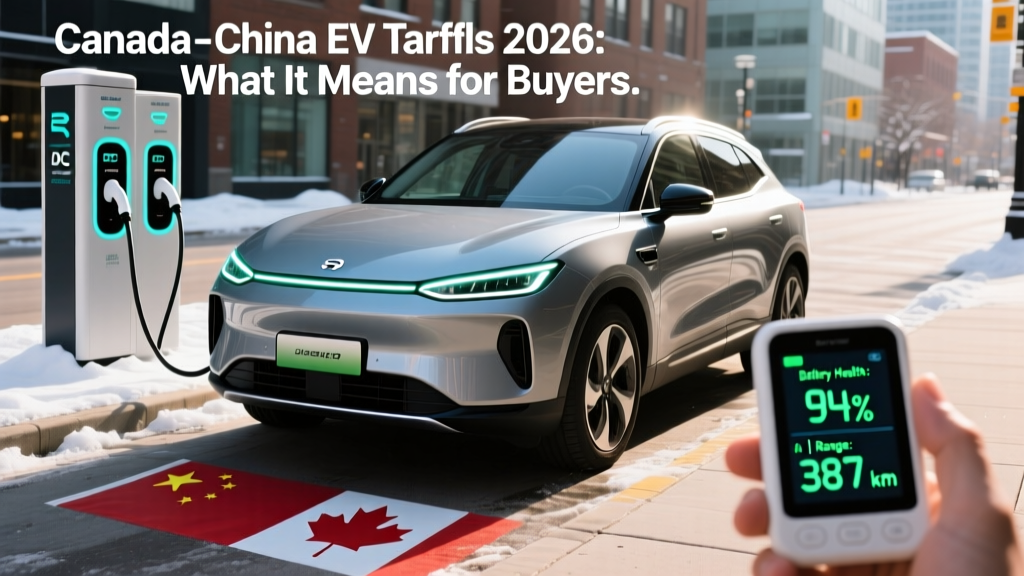
As of 2026, Canada imposes a 100% surtax on all electric vehicles manufactured in China, effectively doubling the price of models like the Tesla Model 3 (Shanghai-built), MG4, and BYD vehicles before they reach Canadian showrooms. This tariff, enacted in October 2024 under the Customs Tariff authority, was designed to counter China's subsidized EV exports and protect North American auto manufacturing. For Canadian EV buyers, this means Chinese-built EVs are priced out of contention, shifting the realistic options toward vehicles assembled in the US, South Korea, Germany, or Japan — many of which qualify for Canada's federal iZEV rebate of up to $5,000 CAD. If you're shopping for an EV in Canada today, focus on models built outside China to avoid the surtax and maximize incentive eligibility.
What the Canada-China EV Tariff Actually Is
On August 26, 2024, the Canadian government announced a 100% surtax on Chinese-made EVs, which took effect on October 1, 2024. This measure mirrors similar actions taken by the United States (which imposed a 100% tariff on Chinese EVs under Section 301) and the European Union (which levied countervailing duties of up to 35.3% on Chinese EVs in late 2024).
The tariff applies to all battery electric vehicles (BEVs) classified under specific HS codes that are manufactured or substantially transformed in China, regardless of the brand's country of origin. This is a critical distinction: it's the factory location, not the badge on the hood, that triggers the surtax.
According to Canada's Department of Finance, the surtax was implemented to "level the playing field" against China's state-subsidized EV sector, which has driven export prices well below the cost of production in many cases.
Which Vehicles Are Affected?
The tariff captures any BEV whose final assembly occurs in China. As of early 2026, the most notable affected models include:
- Tesla Model 3 (Rear-Wheel Drive and some Long Range variants built at Giga Shanghai for Canadian export — though Tesla has largely shifted Canadian supply to Giga Berlin and Giga Texas)
- MG4 EV (SAIC Motor, built in China)
- BYD Atto 3 / Dolphin / Seal (all China-built)
- Polestar 2 (early models were China-built; production has been diversifying to South Korea and the US)
- Volvo EX30 (initially China-built; Volvo announced production shifts to Ghent, Belgium)
- Various Chinese-brand startups (NIO, Xpeng, Zeekr — none have significant Canadian retail presence, but are tariff-blocked if they attempt entry)
Real Cost Impact: Before and After the Tariff
To understand how dramatically this tariff reshapes the Canadian EV market, consider the pricing math on a representative Chinese-built EV:
| Cost Component | Without Tariff | With 100% Tariff |
|---|---|---|
| Factory/FOB price | $30,000 | $30,000 |
| Shipping & logistics | $2,500 | $2,500 |
| Standard import duty (6.1%) | $1,982 | $1,982 |
| 100% China-EV surtax | $0 | $30,000 |
| Dealer margin & fees | $3,500 | $3,500 |
| Total pre-tax MSRP | $37,982 | $67,982 |
A vehicle that would have been a compelling $38,000 competitor to the Hyundai Ioniq 5 or Chevrolet Equinox EV becomes a $68,000 proposition — firmly in luxury territory without luxury appointments. The tariff is, by design, prohibitive rather than merely protective.
How Canadian EV Buyers Should Adjust
With Chinese-built EVs effectively removed from the affordable segment, Canadian shoppers need to reorient their search. Here's a practical breakdown of what's available and what the numbers look like.
Vehicles That Benefit from the Shift
Several non-China-built EVs now face less price competition in the $35,000–$55,000 CAD range:
| EV Model (Assembly Location) | MSRP (CAD) | EPA Range | iZEV Eligible? | Gas Equivalent | Gas MSRP (CAD) |
|---|---|---|---|---|---|
| Hyundai Ioniq 5 (Ulsan, South Korea) | $52,999 | 488 km (Long Range AWD) | Yes — $5,000 | Tucson Hybrid | $39,599 |
| Tesla Model 3 RWD (Fremont/Berlin) | $54,990 | 584 km | Yes — $5,000 | Toyota Camry | $33,990 |
| Chevrolet Equinox EV (Ramos Arizpe, Mexico) | $48,998 | 513 km (3LT) | Yes — $5,000 | Equinox Gas | $33,498 |
| Volkswagen ID.4 (Emden, Germany / Chattanooga, US) | $51,995 | 423 km (AWD Pro S) | Yes — $5,000 | Tiguan | $36,995 |
| Ford Mustang Mach-E (Cuautitlán, Mexico) | $55,995 | 502 km (Extended Range RWD) | Yes — $5,000 | Ford Edge | $44,999 |
Source: Transport Canada iZEV Program and manufacturer Canadian pricing pages, 2026 model year. iZEV eligibility requires MSRP under $55,000 CAD (base trim) or $65,000 (higher trims). Verify current eligibility at purchase.
5-Year Ownership Cost: EV vs. Gas in Canada
The sticker price is only the beginning. Canadian EV buyers benefit from lower per-kilometer energy costs, reduced maintenance, and federal/provincial incentives — but face higher insurance premiums and potential cold-weather range penalties.
| Cost Category | Hyundai Ioniq 5 (EV) | Toyota RAV4 Hybrid (Gas/HEV) | Toyota RAV4 Gas |
|---|---|---|---|
| Purchase price (after iZEV) | $47,999 | $40,599 | $35,799 |
| Provincial incentive (ON: none; QC: up to $7,000) | $0 (ON) / –$7,000 (QC) | $0 | $0 |
| Energy cost (100k km) | $3,200 (home L2) – $6,800 (public DC) | $9,800 (6.5 L/100km) | $12,400 (8.2 L/100km) |
| Maintenance (5 yr) | $1,200 | $3,500 | $4,200 |
| Insurance (5 yr avg) | $11,500 | $8,900 | $8,900 |
| Depreciation (est. 5 yr) | $22,000 | $16,500 | $17,800 |
| Total 5-yr cost (Ontario) | $85,899 | $79,299 | $79,099 |
| Total 5-yr cost (Quebec, with $7k rebate) | $78,899 | $79,299 | $79,099 |
Assumptions: Electricity at $0.13/kWh (Ontario residential), gasoline at $1.65/L average, Ioniq 5 efficiency of 20 kWh/100km. Insurance estimates based on Ontario averages for 35-year-old driver with clean record. Depreciation per Canadian Black Book trends for 2024–2025 models.
Key Takeaways on Cost
- Quebec buyers come out ahead on EVs thanks to the provincial rebate of up to $7,000 CAD stacked with the federal iZEV — potentially saving $12,000 off MSRP.
- Ontario buyers face a narrower gap, with EVs breaking even or slightly trailing hybrids on 5-year cost unless home charging is available and electricity rates are low.
- Insurance is 20–30% higher on EVs in most Canadian provinces — a cost many buyers overlook.
- Cold-weather range loss of 20–40% in January/February means a 488 km EPA-rated Ioniq 5 may deliver 300–390 km in a Prairie winter. This doesn't change the cost math but affects daily usability.
Common Misconceptions About the Canada-China EV Tariff
| Myth | Fact |
|---|---|
| "All Teslas sold in Canada are made in China." | Tesla shifted Canadian Model 3 supply primarily to Giga Berlin and Giga Fremont in 2025. Some Model Y variants were Shanghai-sourced but have largely transitioned to Austin-built units. Always verify the VIN origin (VIN starting with "5" = US, "L" = China, "W" = Germany). |
| "The tariff means no affordable EVs in Canada." | Multiple sub-$55,000 CAD EVs qualify for iZEV: Chevy Equinox EV ($48,998), Hyundai Kona Electric ($46,999), Nissan Leaf ($44,998). The tariff removed Chinese competition but didn't eliminate the budget segment. |
| "Chinese brands will find a workaround." | BYD, NIO, and Xpeng have explored building factories in Mexico or Brazil to bypass tariffs, but Canada's surtax is based on country of manufacture, not brand origin. A BYD built in Mexico would not face the China tariff, but no such plant is operational as of 2026. |
| "The tariff will be repealed soon." | The surtax was enacted via order-in-council under the Customs Tariff and has broad political support. There is no announced sunset date. Plan purchases assuming it remains in effect through at least 2027. |
Decision Framework: Which EV Should a Canadian Buyer Choose?
If-Then Guide for Canadian EV Shoppers (2026)
IF you live in Quebec or BC (strong provincial rebates + dense charging networks)
THEN a mid-price EV like the Hyundai Ioniq 5, Tesla Model 3, or VW ID.4 makes strong financial sense. The combined federal + provincial incentives can total $9,000–$12,000 CAD, and cold-weather range loss is less severe in coastal BC.
IF you live in the Prairies (Alberta, Saskatchewan, Manitoba) with extreme cold and sparse DC fast charging
THEN consider a plug-in hybrid like the Toyota RAV4 Prime (68 km electric range, no range anxiety in –35°C) or wait for extended-range EVs with larger battery packs (100+ kWh) that buffer cold-weather loss. Home Level 2 charging is essential here.
IF you live in Ontario with home charging access (garage or dedicated parking with 240V)
THEN an EV like the Chevrolet Equinox EV or Hyundai Kona Electric is competitive on 5-year cost, especially if your electricity plan offers off-peak rates below $0.08/kWh. Install a Level 2 charger ($1,500–$2,500 CAD including electrician) before delivery.
IF you rely on street parking or apartment living with no charging access
THEN a hybrid (HEV) like the Toyota Camry Hybrid or Honda CR-V Hybrid remains the pragmatic choice. Public DC fast charging costs $0.35–$0.55/kWh in most Canadian cities, eroding the EV energy-cost advantage and adding 30–45 minutes per session.
IF you were specifically interested in a Chinese-brand EV (BYD, MG, NIO)
THEN accept that the 100% surtax makes these vehicles economically nonviable in Canada for the foreseeable future. Redirect your search to Korean (Hyundai, Kia), American (Tesla, Ford, GM), or European (VW, Volvo) alternatives assembled outside China.
First-Time EV Buyer Essentials for Canadians
Home Charging Is Non-Negotiable for Most Owners
Over 80% of EV charging in Canada happens at home. Before purchasing, confirm you can install a Level 2 (240V, 32–48 amp) charger. Expect to pay $800–$1,500 CAD for the charger unit (e.g., ChargePoint Home Flex, Wallbox Pulsar Plus) and $700–$2,000 for a licensed electrician to run a dedicated 50-amp circuit from your panel. If your home has a 100-amp service panel, a panel upgrade to 200 amps may cost $2,500–$5,000 — factor this in.
Understand kW vs. kWh
This trips up many first-time buyers. kWh (kilowatt-hours) measures battery capacity — the "fuel tank size." A 77.4 kWh battery (Ioniq 5 Long Range) holds that much energy when full. kW (kilowatts) measures power flow — how fast you charge or how hard the motor pulls. A 350 kW DC fast charger delivers energy rapidly; a 7.2 kW Level 2 home charger fills the battery overnight. Never confuse the two.
Canadian Incentive Stack (2026)
- Federal iZEV: Up to $5,000 CAD for BEVs with a base MSRP under $55,000 (or $65,000 for higher trims with options). Verify eligibility on Transport Canada's iZEV list at time of purchase.
- Quebec: Up to $7,000 CAD provincial rebate (reducing annually — confirm current amount on Roulez vert).
- British Columbia: CEVforBC rebate up to $4,000 for households earning under $100,000 (income-tested).
- Other provinces: PEI offers $5,000; New Brunswick offers $5,000; most other provinces have no additional incentive as of 2026.
Cold Weather Reality Check
Canada's climate is the ultimate EV stress test. At –20°C, expect:
- 20–40% range reduction (depending on whether you use cabin heat and whether the vehicle has a heat pump)
- Slower DC fast charging (batteries must warm up before accepting peak kW rates — preconditioning helps)
- Regenerative braking may be limited when the battery is cold, altering the driving feel
Vehicles with a heat pump (Hyundai Ioniq 5, Tesla Model 3/Y, VW ID.4) lose less range in cold weather than those relying on resistive heating. This is a meaningful spec to check if you live north of the 49th parallel.
Frequently Asked Questions
Can I still buy a Tesla in Canada, or are they all made in China?
Yes, you can buy a Tesla in Canada, and most 2026 models sold here are not China-built. Tesla shifted Canadian Model 3 supply primarily to Giga Berlin (Germany) and Giga Fremont (California) starting in 2024–2025. Model Y units are largely sourced from Giga Austin (Texas). Check the VIN: a "7" prefix indicates US (Austin), "5" indicates US (Fremont), "W" indicates Germany, and "L" indicates China. Your Tesla advisor can confirm build origin before delivery.
Will the Canada-China EV tariff lower if trade relations improve?
There is no announced sunset clause or review timeline for the surtax. It was enacted as a trade defense measure with broad support across Canadian political parties. Even if diplomatic relations thaw, the tariff is likely to remain until China's EV overcapacity issue is structurally resolved — which industry analysts don't expect before 2028 at the earliest.
Does the tariff apply to used Chinese-built EVs imported privately?
Yes. The 100% surtax applies to all EVs imported from China, whether new or used, and whether imported by a dealer or a private individual. Importing a used BYD from the US (if one existed in the US market) would still trigger the tariff if the vehicle was originally manufactured in China.
Are plug-in hybrids (PHEVs) affected by the China tariff?
The surtax specifically targets battery electric vehicles (BEVs) under designated HS tariff classifications. Plug-in hybrids are classified differently and are generally not subject to the 100% surtax, though standard import duties still apply. This makes PHEVs like the Toyota RAV4 Prime (built in Japan) an unaffected alternative.
What's the cheapest EV I can buy in Canada in 2026?
The Nissan Leaf S starts at approximately $44,998 CAD and qualifies for the $5,000 federal iZEV, bringing the net price to ~$39,998. The Hyundai Kona Electric starts around $46,999. Both are built outside China (Japan and South Korea/Czech Republic respectively) and are tariff-exempt. In Quebec, stacking the provincial rebate brings the Leaf to roughly $33,000 CAD — the most affordable new EV in the country.