Quick Answer: Can You Tow an Electric Car?
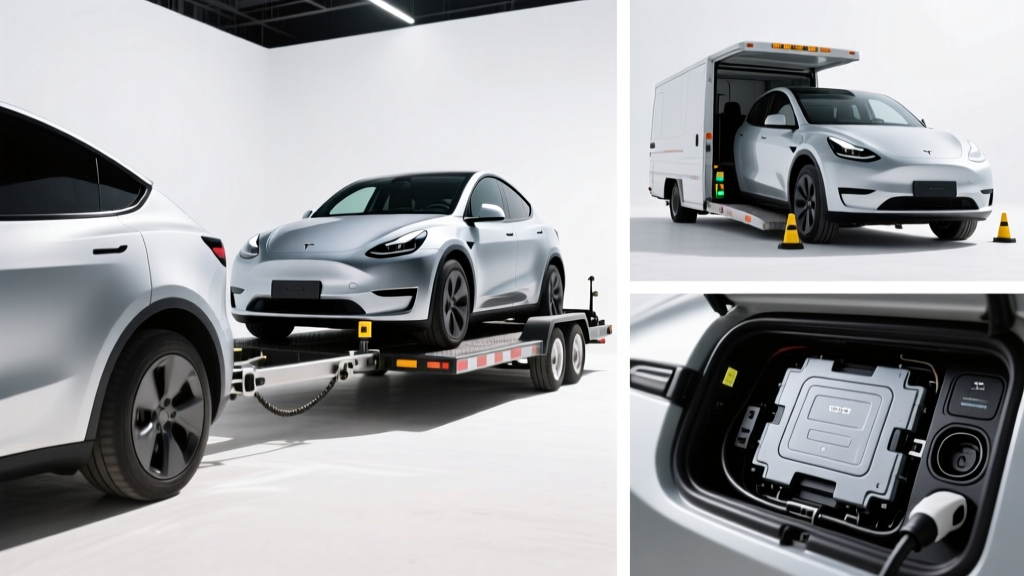
Yes, you can tow an electric car — but almost never by flat-towing (all four wheels down). Most EVs must be transported on a flatbed trailer or car carrier. Flat-towing an EV with its wheels on the ground can spin the electric motor without proper lubrication or back-feed current into the high-voltage battery, risking catastrophic damage that voids your warranty. A handful of EVs can be flat-towed in neutral with strict manufacturer procedures, but the default rule for 2025–2026 models is: wheels off the ground or don't tow it yourself.
If you're asking "can you tow an electric car," you likely fall into one of three camps: an RV owner wondering if you can dinghy-tow an EV behind a motorhome, an EV owner who broke down and needs a tow, or a shopper trying to figure out whether an EV can replace a gas truck for towing boats and trailers. This guide covers all three, with exact numbers and manufacturer guidance.
Why Flat-Towing an EV Is Usually Forbidden
Internal combustion vehicles can often be flat-towed by placing the transmission in neutral. The engine is off, the drivetrain disconnects, and the wheels spin freely. EVs don't work this way.
Electric motors are permanently coupled to the wheels through a single-speed reduction gear. When the wheels turn, the motor turns — and a spinning permanent-magnet motor generates electrical current (back-EMF). Without the vehicle's systems powered on to manage that energy, the current has nowhere safe to go. The consequences include:
- Motor overheating: Sustained spinning without active cooling can damage windings and magnets.
- Inverter and battery damage: Uncontrolled voltage can fry power electronics or push unregulated current into the high-voltage battery pack.
- Warranty void: Manufacturers explicitly exclude flat-tow damage from powertrain and battery warranties. Tesla, Ford, Hyundai, Kia, Rivian, and GM all state this in their owner's manuals.
The correct tow procedure for nearly every 2025–2026 EV is a flatbed truck or wheel-lift with dollies under the drive wheels. If only a wheel-lift tow truck is available, the drive wheels must be lifted and the non-drive wheels placed on dollies.
Which EVs Can Be Flat-Towed? The Short List
A very small number of EVs permit flat-towing under specific conditions. Always verify against the current owner's manual before attempting any tow — procedures change by model year.
| Vehicle | Flat-Tow Approved? | Conditions / Notes |
|---|---|---|
| Ford F-150 Lightning (2022–2026) | No | Flatbed only. 4WD models require all wheels off ground. |
| Rivian R1T / R1S | No | Flatbed only per owner's manual. |
| Tesla Model Y / 3 / S / X | No | Flatbed only. Tow mode in software is for winching, not highway towing. |
| Chevrolet Silverado EV | No | Flatbed required. |
| Hyundai Ioniq 5 / Kia EV6 | No | Flatbed only. |
| Jeep Wrangler 4xe (PHEV) | Yes | Transfer case in neutral, specific procedure. One of the few electrified vehicles approved for dinghy towing. |
| Ford Maverick Hybrid (HEV) | Limited | Check manual — some model years permit flat-tow with procedure. |
The Jeep Wrangler 4xe stands out as the notable exception: a plug-in hybrid with a traditional transfer case that can be placed in true neutral, making it a popular dinghy-tow vehicle behind RVs. If flat-towing behind a motorhome is a dealbreaker, PHEVs with conventional drivetrains currently offer more flexibility than pure BEVs.
EVs That Can Tow: Towing Capacity by Model
If your question is really "can an electric car tow a trailer or boat?" — yes, and several EVs match or exceed gas counterparts. Here's how 2025–2026 models stack up:
| EV Model | Max Towing Capacity | EPA Range | Battery (usable kWh) | Starting MSRP |
|---|---|---|---|---|
| Tesla Cybertruck AWD | 11,000 lbs | 340 mi | 123 kWh (NMC) | $81,695 |
| Rivian R1T Dual Motor | 11,000 lbs | 270–420 mi (pack dependent) | 92–149 kWh | $71,700 |
| Ford F-150 Lightning Ext. Range | 10,000 lbs | 320 mi | 131 kWh (NMC) | $61,995 |
| Chevrolet Silverado EV 4WT | 10,000 lbs | 390 mi (est.) | 200 kWh (NMC) | $74,800 |
| Tesla Model X | 5,000 lbs | 311 mi | 95 kWh (NMC) | $81,630 |
| Hyundai Ioniq 5 (AWD, w/ tow pkg) | 3,500 lbs | 290 mi | 84 kWh (NMC) | $52,600 |
| Kia EV6 GT-Line AWD | 2,700 lbs | 282 mi | 77.4 kWh (NMC) | $54,900 |
| Volkswagen ID.4 AWD | 2,700 lbs | 275 mi | 82 kWh (NMC) | $47,290 |
Source: Manufacturer specifications and fueleconomy.gov. Always confirm the tow package is equipped — many EVs require a factory-installed hitch receiver and software tow mode to reach rated capacity.
The Range Penalty: Towing With an EV vs. Gas
This is where the honest math matters. Towing with any vehicle reduces range, but EVs take a harder hit because:
- Regenerative braking is limited under load. A heavy trailer overwhelms regen capacity, so you rely more on friction brakes and recover less energy on deceleration.
- Aerodynamic drag scales with the square of speed. A boxy trailer at 70 mph can double the energy demand compared to the vehicle alone.
- No reserve fuel can. You can't carry a spare 5-gallon jerry can — you must plan charging stops.
Real-World Towing Range Loss
| Scenario | EV Range Impact | Gas Truck Range Impact |
|---|---|---|
| Light trailer (~2,000 lbs), 65 mph, flat terrain | −30% to −40% | −20% to −30% |
| Medium trailer (~5,000 lbs), 65 mph, flat terrain | −45% to −55% | −30% to −40% |
| Heavy trailer (~8,000+ lbs), 65 mph, hilly | −55% to −65% | −35% to −50% |
| Cold weather (below 32°F) + towing | −60% to −70% | −40% to −55% |
What this means practically: An F-150 Lightning with 320 miles of EPA range towing a 5,000-lb camper in summer will realistically deliver 145–175 miles before needing a charge. A gas F-150 with a 36-gallon tank and 16 MPG towing the same trailer gets roughly 325–390 miles per fill. The gap narrows when you factor in fuel cost per mile (detailed below), but the stop frequency difference is real on long hauls.
Cost Breakdown: EV Towing vs. Gas Truck Towing
Higher stop frequency doesn't necessarily mean higher cost. Here's a 2026 comparison for towing a 5,000-lb trailer on a 500-mile trip:
| Cost Factor | F-150 Lightning (EV) | F-150 3.5L EcoBoost (Gas) |
|---|---|---|
| Towing efficiency (est.) | ~2.2 kWh/mile | ~13 MPG |
| Energy for 500 miles | ~1,100 kWh | ~38.5 gallons |
| Cost (home charging @ $0.16/kWh) | $176 | — |
| Cost (DC fast charging @ $0.40/kWh avg) | $440 | — |
| Cost (gas @ $3.40/gal) | — | $131 |
| Charging/fuel stops required | 3–4 (30–40 min each at 150+ kW) | 1–2 (10 min each) |
| Total trip time (incl. stops) | ~10–11 hours | ~8.5–9 hours |
| Maintenance per 1,000 tow-miles | ~$15 (tire wear, cabin filter) | ~$55 (oil, trans fluid, filters) |
Gas wins on long towing trips for cost and time — if you're relying on public DC fast charging. Home-charged EV towing flips the economics for local hauling (boat ramps, dump runs, horse trailers within 100 miles), where electricity at $0.16/kWh undercuts gas significantly.
Common Towing Misconceptions — Myth vs. Fact
| Myth | Fact |
|---|---|
| "You can flat-tow any EV if it's in neutral." | EV "neutral" disconnects the inverter but the motor still spins with the wheels, generating uncontrolled voltage. Flatbed only unless the manual says otherwise. |
| "EVs can't tow heavy loads." | The Cybertruck and R1T both rate 11,000 lbs — competitive with heavy-duty gas half-tons. Instant torque is actually an advantage for trailer launch. |
| "Towing ruins the EV battery." | High-load towing generates heat, but liquid-cooled packs with active thermal management handle it. Degradation from occasional towing is negligible — sustained 100% SoC + towing in extreme heat is what accelerates wear. |
| "You need a special EV tow truck." | Any flatbed tow truck works. The key is ensuring the operator knows NOT to drag the EV with drive wheels on the ground. Show them the owner's manual page. |
| "EV towing range makes it unusable." | For 200+ mile towing trips, yes — plan carefully. For local towing under 100 miles round-trip, an EV handles it easily with range to spare. |
Decision Framework: Should You Tow With an EV?
Choose an EV for towing if:
- Your typical towing is local (under 100 miles round-trip) — boat ramps, utility trailers, horse trailers to nearby arenas
- You have home Level 2 charging (240V, 40–48A / 9.6–11.5 kW) to recharge overnight between tows
- You value low operating cost and zero idle emissions at campsites or job sites
- You want features like Ford's Pro Power Onboard or Tesla's bi-directional capability to run tools and appliances from the truck's battery
- You need maximum low-end torque for steep trailer launches
Stick with gas or diesel for towing if:
- You regularly tow over 250 miles one-way (RV trips, cross-state hauls)
- Your routes pass through charging deserts (rural Mountain West, parts of the Great Plains)
- You tow in extreme cold (below 20°F) where range loss compounds
- You need to tow 12,000+ lbs — heavy-duty diesel (F-250/2500 class) still dominates here
- Time sensitivity matters — you can't afford 30-minute charging stops on a schedule
Consider a PHEV if:
- You want short electric-only trips for local errands but gas range for long towing hauls
- Flat-towing behind an RV is important (Wrangler 4xe is the standout option)
What a First-Time EV Buyer Should Know About Towing
If you're buying an EV and towing is part of your life, build these realities into your purchase decision:
- Order the factory tow package. Aftermarket hitches may not integrate with the vehicle's trailer light controller, tow-mode software, or range estimation algorithms. The Hyundai Ioniq 5, for example, requires the $350 factory tow prep package to reach its 3,500-lb rating.
- Budget for a home Level 2 charger. Towing drains the battery hard. Relying on Level 1 (120V, ~1.4 kW) means 60+ hours to refill a large pack. A Level 2 install runs $800–$2,500 including equipment and electrician labor, per U.S. Department of Energy estimates, but it's non-negotiable for regular towing use.
- Check the §30D tax credit. The federal clean vehicle credit offers up to $7,500, but eligibility depends on MSRP caps ($80,000 for trucks/vans/SUVs), buyer income limits ($300K joint / $150K single), and battery critical-mineral sourcing requirements. The F-150 Lightning and Silverado EV currently qualify for partial or full credit depending on trim and build date — verify at the point of sale.
- Plan your charging route before a tow trip. Use A Better Routeplanner or the vehicle's built-in navigation with the trailer weight entered. Not all DC fast chargers can accommodate a truck-and-trailer combination — you may need to unhitch or find pull-through stalls (increasingly common at Tesla Supercharger and Electrify America locations with truck-friendly layouts).
- Expect higher insurance premiums. EVs cost 15–25% more to insure than comparable gas vehicles, per IIHS data, due to higher repair costs for battery packs and specialized body structures. Towing use may add a rider.
Frequently Asked Questions
Can I tow a Tesla behind an RV?
No. Tesla explicitly prohibits flat-towing in all owner's manuals. The vehicle must be transported on a flatbed. If you need a dinghy-tow vehicle behind a motorhome, look at the Jeep Wrangler 4xe or a gas-powered compact SUV with flat-tow approval.
Does towing void my EV battery warranty?
Towing within the manufacturer's rated capacity does not void the battery warranty. However, damage caused by improper towing (flat-towing a non-approved vehicle) is excluded. Federal law mandates a minimum 8-year/100,000-mile battery warranty with at least 70% capacity retention — this covers normal use including rated towing.
How much range do I lose towing a camper with an electric truck?
Expect 45–65% range reduction towing a 5,000–8,000 lb camper at highway speeds in moderate weather. An F-150 Lightning Extended Range (320 mi EPA) will realistically deliver 130–175 miles of towing range. Cold weather pushes this lower.
Can I use a tow dolly with an EV?
Only if the dolly lifts the drive wheels completely. For AWD EVs (which is most trucks and crossovers), all four wheels must be off the ground — meaning a full flatbed. Front-drive EVs like the Chevrolet Bolt EUV can use a dolly under the front wheels with rear wheels on a dolly or flatbed, but check the manual.
What's the best EV for towing a boat?
For boats under 3,500 lbs (most ski boats and small pontoons), the Rivian R1T, F-150 Lightning, or even a properly equipped Hyundai Ioniq 5 work well for local lake trips. For boats over 5,000 lbs, the Cybertruck (11,000-lb rating) or Rivian R1T with the Max pack offer the best range-and-capability combination.