The Short Answer: No, Teslas Are 100% Electric
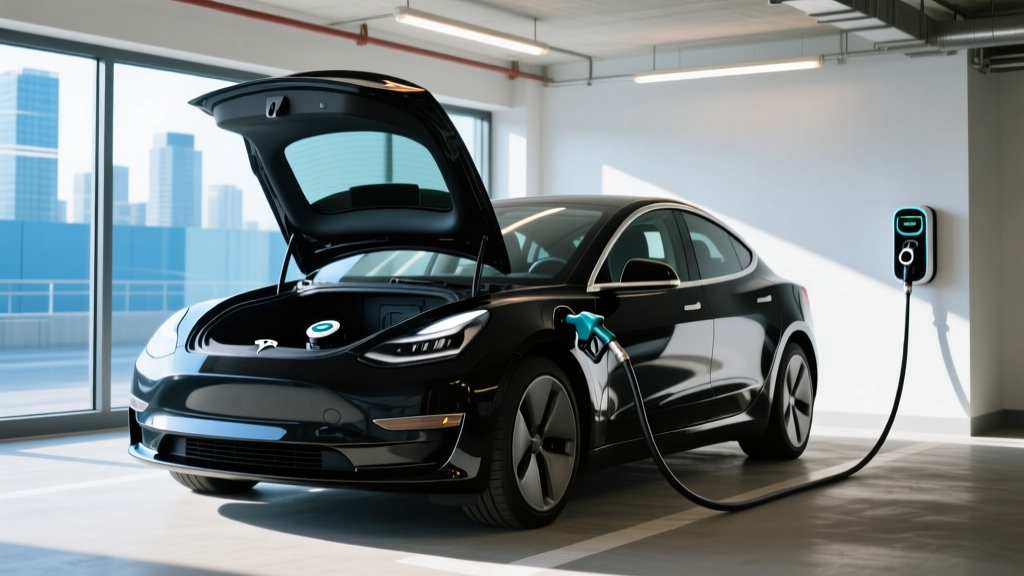
If you've ever pulled up to a gas station and wondered, "can you put gas in a Tesla?" — the answer is a definitive no. Every Tesla vehicle ever produced is a battery-electric vehicle (BEV). There is no fuel tank, no gas cap, no internal combustion engine, and no hybrid powertrain hiding under the hood. Teslas run exclusively on electricity stored in a high-voltage lithium-ion battery pack and are recharged by plugging into an electrical source.
This question comes up more often than you'd think. Search data shows thousands of people ask it every month, and it's a perfectly reasonable question for someone new to electric vehicles. Some confusion stems from the fact that Tesla's Supercharger stalls are often located near gas stations, and the act of "refueling" an EV can feel analogous to pumping gas — just with a cable instead of a nozzle.
Below, we'll break down exactly how you "fuel" a Tesla, what it costs compared to gasoline, and walk through the real-world specs for Tesla's current 2026 lineup so you know precisely what you're getting into.
How You Actually "Fuel" a Tesla: Charging Explained
Instead of a gas tank, every Tesla has a large battery pack (measured in kilowatt-hours, or kWh) that stores electrical energy. Instead of a fuel filler, there's a charge port on the driver-side rear quarter panel. Here are the three ways you replenish that battery:
| Level | Power Source | Max Power (kW) | Miles of Range Added Per Hour | Best For |
|---|---|---|---|---|
| Level 1 | Standard 120V household outlet | ~1.4 kW | 3–5 miles/hr | Overnight trickle, emergencies |
| Level 2 | 240V (dryer outlet / wall connector) | 7.7–11.5 kW | 25–44 miles/hr | Daily home charging |
| DC Fast Charging | Tesla Supercharger / CCS stations | Up to 250 kW (V3) / 350+ kW (V4) | Up to ~1,000 mi/hr peak | Road trips, quick top-ups |
kW vs. kWh — the critical distinction: kW (kilowatts) measures the rate of energy flow — think of it as the speed of water through a hose. kWh (kilowatt-hours) measures total energy stored — the size of the bucket. A Tesla Model 3 Long Range has roughly 82 kWh of usable battery capacity, and a V3 Supercharger can deliver energy at up to 250 kW — but only while the battery's state of charge is low and conditions are optimal.
2026 Tesla Lineup: Range, Battery, and Charging Specs
Here's the current Tesla lineup with the exact numbers that matter. Note that Tesla adjusts specs and pricing frequently — these reflect the latest available 2026 model-year data.
| Model / Trim | EPA Range | Battery (kWh, Chemistry) | Peak DC Charge | 10–80% Time | 0–60 mph | Base MSRP |
|---|---|---|---|---|---|---|
| Model 3 RWD | 272 mi | ~60 kWh (LFP) | 170 kW | ~25 min | 5.8 sec | $38,990 |
| Model 3 Long Range AWD | 341 mi | ~82 kWh (NMC) | 250 kW | ~20 min | 4.2 sec | $45,990 |
| Model Y Long Range AWD | 320 mi | ~82 kWh (NMC) | 250 kW | ~22 min | 4.8 sec | $46,990 |
| Model S Long Range | 402 mi | ~100 kWh (NMC) | 250 kW | ~27 min | 3.1 sec | $79,990 |
| Model X Long Range | 335 mi | ~100 kWh (NMC) | 250 kW | ~28 min | 3.8 sec | $84,990 |
| Cybertruck AWD | 340 mi | ~123 kWh (NMC) | 250+ kW | ~28 min | 3.9 sec | $79,990 |
What Does It Cost to "Fill Up" a Tesla vs. a Gas Car?
The whole point of switching from gasoline to electric is economics — and here's where the math strongly favors the Tesla. Let's compare the cost to add 250 miles of range.
| Scenario | Cost Per Mile | Cost for 250 Miles |
|---|---|---|
| Home charging (Level 2, $0.13/kWh national avg) | ~$0.035 | ~$8.75 |
| Tesla Supercharger (~$0.28/kWh avg) | ~$0.076 | ~$19.00 |
| Gas car (27 MPG, $3.40/gal) | ~$0.126 | ~$31.50 |
| Gas car (27 MPG, $4.50/gal — California) | ~$0.167 | ~$41.75 |
Home charging is where Tesla owners save the most. If you drive 12,000 miles per year and charge at home at the national average electricity rate, your annual "fuel" cost is roughly $420. The equivalent gas car spends $1,500–$2,000. Over a typical 5-year ownership period, that's $5,400–$7,900 in fuel savings alone.
Supercharging is more expensive — roughly half the cost of gasoline per mile — but still meaningfully cheaper. And Tesla's off-peak Supercharger rates at some locations can drop costs further.
Efficiency: MPGe and kWh Per 100 Miles
The EPA rates EV efficiency in MPGe (miles per gallon equivalent), which converts the electrical energy consumed into the energy equivalent of a gallon of gasoline (33.7 kWh). Here's how the Tesla lineup stacks up, per fueleconomy.gov:
- Model 3 RWD: 132 MPGe combined (25 kWh/100 mi)
- Model 3 Long Range AWD: 134 MPGe combined (25 kWh/100 mi)
- Model Y Long Range AWD: 117 MPGe combined (29 kWh/100 mi)
- Model S Long Range: 120 MPGe combined (28 kWh/100 mi)
- Model X Long Range: 102 MPGe combined (33 kWh/100 mi)
- Cybertruck AWD: ~78 MPGe combined (~43 kWh/100 mi)
Tesla's sedans are among the most efficient EVs on the market thanks to their low drag coefficients and sophisticated heat-pump thermal management systems. The Cybertruck's brick-like aerodynamics make it significantly less efficient — something to factor in if you're considering it for high-mileage commuting.
Cargo, Passenger Space, and Practicality
Because Teslas have no engine, transmission tunnel, or exhaust system, they offer packaging advantages over comparable gas cars — including a front trunk ("frunk") for additional storage.
| Model | Cargo (rear seats up) | Cargo (rear seats folded) | Frunk | Rear Legroom | Seating |
|---|---|---|---|---|---|
| Model 3 | 23 cu ft | ~56 cu ft | 3.1 cu ft | 35.2 in | 5 |
| Model Y | 30 cu ft | 72 cu ft | 4.1 cu ft | 37.3 in | 5 (7 optional) |
| Model S | 28 cu ft | ~65 cu ft | 5.3 cu ft | 35.4 in | 5 |
| Model X | 37 cu ft (behind 2nd row) | 88 cu ft | 6.6 cu ft | 36.9 in | 5, 6, or 7 |
| Cybertruck | Bed: 54 cu ft | N/A (truck bed) | 7.0 cu ft | ~36 in | 5–6 |
Federal Tax Credit: Does a Tesla Qualify?
This is where Tesla buyers need to pay close attention. Under the IRS §30D Clean Vehicle Credit, eligibility is not a simple "yes or no" — it depends on the specific model, your income, and battery-component sourcing requirements that shift year to year.
- MSRP cap: Sedans (Model 3, Model S) must be under $55,000. SUVs, vans, and trucks (Model Y, Model X, Cybertruck) must be under $80,000.
- Buyer income cap: Modified adjusted gross income must not exceed $150,000 (single), $225,000 (head of household), or $300,000 (joint filing).
- Battery sourcing: A percentage of critical minerals and battery components must be sourced from the U.S. or free-trade-agreement countries. These thresholds increase annually and can disqualify otherwise eligible vehicles mid-year.
- Point-of-sale transfer: As of 2024, you can transfer the credit to the dealer at purchase, reducing your out-of-pocket cost immediately rather than waiting for tax filing.
As of early 2026, the Model 3 Long Range AWD and certain Model Y configurations have qualified for the full $7,500 credit depending on battery-sourcing compliance at time of delivery — but this changes frequently. Always verify current eligibility on fueleconomy.gov and consult a tax professional before relying on the credit.
Tesla's Standout Tech and Notable Drawbacks
Standout features:
- Supercharger network: With 6,000+ V3/V4 stalls across North America, Tesla's proprietary charging network remains the most reliable and widespread DC fast-charging infrastructure available. Non-Tesla EVs are gaining limited access, but Tesla owners still get priority and seamless plug-and-charge billing.
- Over-the-air updates: Tesla pushes meaningful software improvements — new features, efficiency tweaks, UI changes — directly to your car wirelessly, sometimes multiple times per month.
- Autopilot (included): Adaptive cruise control with lane centering on highways. Functional and well-calibrated, though it remains a SAE Level 2 driver-assistance system requiring full driver engagement at all times.
- Full Self-Driving (Supervised): An $8,000 add-on (or $99/month subscription) that adds automatic lane changes, traffic-light recognition, and limited city-street navigation. Despite the name, FSD is not autonomous — it is SAE Level 2 and requires continuous driver supervision.
- Minimalist interior with 15.4" center screen: All vehicle controls route through the touchscreen — including climate, mirrors, and glovebox. Love it or hate it, it's a defining Tesla trait.
Notable drawbacks:
- No physical controls: Turn signal stalks were removed on refreshed Model 3/Y — signals are now buttons on the steering wheel. Climate, wipers, and mirrors are all screen-controlled, which some drivers find distracting.
- Build quality variability: While significantly improved since 2020, panel-gap inconsistencies and minor interior fit-finish issues still surface more often than on established luxury competitors.
- Limited service center network: Tesla relies on a smaller service-center footprint plus mobile rangers. In some metro areas, service appointments can take weeks.
- Insurance costs: Tesla insurance premiums tend to run 15–30% higher than comparable gas sedans/SUVs due to repair costs and claims data. Always get a quote before purchasing.
Pros and Cons at a Glance
Pros
- Best-in-class Supercharger network
- Class-leading efficiency (MPGe)
- Over-the-air software updates
- Strong real-world range (341 mi EPA, Model 3 LR)
- Low running costs vs. gasoline
- Instant torque, smooth acceleration
- Extensive active safety features standard
Cons
- No physical buttons or stalks
- Build quality still inconsistent
- FSD is expensive and not autonomous
- Higher insurance premiums
- Limited service center availability
- Rear-seat comfort lags luxury rivals
- Tax credit eligibility shifts unpredictably
Who Is a Tesla Best For?
Choose a Tesla if:
- You have access to home Level 2 charging (garage or driveway with 240V) — this is where the economics and convenience really work.
- You take regular road trips and want the most reliable DC fast-charging network available.
- You value software-driven features, OTA updates, and a tech-forward ownership experience.
- You want the lowest per-mile fuel cost in a premium vehicle.
Look elsewhere if:
- You live in an apartment or lack reliable home charging access — public-charging-only Tesla ownership is viable but significantly more expensive and time-consuming.
- You prefer traditional physical controls (knobs, buttons, stalks) over touchscreen-everything.
- You want a luxury interior on par with BMW, Mercedes, or Genesis — Tesla's cabin is minimalist by design, not by budget.
- You need a proven, high-volume dealer service network in your area.
Warranty Coverage
Tesla's warranty structure is competitive with the broader EV market:
- Basic Vehicle: 4 years / 50,000 miles
- Battery & Drive Unit (Model 3/Y RWD with LFP): 8 years / 100,000 miles, minimum 70% capacity retention
- Battery & Drive Unit (Model 3/Y Long Range, Model S/X): 8 years / 120,000 miles, minimum 70% capacity retention
- Cybertruck: 8 years / 120,000 miles (battery & drive unit)
The 70% retention threshold is standard for the industry. In practice, Tesla battery packs have demonstrated strong longevity — large-sample data from Tesla's fleet shows average degradation of roughly 12–15% after 150,000 miles, well within warranty limits. LFP batteries in the Model 3 RWD tend to show even slower degradation and can be routinely charged to 100% without the same long-term wear concerns as NMC packs.
Frequently Asked Questions
Can you put gas in a Tesla to extend its range?
No. Teslas have no internal combustion engine, no fuel tank, and no fuel filler. They are purely battery-electric vehicles. There is no range-extending gas generator, unlike a plug-in hybrid such as the BMW X5 xDrive50e or the Chrysler Pacifica Hybrid. If you need a vehicle that runs on both electricity and gasoline, you want a PHEV, not a Tesla.
What happens if someone accidentally puts gas in a Tesla's charge port?
Pouring gasoline or any liquid into the charge port will cause severe damage to the high-voltage electrical system and will absolutely void your warranty. The charge port is designed only for an electrical connector. If this happens, do not attempt to plug in or drive the vehicle — contact Tesla Roadside Assistance immediately.
Does Tesla make a hybrid or plug-in hybrid?
No. Tesla has never produced a hybrid, plug-in hybrid, or range-extended electric vehicle. Every model in Tesla's history — Roadster, Model S, Model X, Model 3, Model Y, Cybertruck, and Semi — is a full battery-electric vehicle. Elon Musk has stated publicly that Tesla will not pursue hybrid powertrains.
How long does it take to charge a Tesla at home overnight?
On a Level 2 Tesla Wall Connector (11.5 kW / 48A), a Model 3 Long Range adds roughly 44 miles of range per hour. A full charge from 10% to 100% takes about 8–9 hours. Most owners plug in each evening and wake up to a full battery — far more convenient than stopping at a gas station. Installation of a 240V / 60A circuit typically costs $800–$2,000 depending on your electrical panel's capacity and distance from the panel to the charger location.
Is a Tesla cheaper to own than a gas car?
Over 5 years and 60,000 miles, a Tesla Model 3 charged primarily at home will save roughly $5,000–$8,000 in fuel costs compared to a 27 MPG gas sedan at $3.40/gallon. Factor in lower maintenance (no oil changes, fewer brake replacements due to regenerative braking), and the total-cost-of-ownership advantage grows. However, Teslas can carry higher insurance premiums and may depreciate differently than established brands — run the full numbers for your situation.
Can I use a gas station's air pump or other services with a Tesla?
Yes — Tesla owners can use gas station air pumps, vacuum cleaners, and convenience stores just like anyone else. You just can't fuel up there. Many gas stations are adding EV chargers (including Electrify America and EVgo DC fast chargers), so you may find yourself charging at a former "gas station" before long.