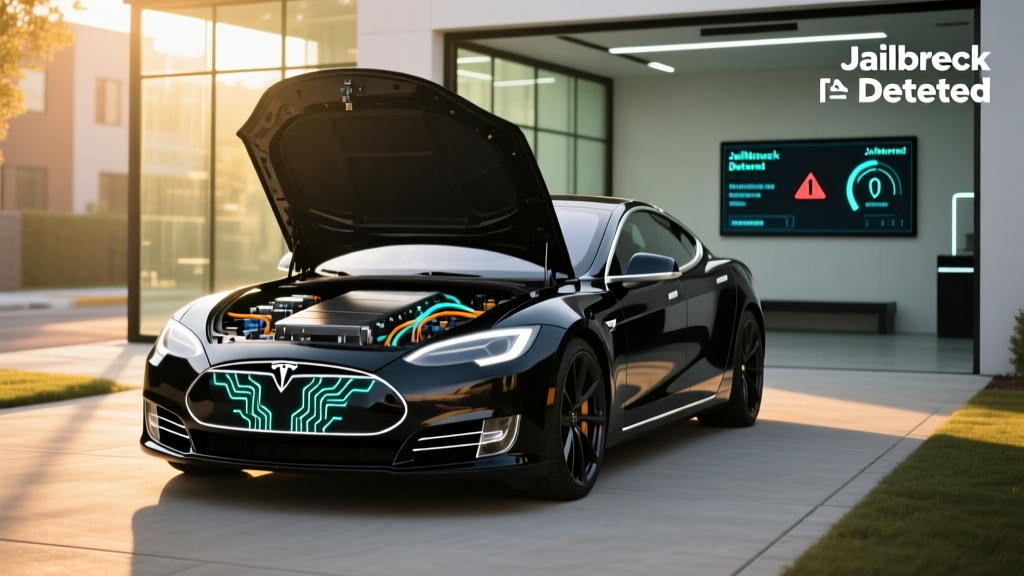
If you've spent any time in Tesla forums, you've seen the question: can you jailbreak a Tesla? The short answer is no—at least not in the way you'd jailbreak a phone. Tesla's software ecosystem is fundamentally different from iOS or Android, and attempting to modify it carries serious financial and safety consequences. But the longer answer involves a gray market of third-party hardware dongles, software "tunes," and range-unlock bypasses that owners should understand before touching their car's firmware.
This guide covers what "jailbreaking" actually means in the Tesla context, the real-world risks to your battery warranty and federal tax credit eligibility, and what legitimate customization options exist for 2026 Model 3 and Model Y owners.
What Jailbreaking a Tesla Actually Means
Unlike smartphones, Teslas don't run a user-accessible operating system you can root. The vehicle's firmware controls everything from battery management to Autopilot sensor fusion, and it's cryptographically signed by Tesla. There is no "jailbreak" tool that gives you root access to the car's core systems.
What does exist falls into three categories:
- Hardware OBD-II dongles that intercept CAN bus signals to alter power limits, regen behavior, or speed limiter settings
- Range/feature unlock bypasses that attempt to enable software-locked battery capacity or Full Self-Driving without paying Tesla
- Aftermarket infotainment mods like third-party app injection or custom themes (mostly cosmetic)
- Model 3 RWD: ~60 kWh LFP battery (lithium iron phosphate) — no software lock, full capacity available
- Model 3/Y Long Range: ~75 kWh NMC battery — no software lock
- Model 3/Y Performance: Same ~75 kWh NMC with different inverter mapping and motor tuning
- Acceleration Boost is a $2,000 official upgrade — 0–60 drops to ~3.7 sec
- Aftermarket wheels can improve handling (at range cost)
- Wraps and PPF protect resale value
- Third-party apps via browser (no system modification)
- Void battery warranty ($12K–$16K replacement exposure)
- Potential tax credit clawback under §30D
- OTA updates can brick modified systems at any time
- Safety system degradation (AEB, stability control)
- Tesla can remotely detect and flag modified vehicles
- Insurance may deny claims on modified vehicles
- MSRP cap: Sedans must be under $55,000 (Model 3 qualifies)
- Buyer income cap: $150K single / $300K joint MAGI
- Battery sourcing: Critical minerals and battery component percentages must meet annual thresholds (increasing each year through 2032)
- Point-of-sale transfer: Credit can be applied at purchase to reduce out-of-pocket cost
None of these constitute a true jailbreak. They're workarounds that exploit communication gaps between vehicle modules—and Tesla has been systematically closing those gaps since 2023.
The Real Risks: Warranty, Safety, and Your Tax Credit
Before considering any modification, understand the cascading consequences:
Battery and Powertrain Warranty Voidance
Tesla's battery warranty covers 8 years or 100,000–120,000 miles (depending on model and battery chemistry) with a minimum 70% capacity retention threshold. If Tesla's diagnostic logs show evidence of third-party CAN bus interference—overcurrent events, unauthorized firmware handshakes, or modified thermal management parameters—your warranty claim can be denied. Given that a replacement battery pack costs between $12,000 and $16,000+ depending on chemistry and capacity, this is not a trivial risk.
Federal Tax Credit Clawback
Under IRS §30D rules, the clean vehicle credit applies to the vehicle as certified. If a modification fundamentally alters the vehicle's certified configuration—particularly anything affecting battery management or emissions-equivalent efficiency—there is theoretical exposure to credit recapture. While enforcement on individual owners remains rare, the legal framework exists.
Safety System Compromise
Tesla's NHTSA-rated safety performance depends on integrated software controlling stability control, automatic emergency braking, and structural battery pack management. Modifying power delivery or thermal thresholds can degrade crash-avoidance performance in ways that aren't obvious until an emergency situation.
What Tesla Actually Lets You Customize (Legitimately)
Rather than risk your warranty, here's what 2026 Tesla owners can modify without consequences:
| Customization | Method | Risk Level |
|---|---|---|
| Acceleration Boost (Model 3/Y Long Range) | Official Tesla in-app purchase (~$2,000) | None — warranty intact |
| Steering feel, regen mode, creep/hold | Vehicle settings menu | None |
| Third-party wheels and tires | Aftermarket (must maintain load rating) | Low — may affect range/efficiency readout |
| Wrap, PPF, tint | Body shop | None |
| Dashcam/sentry USB storage upgrade | Swap USB drive | None |
| HomeLink, phone-as-key configuration | Tesla app | None |
2026 Tesla Model 3 Long Range: The Baseline You're Modifying
If you're considering modifications, you should understand exactly what you're starting with. Here are the 2026 Model 3 Long Range AWD specs:
| Spec | Value |
|---|---|
| EPA Range | 341 miles |
| Battery (usable) | ~75 kWh, NMC (Long Range) / ~60 kWh LFP (RWD Standard) |
| Peak DC Fast Charge | 250 kW (Supercharger V3/V4) |
| 10–80% DC Charge Time | ~25–28 minutes |
| Level 2 Home Charge Rate | 11.5 kW (~44 mi/hr at 48A) |
| 0–60 mph | 4.2 seconds (Long Range AWD) |
| Horsepower | ~346 hp (dual motor) |
| Efficiency | 132 MPGe / 25 kWh/100mi |
| Cargo Volume | 23 cu ft (rear trunk) + 3.1 cu ft (frunk) |
| Rear Legroom | 35.2 inches |
| Base MSRP | $47,740 (Long Range AWD) |
| Battery Warranty | 8 years / 120,000 miles (70% retention) |
The "Range Unlock" Myth: Software-Locked Batteries Explained
One of the most discussed Tesla jailbreak topics involves software-locked battery capacity. In previous model years (primarily 2016–2019), Tesla sold some vehicles with physically larger battery packs that were software-limited to a lower range tier. Owners wondered if they could unlock the full capacity.
For 2026 models, this is largely a non-issue. Tesla has streamlined its battery lineup:
The Performance variants achieve their faster 0–60 times (3.1 seconds for Model 3 Performance) through motor/inverter calibration, not a larger battery. You cannot "unlock" extra range or power because there is no hidden capacity. Third-party dongles that claim to extract more power do so by overriding factory current limits—which accelerates battery degradation and risks thermal events.
Charging Speed: What Modifications Can't Improve
| Charging Method | Power (kW) | Miles Added per Hour | Notes |
|---|---|---|---|
| Level 1 (120V household) | ~1.4 kW | ~5 mi/hr | Emergency/trickle only |
| Level 2 (240V, 48A) | 11.5 kW | ~44 mi/hr | Home Wall Connector or equivalent |
| DC Fast (Supercharger V3) | Up to 250 kW peak | ~1,000+ mi/hr at peak | Tapers significantly above 60% SoC |
| DC Fast (Supercharger V4) | Up to 250–350 kW (cabinet-dependent) | Varies | Model 3 Highland architecture supports higher sustained rates |
No software modification can increase your DC fast-charge rate beyond the vehicle's hardware architecture. The charge curve is dictated by battery chemistry, cell temperature, and the onboard charge controller. Attempting to force higher charge rates via CAN bus manipulation risks lithium plating on the anode—a permanent degradation mechanism that accelerates capacity loss and can create internal short-circuit conditions.
For LFP batteries (Standard Range), Tesla recommends periodic charging to 100% for cell balancing. For NMC (Long Range/Performance), daily charging to 80–90% maximizes longevity. These guidelines come from Tesla's electrochemistry team and should not be overridden.
Is It Worth It? The Honest Assessment
Pros of Legitimate Mods
Cons of Unauthorized Jailbreaks
Tax Credit Eligibility: What You Risk Losing
The 2026 Model 3 Long Range AWD at $47,740 falls under the IRS §30D clean vehicle credit with these requirements:
The credit amount varies based on battery sourcing compliance. As of 2026, vehicles meeting full critical-mineral and component requirements qualify for up to $7,500. Partial compliance yields $3,750. Check the current status on fueleconomy.gov before purchasing, as sourcing requirements tighten annually.
Frequently Asked Questions
Can Tesla detect if I've used a third-party tuning dongle?
Yes. Tesla's telematics system logs CAN bus activity, and anomalous power requests or unauthorized module communication are flagged. Even if you remove the dongle before a service visit, historical logs persist on Tesla's servers. This can result in warranty denial for battery or drive unit claims.
Does jailbreaking void my entire warranty or just the powertrain?
Tesla's warranty language allows denial of coverage for any system affected by the modification. In practice, if a third-party dongle modifies powertrain parameters, Tesla can deny battery and drive unit claims. Infotainment and body-related claims may still be honored, but Tesla has broad discretion.
Can I install custom software on the Tesla touchscreen?
No. The infotainment system runs a locked-down Linux-based OS. While the built-in browser provides limited web app access, there is no sideloading capability. Tesla periodically updates the firmware over-the-air, and any unauthorized modifications would be overwritten—or worse, cause the update to fail, potentially bricking the MCU.
What about third-party FSD alternatives like Comma.ai OpenPilot?
OpenPilot and similar SAE Level 2 driver-assist systems are designed for vehicles with standard ADAS interfaces. Tesla's proprietary Autopilot/FSD hardware and sensor suite are not compatible with these systems. Attempting to intercept Tesla's camera and neural network pipeline would require invasive hardware modification with severe safety implications.
Is there any legal way to get more range from my Tesla?
The most effective range improvements are behavioral: maintain tire pressure at the door-jamb spec (typically 42 psi), use seat heaters instead of cabin heat when possible, pre-condition while plugged in, and maintain highway speeds below 70 mph. Aerodynamic drag increases with the square of velocity—dropping from 75 to 65 mph can recover 20–30 miles on a long trip. No software hack beats physics.
Who is the 2026 Model 3 best for?
The Model 3 Long Range suits daily commuters with home Level 2 charging access, tech-forward buyers who value OTA updates and the Supercharger network, and drivers who prioritize efficiency (132 MPGe) over cargo space. Families needing more rear-seat room and cargo volume should cross-shop the Model Y (76 cu ft max cargo) or competitors like the Hyundai Ioniq 5 or Kia EV6. Road-trippers benefit from Tesla's unmatched DC fast-charging infrastructure, though the 250 kW peak rate means 10–80% stops take 25–28 minutes—plan accordingly.