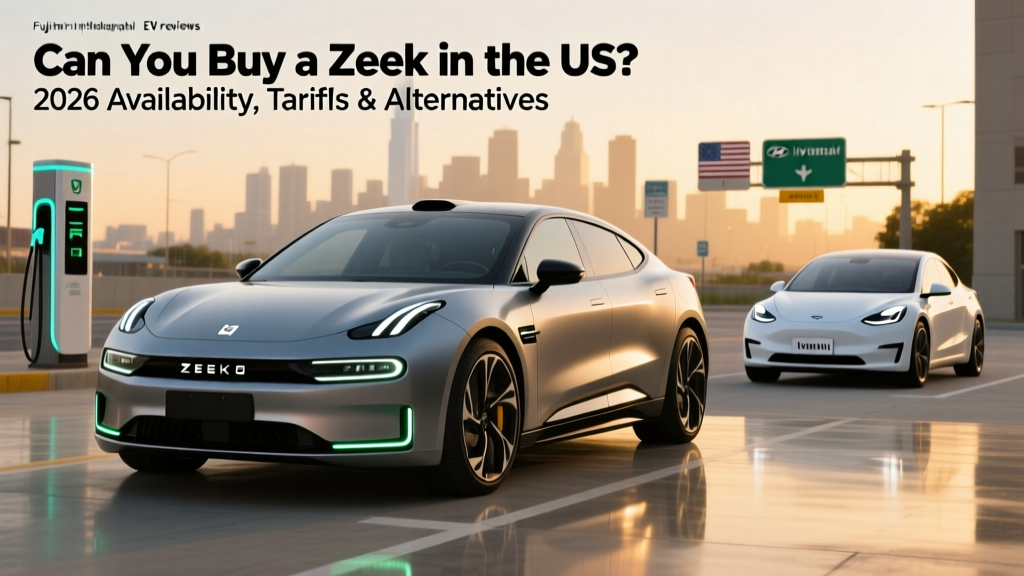
If you've scrolled through EV forums or watched automotive YouTube over the past year, you've likely seen the Zeekr 001, Zeekr X, or the Zeekr 009 minivan and wondered: can you actually buy one of these in the United States? The short answer, as of 2026, is no — not through any official channel, and not without navigating a wall of tariffs, regulatory barriers, and a complete absence of dealer or service infrastructure.
But the longer answer is more nuanced. Zeekr, the premium EV brand owned by China's Geely Holding Group (which also owns Volvo and Polestar), builds genuinely competitive electric vehicles that rival the Tesla Model Y, Hyundai Ioniq 5, and BMW iX on spec sheets. Understanding why you can't buy one — and what your realistic alternatives are — requires unpacking trade policy, homologation rules, and the current state of Chinese EV brands eyeing Western markets.
Can You Buy a Zeekr in the US? The 2026 Reality
No. As of 2026, Zeekr does not sell vehicles in the United States, has no announced US launch date, and has not begun the homologation process required to certify its vehicles for American roads. There are no Zeekr dealerships, no service centers, no US-spec models, and no pathway to register one through legal grey-market import for vehicles under 25 years old.
Zeekr's current markets include China, Europe (Sweden, Netherlands, Germany, and others), the Middle East, and parts of Southeast Asia. The brand launched in Europe in 2023 with the Zeekr 001 shooting brake and Zeekr X compact crossover, but US expansion has never been part of Geely's stated near-term strategy — and the geopolitical environment has made it increasingly unlikely.
| Model | Battery (kWh) | WLTP Range | EPA Range (Est.) | 0–60 mph | HP | Drivetrain | Base Price (Europe) |
|---|---|---|---|---|---|---|---|
| Zeekr 001 (LR AWD) | 100 kWh NMC | 382 mi | ~320 mi | 3.8s | 536 | AWD Dual-Motor | €59,990 |
| Zeekr X (LR RWD) | 66 kWh NMC | 273 mi | ~230 mi | 5.0s | 272 | RWD | €39,990 |
| Zeekr 009 (Grand) | 140 kWh NMC | 436 mi | ~360 mi | 4.5s | 536 | AWD Dual-Motor | ¥789,000 (China) |
| Zeekr 7X | 100 kWh NMC | 373 mi | ~310 mi | 5.8s (RWD) | 421 (RWD) | RWD / AWD | ¥229,900 (China) |
Note: EPA range figures are estimates based on typical WLTP-to-EPA conversion ratios (~15-20% reduction). Zeekr does not publish EPA ratings because it does not sell in the US.
Why Zeekr Isn't Available in the United States
Three structural barriers keep Zeekr out of the American market, and none of them are likely to resolve in the near term.
1. Tariffs on Chinese-Built EVs: 100% and Counting
In May 2024, the Biden administration raised the Section 301 tariff on Chinese-built battery electric vehicles to 100%, effective August 2024. The Trump administration maintained and reinforced this policy through 2025–2026. This means a Zeekr 001 with a factory invoice of roughly $45,000 would carry a $45,000 import duty before it touched American soil — effectively doubling its price and destroying any competitive positioning against US-built or tariff-exempt rivals.
Even if Zeekr were to assemble vehicles in Europe (which Geely does through its Volvo plants in Belgium and Slovakia for some models), US trade authorities apply rules of origin that scrutinize battery cell and module sourcing. Since Zeekr uses CATL-sourced NMC and LFP cells manufactured in China, substantial tariff exposure remains under current IRS §30D battery component and critical mineral sourcing rules.
2. No US Homologation or Safety Certification
Every vehicle sold in the US must be certified by the manufacturer as compliant with Federal Motor Vehicle Safety Standards (FMVSS) overseen by the National Highway Traffic Safety Administration (NHTSA). This is not a simple paperwork exercise — it requires crash testing to US-specific protocols, lighting standards that differ from European ECE regulations, bumper impact requirements, and software compliance for things like rearview camera display specifications.
Zeekr has not submitted any vehicle for FMVSS certification. The grey-market import route (importing a non-conforming vehicle and modifying it through a Registered Importer) costs $20,000–$50,000+ per vehicle and is only practical for vehicles that will eventually qualify under the 25-year rule. No rational buyer would pursue this for a mass-market EV.
3. Zero Dealer, Parts, and Service Infrastructure
Even if tariffs vanished tomorrow, Zeekr would need years to build a US dealer network, establish parts distribution, train technicians on high-voltage systems, and negotiate service agreements. Tesla spent over a decade building this network. Rivian and Lucid are still expanding theirs. Zeekr has made no public investment toward US infrastructure.
What the Zeekr Lineup Offers (On Paper)
Understanding the appeal requires looking at what Zeekr actually builds. These are not budget EVs — they're premium vehicles with specifications that compete directly with established luxury brands.
Because Zeekr publishes WLTP range (the more generous European standard), US buyers should mentally subtract 15–20% for EPA-equivalent figures. Then factor in real-world conditions: highway driving at 75+ mph typically reduces range another 10–15% below EPA estimates, and cold-weather operation (below 32°F) can cut range by 20–35% depending on whether the vehicle uses a heat pump. The Zeekr 001's 100 kWh pack with NMC chemistry and heat pump thermal management should deliver roughly 260–280 real-world highway miles in mild weather, dropping to ~200–220 miles in freezing temperatures.
Charging Speeds
Zeekr's 800-volt architecture (on the 001 and 7X, based on Geely's SEA platform) enables impressive DC fast-charging rates:
| Model | Max DC Rate | 10–80% Time | Level 2 (AC) | Connector |
|---|---|---|---|---|
| Zeekr 001 (2025+) | 260 kW peak | ~18 min | 22 kW (3-phase) / ~11 kW (1-phase) | CCS2 (EU) / GB/T (China) |
| Zeekr X | 150 kW peak | ~30 min | 22 kW / ~11 kW | CCS2 / GB/T |
| Zeekr 7X | 260 kW peak | ~15 min (LFP option) | 11 kW | CCS2 / GB/T |
The charge curve matters as much as peak rate. Zeekr's 800V system sustains high power through the mid-state-of-charge window but tapers significantly above 80% SoC — standard behavior for NMC chemistry to protect cell longevity. Expect the 80–100% top-off to add another 20–25 minutes.
A critical note for any hypothetical US buyer: Zeekr vehicles sold in Europe and China use CCS2 or GB/T connectors — neither of which is the North American standard. US-market EVs use either NACS (Tesla's connector, now adopted by Ford, GM, Rivian, Hyundai, and others) or CCS1. You cannot plug a CCS2 Zeekr into a NACS Tesla Supercharger or a CCS1 Electrify America station without an adapter, and no certified CCS2-to-NACS adapter exists for high-power DC charging as of 2026.
Performance and Technology
The Zeekr 001 in its dual-motor AWD configuration produces 536 horsepower and 506 lb-ft of torque, hitting 0–60 mph in 3.8 seconds — competitive with a Tesla Model Y Performance (3.5s) and significantly quicker than a base BMW iX xDrive50 (4.4s). The Zeekr X offers a more modest 272 hp in RWD form, adequate for its compact crossover segment.
Interior technology is where Zeekr has drawn attention. The 001 features a 15.4-inch center display running a Qualcomm Snapdragon 8295 chip, a 14.7-inch head-up display, a 13-speaker Yamaha audio system, and Zeekr's ADAS suite (branded Zeekr AD) with highway pilot and automated parking features. These are SAE Level 2 driver-assistance systems — the driver must remain attentive and keep hands on or near the wheel. This is not autonomous driving.
Cargo space in the Zeekr 001 shooting brake is generous: approximately 28.4 cu ft behind the rear seats and 57.5 cu ft with seats folded, plus a small 2.1 cu ft frunk. The Zeekr X, as a compact crossover, offers roughly 15.8 cu ft of cargo space — tight for the segment compared to the Hyundai Ioniq 5's 27.2 cu ft.
US Alternatives: What You Can Actually Buy
If the Zeekr lineup appeals to you, here's what matches its positioning in the US market — with full warranty coverage, service infrastructure, and potential tax credit eligibility.
| If You Want a... | Look At | EPA Range | Starting MSRP | Federal Credit? |
|---|---|---|---|---|
| Zeekr 001 (shooting brake, long range) | Tesla Model S / Porsche Taycan Sport Turismo | 402 mi (Model S) / 283 mi (Taycan) | $74,990 / $99,400 | Model S: No (price cap) / Taycan: No (not assembled in NA) |
| Zeekr X (compact premium crossover) | Volvo EX30 / Smart #1 (not US) → closest: Volvo EX40 | 261 mi (EX40) | $53,550 | No (Belgium-assembled) |
| Zeekr 7X (midsize family SUV) | Hyundai Ioniq 5 / Tesla Model Y | 318 mi (Ioniq 5) / 320 mi (Model Y) | $42,600 / $44,990 | Ioniq 5: Yes ($7,500) / Model Y: Yes ($7,500) |
| Zeekr 009 (luxury electric minivan) | Chrysler Pacifica PHEV / Kia EV9 (3-row) | 32 mi EV + 30 mpg (Pacifica) / 282 mi (EV9) | $47,695 / $54,900 | Pacifica PHEV: partial / EV9: Yes ($7,500) |
The Hyundai Ioniq 5 is the closest spiritual equivalent to the Zeekr 7X — a midsize crossover with 800V fast-charging architecture (10–80% in ~18 minutes at 250 kW), strong real-world range, and full US support. It also qualifies for the full $7,500 federal tax credit when purchased through eligible point-of-sale transfer, subject to IRS income and sourcing requirements.
The Tesla Model Y remains the default comparison for any premium crossover EV buyer. With 320 miles of EPA range, access to the Supercharger network (the most reliable DC fast-charging infrastructure in the US), and a starting price around $44,990, it covers most of what makes the Zeekr 001 and 7X appealing — minus the shooting-brake style.
Could Zeekr Come to the US? The Outlook
Geely has floated the idea of entering the US market under a different brand — potentially using Volvo's South Carolina manufacturing plant to build vehicles that would sidestep Chinese-origin tariffs. However, as of early 2026, no such plan has been formally announced, and the political environment for Chinese-affiliated auto brands remains hostile.
The 100% Section 301 tariff applies to vehicles with Chinese-origin battery cells and modules regardless of final assembly location, unless specific trade agreement exemptions apply. Even building in the US from a Geely-owned factory would not resolve battery sourcing concerns under current trade rules. Polestar, which is also Geely-affiliated, has faced similar scrutiny and shifted some production to South Korea to manage tariff exposure.
Bottom line: don't plan your next EV purchase around a Zeekr US launch. If it happens, it's likely 2029 at the earliest, and the vehicles would carry significantly different pricing than their Chinese-market counterparts.
Key Takeaways for US Buyers
- 800V architecture with 260 kW DC fast-charging (001, 7X)
- Premium interior materials and tech at competitive pricing
- Strong range from large NMC packs (100 kWh on 001)
- Shooting-brake and minivan body styles underserved in US EV market
- 536 hp performance variants at non-luxury pricing
- Not available — no dealers, no service, no US-spec vehicles
- 100% tariff makes pricing non-competitive even if imported
- No NACS or CCS1 connector compatibility without adapters that don't exist for DCFC
- Zero federal tax credit eligibility (not on IRS approved list)
- No crash test data from NHTSA or IIHS
- No warranty recourse or parts supply chain in the US
Frequently Asked Questions
Can I import a Zeekr from China or Europe to the US?
Practically, no. Importing a non-FMVSS-certified vehicle requires going through a NHTSA Registered Importer, which costs $20,000–$50,000+ and takes months. You'll also face the 100% Section 301 tariff on Chinese-built EVs, plus the 2.5% standard auto tariff. The total landed cost of a Zeekr 001 would exceed $100,000 with no warranty coverage and no service network. It's not a rational purchase.
Does the Zeekr qualify for the $7,500 federal EV tax credit?
No. To qualify for the IRS §30D clean vehicle credit, a vehicle must appear on the IRS's list of eligible models, be assembled in North America (with limited exceptions for leased vehicles), meet MSRP caps ($55,000 for sedans, $80,000 for SUVs/trucks), and satisfy battery component and critical mineral sourcing requirements. Zeekr is not sold in the US and does not appear on any eligible vehicle list.
What is the real-world range of the Zeekr 001?
Based on its 100 kWh NMC battery and WLTP rating of 382 miles, the estimated EPA-equivalent range is approximately 320 miles. In real-world highway driving at 70–75 mph, expect 260–280 miles in mild temperatures (60–80°F). In freezing weather (below 32°F), range drops to roughly 200–220 miles even with the heat pump engaged. These are estimates — no EPA-certified testing exists for this vehicle.
How does Zeekr compare to Volvo and Polestar?
All three brands share Geely's SEA (Sustainable Experience Architecture) platform and battery supply chains. The Zeekr 001 is mechanically similar to what became the Polestar 4, and the Zeekr X shares its underpinnings with the Volvo EX30 and Smart #1. The key difference is market positioning: Zeekr targets China and price-sensitive European markets, while Volvo and Polestar carry premium Western brand equity and have established US dealer networks.
Is there any Chinese EV brand I can buy in the US?
As of 2026, no Chinese-headquartered brand sells vehicles directly to US consumers. The 100% tariff effectively blocks all Chinese-built EVs. Some brands like BYD are exploring manufacturing partnerships in Mexico and South America, but US-market entry remains blocked by tariff and regulatory barriers. The closest Chinese-adjacent options are Volvo and Polestar, which are Geely-owned but manufacture in Europe, China, and (for some models) the US.
What's the best US alternative to a Zeekr?
For Zeekr 7X buyers: the Hyundai Ioniq 5 (318 mi EPA, 800V charging, $42,600 MSRP, $7,500 credit eligible). For Zeekr 001 buyers wanting a premium shooting-brake feel: the Porsche Taycan Cross Turismo (283 mi, $99,400, no credit) or Tesla Model S (402 mi, $74,990, no credit due to MSRP cap). For Zeekr 009 buyers wanting a 3-row electric family hauler: the Kia EV9 (282 mi, $54,900, credit eligible).