Can Teslas Be Stolen? The Short Answer
Teslas are among the hardest vehicles to steal in the United States, but "hardest" doesn't mean "impossible." Thanks to a combination of GPS tracking, Sentry Mode surveillance, PIN-to-Drive ignition locks, and over-the-air software updates, Tesla theft rates remain dramatically lower than the industry average. According to the Highway Loss Data Institute (HLDI), Tesla models consistently rank among the least-stolen vehicles relative to their production volume. However, relay attacks on key fobs, opportunistic break-ins, and sophisticated hacking attempts still occur — making it essential for current and prospective owners to understand what protections are active, what gaps remain, and how to configure their vehicle for maximum security.
This guide breaks down Tesla's 2026 anti-theft architecture while also providing a full ownership profile of the current 2026 Tesla Model 3 Long Range AWD — the most popular variant and the one most buyers cross-shop. Whether you're worried about theft or simply researching the Model 3 as your next EV, you'll find the hard data you need below.
Tesla's Anti-Theft Technology Stack (2026)
Tesla layers multiple security systems that work in concert. Here's what protects a 2026 Tesla when it's parked and when it's in motion:
Sentry Mode
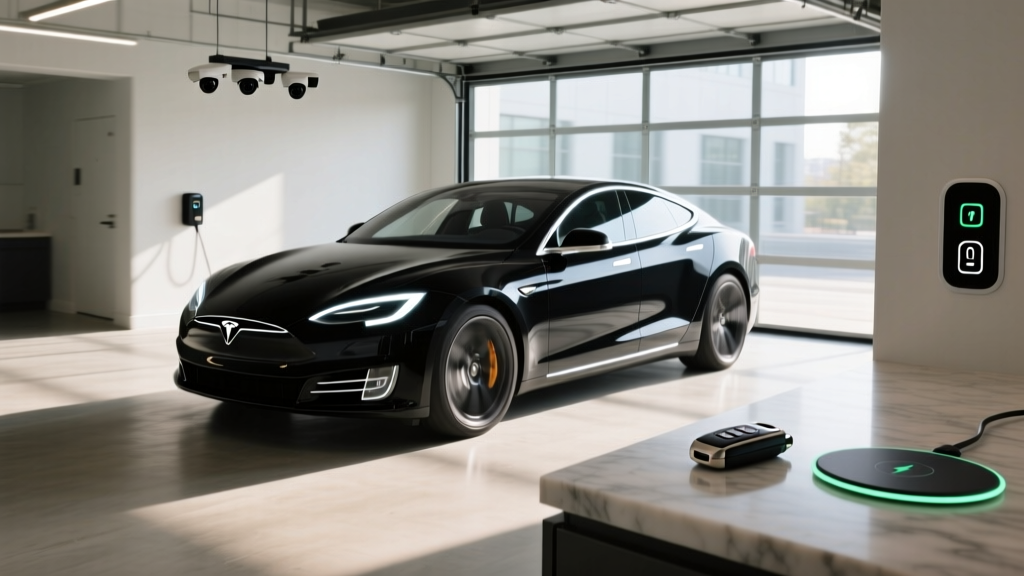
Sentry Mode uses the vehicle's external cameras to monitor the surroundings when the car is parked and locked. If a threat is detected — someone leaning on the car, attempting to break a window, or lingering suspiciously — the system records video clips to a USB drive (or internal storage in newer builds), flashes the headlights, sounds an alarm, and sends a push notification to the owner's Tesla app. In 2026, Sentry Mode also supports live camera streaming through the app, allowing owners to view their vehicle remotely in real time.
PIN to Drive
When enabled, PIN to Drive requires a 4-digit code to be entered on the touchscreen before the vehicle can be shifted into Drive. Even if a thief gains physical entry and somehow bypasses the phone-key authentication, the car won't move without the PIN. This is one of the most effective anti-theft features Tesla offers, and it's available on every model at no extra cost.
GPS Tracking and Remote Disable
Every Tesla has a built-in cellular connection and GPS module. Through the Tesla app, owners can view the car's real-time location at any time. If a Tesla is stolen, owners can share the GPS coordinates with law enforcement. Tesla can also work with police to remotely disable the vehicle, preventing it from being driven once it's stopped. This tracking capability is a major deterrent — a stolen Tesla is far easier to recover than a conventional vehicle.
Phone Key Authentication and Walk-Away Lock
Tesla's Bluetooth-based phone key automatically locks the car when the owner walks away and unlocks it on approach. The encrypted Bluetooth handshake is significantly harder to spoof than traditional RFID key fobs, though relay attacks on legacy Tesla key fobs (sold as accessories) have been documented. Tesla addressed many of these vulnerabilities with firmware updates requiring motion confirmation from the fob.
Speed Limit Mode and Valet Mode
Speed Limit Mode caps the vehicle's top speed (as low as 50 mph) and restricts acceleration, useful if you're lending the car to someone. Valet Mode locks the glovebox, restricts access to personal data and HomeLink, and limits speed and acceleration — preventing misuse by parking attendants or unauthorized drivers.
2026 Tesla Model 3 Long Range AWD: Full Specs
Below is the complete spec profile for the 2026 Model 3 Long Range All-Wheel Drive — the volume seller in Tesla's sedan lineup and the variant most buyers evaluate.
| Specification | Value |
|---|---|
| EPA Estimated Range | 341 miles |
| Battery Capacity (usable) | 79 kWh (NMC chemistry) |
| Drivetrain | Dual-Motor AWD |
| Horsepower | 346 hp combined |
| 0–60 mph | 4.2 seconds |
| Top Speed | 125 mph |
| Max DC Fast-Charge Rate | 250 kW (peak) |
| 10–80% DC Fast Charge | ~25 minutes |
| Level 2 Home Charge Rate | 11.5 kW (~44 miles/hr) |
| EPA Efficiency | 131 MPGe combined (26 kWh/100 mi) |
| Cargo Volume (trunk + frunk) | 23.0 cu ft (rear trunk) + 3.1 cu ft (frunk) |
| Rear Legroom | 35.2 inches |
| Curb Weight | 4,034 lbs |
| Battery/Drive Unit Warranty | 8 years / 120,000 miles |
| Basic Vehicle Warranty | 4 years / 50,000 miles |
| Base MSRP | $47,740 (before destination) |
Real-World Range: What the EPA Number Doesn't Tell You
EPA Estimated: 341 miles
Real-World Highway (70–75 mph, mild weather): ~280–300 miles
Real-World City/Suburban (mixed driving): ~310–330 miles
Cold Weather (below 30°F, highway): ~230–260 miles
Teslas use a heat pump (standard on 2026 models) that significantly reduces cold-weather cabin-heating energy draw compared to resistive heaters. Expect roughly 15–20% range loss in freezing temperatures rather than the 30%+ seen on older EVs without heat pumps. Preconditioning the battery while plugged in — triggered automatically when you set a Supercharger destination in navigation — recovers some of this loss and enables faster DC charging.
The Model 3 Long Range's 79 kWh NMC (nickel manganese cobalt) battery pack delivers strong energy density and is well-suited to drivers who want maximum range. However, NMC chemistry benefits from daily charging limits of 80–90% for longevity. Tesla's battery management system handles this automatically if you set your charge limit in the app, but it's worth knowing that your usable daily range is effectively ~270–300 miles when following best practices for battery health.
Charging Speed: DC Fast, Level 2, and Level 1
Charging speed is often the deciding factor for EV buyers. Here's what the 2026 Model 3 Long Range can handle across all three charging levels:
| Charging Level | Power (kW) | Speed (miles added/hr) | Typical Use Case |
|---|---|---|---|
| Level 1 (120V household outlet) | ~1.4 kW | ~5 mi/hr | Emergency/overnight trickle |
| Level 2 (240V home wall connector) | 11.5 kW | ~44 mi/hr | Daily home charging |
| Level 2 (public AC charger) | 7.2–11.5 kW | ~28–44 mi/hr | Workplace, hotels, malls |
| DC Fast Charge (Tesla Supercharger V3/V4) | Up to 250 kW (peak) | ~1,000+ mi/hr (peak) | Road trips; 10–80% in ~25 min |
| DC Fast Charge (CCS adapter, non-Tesla networks) | Up to 250 kW (peak) | Varies by station | Electrify America, EVgo, etc. |
Charging curve reality: The 250 kW peak rate applies only between roughly 10–30% state of charge (SoC). Above 50%, the rate tapers significantly — by 80%, you're typically seeing 60–80 kW. This is normal for all lithium-ion packs due to thermal and electrochemical limits. Plan road-trip stops around the 10–80% window for maximum efficiency; charging from 80–100% can take as long as the 10–80% session.
Tesla's NACS (North American Charging Standard) connector is now the dominant plug in North America. The 2026 Model 3 ships with a NACS port natively, granting access to the full Tesla Supercharger network (20,000+ stalls in the US). A CCS adapter (sold separately, ~$175) enables charging at non-Tesla DC fast stations, though Tesla's own network remains the most reliable option based on uptime data.
Pricing, Tax Credits, and Total Cost
| Trim | Base MSRP | Destination | Total Before Credit | §30D Credit Potential |
|---|---|---|---|---|
| Model 3 RWD | $38,990 | $1,390 | $40,380 | Up to $7,500* |
| Model 3 Long Range AWD | $47,740 | $1,390 | $49,130 | Up to $7,500* |
| Model 3 Performance | $54,990 | $1,390 | $56,380 | Up to $7,500* |
*Federal tax credit (§30D) eligibility is NOT automatic. For 2026, the IRS requires all of the following:
- MSRP cap: Sedans must be priced at or below $55,000. The Model 3 RWD and Long Range qualify; the Performance trim may not depending on options.
- Buyer income cap: Modified adjusted gross income (MAGI) must not exceed $150,000 (single), $225,000 (head of household), or $300,000 (joint filing).
- Battery sourcing: A percentage of critical minerals and battery components must be sourced from the US or free-trade-agreement countries. These thresholds increase annually. Check the latest IRS clean vehicle credit page for current-year sourcing requirements before purchasing.
- Point-of-sale transfer: As of 2024, buyers can transfer the credit to the dealer at purchase, reducing the out-of-pocket price immediately rather than waiting for a tax refund.
Always verify eligibility with a tax professional and cross-reference fueleconomy.gov before committing to a purchase. Credit rules change, and battery sourcing compliance varies by production batch.
Who Should Buy the 2026 Model 3 — And Who Shouldn't
- Class-leading efficiency at 131 MPGe
- Supercharger network access — most reliable DC fast-charging in the US
- Industry-best anti-theft tech stack (Sentry Mode, PIN to Drive, GPS tracking)
- Minimal maintenance costs — no oil changes, fewer brake replacements due to regen
- Over-the-air updates continuously add features
- Strong resale value relative to EV competitors
- Rear seat is tighter than rivals (35.2" legroom vs. 38"+ in Hyundai Ioniq 6)
- No physical buttons — all controls through the touchscreen
- No Apple CarPlay or Android Auto (Tesla's proprietary infotainment only)
- Panel gaps and paint quality still inconsistent on some builds
- FSD (Supervised) remains SAE Level 2 — not autonomous, requires full driver attention
- Insurance premiums 15–30% higher than comparable gas sedans in many states
Best for: Daily commuters covering 30–80 miles round-trip, tech-forward buyers who want minimal maintenance, road-trippers who value Supercharger access, and urban dwellers who benefit from Sentry Mode and compact dimensions. The Long Range AWD is the sweet spot for four-season climates.
Look elsewhere if: You regularly carry rear-seat adults (the Model Y or Hyundai Ioniq 5 offer more space), you need Apple CarPlay, or you want a traditional dealership service experience. For budget-focused buyers, the base RWD trim at ~$40,380 (before credit) is compelling but sacrifices range and dual-motor traction.
Tesla Theft Prevention: Practical Tips for Owners
Beyond Tesla's built-in systems, here are actionable steps every owner should take:
- Enable PIN to Drive immediately. This is the single most effective anti-theft setting and takes 30 seconds to configure in Controls → Safety.
- Keep Sentry Mode active when parked in public. The energy draw is roughly 1 mile of range per hour — a small cost for significant surveillance.
- Use the Tesla app's location tracking and enable speed alerts if someone else drives your vehicle.
- Avoid leaving key fobs near entryways at home. Relay attacks amplify fob signals through walls. Store fobs in a signal-blocking pouch if you use one as a backup key.
- Disable Passive Entry on your phone key if you live in a dense urban area with high foot traffic near your parked car — this prevents the car from unlocking if your phone is nearby but you're not approaching intentionally.
- Report thefts immediately via the app and police. Tesla's GPS tracking has enabled recovery of stolen vehicles in under an hour in multiple documented cases.
Frequently Asked Questions
Can a Tesla be stolen without the key fob or phone?
It's extremely difficult. Without the authenticated phone key or fob, the car won't unlock via normal means, and even if a thief breaks in, PIN to Drive prevents the vehicle from being shifted into Drive. Documented Tesla thefts typically involve stolen credentials, relay attacks on physical fobs, or insider access (valet, tow-truck scams) rather than traditional hotwiring.
What is the real-world range of the 2026 Model 3 Long Range?
The EPA rates it at 341 miles, but expect 280–300 miles on highway trips at 70–75 mph, 310–330 miles in mixed city driving, and 230–260 miles in sub-freezing winter conditions. The heat pump helps, but cold still reduces battery efficiency and increases cabin-heating demand.
How fast does the Model 3 charge at home?
On a Tesla Wall Connector with a 60-amp circuit (48-amp continuous), the Model 3 Long Range charges at 11.5 kW, adding roughly 44 miles of range per hour. A full charge from 10% to 90% takes about 6–7 hours, making overnight charging more than sufficient for daily use.
Does the 2026 Model 3 qualify for the $7,500 federal tax credit?
It can, but eligibility depends on the buyer's income (MAGI caps apply), the vehicle's MSRP (sedans must be ≤$55,000), and battery-component/critical-mineral sourcing compliance for the current tax year. The RWD and Long Range trims fall under the MSRP cap. Always verify on IRS.gov and consult a tax professional before relying on the credit.
Is the Model 3 worth buying over the Hyundai Ioniq 6 or BMW i4?
The Model 3 wins on charging infrastructure (Supercharger access), efficiency (131 MPGe), anti-theft technology, and total cost of ownership. The Ioniq 6 offers more rear-seat space and 800V ultra-fast charging; the BMW i4 offers a more traditional luxury interior and Apple CarPlay. If Supercharger reliability and software integration are your top priorities, the Model 3 remains the benchmark.
How common are Tesla break-ins vs. full thefts?
Break-ins (smash-and-grab) are significantly more common than full vehicle thefts. Sentry Mode's visible camera recording indicator and alarm response have reduced break-in success rates, but Teslas parked in high-crime urban areas are still targeted for valuables visible inside the cabin. Never leave bags, electronics, or wallets in sight.