The Short Answer: Yes, Tesla Can Go Thru a Car Wash
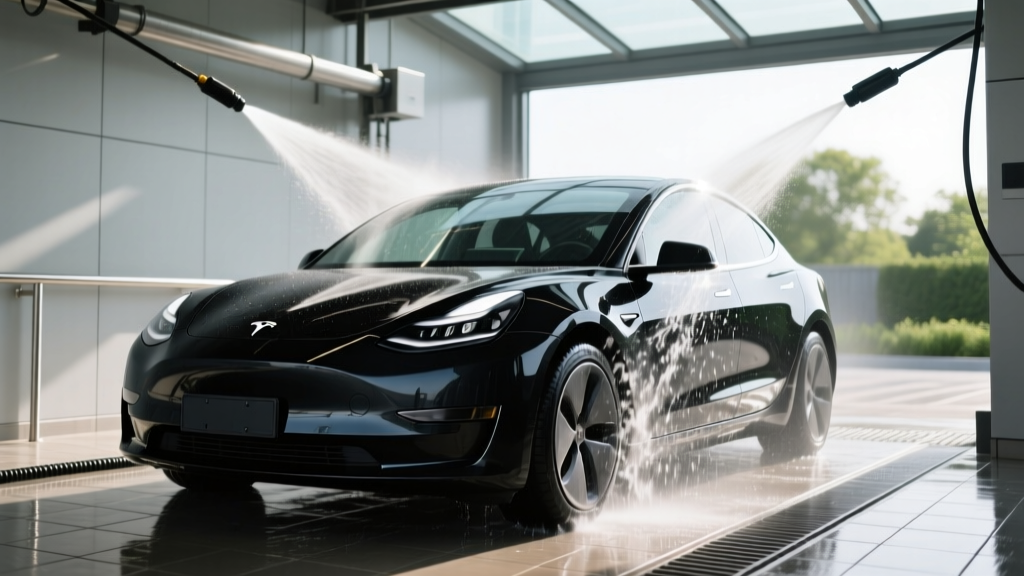
Every Tesla model currently in production — including the 2026 Model 3, Model Y, Model S, and Model X — is fully sealed against water intrusion and rated to handle automated car washes. Tesla explicitly includes a Car Wash Mode in the vehicle software (introduced in 2021 and refined through OTA updates) that prepares the car for automated washes by closing windows, locking the charge port, disabling automatic wipers, and folding mirrors (on equipped trims).
But not all car washes are equal when it comes to protecting your Tesla's paint, sensors, and cameras. This guide breaks down which wash types are safe, how to activate Car Wash Mode, and — because you're researching a Tesla purchase anyway — the full 2026 Model 3 spec profile: EPA range, charging speed, real-world efficiency, tax credit eligibility, and how it stacks up against the Hyundai Ioniq 6 and BMW i4.
2026 Tesla Model 3: Full Spec Profile
Before we get into wash-bay logistics, here's the complete data sheet for the current-generation Model 3 (the "Highland" refresh that launched for 2024 and carries into 2026 with minor trim adjustments). These are the numbers that matter if you're cross-shopping or budgeting.
| Spec | Model 3 RWD | Model 3 Long Range AWD | Model 3 Performance |
|---|---|---|---|
| EPA Range | 363 mi | 341 mi | 315 mi |
| Battery (usable) | ~57.5 kWh (LFP) | ~75 kWh (NMC) | ~75 kWh (NMC) |
| Max DC Fast Charge | 170 kW | 250 kW | 250 kW |
| 10–80% DC Time | ~28 min | ~25 min | ~25 min |
| Level 2 Home Rate | 11.5 kW (~44 mi/hr) | 11.5 kW (~44 mi/hr) | 11.5 kW (~44 mi/hr) |
| 0–60 mph | 5.8 sec | 4.2 sec | 2.9 sec |
| Horsepower | 271 hp | 346 hp | 510 hp |
| Drivetrain | RWD | Dual-Motor AWD | Dual-Motor AWD |
| MPGe (combined) | 132 MPGe | 117 MPGe | 113 MPGe |
| Efficiency | 25 kWh/100mi | 28 kWh/100mi | 29 kWh/100mi |
| Cargo Volume | 23 cu ft (trunk + frunk) | 23 cu ft | 23 cu ft |
| Rear Legroom | 35.3 in | 35.3 in | 35.3 in |
| Base MSRP | $38,990 | $45,990 | $52,990 |
| Battery Warranty | 8 yr / 100,000 mi | 8 yr / 120,000 mi | 8 yr / 120,000 mi |
Source: fueleconomy.gov and Tesla Model 3 official specs. Prices reflect 2026 MSRP before destination fees and incentives.
Real-World Range vs. EPA Sticker: What Owners Actually See
EPA sticker: 341 miles
Real-world highway (70 mph, 72°F): ~285–305 miles
Real-world highway (32°F, winter): ~240–265 miles
City/regen-heavy driving: ~320–340 miles (can approach EPA)
The Model 3 Long Range's 341-mile EPA estimate is among the best in its class, but the number you'll actually see depends heavily on driving style, temperature, and terrain. At sustained highway speeds above 70 mph, aerodynamic drag pushes consumption to roughly 30–32 kWh/100mi, cutting range to around 285–305 miles on a full charge.
Cold weather compounds this. The NMC battery in the Long Range and Performance trims loses roughly 15–25% of usable capacity in freezing temperatures — partly from increased internal resistance and partly from cabin heating demand (the Model 3 uses a heat pump, which is far more efficient than resistive heating but still draws energy). Expect 240–265 miles of real highway range in sub-40°F conditions.
The RWD trim uses LFP (lithium iron phosphate) chemistry, which trades energy density for longevity and thermal stability. LFP cells tolerate repeated 100% charging without accelerated degradation — Tesla actually recommends periodic full charges for LFP packs to recalibrate the BMS. The trade-off: LFP is heavier per kWh and loses slightly more range in extreme cold (~25–30% winter reduction) compared to NMC.
Charging Speed: DC Fast, Home Level 2, and the Charge Curve Reality
| Charging Level | Power (kW) | Miles Added per Hour | Typical Use Case |
|---|---|---|---|
| Level 1 (120V) | ~1.4 kW | ~5 mi/hr | Emergency / overnight trickle |
| Level 2 (240V, 48A) | 11.5 kW | ~44 mi/hr | Daily home charging |
| DC Fast (RWD) | Peak 170 kW | ~650 mi/hr (peak) | Road trips; 10–80% in ~28 min |
| DC Fast (LR/Perf) | Peak 250 kW | ~950 mi/hr (peak) | Road trips; 10–80% in ~25 min |
A critical nuance that spec sheets bury: peak kW is not sustained kW. The Long Range and Performance trims hit 250 kW only at low state-of-charge (roughly 10–25% SoC) and optimal battery temperature. By 50% SoC, the rate tapers to roughly 150–170 kW, and above 80% it drops below 50 kW. This is normal lithium-ion charge-curve behavior — Tesla's thermal management preconditioning (triggered automatically when you navigate to a Supercharger) helps you hit peak rates faster, but physics still governs the taper.
For home charging, the onboard 11.5 kW AC charger adds roughly 44 miles of range per hour. A full overnight session (8 hours) restores about 350 miles — more than enough for virtually any daily commute. Installation of a 240V/60A circuit typically costs $800–$2,000 depending on panel proximity, with the Tesla Wall Connector running $475 for the hardware.
Car Wash Types: Which Are Safe for Your Tesla?
Tesla's owner manual states the vehicle is designed to withstand high-pressure water jets, and the IP (ingress protection) ratings on the battery pack and electronics far exceed anything a car wash produces. Here's how each wash type interacts with the car:
Touchless (High-Pressure) Car Washes — Recommended
Touchless washes use high-pressure water jets and chemical detergents with no physical contact. These are the safest option for any Tesla. There's zero risk of brush-induced swirl marks on the paint, and the water pressure (typically 1,000–1,500 PSI) is well within the vehicle's sealing tolerances. Enable Car Wash Mode and you're set.
Soft-Touch / Brush Car Washes — Use Caution
Soft-cloth or foam brush washes won't damage the car's electronics or seals, but they will eventually inflict micro-scratches and swirl marks on the clear coat. Tesla's water-based paint is relatively soft compared to some competitors, making it particularly susceptible. If you must use a brush wash, choose one that uses fresh foam mitts rather than recycled cloth strips.
Traditional Bristle Brush Washes — Avoid
Old-school rotating bristle brushes trap grit from previous vehicles and will mar the paint aggressively. These also pose a minor risk to the side-repeater cameras and mirror housings. Skip them entirely.
Undercarriage Wash and Wheel Blasters
Safe. The Model 3's battery pack is sealed in a structural aluminum/steel enclosure rated for submersion far beyond anything an undercarriage spray produces. Wheel jets won't damage the aero covers, though removing them before a high-pressure wheel wash prevents cosmetic scuffing.
Hand Wash — Best for Paint Preservation
A two-bucket hand wash with pH-neutral soap and microfiber mitts remains the gold standard for preserving Tesla's relatively soft paint. Many owners alternate: touchless for convenience biweekly, hand wash monthly with a clay bar and spray sealant.
Pricing, Tax Credits, and Total Cost After Incentives
| Trim | Base MSRP | Federal Credit (§30D) | Effective Price |
|---|---|---|---|
| Model 3 RWD | $38,990 | $3,750* | ~$35,240 |
| Model 3 Long Range | $45,990 | $7,500* | ~$38,490 |
| Model 3 Performance | $52,990 | $7,500* | ~$45,490 |
*Federal tax credit amounts under IRS §30D are subject to buyer income caps ($150K single / $300K joint MAGI), vehicle MSRP caps ($55,000 for sedans), and battery critical-mineral and component sourcing requirements that shift annually. The RWD trim's LFP battery (largely sourced from CATL in China) currently qualifies for a partial credit of $3,750 due to critical-mineral sourcing rules. Long Range and Performance trims with NMC packs assembled in North America meet both sourcing thresholds for the full $7,500 as of 2026. Credits can be transferred to the dealer at point of sale as an instant rebate. Always verify current eligibility at fueleconomy.gov before purchasing — rules change with minimal notice.
- MSRP cap: $55,000 for sedans (all Model 3 trims qualify)
- Buyer income cap: $150,000 single / $225,000 HOH / $300,000 joint (MAGI)
- Battery sourcing: Critical minerals and component thresholds increase yearly; verify current-year percentages
- Assembly: Must be final-assembled in North America (all Model 3s are built in Fremont, CA or Austin, TX)
- Point-of-sale transfer: Available — reduces purchase price at delivery rather than waiting for tax filing
How the Model 3 Stacks Up: Ioniq 6 and BMW i4
| Spec | Tesla Model 3 LR | Hyundai Ioniq 6 SEL | BMW i4 eDrive40 |
|---|---|---|---|
| EPA Range | 341 mi | 361 mi | 301 mi |
| Battery | ~75 kWh NMC | 77.4 kWh NMC | 81.5 kWh NMC |
| Peak DC Charge | 250 kW | 350 kW (800V) | 205 kW |
| 10–80% Time | ~25 min | ~18 min | ~31 min |
| 0–60 mph | 4.2 sec | 5.1 sec | 5.5 sec |
| Base MSRP | $45,990 | $42,750 | $57,900 |
| Federal Credit | $7,500 | $7,500 | $7,500 |
| NACS Native | Yes | Yes (2025+) | Yes (2025+) |
The Ioniq 6 charges noticeably faster thanks to its 800-volt architecture and has slightly better EPA range, but Tesla's Supercharger network remains the most reliable public charging ecosystem in North America. The BMW i4 offers premium build quality and driving dynamics but at a significant price premium. If charging convenience on road trips is your top priority, the Model 3's native Supercharger integration still carries a practical edge even as competitors gain NACS ports.
Tech, Driver Assistance, and Ownership Experience
The Model 3's interior is defined by its 15.4-inch center touchscreen, which handles everything from climate control to navigation to media — there are no physical buttons or stalks (turn signals are on the steering wheel rim, a polarizing design choice from the Highland refresh). The infotainment system remains the fastest and most responsive in the segment, with native Spotify, Netflix (while parked), and a built-in trip planner that factors in Supercharger availability, elevation changes, and battery preconditioning.
Autopilot comes standard and includes adaptive cruise control, lane centering, and automatic emergency braking. Full Self-Driving (Supervised) is a $8,000 add-on (or $99/month subscription) that adds automatic lane changes, traffic light/stop sign recognition, and city street navigation. Important clarity: FSD is an SAE Level 2 system — you must remain fully engaged with hands on the wheel and eyes on the road at all times. It is not autonomous driving.
The Model 3 earned the IIHS Top Safety Pick+ rating and a 5-star overall rating from NHTSA, with top marks in every crash-test subcategory.
- Class-leading efficiency (25 kWh/100mi on RWD)
- Supercharger network: best uptime and coverage
- Over-the-air updates continuously add features
- LFP battery on RWD tolerates 100% daily charging
- Strong resale value relative to EV segment average
- Heat pump standard for winter efficiency
- No physical controls — all through touchscreen
- Rear seat legroom (35.3 in) trails Ioniq 6 (37.4 in)
- Paint quality inconsistent; soft clear coat scratches easily
- Stalkless steering wheel takes adjustment
- No Apple CarPlay or Android Auto
- FSD subscription cost adds up without delivering L4 autonomy
Who Should Buy the 2026 Model 3?
Choose the Model 3 if:
- You road-trip frequently and value Supercharger reliability over peak charge speed
- You want the most energy-efficient sedan in the segment (lowest cost per mile)
- You prefer tech-forward minimalism and OTA feature updates
- You can charge at home and want a car that's always "full" each morning
Look elsewhere if:
- You need maximum rear-seat space (Ioniq 6 is roomier)
- You want physical buttons, Apple CarPlay, or a head-up display
- You need the fastest DC charging for frequent long-distance driving (Ioniq 6's 800V system is faster)
- You prioritize luxury materials and ride refinement (BMW i4, Mercedes EQB)
Best for: Solo commuters, tech-forward couples, and frequent road-trippers who value charging infrastructure over cabin luxury. The RWD trim at ~$35,240 after the partial credit is one of the best value-per-mile-of-range propositions on the market. The Long Range AWD is the sweet spot for cold-climate buyers who need all-wheel-drive traction and can absorb the ~$3,000 winter range penalty.
Frequently Asked Questions
Can a Tesla go thru a car wash without damaging the battery?
Yes. The battery pack is sealed in a structural enclosure rated far beyond any car wash water pressure. Tesla designs its vehicles to handle heavy rain, flooding, and high-pressure jets. Car Wash Mode ensures all openings (charge port, windows) are sealed before you enter.
Will a car wash trigger the Tesla's parking sensors or auto-brake?
Without Car Wash Mode, yes — the ultrasonic sensors can detect wash equipment as obstacles and trigger phantom braking or warning chimes. Car Wash Mode disables these sensor responses. Always activate it before entering an automated wash.
Does the Tesla Model 3 qualify for the full $7,500 federal tax credit?
The Long Range AWD and Performance trims currently qualify for the full $7,500 under IRS §30D, provided the buyer meets income caps ($150K single / $300K joint). The RWD trim with its LFP battery qualifies for $3,750 due to critical-mineral sourcing rules. Always verify current eligibility at fueleconomy.gov before purchasing.
What's the real-world range of the Model 3 in winter?
Expect 240–265 highway miles from the Long Range AWD in freezing temperatures, a roughly 20–25% reduction from the 341-mile EPA estimate. The standard heat pump mitigates some loss, but cold battery chemistry and cabin heating both draw from the pack. Preconditioning while plugged in recovers some range.
How much does it cost to charge a Model 3 at home vs. Superchargers?
At the US average residential electricity rate of ~$0.17/kWh, a full 75 kWh charge costs about $12.75 — roughly 3.7 cents per mile. Supercharger pricing averages $0.25–$0.35/kWh depending on location, putting road-trip fueling at 7–10 cents per mile. Both are significantly cheaper than a comparable gas sedan at current fuel prices.
Is it better to hand-wash or use a touchless car wash on a Tesla?
For paint preservation, hand washing with a two-bucket method is ideal. For convenience, touchless automated washes are perfectly safe and won't cause swirl marks. Avoid traditional bristle brush washes, which will scratch the relatively soft Tesla clear coat over time.
Can I wash my Tesla in the rain or take it through deep water?
Rain is obviously fine. Tesla does not publish a wading depth for the Model 3, but the battery and electronics are sealed against water intrusion. That said, driving through standing water deeper than the lower door sill (~6–8 inches) risks water entering the cabin through door seals and is not covered under warranty.