The Short Answer: Yes, But Slowly
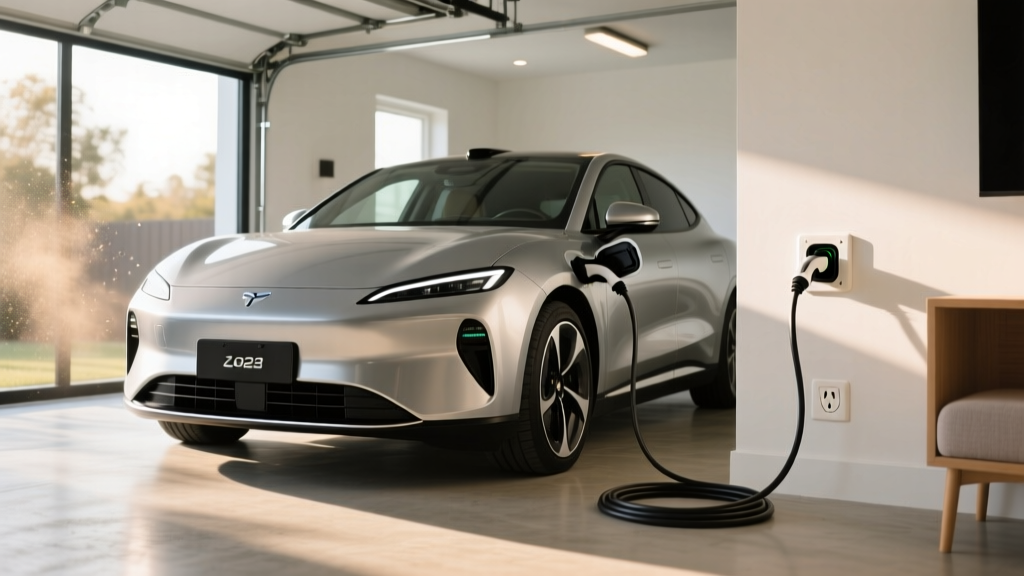
You can plug any electric vehicle into a standard 120-volt household outlet (Level 1 charging) using the portable cord that comes with most new EVs. A typical 120V/15A outlet delivers about 1.2 kW to 1.4 kW of power, adding roughly 3 to 5 miles of range per hour of charging. For a 2026 model like the Hyundai Ioniq 6 (EPA 361 miles, 77.4 kWh battery), a full charge from empty on a regular outlet takes approximately 55 to 65 hours. For daily commutes under 30 miles round-trip, overnight Level 1 charging can be sufficient — but for road trips or higher daily mileage, a 240V Level 2 home charger is the practical standard.
How Level 1 Charging Actually Works on a Regular Outlet
Every EV sold in the U.S. includes (or offers as an accessory) a portable charging cord with a standard NEMA 5-15 plug on one end and a J1772 connector (or NACS on Tesla vehicles) on the other. When you plug into a typical 120V household outlet, the vehicle's onboard charger converts AC power to DC for the battery at a maximum rate dictated by the circuit.
Here's the math that matters:
- 120V × 12A (continuous safe draw on a 15A circuit) = 1.44 kW
- 120V × 16A (on a 20A circuit) = 1.92 kW — if your EV's portable cord supports it
- Real-world delivery: Expect 1.2 to 1.4 kW after accounting for charging losses (heat, battery management overhead)
Most EV manufacturers set the portable cord to draw 12A by default on 120V for safety margin. Some, like the Ford Mobile Power Cord or the Tesla Mobile Connector, allow you to adjust amperage in the vehicle's settings if you confirm the circuit rating.
Critical distinction: kW (kilowatts) measures the rate of power delivery — think of it as the speed of water flowing through a hose. kWh (kilowatt-hours) measures total energy stored in your battery — the size of the tank. A 1.4 kW charge rate filling an 80 kWh battery is like filling a 50-gallon drum with a garden hose.
Real Charging Times: Level 1 vs. Level 2 vs. DC Fast Charging
To put regular-outlet charging in context, here's how the three charging levels compare using a representative 2026 EV — the Chevrolet Equinox EV 2RS (EPA 319 miles, ~85 kWh usable battery):
| Charging Level | Voltage / Amps | Power (kW) | Miles Added Per Hour | 10–80% Time (approx.) |
|---|---|---|---|---|
| Level 1 (regular outlet) | 120V / 12A | ~1.4 kW | ~4 mi/hr | ~45 hours |
| Level 2 (home wallbox) | 240V / 32A | ~7.7 kW | ~25 mi/hr | ~8 hours |
| Level 2 (48A hardwired) | 240V / 48A | ~11.5 kW | ~37 mi/hr | ~5.5 hours |
| DC Fast Charging | 400V+ / up to 150 kW | Peak 150 kW | ~200+ mi/hr (peak) | ~26 min (10–80%) |
The Equinox EV can accept up to 150 kW on DC fast charging, reaching from 10% to 80% in roughly 26 minutes under ideal conditions. But that peak rate only holds briefly — above 80% state of charge, the battery management system tapers the charge rate significantly to protect the NMC lithium-ion cells. This is called the charge curve, and it's why you'll see "10–80%" times quoted rather than 0–100%.
On Level 1, the charge curve taper is negligible — at 1.4 kW, the battery can accept the trickle rate all the way to 100% without thermal concerns. The problem isn't taper; it's simply that 1.4 kW is slow relative to the battery's capacity.
Who Can Actually Live With Level 1 Only?
Level 1 charging on a regular outlet is viable for a specific ownership profile. Here's a practical decision framework:
Level 1 Might Work If:
- Your daily round-trip commute is under 30 miles (you can recover that in 7–8 hours overnight)
- You have access to a dedicated 120V outlet (not shared with other appliances) within cord reach of your parking spot
- Your vehicle is equipped with a heat pump (reduces cabin heating drain in winter, preserving range)
- You don't regularly take trips exceeding your vehicle's range in a single day
- You can use DC fast charging for the occasional road trip
You Need Level 2 If:
- Your daily driving exceeds 40–50 miles
- You live in a cold climate where winter range loss of 20–30% is normal
- You want to take advantage of off-peak utility rates with scheduled charging windows of 6–8 hours
- You own or are considering a larger-battery EV (100+ kWh, like the Ford F-150 Lightning Extended Range) where Level 1 would take 70+ hours
- You use your EV for towing or heavy cargo, which increases energy consumption significantly
Consider a real-world scenario: A 2026 Tesla Model Y Long Range (EPA 320 miles, ~75 kWh usable) driven 35 miles per day in suburban Atlanta. Overnight, the owner plugs into a standard 120V garage outlet for 10 hours, recovering roughly 40 miles of range — more than enough. But in January, with cold-weather range reduction of roughly 20% and the heater running, that same 10-hour session still adds ~40 miles, but the car's effective range drops to ~256 miles. The Level 1 charge still covers the commute, but the margin shrinks. One unexpected 80-mile round trip in a week, and the owner is scheduling a DC fast-charge stop or falling behind.
The Real Cost: Level 1 vs. Level 2 Home Charging vs. Gas
One of the strongest arguments for EV ownership is fuel cost savings — but those savings depend on how and where you charge. Here's a cost comparison using national averages as of early 2026:
| Cost Factor | EV (Level 1 Home) | EV (Level 2 Home) | EV (Public DC Fast) | Gas Car (28 MPG combined) |
|---|---|---|---|---|
| Energy/fuel cost per kWh or gallon | $0.16/kWh (avg. residential) | $0.16/kWh (avg. residential) | $0.35–$0.50/kWh | $3.40/gallon |
| Cost per mile (3 mi/kWh avg EV efficiency) | $0.053/mi | $0.053/mi | $0.12–$0.17/mi | $0.121/mi |
| Annual cost (12,000 miles/year) | $636 | $636 | $1,440–$2,040 | $1,452 |
| Equipment cost | $0–$250 (portable cord included) | $500–$1,800 (charger + install) | N/A | N/A |
| 5-year fuel/energy total | $3,180 | $3,180 + $1,200 install | $7,200–$10,200 | $7,260 |
Source: Residential electricity rates from the U.S. Energy Information Administration; gas prices from EIA weekly retail surveys; DC fast-charging pricing varies by network and region.
The takeaway: Level 1 and Level 2 home charging cost the same per mile because you're drawing from the same utility meter at the same rate. The difference is time, not money. A Level 2 installation pays for itself in convenience and ensures you can fully recharge overnight even after high-mileage days. Public DC fast charging, while essential for road trips, costs roughly 2–3× more per mile than home charging and approaches the cost of gasoline — a critical point many first-time EV buyers overlook.
Maintenance Cost Advantage
EVs eliminate oil changes, spark plug replacements, transmission fluid services, and exhaust system repairs. According to fueleconomy.gov, EVs have significantly fewer moving parts than internal combustion vehicles. Typical annual maintenance savings range from $500 to $1,000 compared to a gas car, though EV tire wear can be 10–20% higher due to vehicle weight and instant torque.
Safety and Electrical Considerations for Regular Outlets
Plugging an EV into a household outlet is safe when done correctly, but "correctly" carries important caveats that your owner's manual will emphasize:
- Dedicated circuit preferred: Your EV should be the only significant load on the circuit. If the outlet also powers a refrigerator, sump pump, or space heater, you risk tripping the breaker or overheating the wiring.
- No extension cords: EV manufacturers universally warn against using extension cords. The continuous 12A draw over many hours can overheat undersized cords. If you absolutely must extend reach, use a heavy-duty 12-gauge cord rated for the amperage — but understand this voids some manufacturers' charging equipment warranties.
- Check outlet condition: A worn or loose outlet creates resistance, generating heat at the plug point. If the plug feels warm to the touch after an hour of charging, stop and have an electrician inspect or replace the receptacle.
- GFCI compatibility: Some older GFCI (ground-fault circuit interrupter) outlets may nuisance-trip with the continuous low-level draw of EV charging. A 2026 NEC-compliant outlet should work, but persistent tripping indicates a compatibility issue an electrician can resolve.
- Outdoor outlets: If your parking spot requires outdoor charging, ensure the outlet has a weatherproof "in-use" cover. The J1772/NACS connector is weather-resistant, but the 120V plug connection at the outlet is the vulnerable point.
For any installation beyond plugging into an existing outlet — including adding a dedicated 120V/20A line or installing a 240V Level 2 circuit — hire a licensed electrician. A typical Level 2 installation on an existing 200A panel with a nearby parking spot runs $800–$1,500. If your home has an older 100A panel, a panel upgrade to 200A adds $1,500–$3,000. Always get a permit; it protects your home insurance coverage.
| Myth | Fact |
|---|---|
| "Regular outlets can't charge an EV at all." | Every EV can charge on 120V — it just adds 3–5 miles per hour. For low-mileage drivers, that's enough. |
| "Level 1 charging will damage my battery." | Slow charging is actually gentle on battery cells. LFP and NMC chemistries both tolerate Level 1 well. Heat from fast charging causes more degradation than slow trickle charging. |
| "I need a special outlet — my regular ones won't work." | A standard NEMA 5-15 outlet in good condition works. A NEMA 5-20 (20A) outlet provides slightly faster charging if your cord supports it. |
| "I'll never be able to fully charge at home without Level 2." | You can fully charge on Level 1 — it just takes 2–3 days for a large battery. If you drive less than your overnight recovery, you'll never actually need a full charge. |
| "Level 1 charging uses more electricity and costs more." | Energy cost per mile is identical between Level 1 and Level 2 from the same utility meter. Slightly higher losses occur at lower charge rates, but the difference is negligible (1–3%). |
First-Time EV Buyer Checklist: Charging Before You Buy
Before signing a purchase agreement, answer these questions honestly — they determine whether Level 1 is a stopgap or a long-term solution for you:
- What is my actual daily mileage? Check your odometer over two weeks. Most Americans drive 30–40 miles per day, but if yours is 60+, Level 1 won't keep up.
- Where exactly will I plug in? Measure the distance from your nearest outlet to your vehicle's charge port. Most portable cords are 15–25 feet. If you need to stretch across a driveway, plan for a dedicated outlet installation.
- What's my electrical panel capacity? Locate your panel and check the amperage rating (100A, 150A, 200A). A 200A panel typically supports a 40A Level 2 circuit without upgrade. If you're already near capacity with HVAC, electric range, and dryer loads, an electrician may recommend a load-management device or panel upgrade.
- Does my utility offer off-peak EV rates? Many utilities offer time-of-use plans with rates 40–60% lower between 10 PM and 6 AM. Scheduled charging on Level 2 maximizes these savings; Level 1 charging is so slow that you may not fully charge even during an 8-hour off-peak window.
- Do I qualify for the federal §30D tax credit? As of 2026, the IRS §30D credit offers up to $7,500 for qualifying new EVs, but eligibility depends on vehicle MSRP caps ($55,000 for cars, $80,000 for SUVs/trucks), buyer income limits ($150K single / $300K joint AGI), and battery critical-mineral and component sourcing requirements. The credit can now be transferred to the dealer at point of sale as an immediate price reduction. Verify your specific vehicle's eligibility on fueleconomy.gov before purchasing.
- What's my cold-weather reality? If you live where winter temperatures regularly drop below 30°F, expect 20–30% range reduction. A vehicle with an EPA range of 250 miles may deliver only 175–200 miles in January. Level 1 charging won't recover a depleted battery quickly enough for consecutive cold-weather driving days.
Bottom Line: When a Regular Outlet Is Enough
A standard 120V outlet is a legitimate Level 1 charging station — it's just a slow one. For urban commuters driving under 30 miles daily with garage access and a dedicated outlet, it works. For everyone else, it's a backup or transitional solution until a Level 2 charger is installed.
The smart approach: buy your EV, use the included portable cord on your existing outlet for the first few weeks, and track your actual charging recovery versus daily consumption. If you're consistently net-positive by morning, you've saved $1,000–$2,000 on a Level 2 installation. If you're falling behind, you now have real data to justify the upgrade — and you'll know exactly what amperage circuit you need.
Can I plug my EV into any regular outlet in my house?
Yes, any standard 120V NEMA 5-15 outlet in good condition will work. However, a dedicated circuit (where the EV is the only major load) is strongly recommended to avoid tripping breakers or overheating wiring. Garage outlets on their own 15A or 20A circuit are ideal.
How much does it cost to charge an EV on a regular outlet?
At the U.S. average residential rate of ~$0.16/kWh, fully charging an 80 kWh battery costs about $12.80 — adding roughly 240–260 miles of range. That's equivalent to about $0.05 per mile, compared to $0.12 per mile for a 28 MPG gas car at $3.40/gallon.
Will Level 1 charging damage my EV battery?
No. Slow Level 1 charging generates minimal heat and is gentle on battery cells. Both LFP (lithium iron phosphate) and NMC (nickel manganese cobalt) chemistries handle trickle charging without accelerated degradation. Most battery degradation comes from repeated DC fast charging, extreme state-of-charge storage, and high temperatures — not slow charging.
Can I use an extension cord with my EV portable charger?
EV manufacturers advise against it. Continuous 12A draw over many hours can overheat standard extension cords. If absolutely necessary, use only a heavy-duty 12-gauge cord no longer than 25 feet, but be aware this may void your charging equipment warranty. The safer solution is to have an electrician install an outlet closer to your parking spot.
How do I know if my home's electrical panel can handle a Level 2 charger?
A licensed electrician can perform a load calculation on your panel. Generally, a 200A panel can accommodate a 40A Level 2 circuit without upgrades. Homes with 100A panels, especially those with electric heat, an electric range, and an electric dryer, may need a panel upgrade ($1,500–$3,000) or a smart load-management device that throttles the charger when other appliances draw heavily.
Is Level 1 charging enough in winter?
It depends on your mileage and climate. Cold temperatures reduce battery efficiency by 20–30%, and cabin heating consumes additional energy. If your daily winter driving exceeds 25 miles, a 10-hour overnight Level 1 session (adding ~40 miles) may barely cover your needs with minimal margin. In sub-freezing climates, Level 2 is strongly recommended to ensure reliable daily recovery and to enable battery preconditioning.