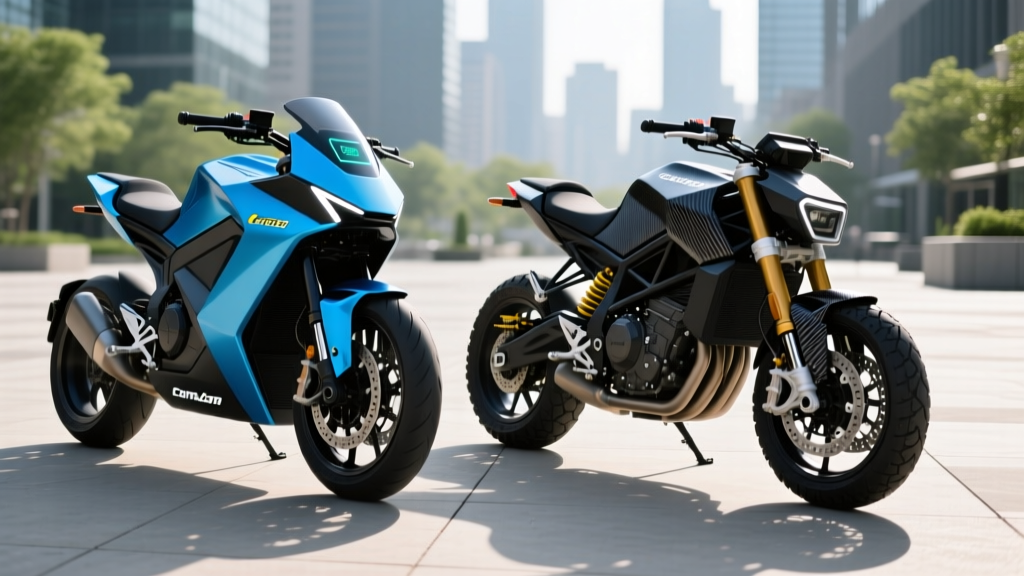
Quick Answer: Can-Am electric motorcycles—the Pulse (urban commuter) and Origin (dual-sport)—are BRP's first electric two-wheelers, arriving at dealers as 2026 models. The Pulse starts around $13,999 with an estimated 100-mile city range, while the Origin starts near $14,499 with roughly 90 miles of mixed-use range. Both use a ~9 kWh usable battery, produce around 47 hp, and charge from 20-80% in about 50 minutes on a DC fast charger. They represent Can-Am's return to motorcycles after a 40-year absence, targeting riders who want instant torque, minimal maintenance, and low fuel costs—but they carry real trade-offs in highway range and charging infrastructure compared to gas equivalents.
Key Specs at a Glance
| Model | Base MSRP | Est. Range | Battery (usable) | Peak Power | DC Fast 20-80% |
|---|---|---|---|---|---|
| Pulse | $13,999 | 100 mi (city) | ~9 kWh | 47 hp (35 kW) | ~50 min |
| Origin | $14,499 | 90 mi (mixed) | ~9 kWh | 47 hp (35 kW) | ~50 min |
Specs based on BRP's announced figures. Final EPA-equivalent ratings may vary at delivery.
Why Can-Am Is Betting on Electric Motorcycles
BRP (Bombardier Recreational Products) hasn't built a Can-Am motorcycle since the late 1970s. The company spent decades dominating the ATV, side-by-side, and Sea-Doo markets, but the electric motorcycle segment pulled them back. The reasoning is straightforward: electric powertrains eliminate the complexity of small-displacement internal combustion engines—no oil changes, no clutch wear, no valve adjustments, no exhaust systems. For urban commuters and weekend trail riders alike, that's a meaningful ownership simplification.
Can-Am enters a market where competitors like Zero Motorcycles and LiveWire have established footholds but haven't cracked mainstream adoption. The BRP press announcements position the Pulse and Origin as accessible entry points—priced below the LiveWire ONE ($21,999) and competitive with Zero's SR/F lineup, while leveraging Can-Am's existing dealer network for service and support.
Can-Am Pulse vs. Origin: Which Model Fits Your Riding?
The two-model lineup is deliberately simple, and choosing between them comes down to where you ride:
Pulse: The Urban Commuter
The Pulse is a naked street bike with upright ergonomics, a relatively low seat height, and a 17-inch wheel setup optimized for pavement. Its claimed 100-mile range is achievable in stop-and-go city riding where regenerative braking recaptures energy at every light. On the highway at 70 mph, expect that number to drop to roughly 60-70 miles—aerodynamic drag and sustained high-speed draw are the enemies of small battery packs.
Origin: The Dual-Sport Adventurer
The Origin borrows from the rally aesthetic—taller suspension travel, a 19-inch front wheel, and more ground clearance. It's designed for riders who split time between pavement and fire roads. The slightly lower estimated range (90 miles mixed) reflects the knobbier tire option and taller riding position that increases drag. Off-road at low speeds, range can actually extend well past 100 miles because regenerative braking works overtime on technical terrain.
Decision Framework: Pulse or Origin?
- Choose the Pulse if: You commute 30-50 miles round trip on paved roads, want the lowest seat height, and rarely ride above 65 mph.
- Choose the Origin if: You ride gravel roads, forest service trails, or want a taller riding position with more suspension compliance for rough pavement.
- Look elsewhere if: Your commute exceeds 70 miles one way or you regularly ride sustained highway stretches above 75 mph. The ~9 kWh battery simply cannot deliver 150+ mile highway range.
Real-World Range: What to Actually Expect
Motorcycle range claims are notoriously optimistic, and electric motorcycles are no exception. Unlike cars, bikes have no standardized EPA test cycle widely published for consumers. Here's how to think about Can-Am's numbers realistically:
| Riding Scenario | Pulse Est. Range | Origin Est. Range | Why It Varies |
|---|---|---|---|
| City (25-40 mph, regen heavy) | 95-105 mi | 85-95 mi | Frequent braking recovers energy; low aero drag |
| Mixed suburban (35-55 mph) | 75-85 mi | 70-80 mi | Moderate speeds, some regen benefit |
| Highway (65-75 mph sustained) | 55-70 mi | 50-65 mi | High aero drag, no regen opportunity, battery drains fast |
| Off-road trail (15-30 mph) | N/A | 90-110 mi | Low speed, heavy regen from braking and deceleration |
| Cold weather (below 40°F) | Reduce all above by 15-25% | Reduce all above by 15-25% | Lithium-ion chemistry loses efficiency; battery heating draws power |
The ~9 kWh usable battery is the limiting factor. For context, a Tesla Model 3 carries roughly 60 kWh and achieves 272 EPA miles. Motorcycles simply can't house that much energy—the packaging constraint is real. Can-Am's engineering prioritized keeping weight under 450 lbs, which meant capping battery size. If your daily riding falls within 60 miles round trip with a mix of conditions, the range works. Beyond that, you're planning around charging stops.
Charging Speeds and Infrastructure Reality
Charging is where electric motorcycle ownership either clicks or breaks down, and Can-Am has equipped both models to handle three scenarios:
| Charging Level | Power | 0-100% Time | Practical Use |
|---|---|---|---|
| Level 1 (standard 120V outlet) | ~1 kW | ~9 hours | Overnight top-up at home; adds ~10-12 mi/hr |
| Level 2 (240V home/public) | ~3.3 kW (onboard charger limit) | ~3 hours | Dedicated home charging; adds ~30-35 mi/hr |
| DC Fast Charging (CCS) | Up to ~12 kW peak | ~50 min (20-80%) | Road-trip charging; infrastructure sparse for motorcycles |
A critical detail: electric motorcycles typically have much smaller onboard chargers than cars. While a car might accept 11-19 kW on Level 2, the Pulse and Origin are limited to roughly 3.3 kW, meaning a full Level 2 charge still takes about three hours. For daily commuting where you plug in overnight, this is irrelevant—you'll wake up full every morning. For road trips, the DC fast charging capability matters, but PlugShare data shows that most public DC chargers are designed for cars, with cable reach and parking positioning that don't always accommodate motorcycles easily.
Home charging is the backbone of electric motorcycle ownership. If you have a garage or dedicated parking spot with a standard 120V outlet, you can maintain the bike with overnight charging. A 240V Level 2 setup (typically $500-$1,200 for a basic home install with an electrician) dramatically improves convenience, letting you fully recharge in about three hours instead of nine.
Cost of Ownership: Can-Am Electric vs. Gas Motorcycles
The upfront price of the Pulse ($13,999) and Origin ($14,499) positions them in the mid-range of the market—comparable to a new Kawasaki Z650 or Honda CB500X in the gas world. But the total cost picture diverges sharply once you factor in fuel and maintenance.
| Cost Factor | Can-Am Pulse (Electric) | Honda CB500F (Gas Equivalent) | Annual Difference |
|---|---|---|---|
| Base MSRP | $13,999 | $6,899 | +$7,100 upfront (electric) |
| Fuel/Energy (5,000 mi/yr) | ~$125 (at $0.14/kWh, 4 mi/kWh) | ~$550 (at $3.50/gal, 56 mpg) | +$425/yr (gas costs more) |
| Annual Maintenance | ~$50 (brake fluid, tire rotation) | ~$350 (oil, filter, chain, valve checks) | +$300/yr (gas costs more) |
| Insurance (est. annual) | ~$600-800 | ~$400-600 | +$150-200/yr (electric costs more) |
| 5-Year Total Operating Cost | ~$4,625-$6,625 | ~$7,800-$9,300 | Electric saves $1,675-$4,675 over 5 years |
The math shows that the Can-Am's higher purchase price takes roughly 10-14 years to recoup through fuel and maintenance savings at 5,000 miles per year. If you ride more—say 8,000-10,000 miles annually—the payback period shortens to 6-9 years. But most motorcycle buyers don't purchase purely on economics; the instant torque, silent operation, and reduced maintenance are experiential benefits that matter too.
Federal Tax Credit Eligibility
Under current IRS §30D rules, the federal clean vehicle credit applies to two- and three-wheeled electric vehicles, but the rules differ from four-wheeled credits. Qualified electric motorcycles can receive a credit of up to $2,500 (10% of the purchase price, capped at $2,500), subject to income limits and manufacturer eligibility requirements. Check the IRS clean vehicle credit page for current eligibility, as sourcing requirements and income caps apply. This credit can meaningfully reduce the effective price to roughly $11,500-$12,000, improving the payback timeline.
Common Misconceptions About Can-Am Electric Motorcycles
| Myth | Fact |
|---|---|
| "Electric motorcycles have no power" | The Pulse and Origin produce 47 hp and deliver peak torque instantly from zero RPM. That's comparable to a 500cc gas twin, but the torque delivery feels significantly stronger because there's no lag waiting for engine revs to build. |
| "You'll be stranded with a dead battery" | With home charging, you start every day with a full "tank." The risk only arises on long highway rides without planned charging stops—exactly the same planning a gas rider does, but with fewer refueling options. |
| "Battery replacement will cost a fortune" | BRP offers a battery warranty (expected 5 years/unlimited miles). Current lithium-ion motorcycle battery replacement runs $3,000-$5,000 out of warranty, but degradation data from the industry shows modern packs retain 80%+ capacity after 100,000+ miles of use. |
| "They're too heavy" | At roughly 440-460 lbs wet, the Pulse and Origin are heavier than a 300cc gas bike (~330 lbs) but lighter than most 650cc gas motorcycles (~430-470 lbs). The low center of gravity from the battery placement makes them feel lighter at a stop than the number suggests. |
| "Charging takes forever" | Overnight home charging (8-9 hours on Level 1) means it's always ready in the morning. DC fast charging to 80% in ~50 minutes is comparable to a lunch break on a road trip—though DC infrastructure for motorcycles remains limited. |
What First-Time Electric Motorcycle Buyers Must Know
If you're coming from a gas bike—or considering an electric motorcycle as your first bike—here are the ownership realities that spec sheets don't capture:
Home charging access is non-negotiable. Unlike electric cars, which can rely on public charging networks for road trips, electric motorcycles depend almost entirely on home charging for daily use. If you live in an apartment without garage access or street-park your bike, owning an electric motorcycle is impractical today. Confirm your parking situation supports plugging in before purchasing.
Plan for range compression in cold weather. Lithium-ion batteries lose 15-25% of their effective capacity below 40°F. A Pulse that delivers 100 miles in July may give you 75 miles in January. If your commute is 40 miles each way, the summer margin is comfortable; the winter margin is thin. Riders in cold climates should budget for this or consider a gas bike for winter months.
Regenerative braking changes how you ride. Both Can-Am models offer adjustable regen levels. At the highest setting, rolling off the throttle slows the bike significantly—enough to ride most city streets without touching the brake lever. This "one-handed riding" takes about a week to internalize but becomes second nature and reduces brake pad wear dramatically.
Insurance costs more (for now). Electric motorcycles carry higher insurance premiums than equivalent gas bikes, typically 20-40% more. This reflects higher repair costs (battery damage in a crash is expensive), limited claims data, and the higher replacement value of the bike. Get insurance quotes before committing to a purchase.
The dealer network matters for service. Can-Am's advantage over smaller EV motorcycle brands is BRP's existing powersports dealer network. When something goes wrong—whether it's a software glitch, a brake line, or a warranty battery claim—you need a nearby dealer who can diagnose and repair. Confirm your local Can-Am dealer is trained and equipped to service the electric motorcycle line before buying.
Bottom Line: Who Should Buy a Can-Am Electric Motorcycle?
The Pulse and Origin are not for every rider. They're purpose-built for a specific use case, and they excel within it:
- Best for: Urban commuters with home charging, 30-60 mile round trips, riders who value low maintenance and instant torque, and dual-sport riders who want quiet trail access.
- Not ideal for: Highway commuters covering 80+ miles daily, apartment dwellers without charging access, riders in extreme cold climates with long commutes, or anyone who regularly takes 200-mile weekend rides without wanting to plan charging stops.
Can-Am's entry into electric motorcycles is a credible first effort from a major manufacturer. The specs are realistic, the pricing is competitive, and the dealer network provides a service safety net that smaller EV brands can't match. If your riding fits the range envelope and you can charge at home, the Pulse and Origin deliver an experience that gas bikes simply can't replicate—silent, torquey, and nearly maintenance-free.
Do Can-Am electric motorcycles qualify for the federal tax credit?
Yes, under IRS §30D, qualified two-wheeled electric vehicles can receive up to $2,500 (10% of purchase price, capped). Eligibility depends on your income, the manufacturer's sourcing compliance, and other requirements. Consult the IRS clean vehicle credit page and a tax professional to confirm your eligibility.
How long does the Can-Am Pulse battery last before replacement?
Modern lithium-ion motorcycle batteries are designed to retain at least 80% of their original capacity after 100,000+ miles. BRP backs the battery with a warranty (expected 5 years). Real-world replacement is unlikely within the first decade of normal use.
Can I ride the Can-Am Origin off-road?
Yes. The Origin is designed as a dual-sport with trail-capable suspension, ground clearance, and wheel sizes. Off-road at low speeds, regenerative braking actually extends range significantly—many riders report 90-110 miles on technical trails.
What happens if I run out of charge on the road?
Unlike a gas bike where you can walk to a station with a fuel can, a depleted electric motorcycle requires a tow or a mobile charging service. Plan rides conservatively, keep a 15-20% buffer, and know your charging options along any unfamiliar route.
How does Can-Am compare to Zero Motorcycles or LiveWire?
Zero offers a broader model range and longer track record but at higher price points ($18,000-$24,000 for comparable models). LiveWire (Harley-Davidson's EV brand) starts at $21,999. Can-Am undercuts both on price while offering a major manufacturer's dealer network—a significant advantage for service and warranty support.