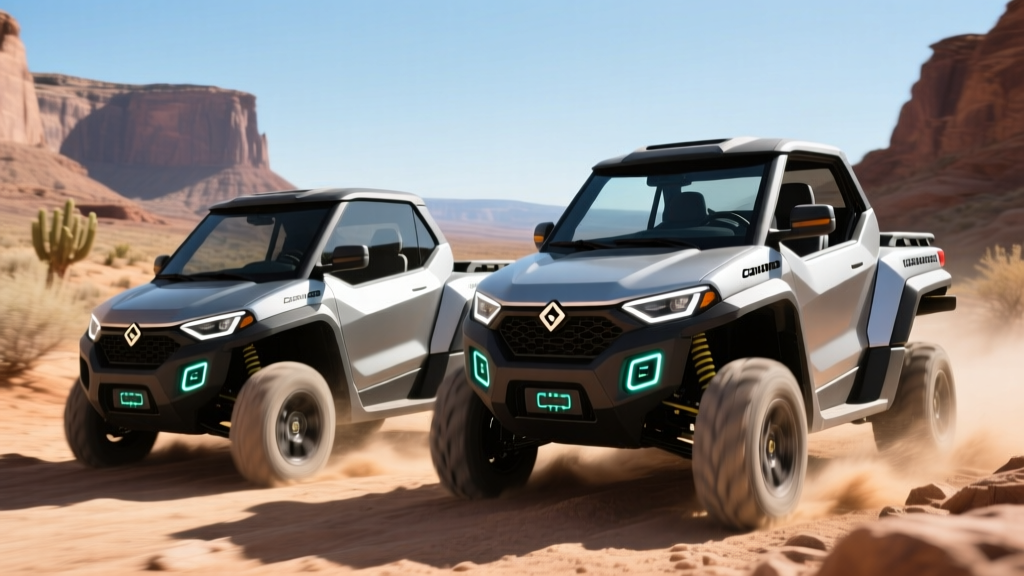
If you've been searching for a Can-Am electric four wheeler, you're likely aware that BRP (Bombardier Recreational Products) has been developing electric off-road side-by-sides. Here's the direct answer: As of early 2026, Can-Am has announced its electric UTV platform targeting the Outranger and Defender segments, but these models are not yet available for retail purchase. BRP has confirmed electric off-road vehicles are in development under its "Grow Beyond" strategic plan, with production models expected to reach dealers in the 2026–2027 timeframe. No final EPA-equivalent range figures, MSRP, or battery specifications have been published as of this writing.
That said, based on BRP's engineering disclosures, patent filings, and the trajectory of the electric off-road segment (led by competitors like the Polaris Ranger XP Kinetic and the upcoming electric side-by-sides from other OEMs), we can piece together what a Can-Am electric four wheeler will likely offer, what it will cost to own, and how it stacks up against gas-powered equivalents. This guide covers everything a prospective buyer needs to know before committing.
What We Know About the Can-Am Electric Four Wheeler Platform
BRP has invested heavily in electrification across its portfolio, including the Can-Am Origin and Pulse electric motorcycles (already on sale for 2025). The company's off-road electric platform is being developed in parallel, leveraging lessons from its motorcycle EV architecture but scaled for the torque, payload, and durability demands of utility and recreational UTVs.
Key engineering signals from BRP's public disclosures include:
- Rotax E-POWER drivetrain: BRP's in-house Rotax division is developing electric powertrains specifically for off-road applications, emphasizing low-end torque delivery critical for rock crawling, towing, and farm/ranch work.
- Modular battery architecture: Patent filings suggest swappable or expandable battery modules, allowing buyers to configure range based on use case (short trail rides vs. all-day work).
- Target segments: The Outranger (recreational/trail) and Defender (work/utility) are the two Can-Am lines most likely to receive EV variants first, mirroring Polaris's strategy with the Ranger XP Kinetic.
Until BRP publishes official specifications, all numbers in this guide are estimates based on segment benchmarks and BRP's engineering trajectory. We'll flag every estimated figure clearly.
Estimated Specs: Can-Am Electric Four Wheeler vs. Gas Equivalent
To understand what a Can-Am Outranger or Defender EV might deliver, we can compare against the current gas-powered models and the segment's only production electric UTV, the Polaris Ranger XP Kinetic. The table below uses confirmed gas specs and estimated EV figures.
| Specification | Can-Am Defender HD11 (Gas, 2025) | Polaris Ranger XP Kinetic (EV, 2025) | Can-Am Defender EV (Estimated) |
|---|---|---|---|
| Powertrain | 999cc V-twin, 82 HP | Dual-motor AWD, 110 HP | Rotax electric, ~100-120 HP (est.) |
| Torque | 69 lb-ft | 140 lb-ft | ~130-150 lb-ft (est.) |
| Battery / Fuel | 10.6-gal fuel tank | 29.8 kWh usable (NMC) | ~25-35 kWh (est., NMC or LFP) |
| Range (typical use) | ~150-200 mi (varies by load/terrain) | ~45 mi (mixed use, EPA-equivalent) | ~40-70 mi (est., mixed use) |
| Towing Capacity | 2,500 lb | 2,500 lb | ~2,000-2,500 lb (est.) |
| Payload | 1,000 lb (bed + cabin) | 1,100 lb | ~1,000 lb (est.) |
| Charging (Level 2) | N/A | ~5 hours (0-100%, 240V) | ~4-6 hours (est., 240V) |
| Base MSRP | $16,399 | $24,999 | ~$22,000-$28,000 (est.) |
| Noise Level | ~85-92 dB (typical UTV) | ~60-70 dB (near-silent at idle) | ~60-70 dB (est.) |
Sources: Can-Am Defender specifications, Polaris Ranger XP Kinetic. Can-Am EV figures are estimates and will be updated with confirmed data upon release.
Real Costs: Electric UTV vs. Gas UTV Ownership
The sticker price of any electric UTV will be higher than its gas counterpart. The battery pack alone accounts for a significant cost premium. But for buyers who use their side-by-side for ranch work, trail riding near residential areas, or hunting (where silence matters), the total cost of ownership and functional advantages can justify the premium.
| Category | Gas Defender HD11 | Defender EV (Est.) |
|---|---|---|
| Purchase Price | $16,399 | $25,000 (est.) |
| Fuel/Energy (5 yrs, 500 hrs/yr) | $3,750 (gas at ~$3.75/gal, ~15 mpg) | $750 (electric at ~$0.13/kWh) |
| Maintenance (oil, filters, belts, plugs) | $1,800 | $400 (no oil, fewer wear items) |
| Insurance (5 yrs, est.) | $2,500 | $2,800 |
| 5-Year Total | $24,449 | $28,950 (est.) |
Assumes 500 operating hours/year, residential electricity rates, and standard UTV insurance. Actual costs vary by region, usage intensity, and electricity pricing.
The electric UTV costs roughly $4,500 more over five years under these assumptions, driven almost entirely by the higher purchase price. However, the gap narrows significantly if you factor in:
- Commercial/farm use: Higher annual hours widen the fuel savings gap. At 1,000 hours/year, energy savings alone approach $6,000 over five years.
- Noise-sensitive applications: Hunting, wildlife management, and residential-adjacent trail riding are qualitatively better on an electric UTV — a value that doesn't show up in a spreadsheet.
- Instant torque: Electric motors deliver peak torque at 0 RPM, making low-speed technical terrain (rock crawling, steep inclines with heavy loads) easier and more controlled.
Charging Realities: What Off-Road EV Buyers Must Plan For
Unlike electric cars, which benefit from a growing DC fast-charging network, electric UTVs will almost exclusively rely on Level 1 (120V) and Level 2 (240V) charging at home, the farm, or the cabin. There are no public fast-charging networks designed for off-road vehicles, and the battery capacities (25-35 kWh estimated) don't justify DC fast-charging infrastructure.
Here's what charging looks like in practice:
| Charging Level | Power (kW) | 0-100% Time (est., 30 kWh pack) | Best For |
|---|---|---|---|
| Level 1 (standard 120V outlet) | ~1.4 kW | ~20-22 hours | Overnight top-ups, light use |
| Level 2 (240V, 30A circuit) | ~6.6 kW | ~4.5-5.5 hours | Daily work use, full recharge overnight |
| Level 2 (240V, 50A circuit) | ~10-11 kW | ~3-3.5 hours | Heavy commercial use, quick turnaround |
Practical considerations for off-road EV charging:
- Cabin or remote property: If your UTV lives at a property without 240V service, you're limited to Level 1 charging. Plan for 20+ hour recharge cycles, which means one full day of hard use followed by a full day of charging.
- Solar integration: Some ranch and cabin owners pair UTV charging with off-grid solar arrays. A 30 kWh battery can absorb a full day of solar production, effectively making your "fuel" free after the solar installation is paid off.
- No trail-side charging: Unlike a gas UTV that can carry spare fuel cans, an electric UTV that depletes its battery on a remote trail must be towed or trailered out. Plan routes within your range envelope.
- Cold-weather impact: Lithium-ion batteries lose 15-30% of usable capacity in sub-freezing temperatures. A UTV rated for 60 miles of range may deliver only 40-50 miles in winter conditions. Battery preconditioning (if offered) can mitigate this but consumes energy.
Common Misconceptions About Electric UTVs
The electric off-road segment is new enough that misinformation is common. Let's address the claims you'll encounter in forums and comment sections.
| Myth | Fact |
|---|---|
| "Electric UTVs have no power for real work." | The Polaris Ranger XP Kinetic produces 110 HP and 140 lb-ft of instant torque — more torque than most gas UTVs in the class. Electric motors deliver peak torque at 0 RPM, making them superior for low-speed pulling and climbing. |
| "You'll be stranded on the trail with a dead battery." | Range planning is essential, but most UTV use occurs within 20-30 miles of home base. For extended expeditions, gas remains the practical choice. Electric UTVs suit defined work areas and day rides, not multi-day overlanding. |
| "The battery will need replacing in 3 years." | Modern NMC and LFP battery packs are rated for 1,000-2,000+ charge cycles before reaching 80% capacity. At 200 cycles per year (heavy use), that's 5-10+ years before meaningful degradation. Polaris offers a 3-year battery warranty on the Kinetic; expect similar from Can-Am. |
| "Electric UTVs can't handle water crossings." | EV powertrains are sealed and have no air intake to flood. Electric UTVs can actually handle water crossings better than gas engines, provided the battery enclosure and electrical connections meet IP67 or higher ingress protection ratings. |
| "You get a $7,500 tax credit for buying an electric UTV." | The federal §30D Clean Vehicle Credit applies to on-road vehicles meeting specific MSRP, income, and battery-sourcing requirements. Off-road UTVs are generally not eligible for §30D credits. Some states or utilities may offer separate rebates for off-road electrification — check your local programs. |
Who Should Buy a Can-Am Electric Four Wheeler (and Who Shouldn't)
Not every UTV buyer is a good candidate for electric — and that's fine. The right choice depends on your specific use pattern, property setup, and priorities. Here's a practical decision framework:
Choose the Can-Am electric four wheeler if:
- Your typical rides are under 40 miles round-trip from your charging point
- You have 240V access at home, the farm, or the cabin for Level 2 charging
- Noise is a concern — hunting, residential-adjacent trails, early-morning farm chores
- You value instant torque for technical terrain or heavy towing at low speeds
- You want to eliminate oil changes, air filters, spark plugs, and exhaust maintenance
- You have solar capacity and want to "fuel" your UTV for near-zero marginal cost
Stick with a gas Can-Am Defender or Outranger if:
- You regularly ride 80+ miles in a day on extended trail systems
- Your UTV lives at a remote cabin without reliable 240V electrical service
- You need to refuel in minutes during all-day commercial operations
- Your budget is under $18,000 — gas UTVs remain significantly cheaper upfront
- You operate in extreme cold (below 0°F) where battery performance drops sharply
- You need the flexibility to carry spare fuel for multi-day expeditions
What First-Time EV Buyers Need to Know About Off-Road Electrics
If the Can-Am electric four wheeler will be your first experience with any electric vehicle, a few fundamentals differ from the gas UTV world you may know:
kW vs. kWh — the critical distinction: Kilowatts (kW) measure power — how fast the motor can deliver energy, or how fast the battery charges. Kilowatt-hours (kWh) measure energy capacity — how much "fuel" the battery holds. A 30 kWh battery delivering 80 kW of motor power is like a 10-gallon fuel tank with a 200 HP engine. Don't confuse the two.
Regenerative braking changes how you drive: Electric UTVs use regenerative braking to recapture energy when decelerating, sending it back into the battery. This extends range and reduces brake wear. Many electric UTVs offer adjustable regen levels, including a "one-pedal" mode where lifting off the throttle slows the vehicle significantly without touching the brake pedal — useful for precise speed control on descents.
State of Charge (SoC) management: Lithium-ion batteries last longest when not regularly charged to 100% or drained to 0%. For daily use, charging to 80-90% is ideal. Save 100% charges for days when you need maximum range. Most EV battery management systems (BMS) include a top and bottom buffer, so the displayed 0% and 100% aren't the battery's true physical limits.
Warranty expectations: Based on industry norms and the Polaris Kinetic precedent, expect Can-Am to offer a battery warranty of approximately 3 years with a capacity retention threshold of 70-80%. This means if the battery degrades below that threshold within the warranty period, BRP would repair or replace it. Confirm exact terms when official specs are released.
When Will the Can-Am Electric Four Wheeler Be Available?
BRP has confirmed that electric off-road vehicles are part of its product roadmap but has not published a firm retail launch date. Based on the company's pattern with the Can-Am Origin and Pulse motorcycles (announced in 2022, available in 2025), a reasonable estimate is:
- Official spec reveal: Late 2025 to mid-2026
- Dealer availability: Model year 2027 (arriving at dealers late 2026 to early 2027)
- Initial trims: Likely starting with a mid-tier Outranger and a Defender work model, with premium trims following
If you're ready to buy an electric UTV today and can't wait, the Polaris Ranger XP Kinetic is the only production electric side-by-side currently available, starting at $24,999 with a 29.8 kWh battery and approximately 45 miles of mixed-use range.
We'll update this guide with confirmed Can-Am specifications, pricing, and availability as soon as BRP makes them public. Bookmark this page and check back for the latest data.
Frequently Asked Questions
How much will the Can-Am electric four wheeler cost?
Based on segment pricing and the Polaris Ranger XP Kinetic at $24,999, expect Can-Am electric UTVs to start in the $22,000–$28,000 range depending on trim and battery configuration. Final MSRP has not been announced.
Can I charge a Can-Am electric UTV from a standard wall outlet?
Yes, but slowly. A standard 120V household outlet (Level 1) delivers roughly 1.4 kW, meaning a full charge of a ~30 kWh battery would take approximately 20-22 hours. For practical daily use, a 240V Level 2 installation (similar to a dryer or welder outlet) is strongly recommended, cutting charge time to 4-6 hours. Have a licensed electrician assess your panel capacity before installation.
Is the Can-Am electric UTV eligible for the federal EV tax credit?
Almost certainly not. The IRS §30D Clean Vehicle Credit applies to on-road vehicles that meet specific criteria including MSRP caps, buyer income limits, and battery component sourcing requirements. Off-road utility vehicles like UTVs/side-by-sides are generally excluded. Check with a tax professional and your state's energy office for any applicable local rebates.
How does cold weather affect an electric UTV's range?
Lithium-ion batteries lose 15-30% of usable capacity in temperatures below freezing (32°F/0°C). At 0°F (-18°C), expect even greater losses. If you operate in northern climates during winter, plan for significantly reduced range and longer charging times, as cold batteries accept charge more slowly. Storing the UTV in a heated garage when not in use helps preserve both range and battery longevity.
Will Can-Am offer a swappable battery for extended range?
BRP's patent filings suggest modular or swappable battery concepts are under development, but nothing has been confirmed for production models. If offered, swappable batteries would allow users to carry a spare pack for extended range or swap a depleted pack for a charged one in minutes — a significant advantage for commercial operations. Watch for this feature in official announcements.
How does an electric UTV handle towing compared to gas?
Electric motors deliver maximum torque at 0 RPM, giving electric UTVs a distinct advantage for low-speed towing, hill starts with heavy loads, and precise throttle control when backing up to a trailer. The Polaris Ranger XP Kinetic matches the gas Ranger's 2,500-lb towing capacity. Expect similar capability from the Can-Am electric platform.