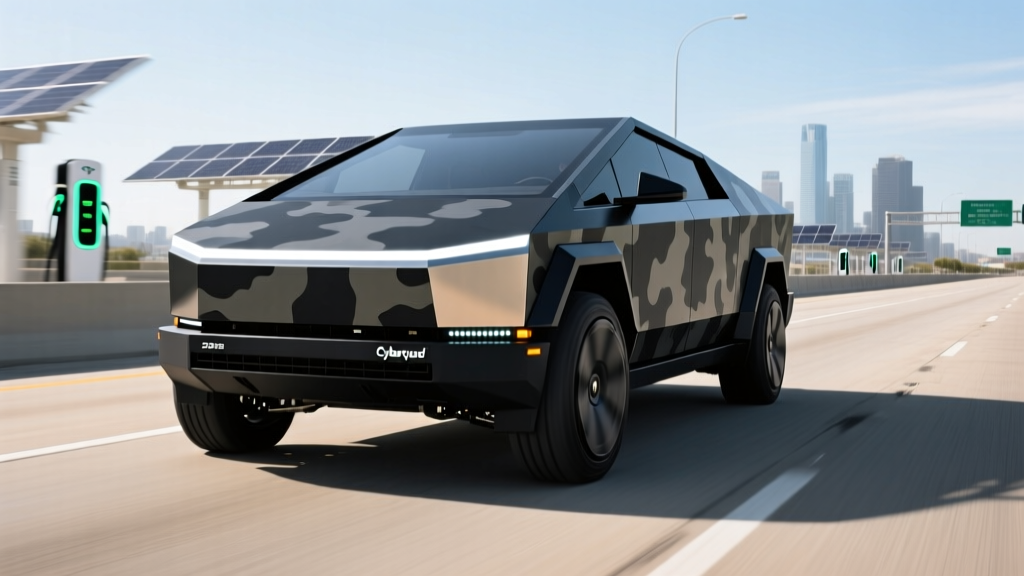
If you have been following EV spy photography over the past year, you have likely seen images of a camouflage Cybertruck prowling the roads around Palo Alto and Austin. These mule vehicles, wrapped in heavy black-and-white patterning, hint at upcoming hardware revisions Tesla is testing for the 2026 and 2027 model years. But for buyers ready to purchase today, the current-production Cybertruck is very much a known quantity — one with real strengths in charging architecture and performance, and real compromises in range efficiency and visibility.
This review covers every spec that matters to an EV buyer: EPA range versus what you will actually see on the highway, 800V DC fast-charging curves, home Level 2 practicality, federal tax credit eligibility under current IRS §30D rules, and whether the Cybertruck earns its place against the Rivian R1T and Ford F-150 Lightning in 2026.
What the Camouflage Cybertruck Prototypes Tell Us About Tesla's Next Move
The camouflage Cybertruck sightings throughout late 2025 and early 2026 have centered on two observable changes: revised rear suspension geometry (suggesting improved ride quality and tow stability) and subtle body-panel reshaping around the bed and tonneau area. Tesla has not officially announced a mid-cycle refresh, but the mule vehicles point toward engineering tweaks rather than a full redesign.
For buyers, this means the current-production Cybertruck — available in Dual Motor AWD and Cyberbeast trims — remains the model you can order and take delivery of today. The Long Range single-motor variant that was initially promised has been repeatedly delayed and, as of early 2026, is not available for order. Everything in this review reflects the currently purchasable lineup.
EPA Range, Battery Specs, and Real-World Efficiency
The Cybertruck's stainless-steel exoskeleton is heavy, and that mass works against efficiency. Here is how the numbers break down across the two available trims:
| Spec | Dual Motor AWD | Cyberbeast (Tri-Motor) |
|---|---|---|
| EPA Range | 340 miles | 320 miles |
| Battery Capacity (usable) | ~123 kWh (NMC) | ~123 kWh (NMC) |
| Efficiency | 56 MPGe / 56 kWh/100mi | 53 MPGe / 60 kWh/100mi |
| 0–60 mph | 3.9 seconds | 2.6 seconds |
| Horsepower | 600 hp | 845 hp |
| Drivetrain | Dual-Motor AWD | Tri-Motor AWD |
| Towing Capacity | 11,000 lbs | 11,000 lbs |
| Base MSRP | $79,990 | $99,990 |
The Cybertruck uses an NMC (nickel manganese cobalt) lithium-ion pack, not the LFP chemistry found in the base Model 3. NMC provides higher energy density — necessary for a vehicle this heavy — but it also means Tesla recommends daily charging to 80% for longevity, reserving 100% for road trips. This effectively reduces your daily usable range to roughly 272 miles (Dual Motor) before accounting for real-world losses.
Charging Speed: 800V Architecture, DC Fast-Charging, and Home Level 2
The Cybertruck uses an 800-volt electrical architecture, which enables higher charge power with lower current and reduced heat generation. This is the same approach used by Hyundai/Kia's E-GMP platform and is a meaningful technical advantage over 400V systems.
| Charging Level | Power (kW) | Speed / Time |
|---|---|---|
| Level 1 (120V household) | ~1.4 kW | ~3 miles per hour |
| Level 2 (240V, 48A Wall Connector) | 11.5 kW | ~27 miles per hour / full charge in ~11 hrs |
| DC Fast Charge (V4 Supercharger) | Peak 250 kW | 10–80% in ~28 minutes |
| DC Fast Charge (350 kW CCS station w/ adapter) | Peak 250 kW (vehicle-limited) | 10–80% in ~28 minutes |
A critical detail on the charging curve: the Cybertruck peaks at approximately 250 kW between 10% and roughly 35% State of Charge (SoC), then tapers progressively. From 50% to 80%, average charge power drops to around 120–140 kW. This is typical for a large NMC pack but means the "250 kW" headline number does not represent sustained speed. Preconditioning the battery by navigating to a Supercharger in the Tesla app is essential — arriving at a fast charger with a cold battery can cut peak power by 40% or more.
For home charging, Tesla's Wall Connector at 48 amps on a 240V/60A circuit adds roughly 27 miles of range per hour. An overnight charge from 20% to 80% takes about 6.5 hours, which is practical for daily use. Installation typically requires a NEMA 14-60 outlet or hardwired connection; budget $800–$2,000 for a licensed electrician depending on panel capacity and run length.
Performance, Ride Quality, and Towing
The Cyberbeast's 2.6-second 0–60 mph time makes it one of the quickest production pickup trucks ever built, and the dual-motor variant's 3.9 seconds is hardly slow. Instant torque from the tri-motor setup delivers relentless acceleration, and the steer-by-wire system — which eliminates the mechanical connection between steering wheel and wheels — provides a surprisingly direct feel at speed, though low-speed maneuvering takes some adaptation.
Ride quality has improved through over-the-air updates and minor hardware revisions since the initial 2024 deliveries, but the stainless-steel body and heavy battery pack mean you feel sharp impacts more than in a Rivian R1T with its air suspension. The adaptive air suspension on the Cybertruck provides up to 16 inches of ground clearance in Extract mode, which is competitive for off-road use.
Towing is rated at 11,000 pounds for both trims. However, towing at or near maximum capacity will cut range roughly in half — expect 140–170 miles between charges when pulling a heavy trailer. This is a physics reality for all EV trucks, not unique to Tesla, but it demands route planning around charging infrastructure.
Interior Space, Cargo, and Daily Practicality
The Cybertruck seats five across two rows. Front-seat space is generous, with 41.5 inches of legroom, but the rear seat is tighter than a full-size truck like the F-150 Lightning, offering approximately 35.5 inches of rear legroom. The angular roofline cuts into rear headroom for taller passengers.
Cargo specifications:
- Bed length: 6 feet (with tailgate up); extends to ~8 feet with tailgate down
- Bed volume: ~67 cu ft (tailgate up)
- Front trunk (frunk): ~7 cu ft — enough for a charging cable kit and small bag
- Sail pillars: The massive rear sail pillars create significant blind spots; the camera-based rear view is essential and standard
The motorized tonneau cover is a standout feature, providing lockable, weather-sealed bed storage. However, the angular bed walls and wheel-well intrusion make loading flat sheets of plywood (a common truck benchmark) impossible without angling them — a practical limitation for contractor use.
Pricing, Trim Levels, and Federal Tax Credit Eligibility
| Trim | Base MSRP | §30D Credit Eligible? | Effective Price (if eligible) |
|---|---|---|---|
| Dual Motor AWD | $79,990 | No — exceeds $80,000 truck MSRP cap | $79,990 |
| Cyberbeast (Tri-Motor) | $99,990 | No — exceeds $80,000 truck MSRP cap | $99,990 |
Under current IRS §30D rules, the federal EV tax credit provides up to $7,500 for qualifying new EVs. However, pickup trucks must have an MSRP at or below $80,000 to qualify. The Dual Motor AWD starts at $79,990, which technically places it under the cap — but adding any options, destination fees, or paint protection pushes it above the threshold. In practice, virtually no Cybertruck configuration qualifies. The Cyberbeast at $99,990 is well above the limit. Source: IRS §30D guidance.
Additionally, buyers must meet income caps ($300,000 joint / $150,000 single modified adjusted gross income) and the vehicle must satisfy battery critical-mineral and component sourcing requirements. Always verify current-year eligibility with a tax professional before purchase.
Driver Assistance, Tech, and Safety
The Cybertruck ships with Tesla's latest hardware suite (HW4) and includes Autopilot as standard, which provides adaptive cruise control and lane-centering on highways. Full Self-Driving (Supervised) is a $8,000 add-on (or $99/month subscription as of 2026) that adds automated lane changes, intersection handling, and parking assistance. In practice, FSD (Supervised) still requires frequent driver intervention in construction zones, unmapped areas, and adverse weather.
The 18.5-inch center touchscreen runs Tesla's latest software with integrated navigation, streaming, and a front-row passenger display. A rear-seat 9.4-inch screen handles climate and entertainment for passengers. The camera-based rear-view mirror replacement is standard and necessary given the sail-pillar blind spots. The Cybertruck has not yet been fully crash-tested by NHTSA or IIHS as of early 2026, so official safety ratings remain pending.
Battery Warranty and Long-Term Ownership Costs
Tesla covers the Cybertruck's battery and drive unit with an 8-year / 120,000-mile warranty (whichever comes first), with a minimum 70% capacity retention threshold during the warranty period. This is competitive with the Rivian R1T (8yr/175,000mi) and Ford F-150 Lightning (8yr/100,000mi).
Long-term battery degradation on NMC packs of this size typically runs 8–12% over the first 100,000 miles based on fleet data from Model S/X vehicles. The Cybertruck's thermal management system is robust, but frequent DC fast-charging and regular 100% charges will accelerate degradation. Charging to 80% daily and preconditioning before fast-charging sessions are the most impactful habits for longevity.
Insurance premiums for the Cybertruck run significantly higher than average for the pickup segment — expect $2,800–$4,200 annually depending on your profile, driven by the vehicle's repair cost (stainless-steel panel replacement is expensive) and performance profile. Get a quote before committing to a purchase order.
Cybertruck vs. Rivian R1T vs. Ford F-150 Lightning: Which Fits Your Use Case?
| Attribute | Tesla Cybertruck (Dual Motor) | Rivian R1T Dual-Motor | Ford F-150 Lightning (Ext. Range) |
|---|---|---|---|
| EPA Range | 340 mi | 352 mi | 320 mi |
| Peak DC Charge | 250 kW | 220 kW | 150 kW |
| 0–60 mph | 3.9 sec | 4.5 sec | 3.8 sec |
| Starting MSRP | $79,990 | $69,900 | $59,995 |
| §30D Credit Eligible | Unlikely (MSRP cap) | Select trims (below $80K) | Select trims (below $80K) |
| Towing Capacity | 11,000 lbs | 11,000 lbs | 10,000 lbs |
| NACS Native | Yes | Yes (2025+) | Adapter required |
- Choose the Cybertruck if: You prioritize Supercharger network access, want the fastest DC charging in the segment, value the stainless-steel durability for work environments, and can accept the range compromise at highway speeds.
- Choose the Rivian R1T if: You want a more refined ride, better off-road capability with quad-motor options, a gear tunnel for creative storage, and a lower starting price with potential tax credit eligibility.
- Choose the F-150 Lightning if: You need a traditional truck form factor, want Pro Power Onboard for job-site use, prefer the lowest entry price, and value Ford's dealer service network for fleet or rural ownership.
Biggest Pros and Cons of the 2026 Cybertruck
- 800V architecture enables 250 kW peak DC charging — fastest in the EV truck segment
- NACS native: full Supercharger network access without adapters
- Cyberbeast performance is genuinely supercar-quick (2.6 sec 0–60)
- Stainless-steel body resists dents and scratches in work environments
- Motorized tonneau cover with integrated bed lighting is best-in-class
- Steer-by-wire enables a tight turning radius (37.4 ft) for a full-size truck
- Real-world highway range falls 15–20% below EPA due to poor aerodynamics
- No federal tax credit in practice — MSRP exceeds §30D truck cap with any options
- Rear visibility is severely compromised; reliance on cameras is mandatory
- Bed cannot fit 4×8 plywood sheets flat — a basic truck utility failure
- Insurance premiums run $2,800–$4,200/year — well above segment average
- Steer-by-wire has a learning curve and no mechanical backup
Frequently Asked Questions
What is the real-world range of the 2026 Cybertruck?
The EPA rates the Dual Motor at 340 miles and the Cyberbeast at 320 miles. In real-world highway driving at 70–75 mph, expect 270–295 miles (Dual Motor) and 255–280 miles (Cyberbeast). Cold weather below freezing can reduce range an additional 15–25%. The Cybertruck's flat, angular bodywork generates significant drag at highway speed, which is the main efficiency penalty.
How fast does the Cybertruck charge at home and on the road?
On a Tesla V4 Supercharger, the Cybertruck peaks at 250 kW and charges from 10–80% in approximately 28 minutes, though charge speed tapers significantly above 50% SoC. At home on a Level 2 Wall Connector (240V, 48A), it adds about 27 miles of range per hour, with a full 0–100% charge taking roughly 11 hours.
Does the Cybertruck qualify for the $7,500 federal EV tax credit?
In practice, almost certainly not. The IRS §30D credit caps eligible pickup trucks at $80,000 MSRP. The Dual Motor AWD starts at $79,990, and any added options or destination charges push it over the limit. The Cyberbeast at $99,990 is far above the cap. Always consult IRS guidance and a tax professional for your specific situation.
Is the Cybertruck worth buying over the Rivian R1T or F-150 Lightning?
It depends on your priorities. If Supercharger access, peak DC charging speed, and raw performance are your top criteria, the Cybertruck is compelling. If you want a lower price, better ride comfort, stronger off-road capability, or tax credit eligibility, the R1T and Lightning are more practical choices. The Cybertruck's range limitations and insurance costs are genuine drawbacks for cost-conscious buyers.
What will the camouflage Cybertruck prototypes change when they reach production?
Based on spy photography, the mule vehicles appear to test revised rear suspension tuning and minor body-panel adjustments. Tesla has not confirmed any changes or a timeline. If a refresh arrives for the 2027 model year, it is likely to focus on ride quality and build-quality refinements rather than major powertrain or battery changes.
How long will the Cybertruck battery last?
Tesla warranties the battery for 8 years or 120,000 miles with a 70% minimum capacity retention threshold. Based on NMC pack degradation data from Tesla's broader fleet, expect 8–12% capacity loss over 100,000 miles with normal use. Avoiding frequent 100% charges and minimizing DC fast-charging when possible will help maximize longevity. Full battery replacement costs, if needed out of warranty, are estimated at $15,000–$22,000 based on pack size and current service pricing.