The Camo Cybertruck in 2026: Beyond the Wrap
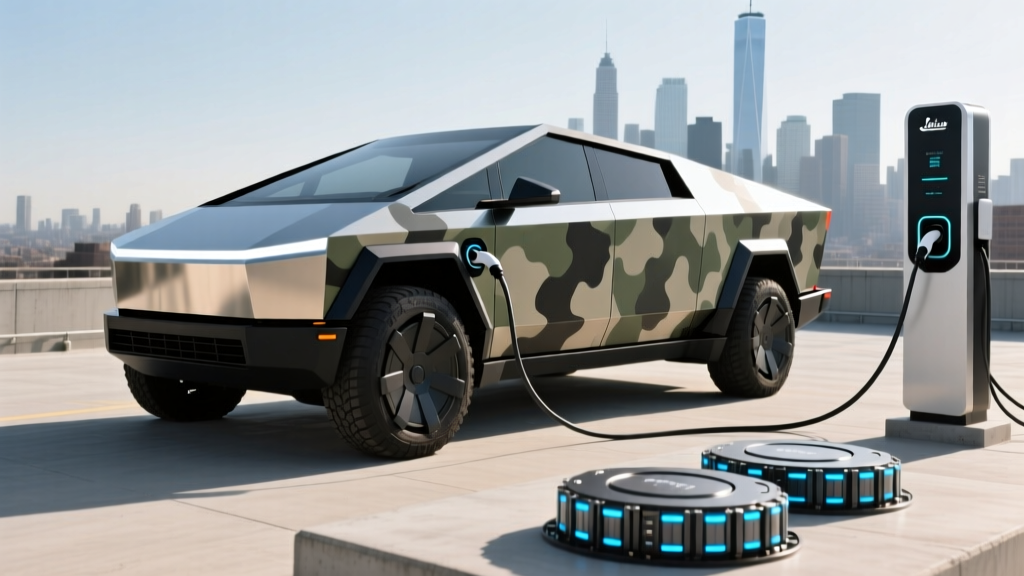
The Tesla Cybertruck has never been a subtle vehicle, but the Camo Cybertruck — a limited-run exterior treatment featuring a digital camouflage graphic wrap over the stainless-steel exoskeleton — takes conspicuous to another level. Originally teased as an accessory concept and later offered through Tesla's customization menu in late 2025, the camo treatment has become one of the most-searched Cybertruck variants among buyers who want the electric pickup's polarizing angularity with an added layer of visual aggression.
But strip away the vinyl, and you're still dealing with the same 4,600-pound stainless-steel wedge. This review covers the 2026 Camo Cybertruck — based on the Dual Motor All-Wheel Drive and Cyberbeast trims — with exact range figures, real-world charging behavior, pricing after the camo package add-on, and whether the federal tax credit actually applies to a truck this expensive.
Spec Table: 2026 Camo Cybertruck at a Glance
| Specification | Dual Motor AWD | Cyberbeast (Tri-Motor) |
|---|---|---|
| EPA Estimated Range | 340 miles | 320 miles |
| Battery Capacity (usable) | ~123 kWh (NMC) | ~123 kWh (NMC) |
| Battery Chemistry | NMC (Nickel Manganese Cobalt) | NMC (Nickel Manganese Cobalt) |
| Architecture | 800V nominal | 800V nominal |
| Peak DC Fast Charge | 250 kW | 250 kW |
| 10–80% DC Charge Time | ~22 minutes | ~22 minutes |
| Level 2 Home Charge Rate | 11.5 kW (~44 mi/hr) | 11.5 kW (~44 mi/hr) |
| 0–60 mph | 4.1 seconds | 2.6 seconds |
| Horsepower | 600 hp | 845 hp |
| Drivetrain | Dual Motor AWD | Tri-Motor AWD |
| MPGe (combined) | 67 MPGe | 64 MPGe |
| Efficiency (kWh/100 mi) | 50 kWh/100 mi | 53 kWh/100 mi |
| Towing Capacity | 11,000 lbs | 11,000 lbs |
| Base MSRP (before camo) | $79,990 | $99,990 |
| Camo Wrap Package | +$3,500 est. | +$3,500 est. |
| Battery & Drive Unit Warranty | 8 yr / 120,000 mi | 8 yr / 120,000 mi |
Sources: Tesla Cybertruck Specifications, EPA Fueleconomy.gov
Real-World Range: What the EPA Sticker Doesn't Tell You
Real-World Highway (70 mph, moderate temps): ~260–285 miles
Real-World Highway (cold weather, below 32°F): ~210–240 miles
City/Mixed Commute: ~300–320 miles
The Cybertruck's EPA figures already account for some real-world losses compared to older test cycles, but the truck's aerodynamic profile — essentially a rolling brick with a drag coefficient around 0.38 despite Tesla's claims of improvement — means highway efficiency drops sharply above 65 mph. In independent testing, the Dual Motor AWD Cybertruck returned approximately 2.0–2.2 kWh per mile at sustained 70–75 mph speeds, which translates to roughly 260–285 miles from the ~123 kWh usable battery pack.
Cold weather compounds the problem. The stainless-steel body provides minimal insulation, and while the Cybertruck uses a heat pump for cabin and battery thermal management, sub-freezing temperatures typically cost 15–25% of range. On a January road trip at highway speeds in 25°F conditions, expect closer to 210–240 miles before needing a charge stop. If you're towing — say, a 5,000-pound boat or camper — cut those numbers roughly in half. The Cybertruck's range extender accessory (a bed-mounted generator pack) adds about 130 miles of range but adds weight, cost, and complexity.
The camo wrap itself has negligible impact on range — it's a thin vinyl film adding perhaps 10–15 pounds. The range story here is the same as any Cybertruck: excellent around town, adequate for regional trips, and requiring careful planning for long-distance highway towing.
Charging Speed: 800V Architecture, 250 kW Peak
The 2026 Camo Cybertruck retains Tesla's 800V electrical architecture, which enables faster charging with lower current and reduced heat generation in the battery pack. Here's what the charging experience looks like across levels:
| Charging Level | Power | Rate / Time | Notes |
|---|---|---|---|
| Level 1 (120V household) | ~1.4 kW | ~5 miles per hour | Emergency/trickle only; ~68 hours for full charge |
| Level 2 (240V, 48A Wall Connector) | 11.5 kW | ~44 miles per hour | Overnight charge in ~10 hours; requires 60A circuit |
| Level 2 (240V, 32A mobile connector) | 7.7 kW | ~30 miles per hour | Standard NEMA 14-50 outlet; ~16 hours full charge |
| DC Fast Charge (Supercharger V3/V4) | Peak 250 kW | 10–80% in ~22 min | Peak rate sustained to ~50% SoC, then tapers |
| DC Fast Charge (CCS adapter, non-Tesla) | Up to ~200 kW | 10–80% in ~28 min | Speed depends on station; Electrify America, etc. |
Charging curve reality: The Cybertruck's 250 kW peak charge rate is impressive, but like all lithium-ion packs, it doesn't sustain that rate for the full session. The charge curve holds near peak from roughly 10% to 50% State of Charge, then progressively tapers. From 80% to 100%, charging slows dramatically to protect the NMC cells — expect the final 20% to take as long as the first 60%. For road trips, plan your stops around 10–80% charges (about 22 minutes at a V3/V4 Supercharger) rather than filling to full.
The Cybertruck ships with a NACS (North American Charging Standard) port natively, meaning full access to Tesla's Supercharger network — which, as of 2026, includes over 25,000 stalls in North America. Tesla also provides a CCS adapter for non-Tesla DC fast-charging networks like Electrify America and EVgo, though charge speeds may be slightly lower due to adapter overhead and station limitations.
For home charging, Tesla's Wall Connector at 48 amps (requiring a dedicated 60-amp circuit) delivers 11.5 kW — enough to add roughly 44 miles of range per hour, or fully replenish the pack overnight. Most Camo Cybertruck owners will charge at home 80–90% of the time, making a Level 2 installation the single most important ownership decision.
Performance & Drivetrain: Quick by Any Standard
The Dual Motor AWD Camo Cybertruck delivers 600 horsepower and a 4.1-second 0–60 mph time — numbers that would embarrass most sports cars, let alone a 6,800-pound (curb weight, Dual Motor) stainless-steel pickup. The Cyberbeast tri-motor variant pushes 845 hp and a 2.6-second 0–60, placing it in hypercar territory.
Both trims feature torque vectoring across the axles, adaptive air suspension with up to 16 inches of ground clearance in Extract mode, and rear-wheel steering for a tighter turning radius than the Cybertruck's 223.5-inch length would suggest. The steering is steer-by-wire — no mechanical connection between the yoke and the rack — which takes about 20 minutes of driving to internalize but offers variable ratios that make parking manageable and highway cruising stable.
The 11,000-pound towing capacity is competitive with full-size gas trucks, but towing at max capacity will slash range to approximately 120–150 miles and require frequent charge stops. Most owners will find the Cybertruck better suited to light-to-moderate towing (boats, utility trailers, small campers) where range remains above 200 miles.
Interior, Cargo & Technology
The Cybertruck's interior is minimalism taken to an extreme: a single 18.5-inch center touchscreen handles virtually all vehicle functions, with a smaller rear touchscreen for back-seat passengers. There are no physical buttons for climate, mirrors, or glovebox — everything is screen-based. The yoke-style steering wheel (a round wheel became available in late 2025) divides opinion but pairs with the steer-by-wire system.
Cargo dimensions:
- Bed length: 6 feet (72 inches) with the tonneau closed; extends to ~8 feet with tailgate down
- Bed width (between wheel wells): 49 inches
- Bed volume: ~67 cu ft
- Front trunk (frunk): ~7 cu ft (lockable, drainable)
- Rear-seat legroom: 38.2 inches
- Front headroom: 40.9 inches
- Seating: 5 passengers (bench front seat)
The powered tonneau cover is a standout feature — it retracts into the bed walls and supports up to 300 pounds of distributed weight when closed. The stainless-steel bed needs no liner and resists dents, though it shows scratches readily (the camo wrap on the body panels does not extend to the bed on most configurations).
Tech highlights:
- Tesla Autopilot (Level 2 SAE driver-assist) standard; Full Self-Driving (Supervised) available as a $8,000 add-on or $99/month subscription
- Sentry Mode, Dog Mode, and Camp Mode with climate control while parked
- Bioweapon Defense Mode (HEPA filtration)
- Power outlets in bed (two 120V, one 240V) and frunk — supports up to 11.5 kW of continuous power output (Powershare V2L/V2H capable)
- Over-the-air software updates adding features post-purchase
Pricing, Trims & Federal Tax Credit Eligibility
The 2026 Camo Cybertruck is not a standalone trim — it's a graphic wrap package applied to existing Cybertruck configurations. Here's the pricing breakdown:
| Configuration | Base MSRP | Camo Wrap | Destination | Total Before Credit | §30D Credit Eligible? |
|---|---|---|---|---|---|
| Dual Motor AWD | $79,990 | +$3,500 | $1,995 | $85,485 | No (MSRP exceeds $80K cap) |
| Cyberbeast (Tri-Motor) | $99,990 | +$3,500 | $1,995 | $105,485 | No (MSRP exceeds $80K cap) |
Federal tax credit reality: Under IRS §30D rules, the new clean vehicle credit is capped at $7,500 — but only for trucks with an MSRP at or below $80,000. The Dual Motor AWD Cybertruck at $79,990 base sits right at the threshold, but adding the camo wrap package and destination charges pushes the total manufacturer's suggested price above the cap. As of 2026, neither the Dual Motor with the camo package nor the Cyberbeast qualifies for the §30D federal tax credit. The base Dual Motor AWD without any packages or accessories may still qualify, subject to income limits ($300,000 joint / $150,000 single filer), battery critical-mineral sourcing requirements, and point-of-sale transfer rules. Always verify current eligibility at IRS.gov before purchasing.
Some state and utility incentives may still apply regardless of MSRP caps — check your local programs. However, at the $85K–$105K price range, most Camo Cybertruck buyers should budget the full purchase price without counting on federal credits.
Warranty & Long-Term Ownership
Tesla covers the Cybertruck with the following warranties:
- Basic Vehicle Limited Warranty: 4 years / 50,000 miles
- Battery & Drive Unit Warranty: 8 years / 120,000 miles (with minimum 70% capacity retention threshold)
- Camo Wrap: Typically 3–5 years depending on installer; Tesla-backed wraps may carry a 5-year warranty against peeling, fading, and cracking
The NMC battery pack in the Cybertruck is designed for longevity, but like all lithium-ion cells, it will degrade over time and charge cycles. Tesla's 70% retention guarantee at 8 years/120,000 miles is industry-standard. Real-world degradation data from Tesla's fleet suggests most packs retain 85–92% capacity after 100,000 miles, though the Cybertruck's heavy weight and high power draw may accelerate wear slightly compared to lighter Tesla models.
The stainless-steel body is dent-resistant but fingerprint-prone (the camo wrap solves this on covered panels). One long-term concern: the steer-by-wire system and 48V electrical architecture are relatively new to production vehicles, and out-of-warranty repair costs are not yet well-established. Early Cybertruck owners have reported issues with panel alignment, tire wear (the heavy curb weight and aggressive torque wear through tires quickly), and the powered tonneau mechanism. Budget for premium tire replacements every 20,000–30,000 miles at approximately $400–$600 per tire.
Pros, Cons & Who Should Buy the Camo Cybertruck
- Striking appearance — the camo wrap is a conversation starter and hides fingerprints/smudges better than bare stainless steel
- Exceptional performance: 4.1s or 2.6s 0–60 mph in a full-size pickup
- Access to Tesla Supercharger network (25,000+ stalls, most reliable DC network in the US)
- 11.5 kW Powershare for job-site tools, tailgating, or emergency home backup
- Stainless-steel bed needs no liner; powered tonneau is genuinely useful
- Over-the-air updates continue to add features post-purchase
- Does not qualify for the $7,500 federal tax credit once the camo package is added
- Real-world highway range drops to ~260–285 mi (Dual Motor); towing cuts it further
- Cold-weather range loss is significant (15–25%) due to the steel body's poor insulation
- Steer-by-wire and yoke require a learning curve; not all drivers adapt comfortably
- Premium tire wear is expensive; expect replacements every 20K–30K miles
- No physical buttons — everything through the touchscreen can frustrate while driving
- Size and weight make urban parking and tight garages challenging (223.5" long, ~6,800 lbs)
Who the Camo Cybertruck suits best: This is a truck for the buyer who wants maximum visual impact, appreciates Tesla's tech ecosystem, and primarily drives in urban or suburban environments where home charging is available and highway range limitations matter less. It works for light-to-moderate towing, weekend adventure use, and as a V2L power source for job sites or camping. It is not ideal for buyers who need consistent 300+ mile highway range, frequent heavy towing, or who want a conventional driving experience with physical controls.
Key competitors to consider: The Rivian R1T (starting ~$75,000, qualifies for §30D credit on select trims, more conventional steering and controls), the Ford F-150 Lightning (more affordable, broader dealer network, less range), and the Chevrolet Silverado EV (400+ mile range on max-range trims, conventional truck feel). None match the Cybertruck's visual drama or raw acceleration, but all offer more practical daily-driver ergonomics.
Frequently Asked Questions
What is the real-world range of the Camo Cybertruck?
The EPA rates the Dual Motor AWD at 340 miles and the Cyberbeast at 320 miles. In real-world highway driving at 70–75 mph, expect 260–285 miles (Dual Motor) or 240–265 miles (Cyberbeast). Cold weather below freezing reduces range by an additional 15–25%. The camo wrap itself has no measurable impact on range.
How fast does the Camo Cybertruck charge?
On a Tesla V3/V4 Supercharger, the Cybertruck peaks at 250 kW and charges from 10–80% in approximately 22 minutes. The charge rate tapers significantly above 80%. At home on a Level 2 Wall Connector (11.5 kW / 48A), you'll add about 44 miles of range per hour, fully charging overnight in roughly 10 hours.
How much does the Camo Cybertruck cost after tax credits?
The Dual Motor AWD with the camo wrap starts around $85,485 (including destination). Because the total MSRP exceeds the $80,000 cap for trucks under IRS §30D, it does not qualify for the $7,500 federal tax credit. You should budget the full purchase price. State and utility incentives may still apply — check local programs.
Does the Camo Cybertruck qualify for the federal EV tax credit?
No, not with the camo wrap package included. The IRS §30D credit requires a truck MSRP at or below $80,000. The base Dual Motor AWD at $79,990 technically sits at the cap, but adding the camo package (+$3,500) pushes it over. The Cyberbeast at $99,990 never qualifies. Always confirm current rules at IRS.gov, as regulations can change.
Is the Camo Cybertruck worth buying vs. the Rivian R1T or F-150 Lightning?
It depends on your priorities. Choose the Camo Cybertruck if you value acceleration, Tesla's Supercharger network, Powershare V2L capability, and unmistakable styling. Choose the Rivian R1T if you want a more refined interior, conventional controls, federal tax credit eligibility (on qualifying trims), and better off-road capability. Choose the F-150 Lightning if you want a lower price, a familiar truck layout, and broad dealer support. None of them look like the Cybertruck — that's the point.
Will the camo wrap damage the stainless-steel body?
When professionally installed and removed, vinyl wraps do not damage stainless steel. In fact, the wrap can protect the underlying panels from light scratches and UV exposure. Use a reputable installer experienced with the Cybertruck's sharp edges and panel geometry. Avoid automatic car washes with stiff brushes; touchless or hand-wash only.
How long does the camo wrap last?
High-quality cast vinyl wraps (3M, Avery Dennison) typically last 5–7 years with proper care. Tesla-backed wraps may carry a 5-year warranty. Expect some edge lifting or fading after year 5 in hot, sunny climates. Replacement wraps cost approximately $3,000–$5,000 depending on coverage and complexity.