Is There Really a California Tesla Ban?
If you've searched "California Tesla ban" recently, you've likely encountered a swirl of headlines, social media claims, and political commentary. Let's cut through the noise with facts: as of 2026, there is no enacted law banning the sale, ownership, or registration of Tesla vehicles in California. No such ban exists at the state or federal level.
What does exist is a complex intersection of regulatory actions, political disputes, and California's aggressive clean-air mandates that occasionally put the state at odds with Tesla's corporate decisions. The confusion typically stems from three overlapping stories:
- California's 2035 zero-emission vehicle mandate — which requires all new cars sold in the state to be electric or hydrogen fuel cell. This actually favors Tesla, a pure-EV automaker.
- Political friction between California regulators and Tesla CEO Elon Musk over issues ranging from autonomous driving oversight to corporate headquarters relocation (Tesla moved its HQ to Texas in 2021).
- NHTSA investigations into Tesla's Autopilot and FSD (Supervised) systems, which California's DMV has separately scrutinized over advertising claims.
The bottom line for buyers: you can purchase, register, and drive a Tesla in California today just as you could five years ago. The real question is whether a Tesla — specifically the high-volume 2026 Model Y — is the right EV for your needs given the competitive landscape and current incentives.
2026 Tesla Model Y: Full Spec Breakdown
The 2026 Model Y received a meaningful refresh (internally dubbed "Juniper") that updated styling, improved ride quality, and refined the interior. Here are the numbers that matter for purchase decisions:
| Specification | Long Range AWD | Performance AWD | Rear-Wheel Drive |
|---|---|---|---|
| EPA Range | 310 miles | 277 miles | 260 miles |
| Battery Capacity | ~78 kWh (usable), NMC | ~78 kWh (usable), NMC | ~60 kWh (usable), LFP |
| Horsepower | 384 hp | 456 hp | 295 hp |
| 0-60 mph | 4.8 sec | 3.5 sec | 6.6 sec |
| Drivetrain | Dual-Motor AWD | Dual-Motor AWD | RWD (single motor) |
| Peak DC Fast Charge | 250 kW | 250 kW | 170 kW |
| 10-80% DC Time | ~25 min | ~25 min | ~30 min |
| Level 2 Home Rate | 11.5 kW (~44 mi/hr) | 11.5 kW (~44 mi/hr) | 11.5 kW (~44 mi/hr) |
| MPGe (combined) | 111 MPGe | 102 MPGe | 119 MPGe |
| Base MSRP | $48,990 | $54,490 | $44,990 |
Chemistry note: The RWD trim uses LFP (lithium iron phosphate) cells, which trade some energy density for longer cycle life, better thermal stability, and the ability to charge to 100% daily without degradation concerns. The Long Range and Performance trims use NMC (nickel manganese cobalt) for higher energy density and greater range, but Tesla recommends daily charging to 80% for longevity. For California commuters who can charge at home nightly, the LFP RWD model is a compelling value play.
Charging: Supercharger Network vs. the Competition
Tesla's Supercharger network remains one of the strongest ownership advantages, particularly for road-trip-heavy California drivers heading to Tahoe, Joshua Tree, or up the Pacific Coast Highway. Here's what charging looks like across levels:
| Charging Level | Power | Miles Added per Hour | Typical Use Case |
|---|---|---|---|
| Level 1 (120V) | ~1.4 kW | ~3-5 mi/hr | Emergency/overnight trickle |
| Level 2 (240V home) | 11.5 kW | ~44 mi/hr | Daily home charging |
| DC Fast (Supercharger V3) | Up to 250 kW | ~1,000+ mi/hr (peak) | Road trips |
| DC Fast (V4 Supercharger) | Up to 350 kW (future) | Higher peak rate | Rolling out 2025-2026 |
Charging curve reality check: The 250 kW peak rate on Long Range and Performance models is not sustained across the full session. The Model Y hits peak rate at low states of charge (roughly 5-30% SoC), then progressively tapers. By 60% SoC, you're typically seeing ~100-120 kW, and above 80%, speeds drop sharply to protect the battery. This is why Tesla (and every other automaker) quotes 10-80% times rather than 0-100%.
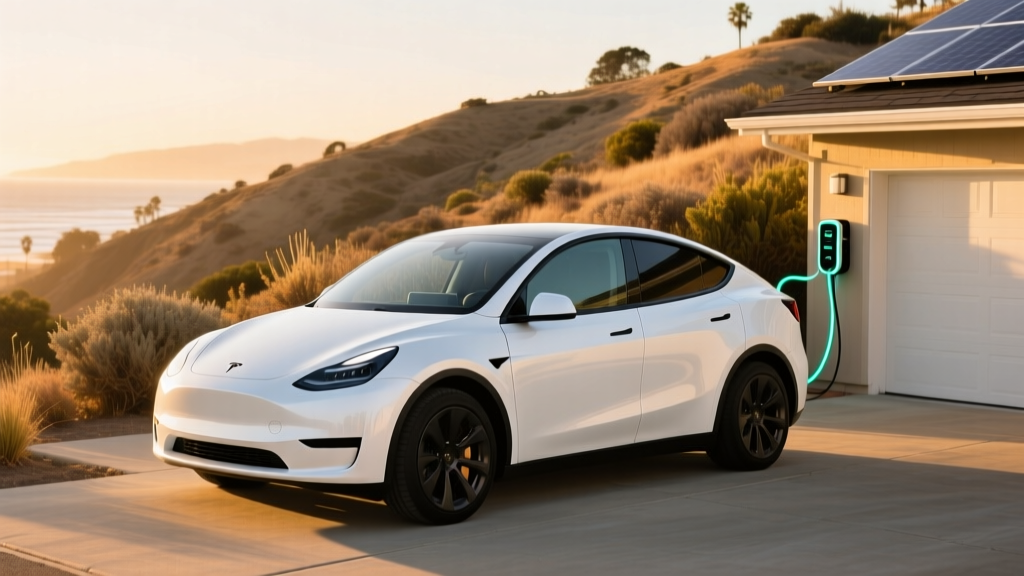
For home charging, a Tesla Wall Connector on a 60-amp circuit delivers 11.5 kW (48 amps continuous), adding roughly 44 miles of range per hour. Most owners who plug in overnight start each morning with a full or near-full battery, making public charging a road-trip concern only. Installation costs vary widely in California — expect $800-$2,500 for a straightforward Wall Connector install, but older homes may require a panel upgrade ($2,000-$5,000+) to support a dedicated 60-amp circuit.
One 2026 development: the Model Y now ships with the NACS (North American Charging Standard) port natively, and non-Tesla EVs increasingly access Superchargers via NACS adapters. This means Tesla owners no longer have exclusive Supercharger access, but the network's reliability and coverage remain industry-leading. According to Tesla's Supercharger page, there are over 6,500 Superchargers in California alone.
Pricing, Tax Credits, and What You'll Actually Pay
Tesla pricing has fluctuated frequently, but as of early 2026, here's where the Model Y lineup stands before incentives:
| Trim | Base MSRP | Est. Destination | Federal Credit (§30D) | Effective Price |
|---|---|---|---|---|
| RWD | $44,990 | $1,390 | Up to $7,500* | ~$38,880 |
| Long Range AWD | $48,990 | $1,390 | Up to $7,500* | ~$42,880 |
| Performance AWD | $54,490 | $$1,390 | Up to $7,500* | ~$48,380 |
*Federal tax credit critical details: The IRS §30D clean vehicle credit offers up to $7,500, but eligibility depends on multiple requirements that change frequently:
- MSRP cap: SUVs (which the Model Y is classified as) must have an MSRP at or below $80,000. All current Model Y trims qualify.
- Buyer income cap: Modified adjusted gross income must not exceed $150,000 (single), $225,000 (head of household), or $300,000 (joint filers).
- Battery sourcing: The credit splits into two halves — $3,750 for critical minerals sourcing and $3,750 for battery component manufacturing. Sourcing requirements tighten annually, and the exact credit amount for any given Model Y build depends on Tesla's supply chain at time of delivery.
- Point-of-sale transfer: As of 2024+, you can transfer the credit to the dealer at purchase, reducing your out-of-pocket cost immediately rather than waiting for tax filing.
Always verify current eligibility with your tax professional and the fueleconomy.gov credit lookup tool before assuming you'll receive the full $7,500.
California-specific incentives: The state's Clean Fuel Reward was discontinued, but California's CVRP rebate program (when funded) and various utility district rebates may apply. Check your local air district and utility for current programs — these vary by county and are subject to funding availability.
Interior, Cargo, and Daily Practicality
The Juniper-refreshed Model Y interior is noticeably more refined than the pre-2025 version, with improved materials, ambient lighting, ventilated front seats, and a rear-seat entertainment screen. Tesla's minimalist approach still polarizes — there are no physical buttons, and nearly all controls (including glovebox release and mirror adjustments) live on the 15.4-inch center touchscreen.
Dimensions that matter:
- Cargo volume (behind 2nd row): 30.2 cu ft
- Cargo volume (2nd row folded): 72.1 cu ft
- Front legroom: 41.8 inches
- Rear legroom: 41.6 inches (generous for the class)
- Frunk (front trunk): 4.1 cu ft — useful for charging cables or a small bag
- Seating: 5 standard (optional 7-seat config available on Long Range, but the third row is extremely tight — best for small children only)
For California families, the Model Y's cargo space competes well with the Hyundai Ioniq 5 (27.2 cu ft rear) and Ford Mustang Mach-E (29.7 cu ft rear). The flat floor and wide hatch opening make it practical for Costco runs, camping gear, or strollers.
Tech, Driver Assistance, and What Tesla Gets Right (and Wrong)
Tesla's software remains the most responsive and feature-rich in the EV space. Over-the-air updates continuously add features, and the navigation, media, and trip-planning integration is seamless. The Model Y includes:
- Autopilot (standard): Adaptive cruise control, lane centering, automatic emergency braking, blind-spot monitoring. This is SAE Level 2 — you must keep hands on the wheel and eyes on the road at all times.
- FSD (Supervised) — $8,000 option or $99/month: Adds automatic lane changes, navigate-on-Autopilot, traffic light/stop sign recognition, and city street driving assist. Despite the name, this is also SAE Level 2. The driver is fully responsible for the vehicle at all times.
- Sentry Mode: 360° camera recording when parked, with phone alerts for incidents.
- Dog Mode / Camp Mode: Climate control presets for leaving pets or maintaining cabin temperature.
Notable drawbacks:
- No Apple CarPlay or Android Auto — Tesla's native infotainment is the only option.
- No heads-up display (HUD), which competitors like the Hyundai Ioniq 5 and BMW iX offer.
- Build quality has improved but still occasionally trails legacy automakers in panel gap consistency.
- Service center wait times in major California metros (LA, Bay Area) can stretch to several weeks for non-urgent repairs.
Warranty and Battery Longevity
Tesla's warranty package is competitive with the broader EV market:
- Basic vehicle warranty: 4 years / 50,000 miles
- Battery and drive unit warranty: 8 years / 120,000 miles (Long Range & Performance) or 8 years / 100,000 miles (RWD)
- Capacity retention guarantee: Tesla warrants that the battery will retain at least 70% of original capacity during the warranty period.
For context, Tesla's warranty documentation specifies that degradation claims require diagnostic confirmation of capacity loss below the 70% threshold. Real-world data from Tesla's fleet suggests average degradation of roughly 10-15% over 150,000 miles for NMC packs, while LFP packs (in the RWD model) show even slower degradation curves, often retaining 90%+ capacity at 100,000 miles.
If you plan to keep the vehicle beyond the warranty period, the LFP RWD model offers the most peace of mind for long-term ownership — the chemistry's inherent durability and tolerance for 100% daily charging make it the lowest-risk option for high-mileage California commuters.
Model Y vs. Key Competitors: Is It Worth Buying?
The Model Y doesn't exist in a vacuum. Here's how it stacks up against its most direct rivals available in California:
| Spec | 2026 Tesla Model Y LR AWD | 2026 Hyundai Ioniq 5 Limited AWD | 2026 Ford Mustang Mach-E Premium AWD |
|---|---|---|---|
| EPA Range | 310 mi | 305 mi | 300 mi |
| Peak DC Charge | 250 kW | 350 kW (800V) | 150 kW |
| 10-80% Time | ~25 min | ~18 min | ~38 min |
| Base MSRP (AWD) | $48,990 | $52,600 | $48,995 |
| Cargo (rear seats up) | 30.2 cu ft | 27.2 cu ft | 29.7 cu ft |
| Charging Network | Supercharger (native) | NACS (Supercharger access) | NACS (Supercharger access) |
| Apple CarPlay | No | Yes (wireless) | Yes (wireless) |
Pros
- Supercharger network reliability (even as it opens to competitors)
- Best-in-class software and OTA updates
- Spacious rear legroom and cargo area
- LFP option on RWD for longevity-focused buyers
- Strong efficiency (111-119 MPGe)
- Competitive pricing after federal credit
Cons
- No Apple CarPlay / Android Auto
- No heads-up display
- FSD marketing continues to confuse buyers about autonomy level
- DC fast charge speed trails 800V competitors (Ioniq 5, EV6)
- Service center capacity in high-volume California markets
Who Should Buy the 2026 Tesla Model Y?
The Model Y remains the default EV recommendation for a specific buyer profile:
- California commuters with home charging who value the Supercharger network for weekend trips and want a practical, efficient crossover with strong software.
- Families needing space who find the Model 3 too small but don't need a three-row SUV like the Model X or Rivian R1S.
- Tech-forward buyers who prefer Tesla's integrated ecosystem over traditional infotainment and don't mind the touchscreen-everything approach.
Consider a competitor if:
- You demand Apple CarPlay (look at Hyundai Ioniq 5 or Ford Mach-E).
- You prioritize the fastest possible DC charging — the Ioniq 5's 800V architecture charges 10-80% roughly 7 minutes faster.
- You want a more traditional interior layout with physical controls and a HUD.
- You need guaranteed Level 2 hands-free driving on mapped highways — GM's Super Cruise and Ford's BlueCruise offer hands-free operation on approved roads (still Level 2, but with eye-tracking instead of steering-wheel torque monitoring).
Frequently Asked Questions
Is Tesla actually banned in California?
No. There is no law banning Tesla sales, ownership, or registration in California. The "California Tesla ban" search trend stems from political disputes, regulatory scrutiny of Tesla's driver-assistance marketing, and California's ZEV mandate (which actually benefits pure-EV makers like Tesla). You can buy and register a Tesla in California without restriction.
What is the real-world range of the 2026 Model Y?
The EPA rates the Long Range AWD at 310 miles. Real-world highway driving at 70-75 mph typically yields 260-280 miles. In cold weather (below 40°F), expect 230-265 miles. The RWD (LFP) model is EPA-rated at 260 miles with real-world highway range of approximately 220-240 miles.
How fast does the Model Y charge at home and on road trips?
At home on a Level 2 Tesla Wall Connector (240V, 60A), the Model Y charges at 11.5 kW, adding about 44 miles of range per hour. An overnight charge (8-10 hours) fully replenishes the battery. On DC fast charging, the Long Range and Performance models peak at 250 kW and charge 10-80% in approximately 25 minutes. The RWD model peaks at 170 kW with a 10-80% time of about 30 minutes.
Does the Tesla Model Y qualify for the $7,500 federal tax credit?
The Model Y is eligible for the federal §30D clean vehicle credit, potentially up to $7,500. However, actual eligibility depends on your income (single filers: under $150k MAGI; joint: under $300k), the vehicle's MSRP (SUVs capped at $80k — Model Y qualifies), and battery component/critical mineral sourcing requirements that change annually. The credit can be transferred at point of sale. Consult a tax professional and check fueleconomy.gov for the latest sourcing determinations.
Is the Model Y worth buying over the Hyundai Ioniq 5 or Ford Mach-E?
It depends on your priorities. Choose the Model Y if you value Supercharger network access, best-in-class software, maximum rear legroom, and strong efficiency. Choose the Ioniq 5 if you want faster DC charging (350 kW capable, 10-80% in ~18 min), Apple CarPlay, and a more distinctive design. Choose the Mach-E if you prefer a more traditional driving feel and Ford's BlueCruise hands-free highway driving.
What are the biggest pros and cons of the 2026 Model Y?
Pros: Supercharger network, over-the-air updates, spacious interior, LFP battery option for longevity, competitive post-credit pricing, strong efficiency. Cons: No Apple CarPlay, no HUD, DC charge speed trails 800V rivals, FSD naming creates confusion about automation level, service wait times in major metros.
How long will the Model Y battery last?
Tesla warrants the battery for 8 years / 120,000 miles (Long Range/Performance) or 8 years / 100,000 miles (RWD) with a minimum 70% capacity retention guarantee. Fleet data suggests NMC packs degrade roughly 10-15% over 150,000 miles. LFP packs in the RWD model show slower degradation, often retaining 90%+ capacity at 100,000 miles. A full battery replacement (out of warranty) costs approximately $12,000-$16,000 depending on the pack.