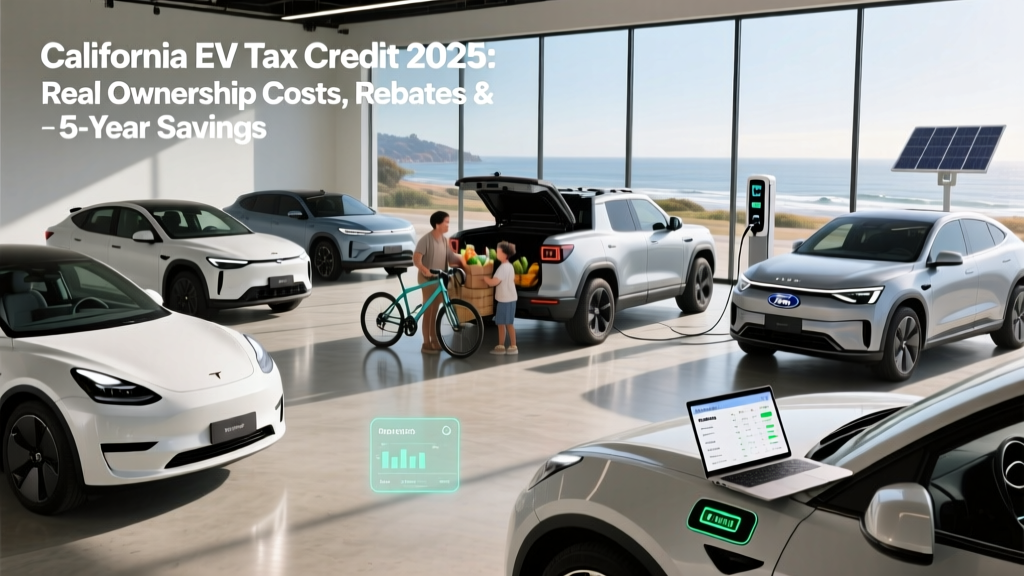
The Real Math Behind California EV Ownership in 2025–2026
If you're shopping for an electric vehicle in California, the headline number — a potential $7,500 federal credit stacked on top of state rebates and utility incentives — looks compelling. But the actual cost of owning an EV over five years depends on variables most buyers gloss over: insurance premiums that run 15–25% higher than gas equivalents, depreciation curves that have flattened but remain model-dependent, and charging costs that swing wildly depending on whether you plug in at home on a time-of-use plan or rely on DC fast charging networks.
This guide walks through every dollar: the California EV tax credit landscape for 2025 model-year purchases, the current IRS §30D federal credit rules, a line-by-line five-year total cost of ownership (TCO) comparison, and the fuel, maintenance, insurance, and resale realities that determine whether an EV actually saves you money in the Golden State.
Federal EV Tax Credit: IRS §30D Rules for 2025–2026 Purchases
The federal clean vehicle credit under IRS §30D remains the single largest purchase incentive available to most California EV buyers. As of 2025, eligible buyers can claim up to $7,500 — and critically, this credit can now be transferred at the point of sale, meaning the dealer applies it as an immediate price reduction rather than waiting for a tax refund the following April.
But qualification is not automatic. The credit has three hard gates that disqualify a significant number of vehicles and buyers:
§30D Federal Tax Credit Eligibility Checklist (2025)
- Adjusted Gross Income Caps: $150,000 (single filer), $225,000 (head of household), $300,000 (married filing jointly). Based on the tax year of delivery or the prior year — whichever is lower.
- MSRP Caps: Vans, SUVs, and pickup trucks must have an MSRP at or below $80,000. Sedans and other passenger cars are capped at $55,000.
- Battery Sourcing Requirements: The $7,500 credit splits into two halves — $3,750 for critical minerals sourced from the U.S. or FTA-partner countries, and $3,750 for battery components manufactured or assembled in North America. These percentages escalate annually. Vehicles that fail either test receive only $3,750 or $0.
- Foreign Entity of Concern (FEOC) Restriction: Vehicles with battery components from a FEOC (effective 2024) or critical minerals from a FEOC (effective 2025) are disqualified entirely, regardless of other criteria.
- Final Assembly: Vehicle must undergo final assembly in North America.
- Point-of-Sale Transfer: Buyers can elect to transfer the credit to the dealer at purchase, receiving the benefit immediately. You must still meet income requirements; if your AGI exceeds the cap at tax time, you may owe the credit back to the IRS.
As of early 2025, vehicles like the Tesla Model Y (Long Range and Performance), Ford F-150 Lightning, Hyundai Ioniq 5, and Chevrolet Equinox EV have qualified for the full $7,500 — but this list shifts as automakers restructure supply chains. Always verify a specific VIN on the fueleconomy.gov credit lookup tool before signing paperwork.
California EV Incentives: State Rebates, Utility Programs & Local Programs
California does not currently offer a direct state tax credit that stacks on top of the federal §30D credit in the same way some states do. However, the state's incentive landscape remains one of the strongest in the country through a patchwork of programs:
California Incentive Programs (2025)
Clean Vehicle Rebate Project (CVRP): Previously offered up to $2,000 for new EV purchases. Funding has been exhausted and the program transitioned — check Energy.ca.gov for current availability.
Clean Cars 4 All (CC4A): Targets low-income residents replacing older gas vehicles. Grants up to $9,500 toward a new or used EV, PHEV, or hybrid for qualifying households in specific air districts (Bay Area, San Joaquin Valley, South Coast).
Utility Rebates: Pacific Gas & Electric (PG&E), Southern California Edison (SCE), and San Diego Gas & Electric (SDG&E) each offer rebates — typically $500–$1,500 — for new EV purchases and/or Level 2 home charger installations. These vary by utility territory and change annually.
Carpool Lane (HOV) Access: California's Clean Air Vehicle (CAV) decal program grants solo HOV lane access to qualifying EVs. Decals are subject to income caps for new applicants (gross income ≤ $250,000 single / $350,000 joint as of recent rules) and expire after a set period. This non-cash benefit can be worth thousands in time savings for commuters on the 405, 10, or 101.
Local Air District Incentives: Programs like the Bay Area Air Quality Management District (BAAQMD) and South Coast AQMD periodically offer additional rebates, particularly for fleet and low-income purchases.
Note: State and local incentives change frequently based on funding cycles. Always verify current availability with the administering agency before relying on a specific rebate amount in your purchase budget.
5-Year Total Cost of Ownership: EV vs. Gas Car in California
To make this concrete, here's a head-to-head five-year TCO comparison between a popular EV and a comparably priced gas vehicle, using California-specific electricity rates and gas prices. The comparison uses a 2025 Hyundai Ioniq 5 SEL (AWD, 84 kWh usable battery, EPA 290 miles, $50,200 MSRP) versus a 2025 Toyota RAV4 XLE AWD (gas, EPA 30 MPG combined, $32,350 MSRP).
| Cost Category | Hyundai Ioniq 5 SEL AWD (EV) | Toyota RAV4 XLE AWD (Gas) |
|---|---|---|
| Purchase Price (MSRP) | $50,200 | $32,350 |
| Federal Tax Credit (§30D) | −$7,500 | $0 |
| Estimated CA Utility Rebate | −$1,000 | $0 |
| Effective Purchase Price | $41,700 | $32,350 |
| Home Level 2 Charger Install | $1,200 (avg.) | $0 |
| Fuel/Energy (75,000 mi) | $3,940 (home TOU avg. $0.18/kWh, 3.5 mi/kWh) | $9,375 (30 MPG, $3.75/gal avg.) |
| Maintenance (5 yr) | $1,200 (tire rotations, cabin filter, fluid top-off) | $3,500 (oil changes, filters, brake pads, transmission fluid) |
| Insurance (5 yr total) | $12,500 ($2,500/yr avg.) | $9,500 ($1,900/yr avg.) |
| Estimated Depreciation (5 yr) | $20,850 (50% of effective price) | $14,560 (45% of MSRP) |
| 5-Year Total Cost | $81,390 | $69,285 |
| Cost Per Mile | $1.09 | $0.92 |
Key takeaway: Even with $8,500 in combined federal and utility incentives, the Ioniq 5 costs roughly $12,100 more over five years in this scenario — driven primarily by higher purchase price, steeper depreciation in absolute dollars, and elevated insurance premiums. The fuel and maintenance savings are real ($7,735 combined over five years), but they don't fully bridge the gap at these price points.
However, this math shifts dramatically in the EV's favor if you: (a) choose a lower-priced EV like the Equinox EV ($33,600 MSRP, eligible for full $7,500), (b) charge primarily on off-peak rates below $0.12/kWh, (c) drive more than 15,000 miles annually, or (d) value HOV lane access at $2,000–$5,000+ per year in time savings.
Charging vs. Gas: The Real Cost-Per-Mile Math
The single biggest operational savings for California EV owners comes at the "pump" — but only if you charge at home. Here's how the per-mile fuel cost breaks down across different charging scenarios, using a 3.5 miles-per-kWh efficiency average (representative of mainstream crossovers like the Ioniq 5, Model Y, and Mach-E):
| Charging Method | Rate ($/kWh) | Cost Per Mile | Annual Cost (15k mi) |
|---|---|---|---|
| Home Off-Peak (TOU plan, overnight) | $0.10–$0.14 | $0.03–$0.04 | $450–$600 |
| Home Standard Rate (no TOU) | $0.25–$0.35 | $0.07–$0.10 | $1,050–$1,500 |
| Public Level 2 (ChargePoint, EVgo L2) | $0.35–$0.55 | $0.10–$0.16 | $1,500–$2,400 |
| DC Fast Charging (EA, Tesla Supercharger) | $0.40–$0.65 | $0.11–$0.19 | $1,650–$2,850 |
| Gas Vehicle (30 MPG, $4.50/gal CA avg.) | — | $0.15 | $2,250 |
At home on a time-of-use plan charging overnight, an EV's fuel cost drops to roughly $0.03–$0.04 per mile — a quarter of what you'd pay for gas. But if you rely exclusively on DC fast charging at $0.55/kWh, your per-mile cost can actually exceed a fuel-efficient gas car. This is the single most important variable in EV ownership economics: home charging access is what makes the math work.
California's average residential electricity rate hovers around $0.28–$0.32/kWh (among the highest in the continental U.S.), but TOU plans from PG&E, SCE, and SDG&E offer off-peak rates as low as $0.09–$0.14/kWh between midnight and 6 AM. If you can install a Level 2 charger and shift charging to these windows, annual fuel savings versus a 25–30 MPG gas car typically run $1,200–$1,800 per year at 15,000 miles driven.
Maintenance Savings: Where EVs Quietly Win
EVs eliminate the majority of routine powertrain maintenance. No oil changes, no transmission fluid, no spark plugs, no timing belts, no exhaust system repairs. Regenerative braking significantly extends brake pad life — many EV owners report original brake pads lasting 80,000–100,000+ miles because the motor handles the bulk of deceleration.
| Service Item | EV Cost | Gas Car Cost |
|---|---|---|
| Oil Changes (6–8 over 5 yr) | $0 | $400–$700 |
| Engine Air Filter | $0 | $100–$200 |
| Transmission Fluid | $0 | $150–$300 |
| Brake Pads (front + rear) | $0–$300 (often not needed by 75k) | $600–$1,200 |
| Coolant Flush | $0–$150 (extended intervals) | $200–$400 |
| Cabin Air Filter | $150–$300 | $150–$300 |
| Tire Rotation / Replacement | $800–$1,400 (EV tires wear faster due to weight + torque) | $600–$1,200 |
| Total Estimated | $950–$2,150 | $2,200–$4,300 |
The maintenance gap is real but modest in absolute dollars — expect to save $500–$2,000 over five years. One often-overlooked offset: EVs are heavier (the Ioniq 5 AWD weighs 4,600 lbs vs. the RAV4 AWD at 3,600 lbs) and deliver instant torque, which accelerates tire wear. Budget for a tire replacement one interval earlier than you would on a gas car, especially if you opt for performance-oriented rubber.
Insurance Cost Reality: The EV Premium
EV insurance costs consistently run 15–30% higher than equivalent gas vehicles. The reasons are structural, not arbitrary:
- Higher repair costs: EV battery packs are expensive to replace if damaged (even minor underbody impacts can total a vehicle). Many body shops require specialized EV certification.
- Higher vehicle values: Insurers base collision/comprehensive premiums on replacement cost, and EVs carry higher MSRPs than comparable gas models.
- Limited repair network: Fewer certified EV collision centers means longer repair times and higher labor rates.
- Total-loss frequency: Battery damage that would be a repairable frame issue on a gas car can trigger a total-loss declaration on an EV due to battery replacement costs ($10,000–$25,000 depending on pack size and chemistry).
For the Ioniq 5 in our comparison, expect annual premiums of $2,200–$2,800 in California (varies by ZIP code, driving record, coverage level) versus $1,600–$2,100 for the RAV4. Over five years, that's a $3,000–$3,500 insurance gap.
Mitigation strategies: Shop quotes from insurers with dedicated EV programs (some offer discounts for home charging or ADAS-equipped vehicles), consider higher deductibles, and bundle with homeowner's or renter's insurance. The gap narrows as the EV market matures and repair networks expand.
EV Depreciation and Resale Value: A Moving Target
EV depreciation has been volatile. In 2023–2024, Tesla's aggressive price cuts triggered a wave of accelerated depreciation across the used EV market, with some models losing 50–60% of value in two years. As of 2025, the market has largely stabilized, but EVs still depreciate faster on average than top-selling gas vehicles like the RAV4, Civic, or Tacoma.
Current five-year depreciation expectations by segment:
- Tesla Model 3 / Model Y: 45–55% (stabilizing after 2023–2024 price-cut turbulence)
- Mainstream EV crossovers (Ioniq 5, EV6, Mach-E): 45–55%
- Luxury EVs (iX, EQS, Taycan): 55–65% (luxury segments depreciate steeply regardless of powertrain)
- Budget EVs (Equinox EV, Bolt EV/EUV): 40–50% (strong demand at lower price points supports residuals)
- Gas crossovers (RAV4, CR-V): 35–45%
The depreciation gap is narrowing as battery longevity data improves (most modern NMC and LFP packs retain 85–90%+ capacity at 100,000 miles), as charging infrastructure expands, and as used-EV demand grows. But if you plan to sell at the three- to five-year mark, depreciation remains the single largest cost line item — and one where gas cars still hold an edge.
One important offset: the used EV tax credit (§25E) allows buyers of qualifying pre-owned EVs to claim up to $4,000 (30% of sale price, capped). This supports used-EV demand and indirectly props up resale values for current owners.
Decision Framework: Does a California EV Purchase Make Financial Sense?
Choose an EV if:
- You can install a Level 2 charger at home and access off-peak TOU electricity rates (the single biggest cost lever).
- Your household income qualifies for the full §30D credit and you're buying an eligible vehicle (effective price reduction of $7,500+).
- You drive 12,000+ miles per year — higher mileage amplifies fuel and maintenance savings.
- Your commute includes HOV lanes where a CAV decal saves meaningful time.
- You plan to keep the vehicle 7+ years, allowing depreciation to flatten and savings to compound.
Stick with gas or hybrid if:
- You rent or lack reliable home charging access — public-only charging erases most fuel savings.
- You drive fewer than 8,000 miles per year — low mileage means savings never offset the price premium.
- You plan to sell or trade within 3 years — depreciation will likely outweigh operational savings.
- Your budget is under $30,000 and you need maximum vehicle for the dollar — the used gas/hybrid market offers better value at this price point.
Frequently Asked Questions
How much does it really cost to own an EV over 5 years in California?
Based on our comparison of a mainstream EV crossover versus a gas equivalent, expect a 5-year TCO of roughly $75,000–$85,000 for the EV (after incentives) versus $65,000–$72,000 for a comparably equipped gas car. The EV's higher purchase price, insurance, and depreciation typically outweigh its fuel and maintenance savings at current price points — unless you drive high mileage, charge cheaply at home, or select a lower-priced EV model.
Do I qualify for the federal $7,500 EV tax credit?
Eligibility depends on three factors: your adjusted gross income (≤$150k single / $300k joint), the vehicle's MSRP (≤$80k for SUVs/trucks, ≤$55k for sedans), and battery component/critical-mineral sourcing. The FEOC restrictions tightened in 2025 and disqualify some previously eligible models. Verify your specific vehicle at fueleconomy.gov and consult a tax professional for income-related questions. The point-of-sale transfer option lets you apply the credit as an immediate discount at the dealer.
How much do I save on fuel and maintenance with an EV?
California EV owners charging at home on off-peak rates typically save $1,200–$1,800 annually on fuel versus a 25–30 MPG gas car. Maintenance savings add another $500–$1,500 over five years (no oil changes, fewer brake replacements, no transmission service). Combined, expect $1,500–$2,500 in annual operational savings — meaningful, but not enough to bridge a large purchase-price gap in three years or fewer.
Are EVs more expensive to insure in California?
Yes — typically 15–30% more than a comparable gas vehicle. Higher repair costs, expensive battery replacement, and a smaller network of certified EV body shops drive the premium. For a $45,000–$50,000 EV crossover in California, budget $2,200–$2,800 per year for full coverage. Shop multiple insurers and ask about EV-specific discounts.
How well do EVs hold their value compared to gas cars?
EVs currently depreciate 45–55% over five years on average, versus 35–45% for popular gas crossovers. The gap has narrowed since the 2023–2024 market correction but persists. Battery health data (most packs retain 85–90%+ at 100k miles), the used-EV tax credit, and expanding charging infrastructure are improving residuals. If you plan to own the vehicle 7+ years, the depreciation gap becomes less relevant.
What California-specific incentives exist beyond the federal credit?
Key programs include utility rebates ($500–$1,500 from PG&E, SCE, SDG&E for vehicle purchase and/or charger installation), the Clean Cars 4 All program (up to $9,500 for low-income residents replacing old gas cars), and the HOV lane CAV decal (significant time savings for commuters). The original CVRP ($2,000 rebate) has been exhausted and restructured. Check Energy.ca.gov and your local utility for current offerings.