Quick Answer: How the California EV Carpool Sticker Works
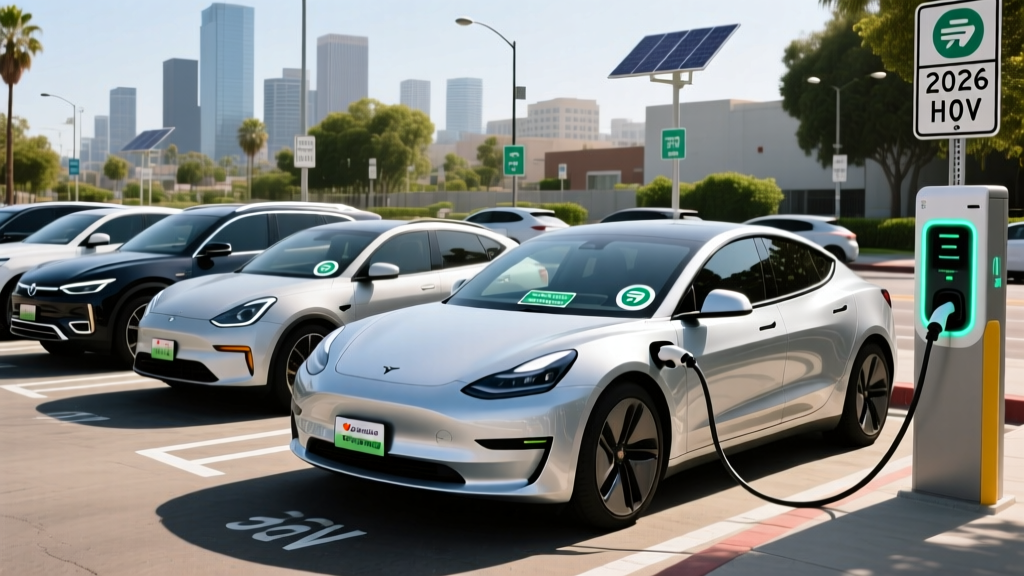
The short version: California's Clean Air Vehicle (CAV) decal program lets qualifying electric vehicles drive solo in carpool (HOV) lanes. As of 2026, only battery-electric vehicles (BEVs) and fuel-cell electric vehicles (FCEVs) with an MSRP at or below the program's income-adjusted price cap are eligible. Plug-in hybrids (PHEVs) are no longer accepted into the program. The decal is valid through September 30, 2027 for stickers issued in 2025–2026. If your income exceeds the cap, you can still get a decal—but only if the vehicle's MSRP falls under the program's vehicle price ceiling. The sticker itself is free; you just pay the $25 DMV processing fee.
For commuters in the Bay Area, Los Angeles, San Diego, or Sacramento, HOV lane access can shave 20–40 minutes off a daily round-trip commute. That time savings alone makes the California EV carpool sticker one of the most valuable state-level EV incentives in the country. But the eligibility rules have tightened significantly since the program's early days. Here's exactly what you need to know to qualify, what it's worth in real dollars, and which EVs make the most sense for HOV lane commuters in 2026.
Who Qualifies for the California EV Carpool Sticker in 2026?
The California DMV administers the CAV decal program under authority from the California Air Resources Board (CARB). Eligibility hinges on three factors: vehicle type, purchase date, and in some cases buyer income.
Vehicle Eligibility
As of 2026, only the following powertrains qualify:
- Battery-Electric Vehicles (BEVs): All zero-emission battery-electric cars, SUVs, and trucks that appear on CARB's approved list.
- Fuel-Cell Electric Vehicles (FCEVs): Hydrogen fuel-cell models like the Toyota Mirai and Hyundai Nexo.
Plug-in hybrids (PHEVs) are no longer eligible. The program phased out PHEV eligibility for new applicants starting in 2024. If you bought a PHEV and received a decal before the cutoff, your existing sticker may still be valid through its expiration date, but you cannot apply for a new one with a PHEV purchase in 2026.
Income and Price Caps
California introduced income-based eligibility tiers to focus the program on buyers who need the incentive most. Here's the 2026 framework:
- Buyers below the income cap (roughly $150,000 single / $300,000 joint filer, subject to annual adjustment): Eligible for a CAV decal on any qualifying BEV or FCEV regardless of vehicle MSRP.
- Buyers above the income cap: Eligible only if the vehicle's base MSRP falls below the program's vehicle price cap (approximately $60,000–$65,000 for 2026, adjusted annually).
Check the current thresholds on the CARB Clean Air Vehicle Decals page, as these figures are indexed and may shift mid-year.
Application Basics
You apply after purchasing or leasing the vehicle. Required documents include your California vehicle registration and proof of purchase. Processing typically takes 2–4 weeks, and the decal ships directly to your address. The fee is nominal—around $25 as of 2026.
Real-World Value: How Much Time and Money Does HOV Access Save?
The headline benefit of the California EV carpool sticker is solo HOV lane access, but quantifying that benefit requires looking at actual commute data.
Time Savings by Corridor
Based on Caltrans commute data and INRIX traffic analytics for major California corridors:
- I-405 (West LA to Valley): HOV lane saves an average of 18–25 minutes per direction during peak hours.
- I-880 / I-680 (East Bay): 12–20 minutes saved per direction.
- I-5 (Sacramento to Bay Area fringe): 10–15 minutes during AM/PM peaks.
- I-15 (San Diego inland corridor): 15–22 minutes saved during rush.
For a commuter saving 35 minutes daily (round trip), that's roughly 145 hours per year—nearly four full work weeks reclaimed. At a blended hourly rate of $40, that time is worth approximately $5,800 annually.
Toll Lane Discounts
CAV decal holders also receive a 15%–25% discount on express lane tolls (FasTrak) on corridors like the I-110, I-10, SR-237, and I-680 express lanes. For a frequent toll-lane user spending $80/month on express tolls, the CAV discount saves roughly $12–$20/month, or $144–$240/year.
Cost Breakdown: EV with Carpool Sticker vs. Gas Car
To evaluate whether the California EV carpool sticker justifies an EV purchase, we need to compare total ownership costs. Below is a 5-year cost model for a popular commuter EV—the 2026 Hyundai Ioniq 6 SE Long Range—against a comparable gas sedan, the 2026 Toyota Camry LE.
| Cost Category (5-Year) | 2026 Hyundai Ioniq 6 SE LR (BEV) | 2026 Toyota Camry LE (Gas) |
|---|---|---|
| Base MSRP | $42,600 | $29,500 |
| Federal §30D Tax Credit (estimated, subject to IRS sourcing rules) | −$3,750 to −$7,500 | $0 |
| California CVRP Rebate (income-qualified) | −$2,000 to −$7,000 | $0 |
| Effective Purchase Price (mid-range incentives) | ~$33,100 | $29,500 |
| Fuel / Electricity (15,000 mi/yr × 5 yrs) | $3,375 (home L2 at $0.15/kWh, 3.5 mi/kWh) | $8,925 (28 MPG combined at $4.20/gal) |
| Maintenance (5 yrs) | $1,200 | $3,500 |
| Insurance (5 yrs, avg CA premium) | $9,500 | $7,800 |
| HOV Time Value (35 min/day × 240 days × 5 yrs × $40/hr) | $28,000 saved | $0 |
| Net 5-Year Cost (before time value) | ~$47,175 | ~$49,725 |
| Net 5-Year Cost (with HOV time savings) | ~$19,175 | ~$49,725 |
Key takeaway: On pure cash costs, the Ioniq 6 and Camley are nearly break-even over 5 years once you factor in fuel savings, lower EV maintenance, and available incentives. But when you assign even a modest dollar value to HOV lane time savings, the EV with a California carpool sticker delivers dramatically better value for commuters on congested corridors.
Note: The federal §30D tax credit eligibility depends on battery sourcing, critical mineral content, MSRP caps ($55,000 for sedans), and buyer income limits ($150K single / $300K joint). Always verify current-year rules with a tax professional.
Best EVs for the California Carpool Sticker in 2026
Not every EV makes equal sense as an HOV-lane commuter. The ideal candidate balances range, charging speed, price (to stay under MSRP caps), and daily usability. Here are five strong picks across price tiers:
| Model | EPA Range | Battery (kWh) | Peak DC Charge (kW) | 10–80% Time | Base MSRP |
|---|---|---|---|---|---|
| 2026 Hyundai Ioniq 6 SE LR | 361 mi | 77.4 kWh (NMC) | 240 kW | ~18 min | $42,600 |
| 2026 Tesla Model 3 Long Range | 341 mi | 79 kWh (NMC) | 250 kW | ~15 min | $47,740 |
| 2026 Chevrolet Equinox EV 3RS | 319 mi | 85 kWh (NMC) | 150 kW | ~32 min | $36,500 |
| 2026 Nissan Ariya Engage | 289 mi | 63 kWh (NMC) | 130 kW | ~35 min | $39,590 |
| 2026 Tesla Model Y Long Range | 320 mi | 78.1 kWh (NMC) | 250 kW | ~15 min | $49,990 |
Real-world range caveat: EPA estimates assume mixed driving at moderate temperatures. Expect 10–20% less range at sustained highway speeds (70–80 mph) and up to 30% less in cold weather (below 40°F). For most California commuters, cold-weather loss is minimal except in mountain passes and high-desert routes.
Charging reality: Peak kW rates are sustained only between roughly 10–50% state of charge. Above 80%, charging slows dramatically to protect the battery—this is the charge-curve taper. Plan DC fast-charging stops around 10–80% for optimal speed. According to fueleconomy.gov, most modern BEVs deliver their rated efficiency in combined driving but drop 15–25% in highway-only use.
Common Misconceptions About the California CAV Decal
| Myth | Fact |
|---|---|
| "Any plug-in hybrid qualifies for the carpool sticker." | PHEVs were phased out of new CAV decal eligibility starting in 2024. Only BEVs and FCEVs qualify for new applications in 2026. |
| "The sticker lasts forever once you get it." | Decals issued in 2025–2026 expire on September 30, 2027. California periodically resets the program; there is no guarantee of renewal or extension. |
| "You need to earn under a certain income to qualify." | Income caps apply to the uncapped MSRP tier. Higher-income buyers can still qualify if the vehicle MSRP is below the program's price ceiling (~$60K–$65K). |
| "Buying used gets you a carpool sticker." | CAV decals are tied to the original application. A used EV may have an existing valid decal that transfers, but you cannot apply for a new one on a used-vehicle purchase. Always verify decal status and expiration with the DMV before buying a used EV for HOV access. |
| "The carpool sticker guarantees HOV lane access everywhere." | The CAV decal grants solo access to designated HOV lanes and carpool lanes on California highways. It does not grant access to transit-only lanes, bus lanes, or certain restricted corridors. Always check signage. |
First-Time EV Buyer Checklist: What to Know Before Applying
If you're buying an EV primarily for the California carpool sticker, make sure you've addressed these practical ownership factors first:
Home Charging Access
This is the single biggest determinant of EV satisfaction. Level 2 home charging (240V, 32–48 amps / 7.7–11.5 kW) adds roughly 25–44 miles of range per hour of charging. Most commuters need only 2–3 hours of overnight charging to replenish a day's driving. If you live in an apartment or condo without charging access, you'll rely on public DC fast chargers and workplace charging—which adds time and cost. Budget $800–$2,500 for a Level 2 home charger installation (equipment + licensed electrician + permit), or more if your electrical panel needs an upgrade to 200 amps.
Driving Patterns
If your daily round-trip commute is under 80 miles, virtually any modern BEV will work. If you regularly drive 200+ miles in a day or take frequent road trips, prioritize models with 300+ EPA miles and DC fast-charging above 200 kW (like the Ioniq 6 or Model 3 LR).
Insurance Costs
EV insurance premiums in California run 15–30% higher than comparable gas cars, driven by higher repair costs and battery replacement risk. Get quotes before purchasing—the difference can be $200–$500/year depending on the model and your driving record.
Federal Tax Credit Complexity
The §30D credit is not a guaranteed $7,500. It depends on:
- Vehicle MSRP cap ($55,000 sedans / $80,000 SUVs and trucks)
- Buyer income cap ($150K single / $300K joint)
- Battery component and critical mineral sourcing (phased thresholds increase yearly)
- Point-of-sale transfer option (you can apply the credit at purchase rather than waiting for tax filing)
As of 2026, many popular EVs qualify for only $3,750 (meeting one of the two sourcing thresholds) rather than the full $7,500. Always verify on the IRS Clean Vehicle Credits page before committing to a purchase.
Decision Framework: Should You Buy an EV for the Carpool Sticker?
Buy an EV and apply for the CAV decal if:
- Your daily commute uses a congested HOV-eligible corridor (I-405, I-880, I-5, I-15, US-101) and you'd save 15+ minutes per direction.
- You have access to Level 2 home charging or reliable workplace charging.
- Your annual mileage is 10,000–20,000 miles (maximizing fuel savings).
- The EV's MSRP falls within the CAV program's price cap (or your income is below the threshold).
- You plan to keep the vehicle 4+ years to amortize the higher upfront cost.
Consider a gas car or wait if:
- Your commute doesn't use HOV-eligible highways—without time savings, the EV value proposition depends entirely on fuel and maintenance savings.
- You lack reliable home or workplace charging and your area has sparse DC fast-charging infrastructure.
- You need a vehicle above the CAV price cap and your income exceeds the threshold.
- You plan to move out of California within 2 years (the decal has no value outside CA, and some states' incentives don't transfer).
- You tow frequently or drive in extreme cold regularly—both significantly reduce real-world range.
Consider a PHEV (without the sticker) if:
- You want some electric commuting (25–40 miles electric-only) but need gas flexibility for long road trips.
- You don't qualify for the CAV decal due to PHEV ineligibility but still want partial electrification.
- Your HOV corridor commute is short enough that the time savings don't justify the EV price premium.
Frequently Asked Questions
How long does the California EV carpool sticker last?
Decals issued in 2025 and 2026 are valid through September 30, 2027. California has historically extended or renewed the program, but there is no legislative guarantee. Always plan your purchase assuming the current expiration date.
Can I transfer the carpool sticker if I sell my EV?
Yes, in most cases. The CAV decal is tied to the vehicle, not the owner. When you sell the EV, the decal transfers to the new owner for the remainder of its validity period. This can add resale value, especially for commuters. However, the new owner cannot apply for a new decal on the same vehicle once the current one expires.
Do I need the sticker to use HOV lanes if I have passengers?
No. Any vehicle with the required number of occupants (typically 2+ or 3+, depending on the corridor) can use HOV lanes. The CAV decal allows solo driving in those lanes.
Does the California carpool sticker work in other states?
No. The CAV decal is a California-only program. Other states have their own HOV exemption programs (for example, Arizona, Colorado, and Georgia have offered similar perks), but California's sticker has no validity across state lines.
What happens if I get a CAV decal and the program rules change?
Your existing decal remains valid through its printed expiration date regardless of rule changes. However, renewal or replacement after expiration would be subject to whatever rules are in effect at that time.
Are Tesla vehicles eligible for the California carpool sticker?
Yes. All Tesla BEVs (Model 3, Model Y, Model S, Model X) qualify for the CAV decal as long as the purchase meets the applicable income or MSRP cap requirements. Note that the Model S and Model X exceed the $55,000 sedan / $80,000 SUV MSRP caps for the federal tax credit, but the California CAV decal has its own separate price thresholds.