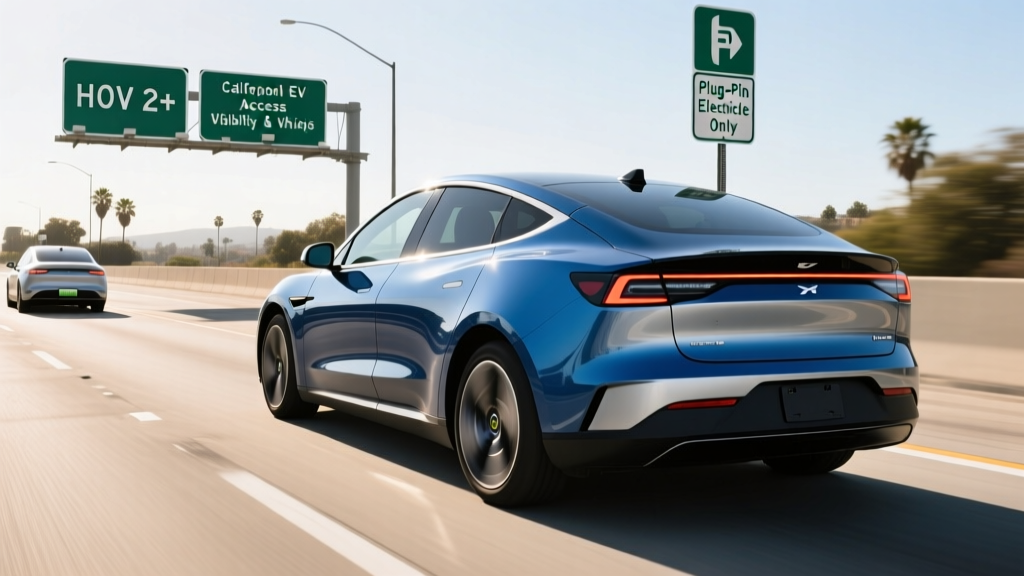
If you're a solo commuter in California spending 45+ minutes crawling through the 405, 101, or 10, the promise of zipping past gridlock in the carpool lane is one of the most tangible perks of going electric. But the rules have changed significantly since the program's early days, and not every EV buyer qualifies.
The CAV decal program is administered through the California DMV in coordination with the California Energy Commission. Understanding exactly who qualifies, what the decal gets you, and whether the time savings make economic sense requires digging into the current rules — which is what this guide covers.
How the California CAV Decal Program Works in 2026
California's HOV lane access for clean vehicles has gone through multiple legislative phases. The original "white sticker" and "green sticker" programs that allowed any Tesla Model S buyer to cruise the carpool lane solo are gone. The current framework, governed by California Vehicle Code §21655.9, prioritizes equitable access.
Eligibility Requirements
To receive a CAV decal granting solo HOV lane access, your purchase must meet all of the following criteria:
- Vehicle type: A new battery-electric vehicle (BEV), fuel-cell electric vehicle (FCEV), or qualifying plug-in hybrid (PHEV) with a minimum all-electric range. The vehicle must appear on the CARB's eligible vehicle list.
- Income cap: Your household income must be at or below 80% of the area median income (AMI) for your county of residence. For Los Angeles County in 2026, that threshold is approximately $72,000 for a household of four. Bay Area thresholds are higher due to higher AMI figures.
- Vehicle price cap: New vehicles must have an MSRP at or below $60,000 (adjusted periodically). Used EV purchases may qualify under separate thresholds.
- California registration: The vehicle must be registered to a California address.
Decal Duration and Expiration
Decals issued under the current income-based program are valid for a defined period — typically through a set calendar year plus a transition grace period (e.g., decals issued in 2025 expire January 1, 2029, with a 90-day transition window). Always check the California DMV CAV decal page for your specific decal's expiration date, as these have been revised multiple times by the legislature.
Common CAV Decal Misconceptions
| Myth | Fact |
|---|---|
| "Any EV gets carpool lane access." | Only vehicles with an active, DMV-issued CAV decal may use HOV lanes solo. The decal must be physically affixed to the vehicle. |
| "I bought a Tesla, so I get the sticker." | Higher-income buyers purchasing new EVs above the price cap or above the income threshold no longer receive CAV decals under the current program. |
| "The decal lasts forever." | All decals have expiration dates set by statute. Expired decals must be removed, and solo HOV access ends. |
| "Hybrids qualify the same as EVs." | Only PHEVs meeting minimum electric-range requirements and appearing on CARB's eligible list qualify. Conventional hybrids (HEVs) do not qualify. |
| "Used EVs never qualify." | Used EV purchases can qualify if the buyer meets income requirements and the vehicle hasn't already received a decal under a prior owner (rules vary — confirm with DMV). |
Which EVs Qualify? Eligible Models Under the Price Cap
The $60,000 MSRP cap eliminates many premium EVs from CAV decal eligibility. Here's a snapshot of popular models that do fall within the cap (base trims, before options):
| Model | Type | Base MSRP (2026) | EPA Range | Battery |
|---|---|---|---|---|
| Chevrolet Equinox EV LT | BEV | $33,600 | 319 mi | 85 kWh NMC |
| Hyundai Ioniq 5 SE | BEV | $42,900 | 303 mi | 77.4 kWh NMC |
| Tesla Model 3 RWD | BEV | $38,990 | 272 mi | 60 kWh LFP |
| Nissan Leaf SV Plus | BEV | $36,190 | 212 mi | 60 kWh NMC |
| Toyota RAV4 Prime (PHEV) | PHEV | $44,900 | 42 mi EV / 38 MPG | 18.1 kWh NMC |
| Hyundai Tucson PHEV | PHEV | $39,400 | 33 mi EV / 35 MPG | 13.8 kWh NMC |
Notable exclusions: Tesla Model Y Long Range ($47,990 base but often configured above $60K), Rivian R1S, BMW iX, Mercedes EQS, and most luxury EVs exceed the cap when options are added. Always confirm your exact configuration's MSRP against the threshold before relying on decal eligibility.
The Real Value of HOV Lane Access: Time and Money Saved
For California commuters, carpool lane access isn't just a perk — it can be the single most valuable benefit of EV ownership, often exceeding the fuel savings. Here's how the economics break down for a typical LA Basin commuter doing 40 miles round-trip, 5 days a week.
Annual Commute Savings: EV with HOV Access vs. Gas Car
| Factor | Gas Car (No HOV) | EV with CAV Decal | Annual Difference |
|---|---|---|---|
| Fuel / Energy Cost | $3,120 (gas at $4.80/gal, 25 MPG) | $780 (home charging at $0.18/kWh) | +$2,340 saved |
| Commute Time (daily) | 90 min (mixed traffic) | 55 min (HOV lane) | ~145 hrs/yr saved |
| Maintenance | $900/yr (oil, brakes, filters) | $250/yr (tires, cabin filter, wipers) | +$650 saved |
| Insurance (avg California) | $2,100/yr | $2,600/yr (EV premium) | −$500 |
| Net Annual Benefit | — | — | ~$2,490/yr + 145 hours |
Assumptions: 10,400 commute miles/yr, California avg electricity rate $0.18/kWh, EV efficiency 3.5 mi/kWh, gas at $4.80/gal. Time savings based on Caltrans HOV lane speed differential studies. Actual savings vary by route and utility rate. Check fueleconomy.gov for model-specific MPGe and kWh/100mi data.
At a conservative $25/hour value of your time, those 145 saved hours are worth $3,625 annually — meaning the total economic benefit of HOV lane access plus fuel savings can exceed $6,100 per year for heavy commuters. Over a 4-year decal lifespan, that's roughly $24,400 in combined time and cost savings.
EV vs. Gas vs. Hybrid: Which Gets You in the Carpool Lane?
Not all electrified vehicles earn HOV access. Here's a clear breakdown of what qualifies and what doesn't:
| Vehicle Type | CAV Decal Eligible? | Example | Key Constraint |
|---|---|---|---|
| BEV (Battery Electric) | ✅ Yes (if income + price qualify) | Tesla Model 3, Chevy Equinox EV | Must meet income & MSRP caps |
| PHEV (Plug-in Hybrid) | ✅ Yes (if on CARB list) | RAV4 Prime, Tucson PHEV | Min. electric range required; income cap |
| HEV (Conventional Hybrid) | ❌ No | Toyota Prius (non-PHEV) | No plug = no decal, regardless of MPG |
| FCEV (Hydrogen Fuel Cell) | ✅ Yes | Toyota Mirai | Income cap applies; limited fueling infra |
| Gas Vehicle | ❌ No | Any ICE vehicle | Requires 2+ occupants for HOV use |
Critical nuance for PHEV buyers: A plug-in hybrid like the RAV4 Prime gives you 42 miles of electric-only range for daily commuting plus a gas engine for road trips — and it still qualifies for a CAV decal. For buyers who can't install a home charger or who frequently drive beyond EV range, a PHEV can be the smarter carpool-lane play. The trade-off is that PHEV maintenance costs are higher than BEVs (you still have an engine, oil changes, and a more complex drivetrain).
Real-World Ownership: What First-Time EV Buyers Need to Know
If you're buying an EV specifically for carpool lane access, here are the ownership realities that affect your daily experience beyond the HOV sticker:
Home Charging Access Is the Biggest Variable
California's HOV lane savings assume you're charging at home at residential electricity rates (~$0.18/kWh on average, with time-of-use plans offering off-peak rates as low as $0.09/kWh in some PG&E and SCE territories). If you're relying exclusively on public DC fast charging, your per-mile energy cost jumps to $0.12–$0.20/mile — rivaling or exceeding a fuel-efficient gas car.
Before buying, confirm:
- Can you install a Level 2 (240V) home charger? A NEMA 14-50 outlet installation typically costs $800–$2,000 if your electrical panel has capacity. A full panel upgrade (100A → 200A) can add $2,000–$5,000.
- Do you have access to workplace charging? Many California employers offer free or subsidized Level 2 charging, which can offset the lack of home charging.
- What's your apartment/HOA situation? California's "right to charge" law (Civil Code §4745) limits HOA restrictions on EV charging, but practical installation in multi-unit dwellings remains challenging.
Cold-Weather and Highway Range Reality
California's climate is generally EV-friendly, but if you commute over the Grapevine (I-5) or through the mountains to Tahoe, expect 20–35% range loss in cold temperatures combined with high-speed climbing. A 303-mile EPA-rated Ioniq 5 may deliver ~210 miles on a winter Sierra crossing. Plan accordingly for road trips beyond your daily commute.
Federal Tax Credit Interaction
If you qualify for the CAV decal based on income, you may also qualify for the federal §30D clean vehicle tax credit (up to $7,500, available as a point-of-sale transfer). However, the §30D credit has its own income caps ($150K single / $300K joint), MSRP caps ($55K cars / $80K SUVs and trucks), and battery sourcing requirements that change annually. A $38,990 Tesla Model 3 RWD may qualify for both the CAV decal and the full $7,500 federal credit — effectively bringing the purchase price to ~$31,490 before state rebates. Consult a tax professional to confirm your specific eligibility.
Decision Framework: Should You Buy an EV for the Carpool Lane?
If-Then Decision Guide
- ✅ IF you commute 30+ miles daily on congested freeways (405, 10, 101, 880, 5) AND your household income is below 80% AMI AND you can install a home Level 2 charger → An EV with a CAV decal is likely your single highest-value transportation decision. Expect $5,000–$7,000+ in combined annual time and cost savings.
- ✅ IF your income exceeds the CAV cap AND you want HOV access → You cannot get solo HOV access through a new EV purchase under current rules. Consider carpooling with a colleague, or check if your existing older CAV decal (from prior programs) is still valid.
- ✅ IF you commute long distances but can't charge at home → Consider a PHEV like the RAV4 Prime. You get HOV access, 42 miles of EV range for daily driving, and a gas engine for flexibility. Public-charging-only BEV ownership erodes your cost savings significantly.
- ⚠️ IF your commute is under 15 miles on surface streets OR your route doesn't include HOV-equipped freeways → The carpool lane benefit is minimal for you. Evaluate the EV purchase on fuel savings, maintenance reduction, and environmental goals alone.
- ⚠️ IF you're buying a used EV → Decal transferability is limited. Confirm with the DMV whether the specific used vehicle can receive a new decal under your ownership before purchasing specifically for HOV access.
Step-by-Step: Getting Your CAV Decal
- Confirm vehicle eligibility: Check the CARB eligible vehicle list and verify the trim's MSRP is at or below $60,000.
- Verify your income eligibility: Find your county's AMI figure (published by HUD) and confirm your household income is at or below 80% of that number.
- Purchase or lease the vehicle from a California dealer. Obtain the purchase/lease agreement showing MSRP.
- Apply through the DMV: Submit form REG 256 (or the current equivalent) along with proof of income, vehicle purchase documentation, and proof of California registration. Applications are processed online or by mail.
- Receive and affix your decal: Once approved, the DMV mails your CAV decal. It must be affixed to the rear quarter panels per the included instructions. Only then may you legally use HOV lanes solo.
- Track your expiration date: Set a calendar reminder for your decal's expiration. Driving with an expired decal in the HOV lane solo is a traffic violation subject to fines of $490+.
Frequently Asked Questions
Can I use the carpool lane with an expired CAV decal?
No. Once your decal expires, you must remove it from the vehicle and you lose solo HOV lane access. Driving solo in the carpool lane without a valid decal is a moving violation with fines starting at $490 in California. CHP enforcement of HOV lane violations is active, especially during commute hours.
Do I need the CAV decal if I have passengers in the car?
No. Any vehicle (gas, hybrid, or electric) with the required number of occupants (typically 2+ or 3+ depending on the specific HOV lane signage) may use the carpool lane. The CAV decal only grants solo access. If you always commute with a passenger, you don't need the decal.
Does the California EV carpool lane benefit apply on all freeways?
CAV decals grant access to any HOV lane marked with the diamond symbol on California state highways and freeways. This includes the extensive HOV networks in Los Angeles, the Bay Area, San Diego, Sacramento, and the Inland Empire. Some express lanes (like the 91 Express Lanes and I-15 Express Lanes) may require a FasTrak transponder in addition to or instead of a CAV decal — check local toll authority rules.
What happens to my HOV access if I move out of California?
The CAV decal is tied to California vehicle registration. If you register your vehicle in another state, your California CAV decal becomes invalid. Other states have their own HOV exemption programs (e.g., Virginia, Maryland, Colorado), but eligibility and rules differ.
Is the CAV decal program guaranteed to continue?
No. The program exists by legislative authority and has been modified, extended, and restructured multiple times. Future legislatures could alter income thresholds, price caps, decal durations, or phase out the program entirely. Do not base a purchase decision solely on the assumption that the program will remain unchanged indefinitely.
Can I get both the CAV decal and the $7,500 federal tax credit?
Yes, these are separate programs with separate eligibility criteria. You can potentially stack the CAV decal (state HOV access), the federal §30D credit (up to $7,500 point-of-sale), the California Clean Fuel Rebate (if active and income-qualified), and utility company EV rebates. The combined incentives can significantly reduce effective purchase price, but each has distinct income, vehicle, and sourcing requirements — verify each independently.
Rules and thresholds for the California CAV decal program are subject to legislative change. Always verify current eligibility requirements with the California DMV and consult a tax professional regarding federal credit eligibility. Data in this article reflects program rules as of early 2026.