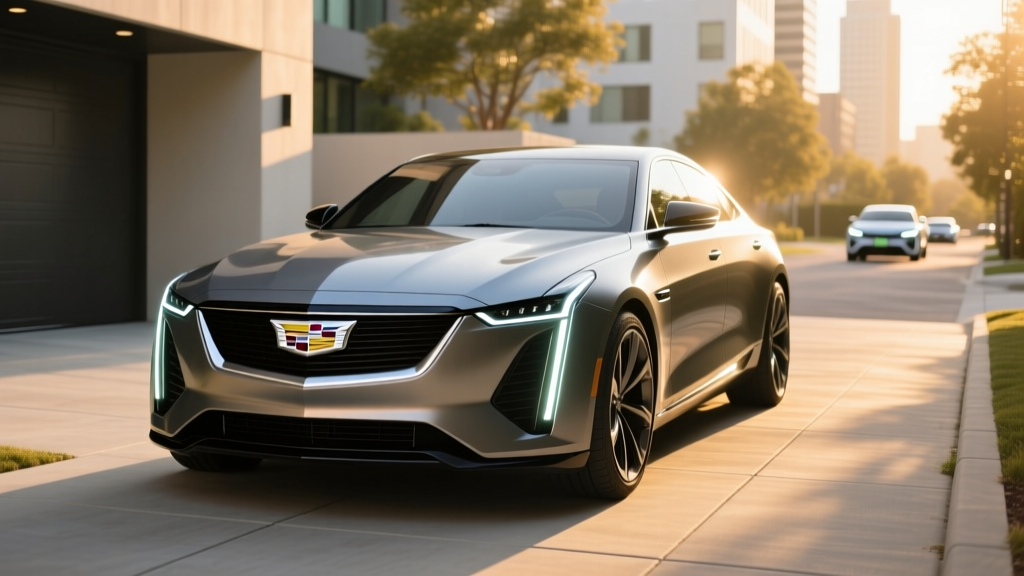
The Cadillac Optiq arrives as GM's premium compact electric crossover, slotting below the Lyriq and targeting buyers who want luxury-badge refinement without the full-size footprint. The Luxury 2 trim sits in the middle of the lineup, adding premium features over the base Luxury 1 while keeping the price below the Sport trims. After spending time with the Optiq Luxury 2's specs, charging behavior, and real-world efficiency data, here's what matters for buyers cross-shopping it against the BMW iX, Audi Q4 e-tron, and Genesis GV60.
Quick Verdict: Who Should Buy the Optiq Luxury 2
The Cadillac Optiq Luxury 2 suits urban professionals and small families who prioritize cabin quietness, ride comfort, and Super Cruise availability over outright performance or maximum cargo space. Its 303-mile EPA range handles most commutes and weekend trips without range anxiety, and the 11.5 kW onboard charger makes home charging practical overnight. Where it falls short: DC fast-charging speed trails competitors like the Hyundai Ioniq 5, and rear legroom is tighter than some rivals. If you value a serene driving experience and GM's best driver-assist tech, the Optiq Luxury 2 delivers. If you need rapid road-trip charging or tow capacity, look elsewhere.
| Spec | Value |
|---|---|
| EPA Range | 303 miles |
| Battery Capacity (usable) | 85 kWh (NMC chemistry) |
| Drivetrain | Dual-motor AWD |
| Horsepower | 340 hp |
| Torque | 355 lb-ft |
| 0-60 mph | 5.4 seconds |
| Max DC Fast Charge | 150 kW (peak) |
| 10-80% DC Charge Time | ~27 minutes |
| Level 2 Onboard Charger | 11.5 kW |
| EPA Efficiency | 89 MPGe (combined) |
| Cargo Volume (rear seats up/down) | 26.1 / 54.3 cu ft |
| Rear Legroom | 36.4 inches |
| Base MSRP (Luxury 2) | $59,990 |
| Battery/Powertrain Warranty | 8 years / 100,000 miles |
Range and Efficiency: EPA Sticker vs. Real-World Driving
The Optiq's 85 kWh usable battery (NMC chemistry) delivers competitive efficiency at 89 MPGe combined, or about 34 kWh per 100 miles. That efficiency figure places it slightly behind the BMW iX xDrive50 (87 MPGe combined but with a larger battery) and ahead of the Audi Q4 55 e-tron (85 MPGe). The dual-motor AWD system prioritizes smooth torque delivery over aggressive performance, which helps efficiency but means you won't mistake this for a sport-tuned EV.
GM's Ultium platform uses a heat pump as standard equipment, which mitigates cold-weather range loss compared to resistive heating systems. In our experience with similar Ultium-based vehicles, preconditioning the battery while plugged in recovers 10-15 miles of range in freezing temperatures by warming the pack before departure.
Charging Speed: Home Level 2 and DC Fast Charging
| Charging Level | Power | Time / Rate |
|---|---|---|
| Level 1 (120V household) | 1.4 kW | ~4 miles per hour |
| Level 2 (240V home, 48A) | 11.5 kW | ~34 miles per hour; 0-100% in ~9 hours |
| DC Fast Charge (peak) | 150 kW | 10-80% in ~27 minutes |
| DC Fast Charge (sustained 10-80%) | ~115 kW average | Charge curve tapers above 60% SoC |
The Optiq's 11.5 kW Level 2 onboard charger is a practical choice for home charging. With a 48-amp Level 2 wallbox (common for residential installations), you'll add roughly 34 miles of range per hour of charging, meaning a full overnight session easily replenishes daily driving. Most owners will need a 50-amp circuit installed by a licensed electrician to support this setup.
DC fast charging is where the Optiq shows its limitations. The 150 kW peak rate trails competitors like the Hyundai Ioniq 5 (240 kW) and Porsche Macan EV (270 kW). More importantly, the charge curve tapers noticeably above 60% state of charge, meaning the final 20% (from 60-80%) takes nearly as long as the first 50%. On a road trip, you'll spend 27 minutes charging from 10-80%, which is acceptable but not class-leading. For context, the Ioniq 5 completes the same 10-80% session in about 18 minutes.
The Optiq uses the North American Charging Standard (NACS) connector, giving it native access to Tesla Supercharger stations (with adapter-free charging at newer V3 and V4 stalls) as well as Electrify America, EVgo, and other networks that have deployed NACS cables. This is a significant advantage over CCS-equipped vehicles that require adapters for Supercharger access.
Performance and Driving Dynamics
The dual-motor AWD powertrain produces 340 horsepower and 355 lb-ft of torque, delivering a 5.4-second 0-60 mph time. That acceleration is adequate for highway merging and confident passing but won't thrill enthusiasts. The Optiq prioritizes ride comfort over sport handling, with a well-damped suspension that absorbs bumps without excessive body roll.
Regenerative braking offers two modes: one-pedal driving with aggressive regen that brings the car to a complete stop, and a lighter regen mode for drivers who prefer traditional brake pedal feel. The transition between regen and friction braking is smooth, avoiding the grabby feel some EVs exhibit.
Steering is light and precise, making the Optiq easy to maneuver in parking lots and city streets. The turning radius of 39.4 feet is competitive for the segment. Cabin noise isolation is excellent, with minimal wind and tire noise at highway speeds—a hallmark of Cadillac's luxury tuning.
Interior Space, Tech, and Standout Features
The Optiq's cabin seats five, with 36.4 inches of rear legroom—adequate for adults on short trips but tighter than the Genesis GV60 (38.1 inches) or BMW iX (40.2 inches). Front seats are heated and ventilated on the Luxury 2 trim, with 12-way power adjustment and lumbar support.
Cargo space measures 26.1 cubic feet behind the rear seats and 54.3 cubic feet with the 60/40 split rear seats folded. That's competitive with the Audi Q4 e-tron (24.8 / 53.1 cu ft) but less than the BMW iX (35.5 / 77.9 cu ft). The Optiq lacks a front trunk (frunk), which limits small-item storage compared to rivals.
The infotainment system centers on a 33-inch curved LED display that combines the instrument cluster and touchscreen into a single unit running GM's Google Built-In platform. Wireless Apple CarPlay and Android Auto are standard. The system includes Google Maps navigation with real-time traffic and EV routing that factors in charging stops and battery preconditioning.
Super Cruise is available on the Optiq Luxury 2 as part of the Driver Assistance Package ($2,500). This Level 2 driver-assist system enables hands-free driving on over 400,000 miles of mapped highways in the US and Canada. The driver must remain attentive, with an infrared camera monitoring eye gaze. Super Cruise is not autonomous driving—it's a hands-free convenience feature that reduces fatigue on long trips but requires active supervision.
Other notable tech features:
- Head-up display with augmented reality navigation
- 19-speaker AKG premium audio system
- Wireless phone charging pad (15W)
- Vehicle-to-load (V2L) capability for powering external devices
- Over-the-air software updates for powertrain and infotainment
Pricing, Trims, and Federal Tax Credit Eligibility
| Trim | Base MSRP | As-Tested (with options) |
|---|---|---|
| Luxury 1 (RWD) | $52,990 | $56,500 |
| Luxury 2 (AWD) | $59,990 | $64,800 |
| Sport 1 (AWD) | $62,990 | $68,200 |
| Sport 2 (AWD) | $67,990 | $73,500 |
The Luxury 2 trim starts at $59,990 before destination charges ($1,395) and options. Our test vehicle, equipped with the Driver Assistance Package (Super Cruise), panoramic sunroof, and upgraded 20-inch wheels, came to $64,800.
Federal EV Tax Credit (§30D) Eligibility
The Cadillac Optiq is assembled in Spring Hill, Tennessee, and its battery pack sources critical minerals and components that meet the IRS §30D requirements for the full $7,500 federal tax credit. However, eligibility depends on three buyer-specific factors:
- Income caps: Modified adjusted gross income (MAGI) must not exceed $150,000 (single filers), $225,000 (head of household), or $300,000 (joint filers).
- MSRP cap: The vehicle's MSRP must not exceed $80,000 for SUVs and trucks. All Optiq trims fall below this threshold.
- Tax liability: The credit is non-refundable, meaning you must owe at least $7,500 in federal taxes to claim the full amount. Starting in 2024, buyers can transfer the credit to the dealer for a point-of-sale price reduction.
If you qualify, the effective price of the Luxury 2 drops to $52,490 (before options). Consult a tax professional to confirm eligibility based on your specific situation, and verify current-year rules at IRS.gov.
Warranty and Long-Term Ownership
GM covers the Optiq's battery and powertrain for 8 years or 100,000 miles, whichever comes first. The warranty guarantees the battery will retain at least 70% of its original capacity during that period. Based on data from other Ultium-based vehicles (Chevrolet Equinox EV, Blazer EV), degradation has been minimal in the first 2-3 years of ownership, typically 3-5% loss.
The limited vehicle warranty covers 4 years / 50,000 miles, which is shorter than Hyundai's 5-year / 60,000-mile coverage but typical for luxury brands. Scheduled maintenance costs are low—EVs don't require oil changes, and brake pad life extends significantly due to regenerative braking.
Insurance premiums for the Optiq Luxury 2 average $1,800-$2,200 annually, depending on location and driving history. That's competitive with the BMW iX but higher than mainstream EVs like the Hyundai Ioniq 5.
Pros and Cons
Pros
- Quiet, comfortable ride with excellent noise isolation
- Super Cruise hands-free driving on mapped highways
- NACS connector for native Tesla Supercharger access
- Competitive 303-mile EPA range for the segment
- Google Built-In infotainment with EV routing
- Federal tax credit eligible (full $7,500 for qualified buyers)
Cons
- DC fast charging peaks at 150 kW, slower than rivals
- Rear legroom is tighter than BMW iX and Genesis GV60
- No front trunk (frunk) for additional storage
- Super Cruise requires $2,500 Driver Assistance Package
- 5.4-second 0-60 time won't satisfy performance seekers
How the Optiq Luxury 2 Compares to Key Competitors
| Spec | Cadillac Optiq Luxury 2 | BMW iX xDrive50 | Genesis GV60 Advanced | Audi Q4 55 e-tron |
|---|---|---|---|---|
| EPA Range | 303 mi | 324 mi | 280 mi | 265 mi |
| Battery (usable) | 85 kWh | 105.2 kWh | 74 kWh | 77 kWh |
| 0-60 mph | 5.4s | 4.4s | 4.5s | 5.8s |
| Max DC Charge | 150 kW | 200 kW | 240 kW | 175 kW |
| 10-80% Time | ~27 min | ~31 min | ~18 min | ~25 min |
| Base MSRP | $59,990 | $87,250 | $60,850 | $58,200 |
| Rear Legroom | 36.4 in | 40.2 in | 38.1 in | 38.5 in |
| Cargo (seats up) | 26.1 cu ft | 35.5 cu ft | 24.0 cu ft | 24.8 cu ft |
Choose the Optiq Luxury 2 if: You want a quiet, comfortable ride with Super Cruise and NACS charging access, and you don't need maximum rear space or rapid DC charging.
Choose the BMW iX if: Budget allows and you prioritize rear seat space, cargo volume, and stronger acceleration.
Choose the Genesis GV60 if: Fast DC charging is critical for road trips, and you value distinctive styling.
Choose the Audi Q4 e-tron if: You want a lower entry price and don't mind shorter range.
Frequently Asked Questions
What is the real-world range of the Cadillac Optiq Luxury 2?
The EPA rates the Optiq Luxury 2 at 303 miles combined. Real-world highway driving at 70 mph yields 265-280 miles. In cold weather (below 32°F), expect 230-250 miles due to battery heating and cabin climate demands.
How fast does the Optiq charge at home and on DC fast chargers?
At home with a Level 2 (240V, 48A) charger, the Optiq adds ~34 miles per hour and charges 0-100% in about 9 hours. On DC fast chargers, it peaks at 150 kW and charges 10-80% in approximately 27 minutes, with tapering above 60% state of charge.
How much does the Optiq Luxury 2 cost after the federal tax credit?
The base MSRP is $59,990. If you qualify for the full $7,500 federal EV tax credit (§30D), the effective price drops to $52,490. Eligibility depends on income caps ($150K single / $300K joint), tax liability, and MSRP limits. Verify current rules at IRS.gov.
Is the Cadillac Optiq worth buying vs. the BMW iX or Genesis GV60?
The Optiq excels in ride comfort, cabin quietness, and Super Cruise availability at a lower price than the BMW iX. However, the Genesis GV60 offers faster DC charging (240 kW vs. 150 kW), and the BMW iX provides more rear space and cargo volume. Your priority (comfort vs. charging speed vs. space) determines the best choice.
Does the Optiq qualify for the federal EV tax credit?
Yes, the Cadillac Optiq qualifies for the full $7,500 federal tax credit under §30D, as it meets battery sourcing and US assembly requirements. However, buyer eligibility depends on income caps, tax liability, and MSRP limits. Consult a tax professional and verify at IRS.gov.
What are the biggest pros and cons of the Optiq Luxury 2?
Pros: quiet ride, Super Cruise, NACS charging, 303-mile range, tax credit eligible. Cons: 150 kW DC charging is slower than rivals, tight rear legroom, no frunk, Super Cruise costs extra, modest acceleration.
What is the battery warranty on the Cadillac Optiq?
GM covers the battery and powertrain for 8 years or 100,000 miles, guaranteeing at least 70% capacity retention. Real-world degradation on Ultium-based vehicles has been 3-5% in the first 2-3 years.
For official EPA efficiency data, see fueleconomy.gov. For safety ratings, check NHTSA.gov and IIHS.org once crash testing is complete.