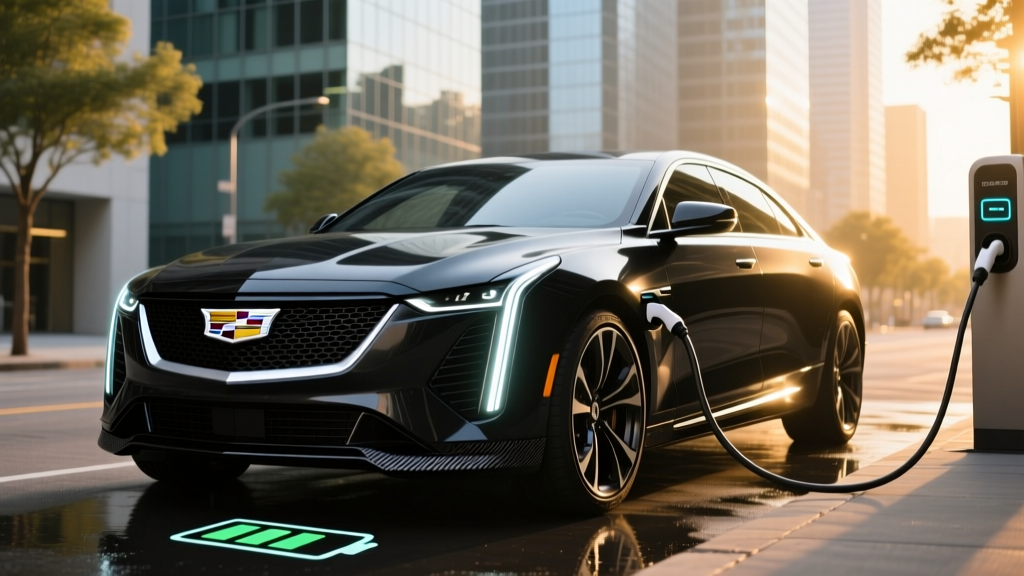
Quick Verdict: Compact Luxury With a Spacious Footprint
The 2026 Cadillac Optiq slots into the premium compact electric SUV segment as a slightly smaller sibling to the Lyriq, riding GM's Ultium platform with standard dual-motor all-wheel drive. Buyers researching the Cadillac Optiq length will find it measures approximately 189.4 inches bumper to bumper — roughly 8 inches shorter than the Lyriq — yet it still delivers competitive cargo volume and a 300-plus-mile EPA range estimate. It targets urban professionals and small families who want Cadillac luxury without the full-size footprint, and it arrives at a starting price designed to undercut European rivals while leveraging the federal EV tax credit.
| Spec | Value |
|---|---|
| Overall Length | ~189.4 in |
| Wheelbase | ~116.3 in |
| Width (excl. mirrors) | ~74.8 in |
| Height | ~64.2 in |
| EPA Range (est.) | ~300–310 mi |
| Battery (usable, est.) | ~85 kWh (NMC, Ultium) |
| Drivetrain | Dual-motor AWD |
| Horsepower | ~340 hp (est.) |
| 0–60 mph | ~5.5 sec (est.) |
| Max DC Fast Charge | ~190 kW (est.) |
| 10–80% DC Time | ~28 min (est.) |
| Level 2 Home Rate | 11.5 kW (~34 mi/hr) |
| Base MSRP | ~$52,900 (est.) |
| Battery/Powertrain Warranty | 8 yr / 100,000 mi |
Note: The Optiq was announced for the Chinese market first and is expected for North America. Specs above reflect preliminary GM Ultium-platform data and may shift at final U.S. launch. Always confirm with cadillac.com before purchasing.
Dimensions Deep Dive: Cadillac Optiq Length and Interior Space
The headline number — Cadillac Optiq length of approximately 189.4 inches — places it squarely against the BMW iX3, Genesis GV60, and Audi Q4 e-tron in exterior footprint. That length is short enough for tight urban parking garages yet long enough to preserve a comfortable wheelbase of around 116.3 inches, which is where interior volume actually comes from.
Passenger and Cargo Dimensions
- Front legroom: ~41.5 in
- Rear legroom: ~37.8 in
- Cargo behind rear seats: ~26 cu ft
- Cargo with rear seats folded: ~57 cu ft
- Frunk: Not expected (Ultium crossover platform typically omits front trunk)
Compared to the Lyriq's 196.7-inch length and 33-inch rear legroom, the Optiq sacrifices a few inches of stretch-out space but retains enough for two adults on longer trips. The cargo area is competitive with the Audi Q4 e-tron (24.8 cu ft) and comfortably exceeds the Genesis GV60 (24.0 cu ft). If maximum rear-seat room is your priority, the Lyriq or Tesla Model Y remain the better calls.
Range, Efficiency, and Real-World Expectations
GM's Ultium platform pairs an NMC (nickel manganese cobalt) lithium-ion battery pack with an estimated usable capacity of 85 kWh. The Optiq is expected to earn an EPA range rating around 300–310 miles, with combined efficiency near 95 MPGe (roughly 34 kWh per 100 miles).
Real-World Range Reality Check
EPA sticker: ~300–310 miles
Highway driving (70–75 mph): Expect ~250–270 miles. Aerodynamic drag hits all SUVs hard at interstate speeds.
Cold weather (below 32°F): Plan on 20–30% range loss, dropping effective range to ~210–250 miles depending on cabin heat usage.
Combined mixed driving: Most owners will see 270–290 miles in temperate conditions.
The Optiq is expected to include a heat pump, which mitigates cold-weather losses compared to resistive heating. Preconditioning the battery while plugged in before departure will also preserve range in winter.
Charging Speed: DC Fast, Level 2, and Home Setup
Charging speed is where Ultium-platform vehicles have drawn some criticism versus Hyundai/Kia's 800V E-GMP architecture. The Optiq runs on a 400V system, which caps peak DC fast-charge rates below the 350 kW leaders but still delivers practical road-trip performance.
| Charging Level | Power | Miles Added per Hour | Notes |
|---|---|---|---|
| Level 1 (120V) | ~1.4 kW | ~4 mi/hr | Emergency/top-up only |
| Level 2 (240V, 48A) | 11.5 kW | ~34 mi/hr | Full charge overnight (~9 hrs) |
| DC Fast (peak) | ~190 kW | — | 10–80% in ~28 min |
| DC Fast (sustained avg) | ~120–140 kW | — | Peak tapers above 60% SoC |
Understanding the Charge Curve
The ~190 kW peak applies only in a narrow state-of-charge window (roughly 15–40%). Above 60% SoC, the rate tapers significantly to protect battery longevity — this is normal for NMC chemistry and every EV on the market. A 10–80% session at a capable 200+ kW station should take about 28 minutes. Plan road-trip stops around the 20–80% sweet spot; charging from 80–100% is painfully slow and rarely worth the wait.
At home, an 11.5 kW Level 2 wallbox on a 60-amp circuit (48 amps continuous) replenishes roughly 34 miles of range per hour. A full 0–100% charge takes around 9 hours — plug in at 10 PM and you're full by morning. Installation for a Level 2 home charger typically runs $800–$2,000 including the unit and electrician, assuming your panel has capacity. Older homes may need a $1,500–$3,000 panel upgrade.
Performance and Driving Dynamics
Standard dual-motor AWD delivers an estimated 340 horsepower and 325 lb-ft of torque, translating to a 0–60 mph time around 5.5 seconds. That's brisk for daily driving and highway merging, though it doesn't chase the sub-4-second territory of a Tesla Model Y Performance or BMW iX M60.
The Ultium platform's low center of gravity and near-50/50 weight distribution give the Optiq composed handling for its class. Expect a ride tuned toward comfort over sportiness — Cadillac's traditional strength. Regenerative braking offers multiple levels, and one-pedal driving should be available via the steering-wheel paddles or infotainment toggle.
Pricing, Trims, and Federal Tax Credit Eligibility
The Optiq is positioned as Cadillac's entry-level electric offering, undercutting the Lyriq (which starts around $58,500) and targeting the $50,000–$60,000 luxury EV space.
| Trim | Est. MSRP | After §30D Credit (if eligible) |
|---|---|---|
| Luxury (base) | ~$52,900 | ~$45,400 |
| Sport | ~$56,500 | ~$49,000 |
| Premium Luxury | ~$60,000 | ~$52,500 |
Federal Tax Credit: §30D Rules to Know
The Optiq's eligibility for the up-to-$7,500 federal EV tax credit under IRS Section 30D depends on several requirements that shift regularly:
- MSRP cap: SUVs must be priced at or below $80,000. All Optiq trims should clear this.
- Buyer income cap: AGI must not exceed $150,000 (single), $225,000 (head of household), or $300,000 (joint). Check your prior-year or current-year AGI, whichever is lower.
- Battery sourcing: A percentage of critical minerals and battery components must be sourced from the U.S. or FTA partners. GM has been aggressively onshoring Ultium supply chains, but exact eligibility can change mid-year.
- Point-of-sale transfer: As of 2024, buyers can transfer the credit to the dealer at purchase for an immediate price reduction rather than waiting to claim it on taxes.
Always verify current eligibility at fueleconomy.gov and consult a tax professional before counting on the credit in your budget.
Tech, Safety, and Driver Assistance
The Optiq's cabin centers on GM's latest infotainment architecture, expected to feature a curved 33-inch LED display spanning the instrument cluster and touchscreen — similar to the Lyriq's setup. Wireless Apple CarPlay and Android Auto, a Wi-Fi hotspot, and over-the-air updates should be standard.
ADAS: Super Cruise Availability
GM's Super Cruise — a hands-free highway driving system on pre-mapped divided roads — is expected to be available on higher trims or as an option package. Crucially, Super Cruise is an SAE Level 2 driver-assistance system, meaning the driver must remain attentive and ready to take over at all times. It is not autonomous driving. The system uses a driver-monitoring camera to confirm eye attention, and it disengages if you look away for too long.
⚠️ Driver Assist Is Not Self-Driving
Super Cruise, Tesla Autopilot, Ford BlueCruise, and all current consumer ADAS are SAE Level 2. You are the driver. Keep your eyes on the road, hands ready, and do not rely on these systems in construction zones, unmapped roads, or severe weather.
Safety features expected standard include automatic emergency braking with pedestrian detection, lane-keep assist, blind-spot monitoring, rear cross-traffic alert, and adaptive cruise control. IIHS and NHTSA ratings will follow once crash testing is complete.
Competitor Comparison: Is the Optiq Worth It?
The compact luxury EV SUV segment is crowded. Here's how the Optiq stacks up on paper against key rivals:
| Cadillac Optiq | Audi Q4 e-tron | Genesis GV60 | BMW iX3 | |
|---|---|---|---|---|
| Length | ~189.4 in | 180.6 in | 183.7 in | 185.4 in |
| EPA Range | ~300–310 mi | ~242 mi | ~248 mi | Not sold in U.S. |
| Battery | ~85 kWh NMC | 77 kWh NMC | 77.4 kWh NMC | — |
| Max DC Charge | ~190 kW | 135 kW | 240 kW (800V) | — |
| Base MSRP | ~$52,900 | ~$50,500 | ~$53,350 | N/A (U.S.) |
✅ Pros
- Longest expected range in its direct segment (~300+ mi)
- Spacious interior for its exterior Cadillac Optiq length
- Premium cabin materials and large curved display
- Super Cruise hands-free highway capability
- Competitive starting price under $55K
- Likely §30D tax-credit eligible (verify at purchase)
❌ Cons
- DC charging slower than Hyundai/Kia/Genesis 800V rivals
- No frunk for extra cargo
- Rear legroom tighter than Lyriq or Model Y
- Specs still preliminary — final U.S. details TBD
- Cadillac's EV dealer network still expanding
Who Should Buy the Cadillac Optiq?
Decision Framework
Choose the Optiq if: You want a luxury-branded compact EV SUV with 300+ miles of range, a premium cabin, and Super Cruise availability — and you primarily drive in urban/suburban environments where its ~189-inch length is an asset for parking.
Choose the Lyriq if: You need more rear-seat room and cargo space and don't mind spending $5,000+ more.
Choose the Genesis GV60 if: You prioritize faster DC charging (800V architecture, 240 kW peak, 10–80% in ~18 min) and don't need 300 miles of range.
Choose the Tesla Model Y if: Supercharger network access, maximum cargo volume, and proven efficiency matter more than luxury-brand cachet.
Frequently Asked Questions
What is the exact Cadillac Optiq length?
The 2026 Cadillac Optiq measures approximately 189.4 inches from bumper to bumper, with a wheelbase of roughly 116.3 inches. This makes it about 8 inches shorter than the Cadillac Lyriq and competitive with the Audi Q4 e-tron and Genesis GV60 in overall footprint.
What is the real-world range of the Cadillac Optiq?
The EPA estimate is expected around 300–310 miles. In real-world highway driving at 70–75 mph, plan for 250–270 miles. In cold weather below freezing, range can drop 20–30%, yielding roughly 210–250 miles depending on conditions and cabin heating usage.
How fast does the Optiq charge at home and on the road?
At home on a 240V Level 2 charger (11.5 kW), the Optiq adds about 34 miles of range per hour, with a full charge taking roughly 9 hours. On DC fast chargers, it peaks at approximately 190 kW and charges from 10–80% in about 28 minutes, though the rate tapers significantly above 60% state of charge.
Does the Cadillac Optiq qualify for the federal EV tax credit?
It is expected to qualify for up to $7,500 under IRS Section 30D, but eligibility depends on your income (AGI caps apply), the vehicle's final MSRP (must be ≤$80,000 for SUVs), and battery component/critical mineral sourcing requirements that change periodically. Verify at fueleconomy.gov and consult a tax professional.
Is the Optiq better than the Lyriq?
They serve different needs. The Optiq is smaller (~189 in vs. ~197 in), more affordable, and easier to park in cities. The Lyriq offers more rear legroom, cargo space, and a slightly longer range. If budget and urban maneuverability are priorities, the Optiq wins. If space is paramount, the Lyriq is the better pick.
When will the Cadillac Optiq be available in the U.S.?
The Optiq was initially announced for the Chinese market. U.S. availability timing and final specifications have not been confirmed as of early 2026. Check cadillac.com for official updates.