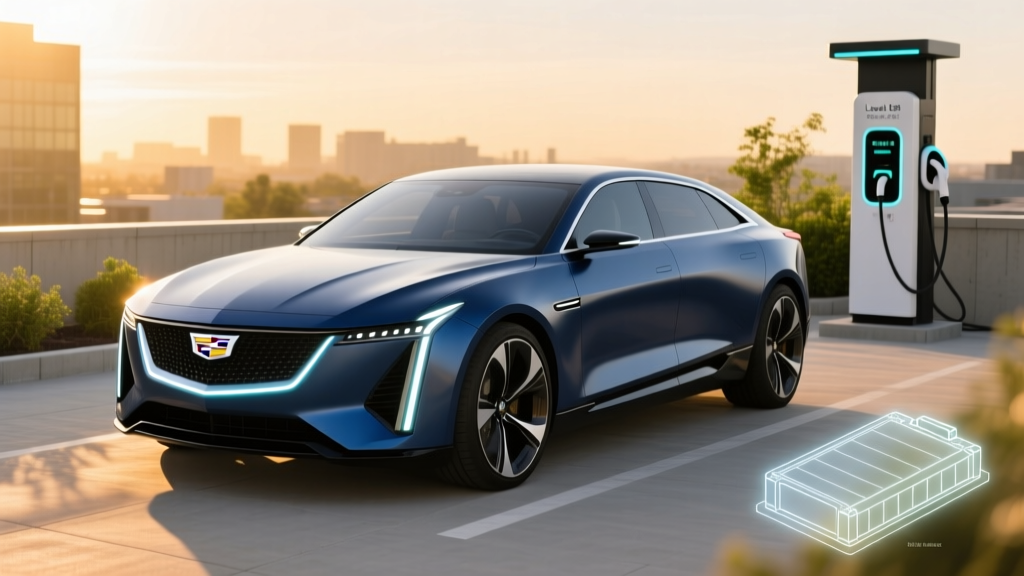
The 2026 Cadillac Optiq enters the luxury compact electric SUV segment with a clear mandate: deliver Cadillac's signature ride refinement and technology on GM's proven Ultium platform, at a price that undercuts European rivals while challenging the Tesla Model Y and Genesis Electrified GV70. After analyzing EPA data, GM's published specs, and early drive impressions, here's what buyers need to know before signing a lease or purchase order.
Quick Verdict: Who the Optiq Is For
The Optiq targets luxury-intent buyers who want a comfortable, tech-forward daily driver with legitimate road-trip capability — not a performance SUV. If you prioritize a quiet cabin, smooth ride quality, and Google-based infotainment over sub-4-second 0-60 times, the Optiq delivers. Its 102 kWh Ultium battery and 190 kW DC fast-charging capability make it viable for cross-country travel, while the starting MSRP under $60,000 keeps it within reach of the federal EV tax credit for eligible buyers.
Range, Battery & Efficiency
The Optiq uses GM's Ultium platform with a 102 kWh usable lithium-ion battery pack. GM has not publicly confirmed the exact cell chemistry split for the Optiq, but the Ultium family uses NMC (nickel manganese cobalt) pouch cells in most configurations, offering higher energy density than LFP at the cost of slightly faster long-term degradation and a lower thermal runaway threshold. For daily driving, this chemistry supports fast charging and delivers the range needed for most commutes and weekend trips.
| Specification | 2026 Cadillac Optiq |
|---|---|
| EPA Range (Luxury AWD) | 307 miles |
| Battery Capacity (Usable) | 102 kWh |
| Battery Chemistry | NMC (Ultium pouch cells) |
| Efficiency (Combined) | 89 MPGe / 36 kWh/100 mi |
| Drivetrain | Dual-motor AWD |
| Horsepower | 340 hp (est.) |
| Torque | 355 lb-ft (est.) |
| 0-60 mph | ~5.5 seconds (est.) |
| Max DC Fast Charge | 190 kW |
| 10-80% DCFC Time | ~27 minutes |
| Level 2 Charge Rate | 11.5 kW (~31 mi/hr) |
| Battery Warranty | 8 years / 100,000 miles |
Efficiency lands at an estimated 89 MPGe combined (36 kWh per 100 miles), which is competitive for a luxury AWD SUV in this weight class but trails the more aerodynamic Tesla Model Y Long Range (122 MPGe combined per fueleconomy.gov). The Optiq's boxier styling and heavier curb weight work against it on the efficiency front, but the larger battery compensates with total range.
Charging Speed: DC Fast & Home Level 2
The Optiq's charging performance is where the Ultium platform proves its worth. On a 190 kW DC fast charger (available at Electrify America and EVgo stations), the Optiq can add roughly 78 miles of range in 10 minutes under ideal conditions. The full 10-80% session takes approximately 27 minutes.
Understanding the charge curve matters here: peak 190 kW is only sustained between roughly 10-40% State of Charge (SoC). Above 50%, the rate tapers to around 120-140 kW, and above 80%, it drops sharply to protect the NMC cells. This is normal behavior for all lithium-ion packs, but it means the last 20% of a charging session takes disproportionately longer. Plan your road-trip stops around the 10-80% window for optimal time efficiency.
| Charging Level | Power | Miles Added per Hour | Full Charge Time |
|---|---|---|---|
| Level 1 (120V outlet) | 1.4 kW | ~3-4 mi/hr | ~72+ hours |
| Level 2 (240V home) | 11.5 kW | ~31 mi/hr | ~9 hours (0-100%) |
| DC Fast (peak) | 190 kW | ~470 mi/hr (peak) | ~27 min (10-80%) |
For home charging, the Optiq's onboard charger accepts up to 11.5 kW on Level 2 (48 amps on a 60-amp circuit). A full overnight charge from empty takes about 9 hours, but most owners will plug in at 20-30% remaining and wake up to a full battery in 6-7 hours. A qualified electrician should install a NEMA 14-50 outlet or hardwired Level 2 station — expect $500-$2,000 for installation depending on your panel capacity and run length.
The Optiq ships with the NACS (North American Charging Standard) port, giving it native access to Tesla Supercharger stations via GM's agreement with Tesla. This significantly expands the reliable public charging network available to Optiq owners, particularly on highway corridors where Supercharger reliability consistently outperforms CCS networks.
Performance & Driving Dynamics
The dual-motor AWD powertrain produces an estimated 340 horsepower and 355 lb-ft of torque, delivering a 0-60 mph time in the 5.5-second range. This is adequate for confident highway merging and passing, but it won't win drag races against the Tesla Model Y Performance (3.5 seconds) or the BMW iX xDrive50 (4.4 seconds).
Where the Optiq differentiates itself is ride quality. GM has tuned the suspension for comfort over sportiness, with well-damped responses to potholes and expansion joints. The steering is light and progressive — not sporty, but precise enough for daily driving. Cabin noise isolation is excellent, aided by the absence of an internal combustion engine and acoustic laminated glass on the front windows.
Regenerative braking offers multiple modes, including a one-pedal driving setting that can bring the vehicle to a complete stop without touching the brake pedal. The transition between regen and friction braking is smooth — a common pain point in some competitors that Cadillac has addressed well.
Interior, Tech & Cargo Space
The Optiq's cabin follows Cadillac's current design language with a dominant 33-inch LED display spanning the instrument cluster and infotainment touchscreen. The system runs Google Built-In, meaning Google Maps, Google Assistant, and the Play Store are native — no phone required for navigation or voice commands. Apple CarPlay and Android Auto are both supported wirelessly.
Notable technology features include:
- Super Cruise availability — GM's Level 2 hands-free driver assistance on mapped divided highways (requires driver attention monitoring)
- Head-up display with augmented reality navigation overlays
- Wireless phone charging pad (15W)
- AKG premium audio system (19 speakers available)
- Over-the-air (OTA) software updates for powertrain, infotainment, and ADAS calibration
Cargo space is practical for the segment:
- Behind rear seats: ~26 cu ft
- Rear seats folded: ~57 cu ft
- Front trunk (frunk): Not available (space used by HVAC and power electronics)
- Rear legroom: ~38.0 inches
- Front headroom: ~40.2 inches
The lack of a frunk is a missed opportunity — competitors like the Tesla Model Y and Ford Mustang Mach-E offer front cargo space. The Optiq's cargo volume trails the Model Y (30/72 cu ft) but matches or exceeds the Genesis Electrified GV70.
Pricing, Trims & Federal Tax Credit
The 2026 Optiq launches in two primary trims:
| Trim | Base MSRP | Est. After §30D Credit | Key Features |
|---|---|---|---|
| Luxury AWD | $59,990 | ~$52,490* | 33" display, Super Cruise ready, 19" wheels, heated seats |
| Sport AWD | $64,990 | ~$57,490* | Black accent package, 21" wheels, sport suspension, AKG audio |
*Estimated effective price assumes full $7,500 federal tax credit eligibility. Actual credit amount varies. See IRS rules below.
- MSRP cap: SUVs/vans/pickups must be under $80,000 (Optiq qualifies)
- Buyer income cap: AGI must not exceed $150,000 (single), $225,000 (head of household), or $300,000 (joint) — per IRS §30D guidelines
- Battery sourcing: Credit splits into two $3,750 halves — critical minerals and battery components must meet escalating domestic-sourcing thresholds. GM has worked to qualify Ultium batteries, but verify current-year eligibility at purchase
- Point-of-sale transfer: Eligible buyers can transfer the credit to the dealer at purchase, reducing the out-of-pocket price immediately (requires dealer registration)
- Verify before buying: Credit eligibility can change with updated Treasury guidance. Confirm with your tax professional and the dealer at time of purchase
Warranty & Ownership Costs
GM backs the Optiq with competitive warranty coverage:
- Battery & electric powertrain: 8 years / 100,000 miles (covers defects and capacity loss below a specified threshold, typically 60-70% retention)
- Bumper-to-bumper: 4 years / 50,000 miles
- Corrosion: 6 years / unlimited miles
- Roadside assistance: 6 years / 70,000 miles
Insurance costs for luxury EVs tend to run 15-25% higher than comparable gas vehicles due to repair complexity and parts cost. Expect annual premiums in the $1,800-$2,600 range depending on your state, driving record, and coverage level. Get quotes before committing to a purchase.
Maintenance savings are real: no oil changes, no spark plugs, no transmission fluid, and brake pads last significantly longer thanks to regenerative braking. Expect annual maintenance costs of $200-$400 versus $600-$1,000 for a comparable gas luxury SUV.
Optiq vs. Key Competitors
| Attribute | Cadillac Optiq | Tesla Model Y LR | Genesis Electrified GV70 |
|---|---|---|---|
| Base MSRP | $59,990 | $48,590 | $68,450 |
| EPA Range | 307 mi | 330 mi | 236 mi |
| Battery | 102 kWh NMC | ~78 kWh NMC | 77.4 kWh NMC |
| Max DCFC | 190 kW | 250 kW | ~210 kW (350V) |
| 0-60 mph | ~5.5 sec | 4.8 sec | 4.5 sec |
| Cargo (rear up) | ~26 cu ft | 30 cu ft | 24 cu ft |
| Hands-Free ADAS | Super Cruise | None (Autopilot is hands-on) | None |
Choose the Tesla Model Y if: Maximum range, lowest price, fastest charging, and the largest cargo area are your top priorities — and you don't mind a minimalist interior and firmer ride.
Choose the Genesis Electrified GV70 if: You want the most opulent interior materials and a sportier driving feel, and you're willing to accept shorter range (236 mi EPA) and higher pricing.
Pros & Cons
✅ Pros
- 307-mile EPA range is competitive for the luxury segment
- NACS port = native Tesla Supercharger access
- Super Cruise hands-free driving on mapped highways
- Excellent ride comfort and cabin quietness
- 190 kW DC fast charging is practical for road trips
- Under $80K MSRP — eligible for §30D tax credit (if buyer qualifies)
- Google Built-In infotainment is responsive and intuitive
❌ Cons
- No front trunk (frunk) — lost cargo utility
- Efficiency (89 MPGe) trails more aerodynamic rivals
- Performance is adequate, not exciting (~5.5 sec 0-60)
- Cargo volume (26 cu ft) trails the Model Y significantly
- Higher starting price than Model Y and some competitors
- Insurance costs likely elevated vs. gas equivalents
- NMC chemistry degrades slightly faster than LFP over 10+ years
Frequently Asked Questions
What is the real-world range of the 2026 Cadillac Optiq?
The EPA rates it at 307 miles, but real-world highway driving at sustained speeds yields approximately 255-275 miles. In cold weather (below freezing), expect 220-240 miles. City driving with frequent regenerative braking opportunities can approach or slightly exceed the EPA figure.
How fast does the Optiq charge at home and on the road?
On a 190 kW DC fast charger, the Optiq charges from 10-80% in approximately 27 minutes, adding about 78 miles in the first 10 minutes. At home on a Level 2 (240V, 48A) charger, it adds roughly 31 miles per hour, fully recharging overnight in about 9 hours from empty.
Does the Cadillac Optiq qualify for the $7,500 federal EV tax credit?
The Optiq's MSRP is under the $80,000 SUV cap, making it potentially eligible. However, the full $7,500 credit depends on the buyer's adjusted gross income (under $150K single / $300K joint), and whether the battery meets current-year critical-mineral and component sourcing requirements under IRS §30D rules. The credit can be transferred to the dealer at point of sale. Verify eligibility with your tax professional before purchasing.
Is the Optiq worth buying over a Tesla Model Y?
It depends on your priorities. The Model Y offers more range (330 mi), faster charging (250 kW), more cargo space (30 cu ft), and a lower starting price ($48,590). The Optiq counters with superior ride comfort, a more traditional luxury interior, Super Cruise hands-free driving, and a quieter cabin. If comfort and brand prestige matter more than spec-sheet dominance, the Optiq is worth serious consideration.
Does the Optiq have Super Cruise?
Yes, Super Cruise is available on the Optiq. It is an SAE Level 2 hands-free driver-assistance system that operates on over 750,000 miles of pre-mapped divided highways in North America. It is not autonomous — the driver must remain attentive and ready to resume control.
What connector does the Optiq use?
The 2026 Optiq is equipped with the NACS (North American Charging Standard) connector, the same plug used by Tesla vehicles. This gives Optiq owners direct access to the Tesla Supercharger network without an adapter, in addition to other NACS-equipped public charging stations.