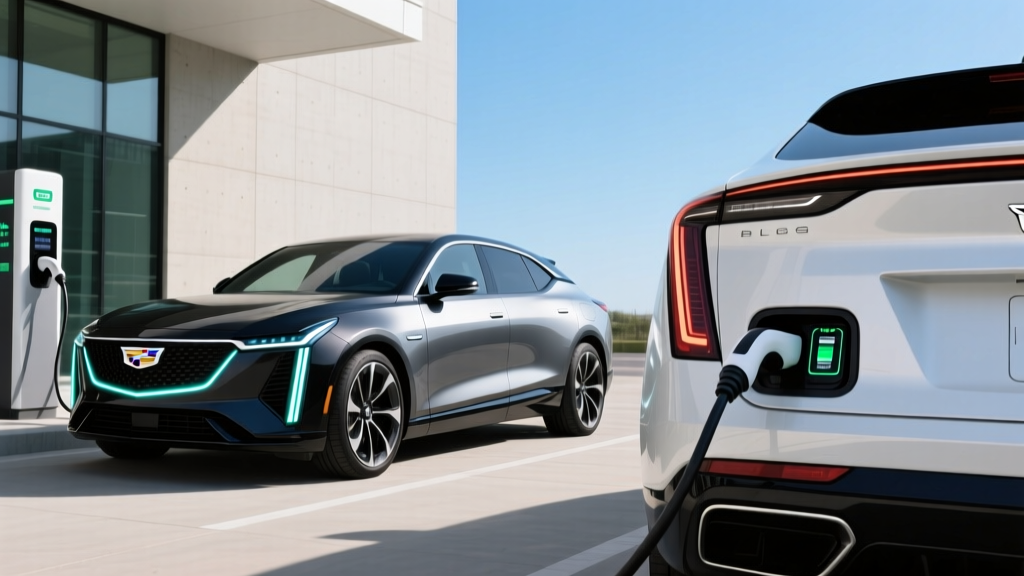
The 2026 Cadillac Optiq arrives as GM's luxury compact electric crossover, slotting below the Lyriq in the brand's EV lineup and targeting buyers who want Cadillac refinement without the Lyriq's larger footprint or price tag. Built on GM's Ultium platform with a 102 kWh usable battery, the Optiq promises over 300 miles of EPA-estimated range and a tech-forward cabin wrapped in one of the most extensive exterior color palettes in the luxury EV segment.
This guide covers every 2026 Cadillac Optiq color option alongside the range, charging, performance, and pricing data you need before configuring one. We'll also break down real-world efficiency expectations and federal tax credit eligibility under current IRS §30D rules.
2026 Cadillac Optiq Colors and Exterior Configurations
Cadillac positions the Optiq as a personalization-forward luxury EV, and the color catalog reflects that. For the 2026 model year, buyers can choose from several exterior paint options across solid, metallic, and premium tri-coat finishes. Color availability varies by trim (Luxury, Sport, and expected Premium Luxury), and some hues are restricted to specific wheel or interior pairings.
Expected Exterior Color Palette
- Crystal White Tricoat — Premium tri-coat; available on all trims. Pairs with both bright and dark exterior accents.
- Black Raven — Solid black; standard across trims, no upcharge.
- Radiant Red Tintcoat — Metallic red with depth-enhancing tint; premium paint upcharge expected (~$495).
- Celestial Metallic — Silver-blue metallic; signature Optiq launch color, available on Sport and Premium Luxury.
- Nimbus Metallic — Light gray metallic; subtle, pairs well with the available 20-inch aero wheels.
- Emerald Lake Metallic — Deep green metallic; Cadillac exclusive, limited to Premium Luxury trim.
- Argent Silver Metallic — Classic silver metallic; no upcharge on most trims.
- Midnight Sky Metallic — Dark blue metallic; available on Sport trim with blacked-out accent package.
Interior colorways typically include Jet Black, Sky Cool Gray with Santorini Blue accents, and a available Sedona Sauvage (warm tan) on upper trims. Cadillac's color configurator on cadillac.com will show exact pairings once ordering opens for your region.
Range, Battery, and Real-World Efficiency
The 2026 Optiq is built on GM's Ultium architecture with a 102 kWh usable lithium-ion battery pack using NMC (nickel-manganese-cobalt) chemistry. This is the same cell format found in the Lyriq and Blazer EV, optimized for energy density over the cycle-life advantages of LFP chemistry.
| Spec | 2026 Cadillac Optiq (Est.) |
|---|---|
| Battery (usable) | 102 kWh, NMC chemistry |
| EPA-estimated range | 300–315 miles (RWD); ~285–300 miles (AWD) |
| MPGe (combined) | ~89 MPGe (EPA est.) |
| Efficiency | ~36 kWh/100 mi |
| Drivetrain | RWD (single motor) or AWD (dual motor) |
| Horsepower | 340 hp (RWD); ~400 hp (AWD) |
| 0–60 mph | ~6.3 sec (RWD); ~4.9 sec (AWD) |
Charging Speed: DC Fast Charge and Home Level 2
Charging capability is a critical differentiator for luxury EV buyers who road-trip. The Optiq supports up to 150 kW peak DC fast charging via its NACS connector (native Tesla Supercharger compatibility, no adapter required for 2026 models). On a Level 2 home charger, the onboard charger accepts up to 19.2 kW, which is among the fastest AC rates in the segment.
| Charging Level | Power (kW) | Speed / Time |
|---|---|---|
| Level 1 (120V standard outlet) | ~1.4 kW | ~4 miles per hour |
| Level 2 (240V, 48A home charger) | 11.5 kW | ~33 miles per hour; full charge ~9 hrs |
| Level 2 (240V, 80A hardwired) | 19.2 kW | ~52 miles per hour; full charge ~5.5 hrs |
| DC Fast Charge (peak) | 150 kW | 10–80% in ~30 minutes |
Charging curve reality: The 150 kW peak rate applies between roughly 10–40% State of Charge (SoC). Above 60%, the curve tapers significantly — expect ~75 kW by 70% SoC and ~40 kW above 85%. This means the 10–80% time of approximately 30 minutes is achievable, but a 10–100% session will take closer to 50–55 minutes. This taper is normal for NMC packs protecting cell longevity, but it means the Optiq charges slightly slower than competitors with 800V architectures (Hyundai Ioniq 5 peaks at 240 kW, 10–80% in ~18 minutes).
Performance, Ride, and Drivetrain
The rear-wheel-drive Optiq delivers 340 hp from a single rear-mounted Ultium drive unit, adequate for confident merging and highway passing. The available dual-motor AWD configuration adds a front motor for approximately 400 combined horsepower and a 0–60 mph time under 5 seconds.
Ride quality benefits from Cadillac's standard continuous damping control on upper trims, and the Optiq's relatively compact wheelbase (approximately 113 inches) makes it maneuverable in urban environments. Regenerative braking offers multiple levels including a one-pedal driving mode, selectable via steering-wheel paddles.
Pricing, Trims, and Federal Tax Credit Eligibility
Cadillac is targeting a starting MSRP around $54,000 for the base Luxury trim (RWD), with AWD adding roughly $3,000 and upper trims pushing toward $65,000 fully optioned.
| Trim | MSRP (est.) | §30D Credit Potential | Effective Price |
|---|---|---|---|
| Luxury RWD | $54,000 | Up to $7,500* | ~$46,500 |
| Luxury AWD | $57,000 | Up to $7,500* | ~$49,500 |
| Sport AWD | $60,000 | Up to $7,500* | ~$52,500 |
| Premium Luxury AWD | $65,000 | Up to $7,500* | ~$57,500 |
Federal tax credit caveat (*): The IRS §30D clean vehicle credit offers up to $7,500, but eligibility is not automatic. Current rules require:
- MSRP cap: SUVs/crossovers must be under $80,000 — the Optiq clears this easily.
- Buyer income cap: AGI must not exceed $150,000 (single) / $300,000 (joint).
- Battery sourcing: Critical minerals and battery component requirements phase in annually; GM's North American battery production (Ultium Cells plants in Ohio and Tennessee) positions the Optiq favorably, but exact credit amounts ($3,750 or $7,500) depend on the sourcing percentages for the specific build month.
- Point-of-sale transfer: Eligible buyers can apply the credit as a down-payment reduction at the dealer rather than waiting for tax filing.
Always verify current eligibility at irs.gov or with a tax professional before purchasing.
Interior, Cargo Space, and Technology
The Optiq's cabin features Cadillac's latest 33-inch LED advanced display, spanning the instrument cluster and infotainment touchscreen in a single curved panel. Google Built-in provides native Google Maps navigation, Google Assistant, and Play Store apps — critical for EV route planning with charging stops.
Cargo volume is estimated at approximately 26 cubic feet behind the rear seats and 57 cubic feet with the rear seats folded. A small front trunk (frunk) adds roughly 2–3 cubic feet for charging cables or a bag.
Driver Assistance: Super Cruise
Standard safety tech includes automatic emergency braking, blind-spot monitoring, rear cross-traffic alert, and lane-keep assist. The Optiq is expected to earn strong ratings from NHTSA and IIHS, though official crash-test results may not be published until after launch.
Warranty and Ownership Costs
GM backs the Optiq's battery and drive units with an 8-year/100,000-mile warranty, with a capacity retention threshold of 60% — meaning GM will repair or replace the pack if it degrades below 60% of original capacity within the warranty period. The limited vehicle warranty covers 4 years/50,000 miles, and complimentary scheduled maintenance is included for the first visit.
Insurance premiums for luxury EVs tend to run 15–25% higher than comparable gas crossovers; expect quotes in the $2,000–$2,800/year range depending on your profile and region.
How the Optiq Compares to Key Rivals
The compact luxury EV crossover segment is crowded. Here's how the Optiq stacks up against its closest competitors:
| Spec | 2026 Cadillac Optiq (AWD) | BMW iX3 | Mercedes EQB 350 | Genesis GV60 |
|---|---|---|---|---|
| EPA Range | ~290 mi | ~280 mi | ~245 mi | ~248 mi |
| Battery | 102 kWh NMC | 80 kWh NMC | 66.5 kWh NMC | 77.4 kWh NMC |
| DC Fast Charge | 150 kW | 150 kW | 100 kW | 233 kW (800V) |
| 0–60 mph | ~4.9 sec | ~6.8 sec | ~6.2 sec | ~4.0 sec (Perf.) |
| Starting MSRP | ~$54,000 | ~$58,000 | ~$55,000 | ~$53,000 |
The Optiq's primary advantage is range — its 102 kWh pack outlasts most rivals. The Genesis GV60 charges faster thanks to its 800V architecture, and the BMW iX3 offers a more engaging driving dynamic, but neither matches the Optiq's combination of range, Super Cruise, and color customization.
Who Should Buy the Cadillac Optiq?
- You want 300+ miles of range in a luxury-badged compact crossover
- You value hands-free highway driving via Super Cruise
- You prefer native NACS/Supercharger access without an adapter
- Exterior color personalization matters to you
- Fastest possible DC charging is your top priority (GV60, Ioniq 5)
- You need three rows of seating (consider the Kia EV9 or Cadillac Lyriq's larger sibling)
- You want a sporty driving experience above all else (BMW iX3, Porsche Macan EV)
Pros and Cons at a Glance
- 300+ mile EPA range in a compact luxury footprint
- Native NACS — no adapter needed for Tesla Superchargers
- 19.2 kW Level 2 onboard charging (fast home replenishment)
- Super Cruise hands-free driving on 750K+ miles of roads
- Extensive color palette with premium tri-coat options
- GM's 8-yr/100K-mi battery warranty
- 150 kW DC peak is slower than 800V rivals (GV60, Ioniq 5)
- Charge curve tapers significantly above 60% SoC
- No LFP battery option for buyers who prioritize longevity over energy density
- Rear cargo space trails some competitors (26 cu ft)
- Luxury EV insurance premiums add $300–$600/year over gas equivalents
Frequently Asked Questions
What is the real-world range of the 2026 Cadillac Optiq?
The EPA estimates 300–315 miles for RWD trims. In real-world highway driving at 70–75 mph, expect 260–280 miles. In cold weather (below 32°F), plan for 220–240 miles depending on cabin heat usage and whether you precondition the battery.
How fast does the Optiq charge at home and on the road?
On a 48-amp Level 2 home charger, you'll add about 33 miles per hour. On a 150 kW DC fast charger, a 10–80% session takes approximately 30 minutes, with the charge rate tapering above 60% SoC.
Does the Cadillac Optiq qualify for the $7,500 federal tax credit?
The Optiq meets the MSRP cap (under $80,000 for SUVs) and GM's North American battery production likely satisfies critical-mineral and component requirements. However, buyer income limits ($150K single / $300K joint) and annual sourcing percentage thresholds apply. Verify at irs.gov before purchase.
How many exterior colors does the 2026 Optiq offer?
Cadillac lists approximately 8 exterior colors for the 2026 Optiq across solid, metallic, and tri-coat finishes. Availability varies by trim — Premium Luxury unlocks exclusive options like Emerald Lake Metallic.
Is the Optiq worth buying over the Genesis GV60 or BMW iX3?
If range and Super Cruise are your priorities, the Optiq wins. If you need the fastest DC charging speeds, the GV60's 800V architecture (233 kW peak) is superior. The BMW iX3 appeals to driving enthusiasts but sacrifices ~10 miles of range versus the Optiq.
What battery chemistry does the Optiq use?
The Optiq uses NMC (nickel-manganese-cobalt) chemistry, which offers higher energy density than LFP. This enables the 300+ mile range in a compact package, though NMC batteries benefit from being kept between 20–80% SoC for daily use to maximize long-term health.