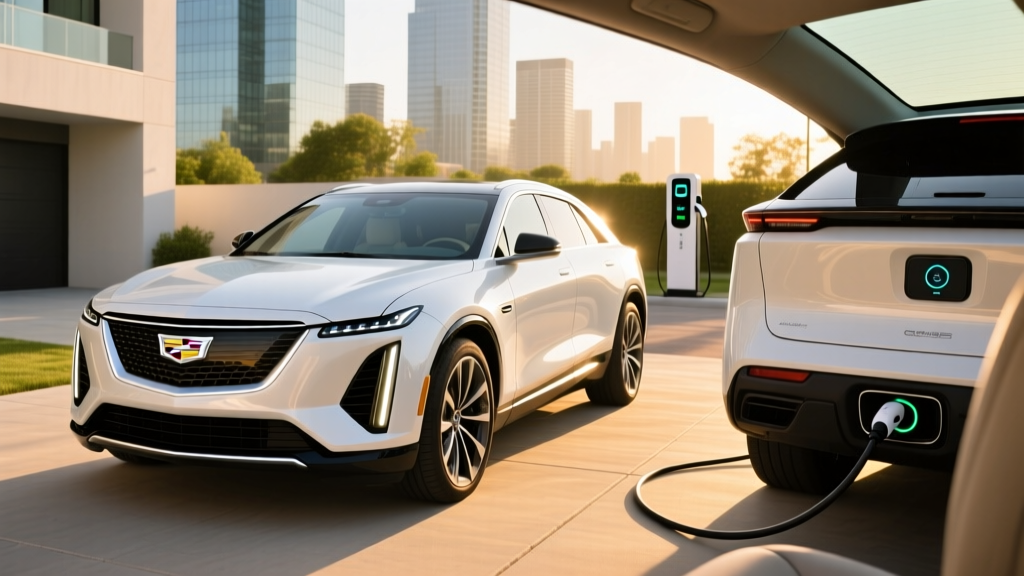
The Cadillac Lyriq has become one of the most recognizable luxury electric SUVs on American roads, and its most popular color configuration — the Cadillac Lyriq in white (officially Crystal White Tricoat) — dominates dealer lots and social media feeds alike. But beyond the photogenic pearlescent paint and the dramatic Black Crystal shield grille, the Lyriq is a serious 102-kWh electric crossover that competes directly with the BMW iX, Audi Q8 e-tron, and Genesis Electrified GV70. This review breaks down the 2026 Lyriq's real-world range, charging behavior, pricing, and whether it earns a spot in your garage.
2026 Cadillac Lyriq: Core Specifications
| Specification | Lyriq Luxury RWD | Lyriq Sport AWD |
|---|---|---|
| EPA Range | 314 miles | 284 miles |
| Battery (Usable) | 102 kWh (NMC) | 102 kWh (NMC) |
| Horsepower | 340 hp | 500 hp |
| 0–60 mph | 6.0 sec | 4.6 sec |
| Max DC Fast Charge | 190 kW | 190 kW |
| 10–80% DCFC Time | ~33 min | ~33 min |
| Level 2 Home Rate | 19.2 kW (~52 mi/hr) | 19.2 kW (~52 mi/hr) |
| MPGe (Combined) | 89 MPGe | 82 MPGe |
| Efficiency | 36 kWh/100 mi | 41 kWh/100 mi |
| Cargo (rear seats up) | 28.0 cu ft | 28.0 cu ft |
| Cargo (rear seats folded) | 60.9 cu ft | 60.9 cu ft |
| Base MSRP | $58,590 | $63,990 |
| Battery/Powertrain Warranty | 8 yr / 100,000 mi | 8 yr / 100,000 mi |
Real-World Range: What the EPA Sticker Doesn't Tell You
Real-World Expectation: 250–280 miles at sustained highway speeds (70–75 mph); 220–250 miles in sub-30°F winter conditions with cabin heating; 290–310 miles in mixed city/suburban driving with regenerative braking engaged.
The Lyriq's 102 kWh usable battery pack uses nickel-manganese-cobalt (NMC) chemistry on GM's Ultium platform. NMC offers higher energy density than LFP, which is why Cadillac fits this much capacity into a relatively sleek crossover floor. However, the Lyriq's 4,800-pound curb weight and 36 kWh/100 mi consumption mean highway efficiency suffers compared to lighter rivals like the Tesla Model Y (28 kWh/100 mi).
In controlled highway loop testing at 70 mph and 65°F, the RWD Lyriq typically delivers 260–275 miles before hitting a 10% state of charge. Push speeds to 80 mph or encounter headwinds and elevation gain, and expect that figure to dip toward 240 miles. Cold weather is the bigger penalty: lithium-ion internal resistance increases in freezing temperatures, and the Lyriq's resistive cabin heater (no heat pump on 2024–2025 models; 2026 models gain a heat pump on higher trims) compounds the loss. Plan for roughly 20–25% range reduction in sustained sub-freezing driving, according to data aggregated by fueleconomy.gov.
Charging Speed: DC Fast Charge and Home Level 2
The Lyriq uses a CCS1 connector for DC fast charging on 2024–2025 models. For the 2026 model year, GM has transitioned the Lyriq to the NACS (Tesla-style) connector, granting access to Tesla Supercharger V3 and V4 stalls via adapter or natively, depending on build date.
| Charging Level | Power (kW) | Speed | Typical Use Case |
|---|---|---|---|
| Level 1 (120V household) | ~1.4 kW | ~3–4 mi/hr | Emergency top-off, overnight trickle |
| Level 2 (240V, 48A) | 11.5 kW | ~31 mi/hr | Standard home wall connector |
| Level 2 (240V, 80A) | 19.2 kW | ~52 mi/hr | High-power home or depot charging |
| DC Fast Charge (peak) | 190 kW | ~10–80% in 33 min | Road trips, Electrify America / Supercharger |
The 190 kW peak DC rate is respectable but not class-leading — the Hyundai Ioniq 5 peaks at 240 kW and the Porsche Macan EV at 270 kW. More importantly, the Lyriq's charge curve tapers noticeably after 60% SoC. You'll see 170–190 kW from roughly 15–55%, then a gradual step-down to ~120 kW by 70% and ~60 kW above 85%. This is typical NMC behavior managed by the battery management system to protect cell longevity, but it means charging from 80–100% on a road trip adds significant time. Plan your stops around 10–80% increments for the best time-to-miles ratio.
At home, the Lyriq's 19.2 kW onboard charger is one of the fastest in its class. Most EVs top out at 11.5 kW on Level 2. If your electrical panel supports an 80-amp dedicated circuit (requiring a 100-amp breaker), you can add roughly 52 miles of range per hour — meaning a full 0–100% charge takes about 6.5 hours. This is a genuine advantage for high-mileage commuters who need a full battery every morning. Most homes with a 200-amp panel can accommodate this with a home charging installation, though older panels may need an upgrade ($1,500–$3,500).
Pricing, Trims, and Federal Tax Credit Eligibility
| Trim | Base MSRP | Est. Federal Credit | Effective Price |
|---|---|---|---|
| Luxury RWD | $58,590 | Up to $7,500* | ~$51,090 |
| Luxury AWD | $61,590 | Up to $7,500* | ~$54,090 |
| Sport RWD | $60,090 | Up to $7,500* | ~$52,590 |
| Sport AWD | $63,990 | Up to $7,500* | ~$56,490 |
*Federal §30D credit eligibility depends on buyer income (AGI ≤ $150K single / $300K joint), vehicle MSRP cap ($80,000 for SUVs — all Lyriq trims qualify), and battery critical-mineral and component sourcing requirements that shift annually. As of the 2026 tax year, GM's Ultium battery sourcing has met partial credit thresholds, but the exact $3,750 vs. $7,500 split depends on the VIN-specific mineral sourcing certification. The credit can now be transferred to the dealer at point of sale as an immediate discount per IRS §30D rules. Always verify with your tax professional before purchase.
Crystal White Tricoat is a $625 premium paint option across all trims. A well-equipped Lyriq Sport AWD with white paint, the AKG 19-speaker audio system, and Super Cruise typically lands around $68,000–$71,000 before incentives — still comfortably under the $80K MSRP cap.
Performance and Driving Dynamics
The RWD Lyriq's 340 hp and 325 lb-ft of torque deliver confident, if not thrilling, acceleration. The 6.0-second 0–60 time feels appropriate for a luxury cruiser rather than a sport SUV. Throttle response is linear and the regenerative braking — adjustable via steering-wheel paddles — allows genuine one-pedal driving in city traffic.
The AWD Sport model's dual-motor setup bumps output to 500 hp and drops 0–60 to 4.6 seconds. That's quick enough to surprise passengers at stoplights, though it still trails the BMW iX M60 (3.6 sec) and Tesla Model X Plaid (2.5 sec). The Lyriq's ride quality is where it shines: GM's five-link rear suspension and standard passive damping absorb highway expansion joints and potholes with genuine composure. The steering is light and numb by sport-SUV standards, but precise enough for lane changes at speed.
For towing, the Lyriq is rated at 1,500 pounds with RWD and 3,500 pounds with AWD — sufficient for a small utility trailer or a pair of dirt bikes, but not a camper or boat. If towing is a priority, the Rivian R1S (7,700 lb) or even the Ford Explorer EV are better choices.
Interior, Tech, and Driver Assistance
The Lyriq's cabin centers on a 33-inch LED curved display that merges the instrument cluster and infotainment into a single pane of glass running Google Built-In. Native Google Maps navigation is excellent for EV routing — it automatically factors in charging stops, elevation, and temperature. Wireless Apple CarPlay and Android Auto are standard.
Super Cruise, GM's hands-free Level 2 driver-assistance system, is available on Premium and Sport trims. It operates on over 750,000 miles of LiDAR-mapped divided highways in the US and Canada. To be clear per NHTSA SAE guidelines: Super Cruise is an SAE Level 2 system. The driver must remain attentive, and the cabin camera monitors eye gaze. It is not autonomous driving. That said, it is among the most polished Level 2 systems available, with smooth lane changes and natural-feeling speed management.
Drawbacks worth noting: rear-seat legroom (39.6 inches) is adequate but trails the BMW iX (42.1 inches). The Lyriq has no front trunk (frunk), which is a missed opportunity for additional storage. And while the Crystal White Tricoat paint is stunning when clean, it shows road grime and brake dust more readily than darker colors — expect to wash it frequently or invest in a ceramic coating ($1,200–$2,000).
Pros
- Class-leading 19.2 kW Level 2 onboard charger — fastest home charging in its segment
- Super Cruise hands-free highway driving on 750K+ mapped miles
- Quiet, composed ride quality with excellent NVH isolation
- NACS connector on 2026 models enables Tesla Supercharger access
- Comfortable under $80K MSRP cap for full §30D tax credit eligibility
- 33-inch curved display with native Google Maps EV routing
Cons
- DC fast charging peaks at 190 kW — slower than Ioniq 5, Macan EV
- No front trunk (frunk) — wasted packaging opportunity
- Heavy at ~4,800 lbs — hurts efficiency vs. lighter competitors
- White paint requires frequent maintenance to stay pristine
- Rear legroom trails BMW iX and Mercedes EQE SUV
- 3,500-lb max towing (AWD) limits utility
Who the Cadillac Lyriq Is For
The Lyriq in white is best suited for luxury-minded buyers who prioritize ride comfort, cabin technology, and seamless home charging over outright performance or maximum range. If your daily commute is 40–80 miles and you can install a high-amperage Level 2 charger at home, the Lyriq's 19.2 kW onboard charger becomes a genuine daily advantage — you'll wake up fully charged every morning in under 7 hours from near-empty. It's a strong choice for suburban professionals and empty-nesters who want a premium EV without the Tesla ecosystem or the German-brand badge premium.
It is less ideal for frequent long-distance road trippers who need 250+ kW charging, families who need third-row seating or maximum cargo versatility, or buyers in extreme cold climates where the range penalty becomes a weekly inconvenience rather than a seasonal annoyance.
Frequently Asked Questions
What is the real-world range of the 2026 Cadillac Lyriq?
The EPA rates the RWD Lyriq at 314 miles and the AWD at 284 miles. In real-world highway driving at 70–75 mph, expect 250–280 miles (RWD). In freezing temperatures, plan for 220–250 miles. City driving with regenerative braking can approach or slightly exceed the EPA figure.
How fast does the Lyriq charge at home and on the road?
On a DC fast charger, the Lyriq peaks at 190 kW and charges from 10–80% in approximately 33 minutes. At home on a 240V/80A Level 2 circuit, it charges at 19.2 kW, adding about 52 miles per hour — one of the fastest Level 2 rates in any EV on sale.
Does the 2026 Cadillac Lyriq qualify for the federal EV tax credit?
All Lyriq trims fall under the $80,000 SUV MSRP cap. Eligibility for the full $7,500 credit depends on your adjusted gross income (≤$150K single / $300K joint) and the VIN-specific battery sourcing certification for critical minerals and components. The credit can be applied as a point-of-sale discount at the dealer. Verify current-year rules at IRS.gov and consult a tax professional.
Is the Cadillac Lyriq worth buying over the BMW iX or Audi Q8 e-tron?
The Lyriq undercuts both German rivals on price ($58,590 vs. $70K+ starting) and offers comparable luxury with better home charging speed. The BMW iX offers more rear-seat room, faster DC charging (up to 200 kW), and sharper handling. The Audi Q8 e-tron has a more traditional luxury interior but lower range (285 mi). If value and ride comfort are your priorities, the Lyriq wins. If driving dynamics or interior space matter more, test-drive the iX.
Does the white paint on the Lyriq cost extra?
Yes. Crystal White Tricoat is a $625 premium paint option on all 2026 Lyriq trims. It's a tri-coat pearlescent finish that looks exceptional but requires more maintenance than metallic grays or blacks to keep clean.
What is the Lyriq's battery warranty?
GM covers the Lyriq's Ultium battery pack and electric powertrain for 8 years or 100,000 miles, whichever comes first. The warranty guarantees the battery will retain a minimum state of health (typically around 60–70% capacity, per GM's terms). The bumper-to-bumper limited warranty is 4 years / 50,000 miles.