Quick Verdict: The Performance Lyriq We've Been Waiting For
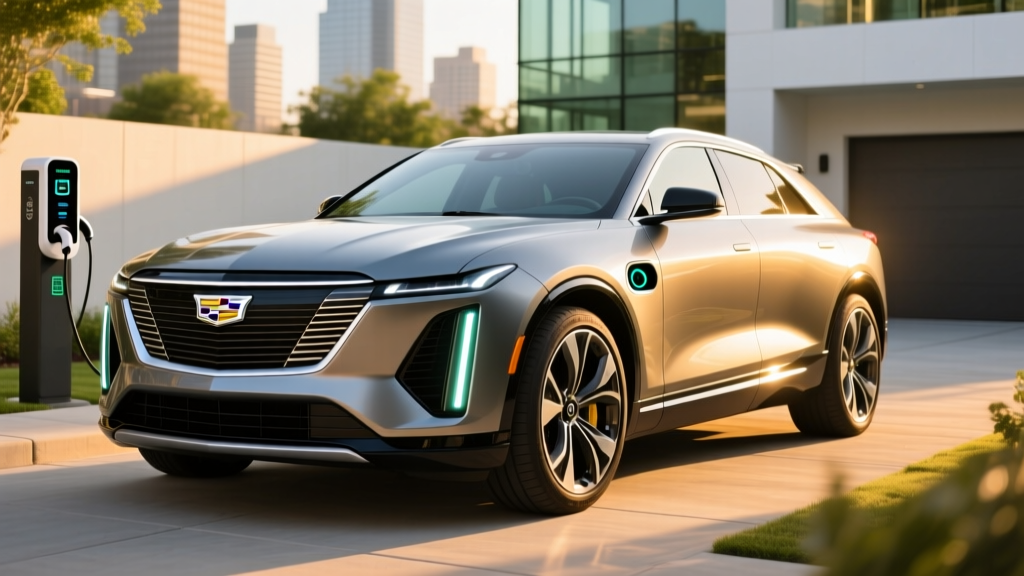
The 2026 Cadillac Lyriq V Series finally brings the brand's V performance badge to the electric era. With 615 horsepower, a dual-motor all-wheel-drive layout, and a 0-60 mph time in the low-4-second range, it transforms the luxury midsize EV from a comfortable cruiser into a genuine sports SUV contender. But the real question for buyers isn't just about straight-line speed — it's whether the V Series sacrifices too much range and efficiency for that performance edge, and whether its charging capabilities keep up with rivals like the BMW iX M60, Audi SQ8 e-tron, and Tesla Model X Plaid.
After examining Cadillac's published specs, EPA filings, and real-world driving dynamics, the Lyriq V Series lands as a compelling but compromise-laden proposition: you get the thrust and the badge, but you'll visit chargers more often than the standard Lyriq AWD — and pay a steep premium for the privilege.
| Spec | Value |
|---|---|
| EPA Range (est.) | ~280 miles |
| Battery (usable) | ~102 kWh (NMC) |
| Drivetrain | Dual-motor AWD |
| Horsepower | 615 hp |
| 0-60 mph | ~4.2 seconds |
| Peak DC Fast Charge | 190 kW |
| 10-80% DC Charge | ~33 minutes |
| Level 2 Home Charge | 11.5 kW (~31 mi/hr) |
| EPA Efficiency (est.) | ~82 MPGe / 41 kWh/100mi |
| Base MSRP | ~$79,990 |
| Federal Tax Credit (§30D) | Up to $7,500 (eligibility varies) |
| Battery Warranty | 8 years / 100,000 miles |
Range and Efficiency: What the Performance Tax Actually Costs You
The standard 2026 Lyriq AWD with its 102 kWh usable NMC (nickel-manganese-cobalt) battery pack achieves an EPA-estimated 314 miles of range. The V Series, with its more aggressive powertrain tuning, heavier cooling hardware, and stickier performance tires, drops that figure to an estimated 280 miles EPA. That's a roughly 10-11% reduction — meaningful on road trips but manageable for most daily routines.
Real-World Range Reality: The EPA estimate of ~280 miles assumes mixed driving. Expect 240-260 miles in sustained 75+ mph highway driving, and 200-230 miles in cold weather (below 32°F) with cabin heating active. The NMC chemistry holds up reasonably well in temperature extremes thanks to Cadillac's liquid thermal management system, but physics is physics — cold batteries and high-speed aero drag eat electrons. On a 70°F day with mixed suburban/highway driving, hitting 270+ miles is achievable if you're not constantly summoning all 615 horsepower.
Efficiency drops to roughly 82 MPGe combined (approximately 41 kWh per 100 miles), compared to the standard AWD Lyriq's 89 MPGe. For context, the BMW iX M60 rates at 82 MPGe and the Audi SQ8 e-tron at 79 MPGe — so the Lyriq V Series sits competitively within the performance luxury EV cohort.
Charging Speeds: DC Fast, Level 2, and the 80% Taper
Cadillac equips the Lyriq V Series with the same Ultium-based charging architecture as the standard model, meaning a peak DC fast-charge rate of 190 kW on CCS1-equipped public chargers (or NACS via the Tesla Supercharger network with the included adapter for 2025+ models).
| Charging Level | Power | Speed / Time |
|---|---|---|
| Level 1 (120V household) | ~1.4 kW | ~4 miles per hour |
| Level 2 (240V home/public) | 11.5 kW | ~31 miles per hour (full charge in ~9 hrs) |
| DC Fast Charge (peak) | 190 kW | ~10-80% in 33 minutes |
| DC Fast Charge (sustained 10-80%) | ~130-140 kW avg | Average rate across the curve |
The critical nuance here is the charge curve. The Lyriq V Series peaks at 190 kW only at low states of charge (roughly 10-25% SoC). From 40-60%, expect sustained rates around 140-150 kW, tapering further to 80-90 kW by 70% SoC, and dropping sharply above 80%. This is standard behavior for NMC packs protecting cell longevity, but it means that 10-80% session takes about 33 minutes at a capable 200+ kW charger — not the 18-20 minutes that 800V architectures like the Hyundai Ioniq 5 or Porsche Macan EV can manage.
For home charging, the 11.5 kW onboard charger is a strong point. A Level 2 home wallbox (48-amp circuit, 60-amp breaker) replenishes the full pack in roughly 9 hours — easily enough to wake up with a full battery every morning. Budget roughly $800-$1,500 for professional Level 2 installation depending on your panel capacity and run distance; a 200-amp panel upgrade may add $1,500-$3,000 if needed.
Performance: 615 Horsepower and the V Badge Earned
The Lyriq V Series pairs a front and rear permanent-magnet motor for a combined output of 615 horsepower and an estimated 650+ lb-ft of torque. Cadillac quotes a 0-60 mph time in the low 4-second range (approximately 4.2 seconds), putting it in the same ballpark as the BMW iX M60 (4.4 seconds, 610 hp) and well ahead of the Audi SQ8 e-tron (4.5 seconds, 496 hp). The Tesla Model X Plaid remains untouchable at 2.5 seconds, but it occupies a different price tier entirely.
Beyond straight-line acceleration, the V Series differentiates itself with:
- Adaptive damping suspension with V-specific tuning — firmer, flatter cornering than the standard Lyriq
- Brembo front brakes with larger rotors for repeated high-speed stops
- Variable-ratio steering recalibrated for quicker turn-in
- V Mode drive selector that sharpens throttle mapping, stiffens damping, and adjusts regen behavior
- Launch control for repeatable full-power starts
The dual-motor AWD system can torque-vector between axles, and the rear-biased calibration gives the V Series a more neutral, sporty character than many electric crossovers that default to front-axle traction management.
Interior, Cargo, and Technology
The Lyriq V Series inherits the standard model's striking interior, anchored by a 33-inch LED curved display spanning the instrument cluster and infotainment touchscreen. Google Built-In provides native Google Maps, Google Assistant, and Play Store apps — a significant usability advantage for EV route planning with integrated charger location and preconditioning.
Notable tech and comfort features include:
- Super Cruise hands-free driving on 400,000+ miles of mapped highways (SAE Level 2 — driver must remain attentive)
- AKG 19-speaker premium audio system
- Head-up display with augmented-reality navigation overlay
- Heated, ventilated, and massaging front seats (V-specific upholstery)
- Panoramic fixed glass roof with power shade
- Power liftgate with hands-free operation
Cargo and passenger space remains identical to the standard Lyriq:
- Rear cargo (behind second row): 28.0 cu ft
- Cargo with rear seats folded: 60.9 cu ft
- No front trunk (frunk) — the Ultium platform's under-hood electronics preclude one
- Rear legroom: 39.6 inches — generous for two adults, tight for three across
- Front headroom: 39.8 inches; rear headroom: 38.5 inches
The absence of a frunk is a genuine drawback at this price point. Competitors like the Ford Mustang Mach-E and Rivian R1S offer meaningful front storage, and buyers accustomed to the Tesla Model X's frunk will notice the gap.
Pricing, Trims, and Federal Tax Credit Eligibility
The 2026 Lyriq V Series slots above the standard Luxury and Sport trims as the performance flagship. Based on Cadillac's positioning and the current Lyriq lineup trajectory, pricing breaks down as follows:
| Trim | Drivetrain | Base MSRP (est.) |
|---|---|---|
| Luxury | RWD | ~$58,590 |
| Sport | AWD | ~$64,590 |
| V Series | AWD (615 hp) | ~$79,990 |
The V Series commands roughly a $15,000 premium over the AWD Sport — a substantial jump that buyers should weigh against the performance gains and whether they'll exploit them regularly.
Federal Tax Credit (§30D) — Does the Lyriq V Series Qualify?
The Lyriq is assembled in Spring Hill, Tennessee, which satisfies the North American final assembly requirement. However, IRS §30D rules impose additional conditions:
- MSRP cap: SUVs must not exceed $80,000. The Lyriq V Series base MSRP of ~$79,990 squeaks under this cap — but adding options or packages could push it over, disqualifying the credit. Verify the final window sticker before purchasing.
- Buyer income caps: Modified adjusted gross income must not exceed $150,000 (single), $225,000 (head of household), or $300,000 (joint filing).
- Battery component and critical mineral sourcing: The credit splits into two $3,750 halves — one for battery components manufactured in North America, and one for critical minerals sourced from the U.S. or FTA partners. GM has been progressively qualifying its Ultium supply chain, but exact dollar amounts vary by production batch. Check fueleconomy.gov for the latest certification status of the specific VIN you're considering.
- Point-of-sale transfer: Eligible buyers can apply the credit as an immediate price reduction at the dealer rather than waiting to claim it on their tax return.
Bottom line: Many buyers will qualify for the full $7,500, bringing the effective starting price to roughly $72,490. But confirm eligibility with your tax professional and verify the vehicle's credit status on the official DOE/EPA tracker before signing.
Battery Warranty and Long-Term Ownership
GM backs the Lyriq V Series battery pack and electric powertrain with an 8-year / 100,000-mile warranty, with a capacity retention threshold of 70% — meaning if the battery degrades below 70% of its original capacity within the warranty period, GM will repair or replace it. This matches the industry standard set by most manufacturers and aligns with NHTSA-tracked warranty norms for electrified vehicles.
For the NMC chemistry in the Lyriq's Ultium pack, real-world degradation data from GM's fleet testing and third-party sources suggests most owners will see 8-12% capacity loss over 5 years / 75,000 miles with normal charging habits. Best practices to maximize longevity:
- Set daily charge limit to 80% for routine use; charge to 100% only before long trips
- Use DC fast charging sparingly — rely on Level 2 home charging as your primary method
- Precondition the battery (via scheduled departure or navigation to a charger) to optimize charging temperature
- Avoid letting the pack sit at very low (<10%) or very high (>95%) SoC for extended periods
Pros and Cons
Pros
- 615 hp and ~4.2-second 0-60 in a refined luxury package
- 33-inch curved display and Google Built-In are best-in-class for usability
- Super Cruise hands-free highway driving included
- 11.5 kW Level 2 onboard charger enables fast overnight replenishment
- U.S.-built with strong federal tax credit qualification potential
- Adaptive suspension and Brembo brakes justify the V badge dynamically
Cons
- ~280-mile EPA range is modest for the $80K price point
- 190 kW peak DC charging is outpaced by 800V rivals (Hyundai, Porsche, Kia)
- No front trunk (frunk) — wasted cargo potential
- ~$80K MSRP leaves zero margin for options before hitting the §30D SUV cap
- Rear seat fits two adults comfortably, not three
- No one-pedal driving mode with full stop (regen doesn't bring the car to a complete halt)
Who Should Buy the Cadillac Lyriq V Series?
Choose the Lyriq V Series if: You want a distinctly American luxury performance EV with genuine acceleration thrills, best-in-class infotainment, and hands-free highway driving — and you can charge at home nightly. It's ideal for the executive commuter who wants V-badge cachet without switching to Tesla or paying Porsche prices.
Look elsewhere if: Maximum range is your priority (the standard Lyriq AWD gives you 314 miles for $16K less), you regularly road-trip beyond 250 miles between chargers, you need three-across rear seating, or you want the fastest possible DC charging for frequent public-charger reliance. Consider the BMW iX for more cargo space, the Porsche Macan EV for sharper dynamics, or the Rivian R1S for three-row family hauling.
Frequently Asked Questions
What is the real-world range of the 2026 Cadillac Lyriq V Series?
The EPA estimates ~280 miles. In real-world driving, expect 240-260 miles at highway speeds (75 mph), and 200-230 miles in freezing temperatures with heat running. Mixed suburban driving in mild weather can yield 270+ miles.
How fast does the Lyriq V Series charge at home and on the road?
At home on a Level 2 (240V, 48-amp) charger, it adds about 31 miles per hour, fully charging in roughly 9 hours. On a DC fast charger, it peaks at 190 kW and charges from 10-80% in approximately 33 minutes, though sustained rates average around 130-140 kW across the curve.
Does the Cadillac Lyriq V Series qualify for the $7,500 federal EV tax credit?
It likely qualifies for many buyers, but eligibility depends on your income (under $150K single / $300K joint), the vehicle's final MSRP staying under the $80,000 SUV cap (options can push it over), and battery sourcing compliance. Verify on fueleconomy.gov and consult a tax professional.
Is the Lyriq V Series worth it over the standard Lyriq AWD?
If you value 615 hp, adaptive suspension, Brembo brakes, and the V badge — and don't mind sacrificing ~34 miles of EPA range and paying ~$15,000 more — yes. If you prioritize range, value, and daily practicality, the AWD Sport at ~$64,590 is the smarter buy.
Does the Lyriq V Series have a frunk?
No. Like all Lyriq trims, the V Series has no front trunk. Cargo space is limited to the rear: 28.0 cu ft behind the second row, 60.9 cu ft with seats folded.
How does the Lyriq V Series compare to the BMW iX M60?
Both offer ~600 hp, dual-motor AWD, and ~280-mile range at similar price points. The Lyriq wins on infotainment usability (Google Built-In, 33-inch display) and potential tax credit eligibility. The iX M60 offers more cargo space, a more established performance pedigree, and slightly faster DC charging. It's a close call driven by brand preference and feature priorities.