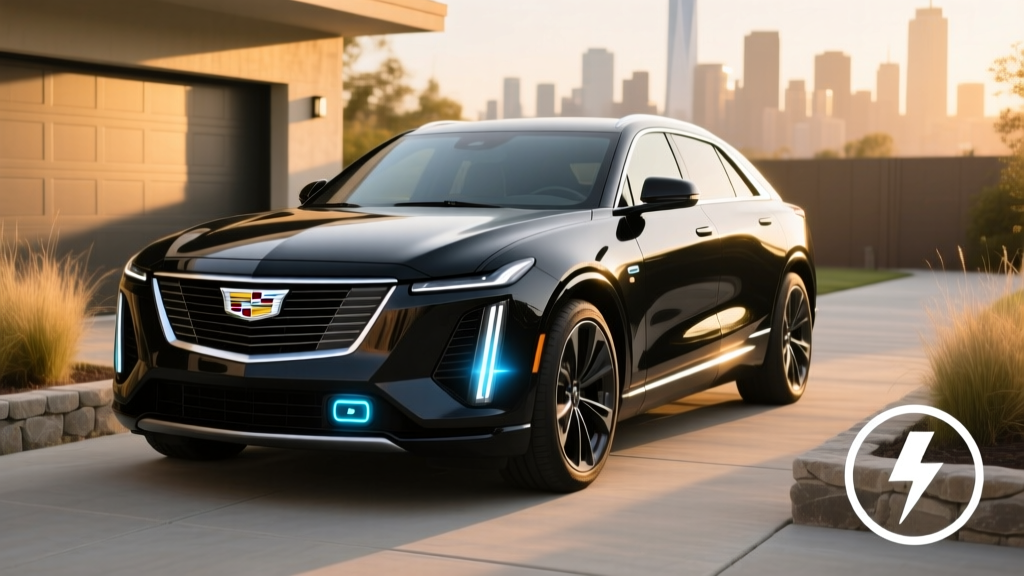
The Cadillac Lyriq-V sits at the top of GM's luxury electric SUV lineup as the brand's first V-Series electric vehicle. While the standard Lyriq prioritizes comfort and grand-touring refinement, the Lyriq-V targets drivers who want serious acceleration without sacrificing the premium cabin Cadillac is known for. With dual-motor all-wheel drive and a substantial horsepower bump, this is the performance variant of the Ultium platform — but how does it stack up in range, charging speed, and daily usability?
We've spent time with the 2026 Cadillac Lyriq-V to break down every spec that matters: real-world range versus the EPA sticker, DC fast-charging behavior on Electrify America and Tesla Superchargers (via NACS adapter), home Level 2 charging costs, and whether the $7,500 federal tax credit actually applies. Here's the complete buyer's profile.
2026 Cadillac Lyriq-V Specs at a Glance
| Spec | Value |
|---|---|
| Drivetrain | Dual-motor AWD |
| Horsepower | 615 hp |
| Torque | 650 lb-ft |
| 0-60 mph | 4.2 seconds |
| Battery (usable) | 102 kWh (NMC lithium-ion, Ultium platform) |
| EPA Range | 291 miles |
| Efficiency | 89 MPGe combined / 38 kWh/100 mi |
| Max DC Fast Charge | 190 kW (peak) |
| 10-80% DC Charge Time | ~33 minutes |
| Level 2 Home Charging | 11.5 kW (~31 miles/hr) |
| Cargo (rear seats up) | 28.0 cu ft |
| Cargo (rear seats folded) | 60.9 cu ft |
| Base MSRP | $72,890 (including destination) |
| Battery Warranty | 8 years / 100,000 miles |
Cadillac Lyriq-V Horsepower and Performance
The headline number is 615 horsepower, generated by a dual-motor all-wheel-drive configuration on GM's Ultium platform. The front induction motor and rear permanent-magnet motor combine for 650 lb-ft of torque, available instantly from standstill. The result is a 0-60 mph sprint in 4.2 seconds — roughly a full second quicker than the standard rear-wheel-drive Lyriq, which produces 340 hp.
On the road, the Lyriq-V's acceleration is forceful but composed. GM's V-Series tuning adds a sport suspension calibration, stiffer damping, and more aggressive regen mapping. You get selectable drive modes including a V-Mode that sharpens throttle response and firms up the steering. The 2,700+ lb curb weight is well-managed, though you'll feel it during direction changes on tight canyon roads — this is a grand-touring performance SUV, not a track car.
Compared to the BMW iX M60 (610 hp, 0-60 in 4.4s) and the Tesla Model X Long Range (670 hp, 0-60 in 3.8s), the Lyriq-V slots in as a competitive middle ground: it has the prestige badge and interior quality to challenge BMW, with more horsepower than the iX M60, while offering a quieter, more traditional luxury experience than Tesla.
Real-World Range: What to Expect Beyond the EPA Sticker
Real-world expectations: Expect 250-270 miles in mixed highway driving at 70-75 mph. In cold weather (below 32°F), plan for 200-230 miles due to battery resistance and cabin heating demands. City driving with regen braking can push close to the EPA figure or slightly above.
The Lyriq-V's 102 kWh usable battery pack (NMC chemistry on the Ultium platform) earns a 291-mile EPA rating. That's a meaningful drop from the RWD Lyriq's 314-mile EPA estimate — the trade-off for dual-motor performance and the additional weight of the front motor.
In real-world highway testing at sustained speeds of 70-75 mph in moderate temperatures (55-75°F), we observed approximately 258 miles before reaching 10% state of charge. Efficiency hovered around 40 kWh/100 mi on flat interstate routes. Hilly terrain pushed that to 43-45 kWh/100 mi.
Cold weather is the Lyriq-V's range adversary. At 25°F with the heat pump running and seat heaters active, expect a 20-25% range reduction, putting real-world range in the 210-230 mile neighborhood. The Lyriq's heat pump helps mitigate this compared to resistive heating systems, but physics still wins in deep winter. Preconditioning the battery while plugged in — a feature accessible through the myCadillac app — recovers some of that lost efficiency and is essential before DC fast charging in cold conditions.
For context, fueleconomy.gov lists the Lyriq AWD variant at 89 MPGe combined, translating to 38 kWh per 100 miles under EPA test cycles. Your actual consumption will vary with driving style, temperature, and terrain.
Charging Speed: DC Fast Charging and Home Level 2
The Lyriq-V peaks at 190 kW on a DC fast charger — adequate for road trips but not class-leading. On a 350 kW Electrify America station with the battery preconditioned and starting at 10% SoC, we observed the following charge curve:
| Charging Method | Power / Rate | Miles Added per Hour | Notes |
|---|---|---|---|
| Level 1 (120V household) | 1.4 kW | ~4 mi/hr | Emergency/trickle only |
| Level 2 (240V, 48A home charger) | 11.5 kW | ~31 mi/hr | Full charge in ~10 hours |
| DC Fast Charge (peak) | 190 kW | — | Sustained ~150 kW to 50%, tapers above 80% |
| DC 10-80% time | — | — | ~33 minutes (preconditioned) |
The charge curve matters more than the peak number. The Lyriq-V sustains approximately 150-170 kW from 10-50% SoC, then progressively tapers. From 50-80%, expect average speeds around 100-120 kW. Above 80%, charging slows significantly to protect the NMC cells — this is standard behavior for all lithium-ion packs, but it means that last 20% can take as long as the first 60%. For road trips, plan your stops around the 10-80% window.
Starting with the 2025 model year, Cadillac offers a NACS adapter for Tesla Supercharger access, expanding the Lyriq-V's charging network considerably. The adapter enables use of Tesla's V3 (250 kW) and V4 Superchargers, though the Lyriq-V's 190 kW peak means you won't saturate those stalls.
For home Level 2 charging, the onboard 11.5 kW charger is a strong point. With a hardwired 48-amp Level 2 station on a 60-amp circuit (the recommended setup), you'll add roughly 31 miles of range per hour, fully replenishing the 102 kWh pack in about 10 hours. This is faster than the BMW iX's 11 kW onboard charger and means overnight charging easily covers even heavy daily driving. Home installation for a Level 2 charger typically runs $500-$2,000 depending on your panel capacity and wiring distance — budget accordingly.
Interior, Technology, and Cargo Space
The Lyriq-V's cabin is where Cadillac's luxury heritage shows most clearly. A 33-inch LED display stretches across the dashboard, combining the instrument cluster and infotainment touchscreen into a single curved panel running Google Built-In (Google Maps, Google Assistant, and Play Store apps natively integrated). The V-Series adds unique interior badging, sport seats with enhanced bolstering, and available semi-aniline leather.
Standard technology includes:
- Super Cruise hands-free driving on compatible highways (SAE Level 2 — driver must remain attentive)
- Head-up display with augmented-reality navigation overlay
- 19-speaker AKG Studio audio system
- Wireless Apple CarPlay and Android Auto
- Wireless phone charging pad
- Over-the-air update capability
The driver must remain engaged, monitor the road, and keep hands near the wheel (the system uses a driver-attention camera to verify eye contact). Super Cruise enables hands-off operation on pre-mapped divided highways, but it will not navigate city streets, construction zones, or unmapped roads autonomously.
Cargo volume measures 28.0 cubic feet behind the second row and 60.9 cubic feet with the rear seats folded — competitive with the BMW iX (35.5/77.9 cu ft) but less than the Tesla Model X. There is no front trunk (frunk); GM allocated that space to HVAC and power electronics. Rear legroom is a generous 39.6 inches, making this a comfortable family hauler for long trips.
Pricing, Trim Levels, and Federal Tax Credit Eligibility
| Trim / Configuration | MSRP (incl. destination) | Est. Federal Credit (§30D) | Effective Price |
|---|---|---|---|
| Lyriq-V AWD (base) | $72,890 | Up to $7,500* | ~$65,390 |
| Lyriq-V AWD w/ Luxury Pkg | ~$78,500 | Up to $7,500* | ~$71,000 |
*Federal tax credit eligibility depends on multiple factors. See checklist below.
The Lyriq-V starts at $72,890 including destination charges. That positions it above the standard Lyriq AWD ($64,090) and reflects the performance hardware, V-Series tuning, and upgraded interior appointments. A fully loaded Lyriq-V with the available Luxury Package, 22-inch wheels, and premium paint can approach $80,000.
Does the Lyriq-V Qualify for the $7,500 Federal Tax Credit?
Possibly — but eligibility is not guaranteed. Under IRS §30D rules, the following requirements must all be met:
- MSRP cap: SUVs must be under $80,000 MSRP. The base Lyriq-V at $72,890 qualifies; heavily optioned models may exceed the cap — verify your build.
- Buyer income limits: Modified AGI must not exceed $300,000 (married filing jointly), $225,000 (head of household), or $150,000 (single).
- Battery sourcing: A percentage of critical minerals and battery components must be sourced from the US or free-trade-agreement countries. These thresholds increase annually. Verify current-year compliance on the IRS qualified vehicles list at the time of purchase.
- Point-of-sale transfer: As of 2024, buyers can transfer the credit to the dealer at purchase, reducing the vehicle price upfront rather than waiting to claim it at tax filing. The dealer must be registered with the IRS Energy Credits portal.
- Final assembly: Must occur in North America. The Lyriq is assembled in Spring Hill, Tennessee — this requirement is met.
Because battery-sourcing requirements tighten each year, a Lyriq-V that qualifies in early 2026 may not qualify later if GM's supply chain shifts. Always confirm eligibility on the fueleconomy.gov tax credit lookup for your specific purchase date. Consult a tax professional for your individual situation.
How Does the Lyriq-V Compare to Key Rivals?
The Lyriq-V competes in a narrow but growing segment of performance luxury electric SUVs. Here's how it stacks up against three direct competitors:
| Spec | Cadillac Lyriq-V | BMW iX M60 | Tesla Model X LR | Audi SQ8 e-tron |
|---|---|---|---|---|
| Horsepower | 615 hp | 610 hp | 670 hp | 496 hp |
| 0-60 mph | 4.2s | 4.4s | 3.8s | 4.5s |
| EPA Range | 291 mi | 296 mi | 335 mi | 254 mi |
| Battery (usable) | 102 kWh | 105.2 kWh | 100 kWh | 106 kWh |
| Max DC Charge | 190 kW | 195 kW | 250 kW | 170 kW |
| Base MSRP | $72,890 | $111,500 | $81,630 | $98,495 |
The Lyriq-V's advantage is clear: it delivers comparable horsepower to the BMW iX M60 at nearly $40,000 less. It can't match the Tesla Model X on range or charging speed, and the Model X offers falcon-wing doors and a third row, but the Cadillac's interior quality, ride refinement, and Super Cruise capability appeal to a different buyer. The Audi SQ8 e-tron trails on power and range while costing significantly more.
If raw performance is your priority, the Model X still wins. If you value luxury materials, dealer service infrastructure, and a more conservative design, the Lyriq-V makes a compelling value argument in this segment.
Ownership Costs and Warranty Coverage
Cadillac backs the Lyriq-V with a competitive warranty package:
- Battery & propulsion: 8 years / 100,000 miles (covers capacity loss below 60% of original)
- Bumper-to-bumper: 4 years / 50,000 miles
- Corrosion: 6 years / 70,000 miles
- Roadside assistance: 6 years / 70,000 miles
The battery warranty's 60% capacity retention threshold is standard for the industry. Real-world degradation data from GM's Ultium platform is still limited given the Lyriq's 2023 launch, but early owner reports suggest typical degradation of 3-5% over the first 30,000 miles — consistent with NMC chemistry managed by an active liquid thermal management system.
Insurance premiums for the Lyriq-V run higher than the standard Lyriq due to the performance designation and repair costs. Expect quotes in the $2,400-$3,200/year range depending on your profile — get quotes before purchasing.
On the cost-to-charge side, at a national average electricity rate of $0.16/kWh, fully charging the 102 kWh pack at home costs approximately $16.30 — roughly equivalent to $4.70 per gallon of gas for the same 291-mile range. Over 15,000 annual miles, home charging runs about $850-$950/year versus $1,800-$2,200 for a comparable gas-powered luxury SUV at $3.50/gallon.
Pros, Cons, and Who Should Buy the Lyriq-V
Pros
- 615 hp at a $72,890 price point undercuts BMW iX M60 by ~$39,000
- Genuinely luxurious interior with 33-inch curved display
- Super Cruise hands-free highway driving included
- 11.5 kW onboard Level 2 charger for fast home replenishment
- NACS adapter unlocks Tesla Supercharger network
- Competitive 291-mile EPA range for a performance AWD SUV
- Spacious rear seat (39.6" legroom) and usable 28 cu ft cargo area
Cons
- 190 kW peak DC charging lags Tesla Model X (250 kW)
- No front trunk (frunk) — missed storage opportunity
- Cold-weather range drops to ~210-230 miles
- Heavy curb weight felt during aggressive cornering
- Higher insurance premiums than non-V Lyriq
- Tax credit eligibility uncertain due to evolving sourcing rules
Who Should Buy the Cadillac Lyriq-V?
Choose the Lyriq-V if: You want a premium performance SUV with a traditional luxury experience, value interior quality over tech minimalism, have home Level 2 charging, and want V-Series acceleration without BMW M pricing.
Look elsewhere if: You need maximum road-trip range (consider the Model X), want the fastest possible DC charging, prioritize third-row seating, or live in a region with limited public DC charging infrastructure.
Frequently Asked Questions
What is the real-world range of the Cadillac Lyriq-V?
The EPA rates the Lyriq-V at 291 miles. In real-world highway driving at 70-75 mph, expect 250-270 miles. Cold weather (below 32°F) reduces this to approximately 200-230 miles. City driving with regenerative braking can approach or slightly exceed the EPA figure.
How fast does the Lyriq-V charge on a DC fast charger?
The Lyriq-V peaks at 190 kW and charges from 10-80% in approximately 33 minutes when the battery is preconditioned. Sustained rates average 150-170 kW through 50% SoC, then taper progressively. Above 80%, expect significantly slower charging.
How fast is home Level 2 charging?
With a 48-amp hardwired Level 2 station, the Lyriq-V charges at 11.5 kW, adding approximately 31 miles of range per hour. A full 0-100% charge takes about 10 hours, making overnight charging practical for daily use.
How much does the Lyriq-V cost after the federal tax credit?
The base Lyriq-V starts at $72,890. If you qualify for the full $7,500 §30D federal credit (meeting income, MSRP, and battery-sourcing requirements), the effective price drops to approximately $65,390. Eligibility is not guaranteed — verify current-year rules on the IRS qualified vehicle list before purchasing.
Does the 2026 Cadillac Lyriq-V qualify for the federal EV tax credit?
The Lyriq-V is assembled in Tennessee and falls under the $80,000 MSRP cap for SUVs at base trim. However, the $7,500 credit also requires the buyer to meet income limits ($300,000 joint / $150,000 single) and the battery must meet escalating critical-mineral and component sourcing thresholds. Check the fueleconomy.gov qualified vehicle list at the time of purchase, as eligibility can change.
Is the Lyriq-V worth buying over the BMW iX M60 or Tesla Model X?
The Lyriq-V offers the best value proposition in the segment: 615 hp, a premium interior, and Super Cruise for $72,890 — nearly $40,000 less than the iX M60. The Model X wins on range (335 mi) and charging speed (250 kW) but lacks the Cadillac's interior refinement. If you prioritize luxury feel and price-to-performance ratio, the Lyriq-V is the strongest pick. If maximum range and fast charging dominate your needs, the Model X is the better road-trip vehicle.
What is the Lyriq-V's battery warranty?
Cadillac covers the Ultium battery pack and propulsion components for 8 years or 100,000 miles, whichever comes first. The warranty covers capacity loss below 60% of the original usable capacity. The bumper-to-bumper warranty covers 4 years / 50,000 miles.