Quick Verdict: A Luxury EV SUV That Can Actually Tow
The Cadillac Lyriq occupies a specific niche: it's the electric SUV for buyers who want premium-badge comfort, a genuinely usable 314-mile EPA range, and enough towing capability for a small boat or utility trailer — but who don't need the brute-force specs of a Tesla Model X or Rivian R1S. For the 2026 model year, the Lyriq carries over its Ultium platform with a 102 kWh battery pack, refined driver-assist features, and a starting price that — with federal tax credits factored in — makes it one of the more compelling luxury EV crossovers on the market.
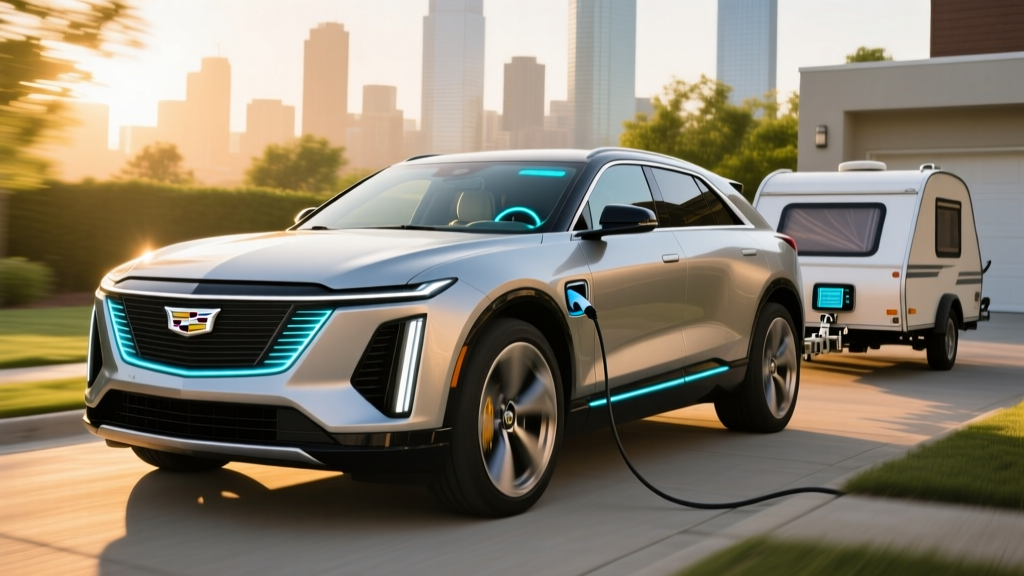
But the headline question many buyers bring to the Lyriq is about utility: what is the Cadillac Lyriq towing capacity, and can it handle real-world hauling? The short answer is 3,500 pounds with the available towing package. That's enough for a 16-foot aluminum boat on a single-axle trailer, a pair of jet skis, or a lightweight camping trailer — but it falls well short of body-on-frame electric trucks and the 5,000-lb ratings of some competitors. Let's break down every number that matters.
Cadillac Lyriq Towing Capacity: What 3,500 Pounds Gets You
The 2026 Cadillac Lyriq is rated to tow up to 3,500 pounds when properly equipped with the factory towing package (available on both RWD and AWD trims). This rating includes the weight of the trailer plus cargo, passengers, and any equipment in the Lyriq itself — what the industry calls Gross Combined Weight Rating (GCWR) compliance.
Here's what 3,500 pounds of capacity looks like in practical terms:
- Small boat trailers: A 16–18 ft aluminum fishing boat with a single-axle trailer typically weighs 2,000–3,000 lbs loaded
- Personal watercraft: Two jet skis on a dual-rack trailer run approximately 1,800–2,500 lbs
- Light utility trailers: A 5×8 enclosed cargo trailer loaded with gear comes in around 2,500–3,200 lbs
- Teardrop campers: Compact teardrop trailers (e.g., NuCamp T@B 320S) weigh 2,800–3,400 lbs loaded
What the Lyriq cannot tow: full-size travel trailers (typically 5,000–8,000 lbs), large fifth wheels, horse trailers, or heavy equipment haulers. If you need to pull a 24-foot Airstream or a two-horse trailer, you'll want to look at the Rivian R1S (7,700 lbs), Tesla Model X (5,000 lbs), or an electric truck like the Ford F-150 Lightning (7,700–10,000 lbs).
Spec Table: 2026 Cadillac Lyriq at a Glance
| Specification | 2026 Lyriq Details |
|---|---|
| EPA Range (RWD) | 314 miles |
| EPA Range (AWD) | 307 miles |
| Battery Capacity | 102 kWh usable (NMC chemistry, Ultium platform) |
| Max DC Fast Charge | 190 kW peak |
| 10–80% DC Charge Time | ~33 minutes |
| Level 2 Home Charging | 19.2 kW (11.5 kW standard) / ~31–52 mi/hr |
| Horsepower (RWD / AWD) | 340 hp / 500 hp |
| 0–60 mph (RWD / AWD) | 6.0 sec / 4.6 sec |
| Drivetrain | Rear-Wheel Drive or Dual-Motor AWD |
| Towing Capacity | 3,500 lbs (with towing package) |
| EPA Efficiency (RWD) | 89 MPGe combined / 38 kWh/100mi |
| Cargo Volume | 28.0 cu ft (rear seats up) / 60.9 cu ft (folded) |
| Base MSRP (Tech RWD) | $58,590 (incl. destination) |
| Battery/Powertrain Warranty | 8 years / 100,000 miles |
Source: fueleconomy.gov and Cadillac official specifications.
Range, Efficiency & Real-World Expectations
EPA Estimated: 314 miles (RWD) / 307 miles (AWD)
Real-World Highway (70 mph): ~255–275 miles
Real-World City/Suburban: ~290–310 miles
Cold Weather (below 32°F): ~220–260 miles (30–35% reduction typical for NMC packs)
Towing (near max capacity): ~190–240 miles
The Lyriq's 102 kWh usable battery uses GM's Ultium platform with NMC (nickel manganese cobalt) chemistry. NMC offers higher energy density than LFP (lithium iron phosphate), which is how Cadillac fits this much capacity into a midsize crossover footprint — but it comes with slightly faster degradation over time and more sensitivity to extreme temperatures.
At 89 MPGe combined (RWD), the Lyriq is efficient for its size and weight, consuming about 38 kWh per 100 miles. That translates to roughly $0.11–$0.15 per mile on residential electricity rates (national average ~$0.17/kWh), or about $5.50–$7.50 to fully recharge at home. For comparison, a similarly sized gas SUV getting 22 MPG combined at $3.40/gallon costs about $0.15 per mile — so the Lyriq's efficiency advantage is real but not dramatic unless you have access to cheap off-peak electricity or solar.
The Lyriq does not include a front trunk (frunk), which is a missed opportunity for cargo organization. All 28.0 cubic feet of cargo space lives behind the rear seats, expanding to 60.9 cu ft with the 60/40 split rear seats folded. That's competitive with the BMW iX (27.2 / 60.2 cu ft) but trails the Tesla Model X (37.1 / 81.5 cu ft with frunk included).
Charging Speed: DC Fast Charging & Home Setup
The Lyriq's charging performance is adequate but not class-leading. Here's the full breakdown:
| Charging Level | Power | Speed / Time | Notes |
|---|---|---|---|
| Level 1 (120V) | ~1.4 kW | ~3–4 mi/hr | Emergency/top-up only; full charge in 3+ days |
| Level 2 (240V, 48A standard) | 11.5 kW | ~31 mi/hr, full charge ~10 hr | Standard onboard charger; ideal for overnight |
| Level 2 (240V, 80A optional) | 19.2 kW | ~52 mi/hr, full charge ~6 hr | Requires upgraded home charger + 100A circuit |
| DC Fast Charge | 190 kW peak | 10–80% in ~33 min | Tapers significantly above 80%; CCS connector (NACS adapter available) |
Charging-curve reality check: The 190 kW peak is only sustained briefly between roughly 10–30% State of Charge (SoC). Expect average charging power of around 130–145 kW across the full 10–80% session. Above 80%, the charge rate drops sharply to protect the NMC battery — a 10–100% session can take 55+ minutes. For road trips, plan to charge to 80% and move on; that last 20% is painfully slow.
On the road, the Lyriq uses a CCS1 connector natively. Cadillac has announced NACS (Tesla-style) adapter compatibility, giving Lyriq owners access to Tesla's Supercharger network — a significant practical advantage for long-distance travel. Check with your dealer for adapter availability and any firmware requirements.
At home, most Lyriq owners will install a Level 2 wallbox on a 60-amp circuit (delivering the standard 11.5 kW / 48 amps). Budget $800–$2,200 for a quality Level 2 charger and professional installation, depending on your electrical panel's proximity to the garage and whether a panel upgrade is needed. A full overnight charge adds roughly 250+ miles — more than enough for daily driving needs.
Performance, Drivetrain & Driving Dynamics
The 2026 Lyriq offers two powertrain configurations:
- Rear-Wheel Drive (RWD): 340 hp, 325 lb-ft torque, 0–60 mph in 6.0 seconds. Adequate for highway merging and confident in daily driving. This is the efficiency-focused choice, delivering the full 314-mile EPA range.
- Dual-Motor AWD: 500 hp, 450 lb-ft torque, 0–60 mph in 4.6 seconds. Genuinely quick for a 5,700-lb luxury SUV, with the traction benefits of all-wheel drive for snow and rain. The range penalty is modest — only 7 miles of EPA range sacrificed.
The Lyriq rides on GM's BEV3 platform with a low center of gravity thanks to the underfloor battery pack. Ride quality is composed and quiet — this is a Cadillac tuned for comfort, not sportiness. The steering is light and precise but offers minimal feedback, which suits the luxury-cruiser mission but disappoints anyone expecting BMW iX dynamics. Regenerative braking is adjustable via paddle shifters behind the steering wheel, and the one-pedal driving mode is strong enough to bring the Lyriq to a complete stop without touching the brake pedal.
The available Super Cruise driver-assistance system (SAE Level 2 — driver must remain engaged and eyes on the road) works on over 750,000 miles of compatible highways in the US and Canada. It's one of the best hands-off-wheel systems available, with genuinely smooth lane-keeping and adaptive cruise behavior. However, it does not handle city streets, construction zones, or unmapped roads. Think of it as a highly polished highway co-pilot, not a self-driving system.
Pricing, Trims & Federal Tax Credit Eligibility
The 2026 Cadillac Lyriq is offered in several trim levels. Here's the pricing landscape:
| Trim | Drivetrain | MSRP (incl. destination) | Est. After §30D Credit |
|---|---|---|---|
| Tech | RWD | $58,590 | ~$51,090* |
| Luxury | RWD | $62,690 | ~$55,190* |
| Sport | AWD | $65,090 | ~$57,590* |
| Sport (fully loaded) | AWD | ~$72,000+ | ~$64,500+* |
*Estimated prices assume full $7,500 federal tax credit eligibility. Actual credit amount varies.
- MSRP Cap: SUVs must be priced at or below $80,000 — all Lyriq trims qualify
- Buyer Income Cap: AGI must not exceed $150,000 (single), $225,000 (head of household), or $300,000 (married filing jointly)
- Battery Sourcing: The credit is split into two halves ($3,750 each) — one for critical-mineral sourcing and one for battery-component manufacturing. GM's Ultium batteries are assembled in the US, but critical-mineral compliance depends on supply-chain shifts that change periodically
- Point-of-Sale Transfer: Eligible buyers can transfer the credit to the dealer at purchase, reducing the purchase price immediately rather than waiting for a tax refund
Tech, Interior & Standout Features
The Lyriq's interior is where Cadillac makes its strongest luxury statement. The centerpiece is a 33-inch curved LED display that spans from the instrument cluster to the infotainment touchscreen, running Google Built-In with native Google Maps, Google Assistant, and Play Store apps. The interface is responsive and visually impressive, though some owners report that the touch-capacitive climate controls integrated below the screen require more attention than physical buttons.
Standout features include:
- 33-inch curved LED display (9K resolution)
- Super Cruise hands-free highway driving (Level 2, 750,000+ compatible miles)
- AKG Studio 19-speaker audio system (available)
- Power-adjustable steering column with memory
- Wireless Apple CarPlay and Android Auto
- Head-up display with augmented-reality navigation overlay
- Heated and ventilated front seats with heated steering wheel (standard on Luxury and above)
Notable drawbacks:
- No front trunk (frunk) — cargo space is rear-only
- Touch-capacitive climate controls lack tactile feedback
- Rear-seat legroom (39.6 inches) is adequate but trails the Hyundai Ioniq 5 and Tesla Model X
- DC fast-charging speed (190 kW) lags behind the Hyundai Ioniq 5 (350 kW) and Porsche Macan EV (270 kW)
- 3,500-lb towing capacity is the lowest in the luxury electric SUV segment
- No third-row seating option
Lyriq vs. Competitors: Towing & Overall Comparison
| Vehicle | Towing | EPA Range | Max DC kW | Starting MSRP |
|---|---|---|---|---|
| Cadillac Lyriq AWD | 3,500 lbs | 307 mi | 190 kW | $62,690 |
| Tesla Model X | 5,000 lbs | 320 mi | 250 kW | $79,990 |
| BMW iX xDrive50 | 3,500 lbs | 324 mi | 200 kW | $87,250 |
| Rivian R1S Dual-Motor | 7,700 lbs | 352 mi | 200 kW | $79,900 |
| Hyundai Ioniq 5 (AWD) | 2,700 lbs | 290 mi | 350 kW | $54,600 |
Sources: fueleconomy.gov, manufacturer specifications.
The Lyriq's closest competitor on paper is the BMW iX, which matches its 3,500-lb towing rating but costs nearly $25,000 more. The Tesla Model X tows 5,000 lbs and offers a frunk plus available third row, but its interior quality doesn't match the Cadillac's premium feel. If towing is your primary concern, the Rivian R1S dominates the segment — but it's significantly more expensive and larger. The Lyriq hits a middle ground: it's the most affordable luxury electric SUV that can still tow a meaningful load.
Pros, Cons & Who Should Buy the Lyriq
- 314-mile EPA range is competitive and achievable in mixed driving
- 33-inch curved display is genuinely impressive
- Super Cruise is one of the best Level 2 systems available
- Quiet, comfortable ride quality befitting the Cadillac badge
- Under-$60K starting price for a luxury EV SUV
- Eligible for federal tax credit (subject to income/sourcing rules)
- AWD available with only a 7-mile range penalty
- 3,500-lb towing is the lowest in its segment
- 190 kW peak DC charging trails competitors (Ioniq 5: 350 kW)
- No frunk — missed cargo opportunity
- Touch-capacitive climate controls are distracting
- Rear-seat legroom is merely adequate
- No third-row option for growing families
- 33-minute 10–80% charge time feels slow for road trips
- Luxury commuters who want a quiet, tech-forward daily driver with 300+ miles of range
- Light-duty towers who need to pull a small boat, jet skis, or teardrop camper a few times a year
- Highway road-trippers who'll take advantage of Super Cruise on long interstates
- Buyers wanting premium feel without the $80K+ price tag of the Model X, iX, or R1S
- Heavy towers — get a Rivian R1S (7,700 lbs) or F-150 Lightning (10,000 lbs)
- Families needing 3 rows — the Tesla Model X or Kia EV9 are better fits
- Road-trip warriors who prioritize charging speed — the Ioniq 5's 350 kW architecture is faster
Frequently Asked Questions
What is the Cadillac Lyriq's towing capacity?
The 2026 Cadillac Lyriq can tow up to 3,500 pounds when equipped with the factory towing package. This applies to both RWD and AWD trims. It's sufficient for small boats, jet skis, teardrop campers, and light utility trailers, but not for full-size travel trailers or heavy equipment.
What is the real-world range of the Cadillac Lyriq?
The EPA rates the Lyriq RWD at 314 miles and AWD at 307 miles. In real-world highway driving at 70 mph, expect 255–275 miles. In cold weather (below freezing), plan for 220–260 miles due to NMC battery chemistry's temperature sensitivity and cabin heating demands. When towing near max capacity, range drops to approximately 190–240 miles.
How fast does the Lyriq charge?
On DC fast chargers, the Lyriq peaks at 190 kW and charges from 10–80% in approximately 33 minutes. At home on a standard Level 2 (11.5 kW / 48A), a full charge takes about 10 hours and adds roughly 31 miles of range per hour. An optional 19.2 kW onboard charger reduces home charging to about 6 hours but requires a 100-amp electrical circuit.
Does the Cadillac Lyriq qualify for the federal EV tax credit?
The Lyriq is eligible for up to $7,500 under IRS §30D, but eligibility depends on the buyer's adjusted gross income (caps of $150K/$225K/$300K by filing status), the vehicle's MSRP being under $80,000 (all trims qualify), and battery-component/critical-mineral sourcing requirements that change periodically. The credit can be transferred to the dealer at point of sale to reduce your purchase price immediately. Always verify current eligibility on IRS.gov.
Is the Cadillac Lyriq worth buying vs. the Tesla Model X or BMW iX?
If you prioritize interior luxury, a comfortable ride, and a sub-$65K price point, the Lyriq is the strongest value in the luxury electric SUV segment. The Model X offers more towing (5,000 lbs), a frunk, and available third row, but costs $20K+ more with a less refined interior. The BMW iX is dynamically superior to drive but starts at $87K. For light towing and daily luxury commuting, the Lyriq's value proposition is hard to beat.
Does towing affect the Lyriq's warranty?
No. As long as you stay within the 3,500-lb rated capacity and use the factory towing package, towing does not void the Lyriq's 8-year/100,000-mile battery and powertrain warranty. Exceeding the rated capacity or using aftermarket towing equipment not approved by Cadillac could affect warranty coverage.
Can the Lyriq use Tesla Superchargers?
Cadillac has enabled NACS (Tesla connector) adapter compatibility for the Lyriq, allowing access to the Tesla Supercharger network. Check with your dealer for adapter availability and any required software updates. The Lyriq also natively supports CCS1 for Electrify America, EVgo, and other networks.