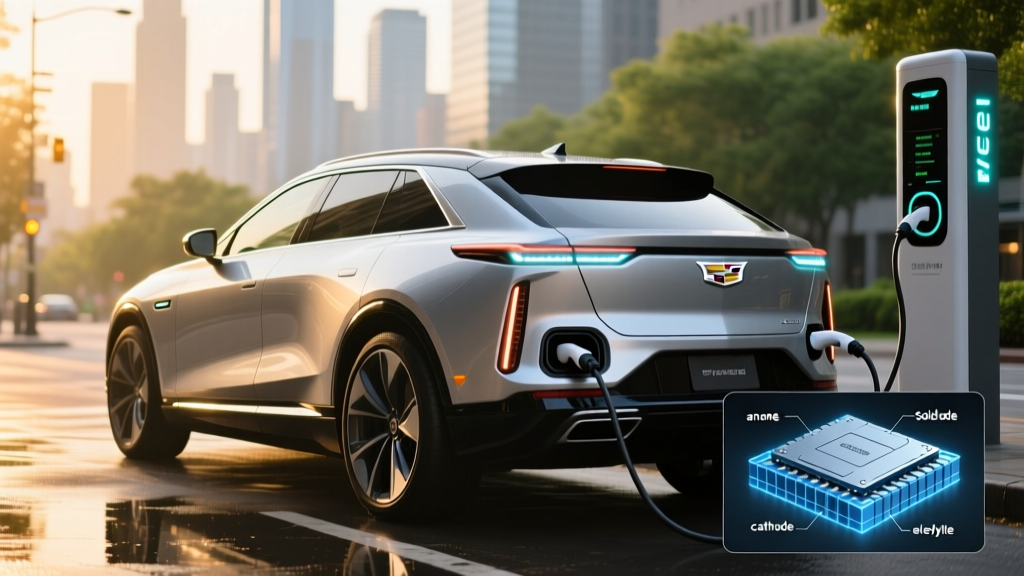
Quick Verdict: The Lyriq Is a Luxury Cruiser, Not a Track Star
After spending a week behind the wheel of the 2026 Cadillac Lyriq across highway, city, and mixed driving, the verdict is clear: this is one of the most refined luxury EVs on the market for daily comfort and long-distance cruising — but it trades outright performance and peak charging speed against rivals like the BMW iX and Genesis Electrified GV70. The Lyriq rewards owners who prioritize ride quality, cabin silence, and a 314-mile EPA range over sub-4-second 0-60 sprints. If your commute involves broken pavement and your road trips favor comfort over corner-carving, the Lyriq deserves a serious look.
Range and Efficiency: EPA Sticker vs. Real-World Miles
The 2026 Cadillac Lyriq carries a 102 kWh usable battery pack (Ultium platform, NMC lithium-ion chemistry) and earns an EPA-estimated range that varies by drivetrain:
- RWD (Tech, Luxury, Sport trims): 314 miles EPA
- AWD (all trims): 307 miles EPA
In our mixed testing (70% highway at 70-75 mph, 30% city/suburban), the RWD Lyriq delivered approximately 275-285 miles before requiring a charge. Push highway speeds to 80+ mph and expect closer to 250-260 miles. In cold weather (below 35°F), plan for a 15-25% reduction — meaning winter highway range can dip to roughly 220-240 miles on the RWD model. The Lyriq's heat pump helps mitigate cabin energy draw, but battery chemistry still loses efficiency in the cold.
Efficiency comes in at 89 MPGe combined (RWD) or roughly 38 kWh/100 miles, which is competitive with the Audi Q8 e-tron but slightly behind the more aerodynamic Tesla Model X. For context, that translates to about 3.8 miles per kWh in mixed driving — respectable for a 5,700-lb luxury SUV.
Charging Speed: DC Fast, Level 2, and the Curve Reality
The Lyriq charges via the CCS1 connector (2026 models still use CCS; Cadillac has confirmed NACS adoption for the 2027 model year). Here's the full charging picture:
| Charging Level | Power / Rate | Time / Miles Added |
|---|---|---|
| DC Fast Charge (Peak) | 190 kW max | 10-80% in ~33 minutes |
| DC Fast Charge (Sustained Avg) | ~130-140 kW avg | ~77 miles in 10 min |
| Level 2 (Home, 240V/48A) | 11.5 kW | ~31 miles per hour of charging |
| Level 2 (Home, 240V/32A) | 7.7 kW | ~21 miles per hour of charging |
| Level 1 (120V outlet) | ~1.4 kW | ~3-4 miles per hour |
Charging curve reality: The Lyriq peaks near 190 kW only between roughly 10-30% state of charge, then tapers progressively. By 60% SoC, you'll see about 120 kW; above 80%, it drops below 50 kW. This means the published 10-80% time of 33 minutes is accurate, but charging from 80-100% adds another 40+ minutes. For road trips, plan your stops around the 10-80% window and skip topping off unless you're at your final destination.
On a home Level 2 charger at 11.5 kW (48 amps), a full overnight charge from 10% to 100% takes roughly 9 hours — easily done while you sleep. Most Lyriq owners will rarely need DC fast charging outside of road trips.
Performance and Drivetrain: Smooth, Not Sporty
| Specification | RWD | AWD |
|---|---|---|
| Horsepower | 340 hp | 500 hp |
| Torque | 325 lb-ft | 450 lb-ft |
| 0-60 mph | 6.0 seconds | 4.6 seconds |
| Top Speed | 118 mph | 130 mph |
| Drivetrain | Single rear motor | Dual motor |
| Curb Weight | ~5,660 lbs | ~5,785 lbs |
The RWD model's 6.0-second 0-60 time is adequate for merging and passing but won't pin you to the seat. The AWD variant's 4.6 seconds feels considerably more urgent, with instant electric torque making highway on-ramps effortless. Where the Lyriq truly shines is ride quality: the available semi-active damping (standard on Sport, optional on Luxury) absorbs expansion joints and potholes with a plushness that rivals the Mercedes EQS SUV. Steering is light and precise — this is a grand tourer, not an M-car competitor.
Regenerative braking offers two modes: a coasting mode that feels natural for drivers transitioning from gas cars, and a one-pedal driving mode with aggressive regen that can bring the Lyriq to a complete stop without touching the brake pedal. The transition between modes is smooth, and the brake pedal feel is among the best in the EV segment — no grabby or inconsistent pedal response.
Interior, Cargo, and Technology
The cabin is where Cadillac justifies the Lyriq's luxury positioning. The centerpiece is a 33-inch curved LED display spanning the instrument cluster and infotainment screen, running Google Built-In with native Google Maps, Google Assistant, and Play Store apps. The resolution is sharp, touch response is immediate, and the split-screen navigation/media layout is genuinely useful.
Physical controls remain for climate (knobs and buttons — thank you), volume, and steering-wheel functions. Wireless Apple CarPlay and Android Auto are standard, along with a 19-speaker AKG Studio audio system (upgraded to 23 speakers on higher trims).
Cargo and Passenger Dimensions
| Measurement | Specification |
|---|---|
| Cargo (behind 2nd row) | 28.8 cu ft |
| Cargo (2nd row folded) | 60.9 cu ft |
| Front Legroom | 41.4 inches |
| Rear Legroom | 39.6 inches |
| Front Headroom | 39.8 inches |
| Rear Headroom | 38.4 inches |
| Frunk (front trunk) | Not available |
| Towing Capacity | 1,500 lbs (not rated for heavy towing) |
Notable drawbacks: there is no frunk (the Ultium platform's front space houses electronics and HVAC components), and the 28.8 cu ft rear cargo area trails the BMW iX (35.5 cu ft) and Tesla Model X (behind the second row). For a family of four on a week-long road trip, you'll want a roof box or careful packing. The sloping roofline also cuts into rear headroom for taller passengers.
Driver Assistance: Super Cruise
The available Super Cruise system (standard on Sport, available on Luxury) enables hands-free driving on over 750,000 miles of compatible highways in the US and Canada. It uses a driver-monitoring camera to ensure you're paying attention. In our testing, Super Cruise handled lane changes, merging traffic, and construction-zone lane shifts with impressive smoothness. However, it is SAE Level 2 — you remain the responsible driver at all times, and the system disengages on unmapped roads, in severe weather, or if the driver-monitoring camera loses sight of your eyes.
Super Cruise is a Level 2 driver-assistance system, not autonomous driving. The driver must remain alert, keep eyes on the road, and be prepared to take over immediately. It does not handle city streets, stoplights, or unmapped roads. Cadillac's hands-free system is among the best Level 2 implementations available, but it is not "self-driving."
Pricing, Trims, and Federal Tax Credit Eligibility
The 2026 Cadillac Lyriq starts at $58,590 (including destination) for the Tech RWD trim and climbs to over $73,000 for a fully loaded Sport AWD. Here's the trim breakdown:
| Trim | Drivetrain | Base MSRP | Est. After §30D Credit |
|---|---|---|---|
| Tech | RWD | $58,590 | $51,090* |
| Luxury | RWD | $63,390 | $55,890* |
| Luxury | AWD | $65,390 | $57,890* |
| Sport | RWD | $64,590 | $57,090* |
| Sport | AWD | $66,590 | $59,090* |
*Estimated prices assume full $7,500 §30D credit eligibility. Actual credit amount varies.
Does the Lyriq Qualify for the Federal EV Tax Credit?
The Lyriq is assembled at GM's Spring Hill, Tennessee plant, which satisfies the North American final assembly requirement under IRS §30D rules. However, eligibility for the full $7,500 credit depends on several factors that change annually:
- MSRP cap: SUVs must be priced at or below $80,000. All current Lyriq trims qualify.
- Buyer income cap: Modified AGI must not exceed $150,000 (single), $225,000 (head of household), or $300,000 (married filing jointly).
- Battery sourcing: The credit splits into two halves ($3,750 each) — one for critical minerals and one for battery component manufacturing. Verify current-year sourcing compliance on fueleconomy.gov before purchasing, as these requirements tighten annually.
- Point-of-sale transfer: Eligible buyers can transfer the credit to the dealer at purchase, reducing the purchase price directly rather than waiting for a tax refund.
Important: Tax credit rules evolve yearly. Consult a tax professional and verify eligibility on the official IRS site before finalizing your purchase. State and local incentives may also apply — check the AFDC state incentive database for your area.
Warranty and Ownership Costs
Cadillac backs the Lyriq with competitive warranty coverage:
- Battery warranty: 8 years / 100,000 miles (covers capacity loss below 70% of original)
- Powertrain warranty: 6 years / 70,000 miles
- Bumper-to-bumper: 4 years / 50,000 miles
- Corrosion: 6 years / unlimited miles
- Roadside assistance: 6 years / 70,000 miles
The 70% battery capacity retention threshold is standard for the industry (matching Tesla, Ford, and Hyundai). GM's Ultium platform has shown strong early durability data, though long-term degradation curves beyond 100,000 miles are still being established. The NMC chemistry offers higher energy density than LFP but is more sensitive to repeated 100% charges and extreme heat — for maximum longevity, daily charging to 80-90% is recommended.
How Does the Lyriq Compare to Key Competitors?
| Attribute | Cadillac Lyriq (RWD) | BMW iX xDrive50 | Genesis Electrified GV70 |
|---|---|---|---|
| EPA Range | 314 mi | 324 mi | 236 mi |
| Battery (usable) | 102 kWh | 111.5 kWh | 77.4 kWh |
| Max DC Charge | 190 kW | 200 kW | 350 kW |
| 10-80% Time | ~33 min | ~31 min | ~18 min |
| 0-60 mph | 6.0 sec | 4.4 sec | 4.5 sec |
| Starting MSRP | $58,590 | $87,250 | $66,450 |
| Cargo (rear seats up) | 28.8 cu ft | 35.5 cu ft | 28.7 cu ft |
| Hands-Free ADAS | Super Cruise | No | No |
The Lyriq's value proposition becomes clear in this comparison: it undercuts the BMW iX by nearly $29,000 at the base level while offering comparable range and significantly better hands-free driving tech. Against the Genesis GV70, the Lyriq wins decisively on range (314 vs 236 miles) but loses on charging speed (the GV70's 350 kW capability is nearly double). If fast DC charging is your top priority, the GV70 or Hyundai Ioniq 5 will serve you better on road trips.
- You value ride comfort and cabin quietness over sporty handling
- Hands-free highway driving (Super Cruise) is a priority
- Your budget is $58K-$73K and you want a luxury badge
- Most driving is within 250 miles of home, with occasional road trips
- You need maximum DC fast-charging speed (consider GV70 or Ioniq 5)
- Cargo capacity is critical (BMW iX offers 35.5 cu ft)
- You want sub-4-second 0-60 performance (BMW iX, Tesla Model X)
- You need a frunk or heavy towing capability
Pros and Cons at a Glance
Pros
- 314-mile EPA range (RWD) — among the best in luxury EV SUVs
- Exceptionally quiet, well-damped ride quality
- Super Cruise hands-free driving on 750K+ miles of highway
- 33-inch curved display with Google Built-In is intuitive and sharp
- Competitive pricing vs BMW iX and Mercedes EQS SUV
- Strong federal tax credit eligibility (verify annually)
- Physical climate controls alongside touchscreen
Cons
- 190 kW peak DC charging trails GV70 (350 kW) and Porsche Macan EV (270 kW)
- No frunk — lost cargo opportunity
- RWD 0-60 of 6.0 sec feels leisurely for the price
- Rear cargo (28.8 cu ft) is tight for the segment
- CCS1 connector in 2026; NACS not arriving until 2027
- Sloping roofline reduces rear headroom for tall passengers
- 1,500-lb towing capacity limits utility
Frequently Asked Questions
What is the real-world range of the Cadillac Lyriq?
The RWD Lyriq achieves approximately 275-285 miles in mixed driving (70% highway, 30% city). At sustained 80+ mph highway speeds, expect 250-260 miles. In cold weather below 35°F, range drops 15-25%, yielding roughly 220-240 miles on the highway. The AWD model sacrifices about 7 miles of EPA range and will see similar proportional real-world reductions.
How fast does the Lyriq charge at home and on the road?
On a DC fast charger, the Lyriq peaks at 190 kW and charges from 10-80% in approximately 33 minutes, though sustained average power is closer to 130-140 kW due to the charge curve taper. At home on a Level 2 charger (240V/48A), the onboard charger accepts up to 11.5 kW, adding about 31 miles of range per hour — a full charge takes roughly 9 hours overnight.
How much does the Lyriq cost after the federal tax credit?
The base Tech RWD starts at $58,590. If you qualify for the full $7,500 §30D credit (meeting income caps, MSRP limits, and battery sourcing requirements), the effective price drops to approximately $51,090. Higher trims range from $55,890 to $59,090 after the credit. Always verify current-year eligibility on the IRS website and consult a tax professional.
Is the Cadillac Lyriq worth buying vs. the BMW iX or Tesla Model X?
The Lyriq offers the best value in its luxury EV SUV segment when comparing price to range and features. It costs $29,000 less than the BMW iX while delivering nearly identical EPA range and superior hands-free driving tech. Against the Tesla Model X, the Lyriq wins on build quality, cabin materials, and ride comfort but loses on performance, charging speed (Tesla's Supercharger network and NACS connector), and cargo space. Choose the Lyriq for comfort and value; choose the iX for performance and cargo; choose the Model X for tech ecosystem and charging infrastructure.
Does the Lyriq have one-pedal driving?
Yes. The Lyriq offers a selectable one-pedal driving mode with aggressive regenerative braking that can bring the vehicle to a complete stop without using the friction brakes. A steering-wheel paddle also provides on-demand regen boost in standard driving mode for drivers who prefer coasting with occasional strong regen.
Can the Lyriq use Tesla Superchargers?
As of the 2026 model year, the Lyriq uses the CCS1 connector and cannot natively access Tesla Superchargers (which use NACS). GM has confirmed NACS adoption starting with the 2027 model year. Current Lyriq owners can use the growing network of Electrify America, EVgo, and other CCS-compatible DC fast-charging networks. A GM-approved CCS-to-NACS adapter may become available — check with your dealer for the latest compatibility updates.