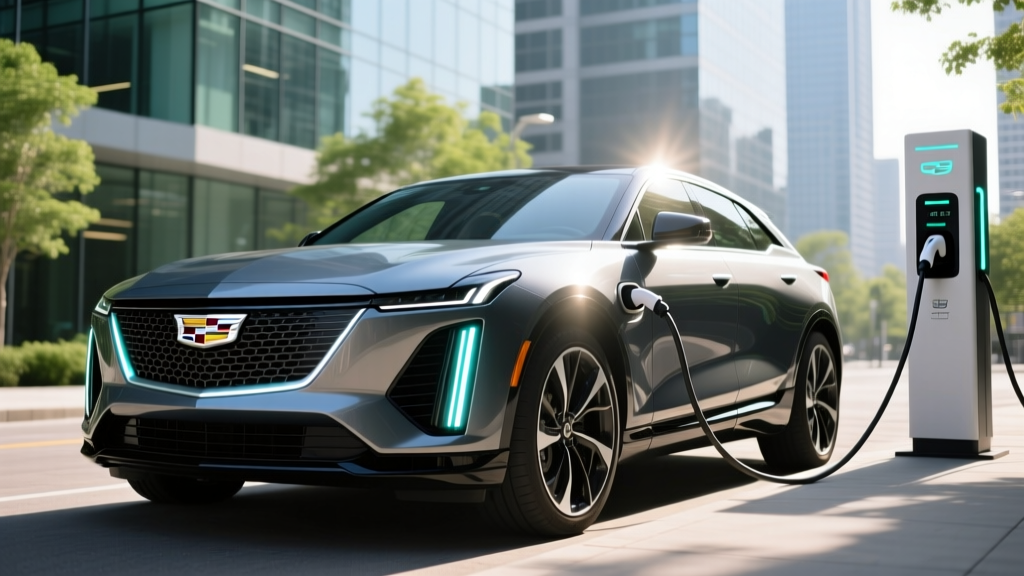
The 2026 Cadillac Lyriq Sport 3 sits at the top of GM's luxury electric SUV lineup, pairing dual-motor all-wheel drive with Cadillac's most feature-dense trim. It's the variant buyers land on when they want the Lyriq's striking design and 33-inch LED display but also need serious acceleration and all-weather traction. The question is whether its real-world range, charging behavior, and pricing hold up against rivals like the BMW iX xDrive50, Audi Q8 e-tron, and Genesis Electrified GV70.
After examining EPA data, manufacturer specifications, and real-world driving variables, here's what the Lyriq Sport 3 actually delivers — and where it falls short.
2026 Cadillac Lyriq Sport 3 Specifications at a Glance
| Spec | Value |
|---|---|
| EPA Range | 314 miles |
| Battery (usable) | 102 kWh, NMC (NCMA) |
| Drivetrain | Dual-motor AWD |
| Horsepower | 500 hp |
| 0–60 mph | 4.6 seconds |
| Max DC Fast Charge | 190 kW (peak) |
| 10–80% DC Charge Time | ~33 minutes |
| Level 2 Home Charge Rate | 19.2 kW (52 mi/hr) |
| MPGe (combined) | 89 MPGe |
| Efficiency | 38 kWh/100 mi |
| Cargo (behind rear seats) | 28.0 cu ft |
| Cargo (rear seats folded) | 60.9 cu ft |
| Base MSRP | $73,990 (incl. destination) |
| Battery/Powertrain Warranty | 8 years / 100,000 miles |
Real-World Range: What the EPA Number Doesn't Tell You
The Lyriq Sport 3 carries an EPA-estimated 314 miles of range. That figure is competitive for a 5,700-pound luxury AWD SUV, but EPA stickers assume a mix of city and highway driving at moderate temperatures. Real-world results diverge based on how and where you drive.
EPA sticker: 314 miles
Highway-only (70 mph, 75°F): ~265–280 miles
City-heavy mixed driving: ~295–310 miles (regen braking recovers energy)
Cold weather (20°F, highway): ~210–240 miles (30–35% loss typical for NMC packs without heat-pump preconditioning)
Towing (max 3,500 lb trailer): ~160–190 miles
The Lyriq uses GM's Ultium platform with a 102 kWh usable NMC (nickel-manganese-cobalt, specifically NCMA) battery. This chemistry delivers strong energy density — necessary to push a heavy luxury SUV past 300 miles — but it's more sensitive to cold-weather range loss than LFP chemistry. The Lyriq does include a heat pump for cabin heating efficiency, which mitigates some winter losses, but battery preconditioning for DC fast charging in cold weather is less aggressive than Tesla's system. Expect to plan charging stops conservatively on sub-freezing road trips.
The Sport 3's dual-motor AWD system and 20-inch wheels (standard on this trim) also consume more energy than the single-motor Luxury trims. The combined efficiency rating of 89 MPGe (38 kWh/100 mi) is respectable for its class, but it trails the single-motor Lyriq's 93 MPGe. Source: fueleconomy.gov.
Charging Speed: DC Fast and Home Level 2
The Lyriq Sport 3 peaks at 190 kW on a DC fast charger using its CCS1 connector. That's adequate but not class-leading — the Hyundai Ioniq 5 hits 240 kW, and the Porsche Macan Electric reaches 270 kW on 800-volt architectures. The Lyriq runs on GM's Ultium 400-volt platform, which limits its peak charge rate.
| Charging Level | Power (kW) | Rate / Time |
|---|---|---|
| Level 1 (120V household) | ~1.4 kW | ~4 miles per hour |
| Level 2 (240V, 48A) | 11.5 kW | ~31 miles per hour |
| Level 2 (240V, 80A / 19.2 kW AC) | 19.2 kW | ~52 miles per hour |
| DC Fast Charge (peak) | 190 kW | 10–80% in ~33 min |
| DC Fast Charge (sustained avg.) | ~130 kW | 80–100% adds ~25+ min (taper) |
The critical detail for road-trippers: peak charge rate is not sustained rate. The Lyriq hits 190 kW briefly at low state of charge (around 10–20% SoC) and tapers progressively. The average rate from 10–80% is closer to 130 kW, which is why the full 10–80% session takes roughly 33 minutes. Above 80%, the charge curve drops steeply to protect the NMC cells — adding the final 20% can take as long as the first 70%. This is normal battery management behavior, but it means you should plan to charge to 80% and go, not wait for a full top-off on road trips.
At home, the Lyriq's onboard charger supports up to 19.2 kW on a hardwired Level 2 station (80 amps). That's one of the faster AC charge rates in the luxury EV segment and can refill the full 102 kWh battery in about 5.5 hours. Most buyers will install a 48-amp Level 2 charger (11.5 kW), which adds roughly 31 miles per hour and fully recharges overnight in ~9 hours. Budget $800–$2,000 for a quality Level 2 home charger and professional installation, with the caveat that a 200-amp electrical panel upgrade (common in older homes) can add $1,500–$3,000.
Performance and Driving Dynamics
The Sport 3's dual-motor setup produces 500 horsepower and 450 lb-ft of torque, launching the Lyriq from 0–60 mph in 4.6 seconds. That's genuinely quick for a family SUV and noticeably more urgent than the single-motor variants (which run ~6.0 seconds to 60). The instant electric torque makes highway merging and passing effortless.
Ride quality leans comfortable rather than sporty despite the "Sport" badge. The suspension absorbs bumps well, and cabin noise isolation is excellent — among the quietest in the luxury EV segment. The steering is light and precise but not engaging. If you want a driver-focused luxury EV SUV, the BMW iX is more dynamic. The Lyriq prioritizes serene cruising, which suits its grand-tourer character.
The Sport 3 comes standard with 20-inch alloy wheels wrapped in all-season tires. A towing package is available with a 3,500-pound max capacity — enough for a small boat or utility trailer, but well below the Rivian R1S or Tesla Model X.
Interior, Tech, and Cargo
The Lyriq's interior is where Cadillac's luxury ambitions are most visible. The centerpiece is a 33-inch diagonal advanced LED display that stretches across the dashboard, combining the instrument cluster and infotainment touchscreen into one curved panel running Google Built-In (Google Maps, Google Assistant, Play Store apps). Wireless Apple CarPlay and Android Auto are standard.
The Sport 3 trim adds:
- Nappa leather seating surfaces with heated and ventilated front seats
- Heated steering wheel and heated rear outboard seats
- 19-speaker AKG Studio audio system
- Head-up display with augmented-reality navigation overlay
- Super Cruise hands-free driving on compatible highways (SAE Level 2 — driver must remain attentive)
- Ambient lighting with 26 color choices
Cargo space measures 28.0 cubic feet behind the rear seats and 60.9 cubic feet with the rear seats folded flat. That's competitive with the Genesis Electrified GV70 but trails the BMW iX (35.5 / 77.9 cu ft). There is no front trunk (frunk) — the space under the hood houses electronics and the HVAC system. Rear legroom is 39.6 inches, adequate for adults on long trips.
A notable drawback: the Lyriq's rear visibility is compromised by the sloping roofline and thick C-pillars. The digital rearview camera mirror (standard on Sport 3) largely solves this, but it takes adjustment if you're accustomed to a traditional mirror.
Pricing, Trims, and Federal Tax Credit Eligibility
The 2026 Cadillac Lyriq Sport 3 starts at $73,990 including destination. Well-equipped examples with the AKG audio upgrade, crystal white metallic paint, and advanced safety packages can reach $78,000–$80,000 before incentives.
| Trim | MSRP (incl. dest.) | Key Additions Over Base |
|---|---|---|
| Sport 1 (AWD) | $66,290 | Dual-motor AWD, 20" wheels, Super Cruise |
| Sport 2 (AWD) | $69,990 | Nappa leather, AKG 19-speaker audio, HUD |
| Sport 3 (AWD) | $73,990 | Sport appearance package, premium lighting, all driver-assist features |
Federal EV tax credit eligibility for the Lyriq is a moving target under IRS §30D rules. Here's the framework as of 2026:
- MSRP cap: SUVs must be priced at or below $80,000. The Lyriq Sport 3 at $73,990 qualifies; heavily optioned examples that cross $80,000 do not.
- Buyer income cap: Modified adjusted gross income must not exceed $300,000 (joint filers), $225,000 (head of household), or $150,000 (single).
- Battery sourcing requirements: The credit is split into two $3,750 halves — one for critical minerals sourcing and one for battery component manufacturing. GM has progressively shifted Ultium battery sourcing to North America (Lansing, MI and Spring Hill, TN plants), but the exact credit amount ($3,750 or $7,500) depends on the model year's compliance with critical-mineral and component thresholds. Some Lyriq builds may qualify for only $3,750.
- Point-of-sale transfer: Eligible buyers can transfer the credit to the dealer at purchase, reducing the upfront price rather than waiting for a tax refund.
Always verify current eligibility on the IRS clean vehicle credit page (irs.gov) and confirm with your tax professional before purchasing. State and local incentives vary and may stack on top of the federal credit.
Base MSRP: $73,990
Federal credit (if full $7,500): –$7,500
Effective price: ~$66,490
Federal credit (if $3,750 partial): –$3,750
Effective price: ~$70,240
Your actual savings depend on sourcing compliance for your build month, income eligibility, and tax liability.
Pros and Cons
- 314-mile EPA range is competitive for a luxury AWD EV SUV
- 19.2 kW AC onboard charger — fastest in its class for home charging
- Super Cruise hands-free highway driving is well-executed and confidence-inspiring
- 33-inch LED display is visually stunning and responsive
- Exceptionally quiet cabin with refined ride quality
- 500 hp dual-motor acceleration (4.6s 0–60) is thrilling
- 190 kW peak DC charge rate lags behind 800V competitors (Ioniq 5, Macan Electric)
- No front trunk (frunk) — lost utility for the segment
- Cargo space (28.0 cu ft) trails the BMW iX significantly
- Rear visibility is poor without the digital camera mirror
- Cold-weather range loss is substantial (30%+ at highway speeds)
- Tax credit eligibility is uncertain and depends on build-month sourcing
How It Compares to Key Competitors
The Lyriq Sport 3 competes in the midsize luxury EV SUV segment. Here's how it stacks up on the metrics buyers care about most:
| Cadillac Lyriq Sport 3 | BMW iX xDrive50 | Audi Q8 e-tron Prestige | Genesis Electrified GV70 | |
|---|---|---|---|---|
| EPA Range | 314 mi | 324 mi | 285 mi | 236 mi |
| Battery (usable) | 102 kWh NMC | 105.2 kWh NMC | 106 kWh NMC | 77.4 kWh NMC |
| Peak DC Charge | 190 kW | 200 kW | 170 kW | 240 kW |
| 0–60 mph | 4.6s | 4.4s | 5.5s | 4.2s |
| Cargo (rear up) | 28.0 cu ft | 35.5 cu ft | 28.5 cu ft | 28.7 cu ft |
| Base MSRP (AWD) | $73,990 | $87,250 | $79,800 | $68,350 |
| Hands-Free ADAS | Super Cruise | Highway Assistant | — | — |
The Lyriq Sport 3 undercuts the BMW iX on price by over $13,000 while offering comparable range and a more intuitive hands-free driving system. It matches the Audi Q8 e-tron on cargo but beats it on range and acceleration. The Genesis Electrified GV70 is cheaper but gives up 78 miles of range — a significant deficit for road-trippers.
If cargo capacity is your top priority, the BMW iX wins. If you want the best value with hands-free highway driving and strong range, the Lyriq Sport 3 is the strongest argument in the segment.
Who Should Buy the Cadillac Lyriq Sport 3?
The Lyriq Sport 3 is best suited for:
- Luxury commuters who drive 40–80 miles daily and can charge at home overnight — the 19.2 kW onboard charger means you'll always wake up with a full battery.
- Families who value a quiet, refined cabin and Super Cruise for highway-heavy road trips to visit relatives.
- All-weather drivers in snow-belt states who need dual-motor AWD and a heat pump for winter efficiency.
It's less ideal for:
- Frequent road-trippers who prioritize the fastest possible DC charging — the 190 kW peak and 33-minute 10–80% time is fine but not best-in-class.
- Cargo-heavy buyers who regularly haul bulky gear — the 28 cu ft trunk and lack of a frunk limit utility.
- Budget-conscious EV shoppers — at $74K, even with a potential $7,500 credit, this is a premium purchase.
Frequently Asked Questions
What is the real-world range of the Cadillac Lyriq Sport 3?
The EPA rates it at 314 miles, but expect roughly 265–280 miles on highway-only trips at 70 mph, and as low as 210–240 miles in freezing temperatures. City driving with regenerative braking gets you closer to the EPA number.
How fast does the Lyriq Sport 3 charge?
On a DC fast charger, it peaks at 190 kW and charges from 10–80% in approximately 33 minutes. At home on a 19.2 kW Level 2 station, it adds about 52 miles of range per hour, fully recharging in roughly 5.5 hours.
Does the Lyriq Sport 3 qualify for the $7,500 federal EV tax credit?
It may qualify for $3,750 or the full $7,500 depending on battery sourcing compliance for your specific build month. The $73,990 MSRP is under the $80,000 SUV cap, but buyer income limits apply ($300K joint / $150K single). Confirm on irs.gov before purchasing.
Is the Lyriq Sport 3 worth buying over the BMW iX?
If you prioritize value, the Lyriq wins — it's over $13,000 cheaper with comparable range and superior hands-free driving (Super Cruise). If cargo space and slightly faster DC charging matter more, the iX is the better pick.
Does Super Cruise make the Lyriq self-driving?
No. Super Cruise is an SAE Level 2 system that allows hands-free driving on mapped highways, but the driver must remain attentive and ready to take control immediately. A camera monitors your eyes to enforce this. It is not Level 4 autonomous driving.
What is the battery warranty?
GM covers the Lyriq's Ultium battery and powertrain for 8 years or 100,000 miles, whichever comes first. The warranty guarantees the battery will retain a minimum capacity threshold (typically 60–70% of original capacity, per GM's terms) during the coverage period.