Quick Verdict: The Cadillac Lyriq in 2026
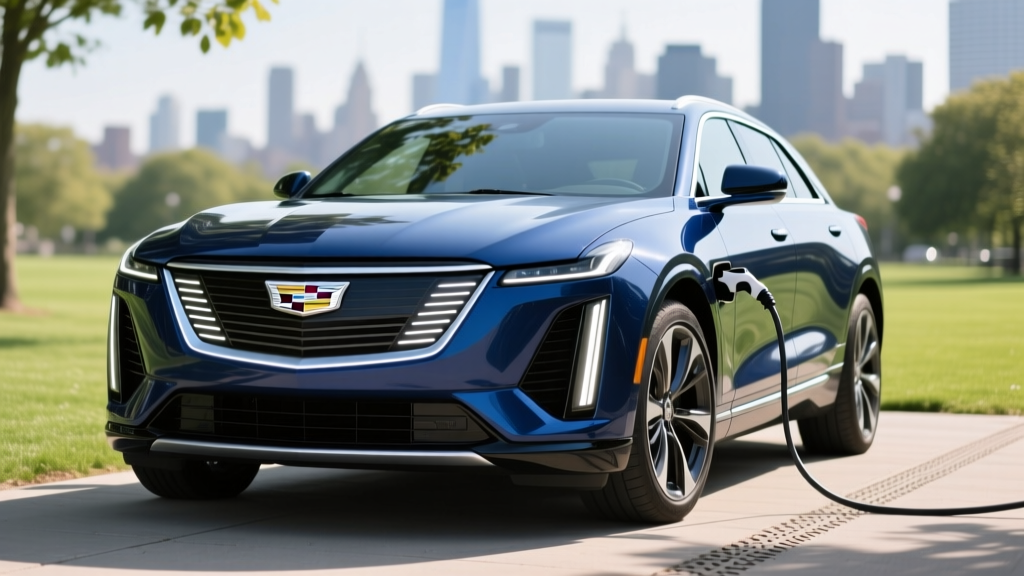
The Cadillac Lyriq remains General Motors' flagship luxury electric crossover, and for 2026 it carries forward the Ultium platform refinements that made it a legitimate BMW iX and Genesis Electrified GV70 competitor. With a 102 kWh usable battery, EPA-estimated range up to 314 miles, and a starting MSRP that undercuts German rivals by $10,000 or more, the Lyriq targets buyers who want American luxury without the European price premium. But spec sheets only tell part of the story — charging-curve behavior, real-world efficiency, and §30D tax-credit eligibility are where purchase decisions actually get made.
| Spec | Luxury (RWD) | Sport/Luxury AWD |
|---|---|---|
| EPA Range | 314 mi | 307 mi |
| Battery (usable) | 102 kWh, NMC (Ultium) | |
| Horsepower | 340 hp | 500 hp |
| Torque | 325 lb-ft | 450 lb-ft |
| 0-60 mph | 6.0 sec | 4.6 sec |
| Drivetrain | Rear-Wheel Drive | Dual-Motor AWD |
| Max DC Fast Charge | 190 kW (peak) | |
| 10-80% DC Charge Time | ~33 minutes | |
| Level 2 Home Charge Rate | 11.5 kW (19.2 kW capable) | |
| MPGe (combined) | 89 MPGe | 88 MPGe |
| Efficiency | 38 kWh/100mi | 39 kWh/100mi |
| Base MSRP | $58,590 | $64,090 |
| Battery Warranty | 8 years / 100,000 miles | |
Range and Efficiency: EPA vs. Reality
The rear-wheel-drive Lyriq Luxury carries an EPA-estimated 314 miles of range, while the dual-motor AWD variants drop slightly to 307 miles. Those numbers position the Lyriq competitively against the BMW iX xDrive50 (324 mi) and well ahead of the Genesis Electrified GV70 (236 mi). But EPA testing uses a weighted city/highway cycle with moderate temperatures — conditions that rarely match a 75-mph interstate drive in January.
Real-World Range Expectations
EPA Sticker: 314 miles (RWD) / 307 miles (AWD)
Highway (70-75 mph, 65°F): Expect 260-280 miles. The Lyriq's 38-39 kWh/100mi combined efficiency rises to roughly 42-44 kWh/100mi at sustained highway speeds, where aerodynamic drag dominates.
Cold Weather (30°F, highway): Plan for 210-240 miles. The Ultium battery's active thermal management mitigates some loss, but cabin heating and reduced battery chemistry efficiency still extract a 20-30% toll.
City / Mixed Commute (55-65°F): You'll see numbers close to or slightly above the EPA estimate thanks to regenerative braking recovery.
One practical note: the Lyriq's One-Pedal Driving mode, when engaged, provides enough regenerative deceleration for most stop-and-go driving without touching the brake pedal. It's not as aggressive as Tesla's hold mode but is effective once you adjust. The available steering-wheel regen paddle (a carry-over from the Chevy Bolt) lets you modulate regen on demand — a feature many owners prefer over full one-pedal.
Charging Speed: DC Fast, Level 2, and the Curve Reality
The Lyriq's 190 kW peak DC fast-charge rate is adequate for 2026, though it trails the Hyundai Ioniq 5's 240 kW and the Porsche Macan EV's 270 kW. More important than peak rate is the charge curve — how long the battery sustains high power before tapering to protect cell health.
| Charging Level | Power / Rate | Speed | Notes |
|---|---|---|---|
| Level 1 (120V) | 1.4 kW | ~3-4 mi/hr | Emergency/trickle only |
| Level 2 (240V, 48A) | 11.5 kW | ~31 mi/hr | Standard home charger; 0-100% in ~10.5 hrs |
| Level 2 (240V, 80A) | 19.2 kW | ~52 mi/hr | Requires upgraded onboard charger option + 100A circuit |
| DC Fast (peak) | 190 kW | ~10-80% in 33 min | Peak only below 40% SoC; tapers to ~90 kW above 60% |
On a 350 kW Electrify America or EVgo station, the Lyriq will accept its full 190 kW — but only up to roughly 35-40% state of charge. From 40-60%, expect rates around 140-150 kW, and above 80%, the rate drops sharply to approximately 40-50 kW. This taper is standard for NMC chemistry protecting long-term cell health, but it means a 10-90% session takes closer to 48-50 minutes, not the 33-minute figure quoted for 10-80%. For road trips, the practical strategy is to charge to 80% and go — the time penalty from 80-100% is rarely worth the extra 60 miles.
For home charging, most Lyriq owners install a 48-amp Level 2 wall connector on a 60-amp circuit, delivering 11.5 kW. That's sufficient to replenish a full day's driving (40-60 miles) in about two hours overnight. The optional 19.2 kW onboard charger requires an 80-amp continuous circuit (100-amp breaker) — feasible in homes with 200-amp panels, but expect $800-$1,500 in additional electrical work if a panel upgrade is needed.
Performance and Driving Dynamics
The RWD Lyriq's 340 hp and 6.0-second 0-60 time deliver effortless highway merging and confident passing — this is not a performance SUV, and it doesn't pretend to be. The torque arrives instantly from the rear-mounted permanent-magnet motor, and the ride quality, aided by GM's five-link rear suspension and available air suspension, is genuinely plush. Road noise isolation is a standout; at 70 mph the cabin is quieter than a BMW iX.
Step up to the dual-motor AWD Sport trim and the character changes. With 500 hp and 450 lb-ft, the 4.6-second 0-60 time puts it in sports-sedan territory, and the torque-vectoring rear axle provides genuine cornering confidence. The AWD system can fully disconnect the front motor for efficiency during steady-state cruising, which helps explain why the AWD range penalty is only 7 miles.
Towing capacity is rated at 1,500 pounds across all trims — adequate for a small utility trailer or a pair of dirt bikes, but not competitive with the Rivian R1S (7,700 lbs) or even the Tesla Model X (5,000 lbs). If towing is a priority, the Lyriq isn't your vehicle.
Interior, Tech, and Driver Assistance
The Lyriq's cabin centers on a 33-inch diagonal LED display that spans from the instrument cluster to the infotainment touchscreen in a single curved panel. Resolution is sharp, the Google Built-in interface (Google Maps, Assistant, Play Store) is responsive, and wireless Apple CarPlay and Android Auto are standard. The available AKG 19-speaker audio system is a highlight, with a headrest-mounted speaker array for navigation prompts and phone calls that doesn't interrupt music for other passengers.
Cargo space measures 28.0 cubic feet behind the second row and 60.9 cubic feet with the rear seats folded — competitive with the BMW iX (30.5/67.4) but trailing the Tesla Model X (37.1/81.5). Rear-seat legroom is generous at 39.6 inches, and the flat floor (no transmission tunnel) makes the middle seat usable for adults on shorter trips.
Notably, the Lyriq does not have a front trunk (frunk). GM allocated that space to HVAC and power electronics, which improves cabin heating efficiency but costs you 2-3 cubic feet of sealed storage that competitors like the Rivian R1S and Ford Mustang Mach-E offer.
Super Cruise: Level 2, Not Self-Driving
Cadillac's Super Cruise is a SAE Level 2 driver-assistance system. It provides hands-free driving on over 750,000 miles of pre-mapped divided highways in the US and Canada, using a driver-monitoring camera to confirm your eyes remain on the road. You must stay engaged and ready to take over at any moment. This is fundamentally different from Level 4 robotaxi services like Waymo, which operate without a driver. Super Cruise is among the best Level 2 systems available — smoother and more predictable than Tesla Autopilot on mapped routes — but it is not autonomous driving.
The available Ultra Cruise (on higher trims) extends hands-free capability to city streets and non-divided roads, though it still requires driver supervision. Lane-change-on-demand, automatic lane positioning, and adaptive cruise with stop-and-go are all seamlessly integrated.
Pricing, Trims, and Federal Tax Credit Eligibility
The 2026 Lyriq lineup starts at $58,590 for the Luxury RWD, scaling up to $73,490 for the Sport AWD with the available Premium package. Destination charges add $1,395. Here's the trim breakdown with estimated credit-adjusted pricing:
| Trim | MSRP | Est. §30D Credit | Effective Price |
|---|---|---|---|
| Luxury RWD | $58,590 | Up to $7,500 | ~$51,090 |
| Luxury AWD | $64,090 | Up to $7,500 | ~$56,590 |
| Sport RWD | $63,590 | Up to $7,500 | ~$56,090 |
| Sport AWD | $68,090 | Up to $7,500 | ~$60,590 |
Federal §30D tax credit eligibility is not automatic. According to current IRS guidelines, the Lyriq must satisfy several criteria:
- MSRP cap: The Lyriq's base MSRP falls under the $80,000 SUV/truck cap, but heavily optioned Sport AWD models approaching $80,000 should be verified at point of sale.
- Buyer income limits: Modified adjusted gross income must not exceed $300,000 (joint filers), $225,000 (head of household), or $150,000 (individual).
- Battery sourcing: The required percentage of critical minerals and battery components must be sourced from the US or free-trade-agreement countries. GM has progressively shifted Ultium cell supply chains to meet these thresholds, but eligibility can change — confirm with your dealer and review the latest DOE/FuelEconomy.gov credit list before purchasing.
- Point-of-sale transfer: As of 2024, you can transfer the credit to the dealer at purchase, reducing your out-of-pocket cost directly rather than waiting to claim it on your tax return.
Consult a tax professional for your specific situation. Credit rules are subject to legislative changes and supply-chain updates throughout the model year.
Warranty and Long-Term Ownership
GM backs the Lyriq's Ultium battery pack and electric drive components with an 8-year/100,000-mile warranty, guaranteeing the battery will retain at least 70% of its original capacity during that period. The limited vehicle warranty covers 4 years/50,000 miles, and complimentary scheduled maintenance (cabin air filter, tire rotation, multi-point inspection) is included for the first year.
NMC battery degradation data for the Ultium platform is still maturing — the Lyriq launched for the 2023 model year, so the longest-running examples are approaching 3 years of real-world use. Early owner reports and GM's internal testing suggest degradation in the 5-8% range over the first 100,000 miles, which is typical for liquid-cooled NMC packs. The active thermal management system preconditions the battery during navigation-routed charging sessions, which reduces stress on cells during DC fast charging.
Insurance costs for the Lyriq run 15-25% higher than a comparably priced gas-powered Cadillac XT5, which is consistent with the EV segment broadly. Get quotes before purchasing — premiums vary significantly by state, driver profile, and insurer.
Pros
- Quiet, refined ride quality that rivals $80K+ European EVs
- 314-mile EPA range (RWD) reduces charging stops on road trips
- Super Cruise is among the most polished Level 2 systems available
- Google Built-in infotainment is fast and intuitive
- Competitive pricing undercuts BMW iX by $25,000+
- Optional 19.2 kW Level 2 charging for rapid home replenishment
Cons
- No front trunk (frunk) — lost cargo utility
- 190 kW peak DC charging trails Korean and German rivals
- 1,500-lb towing capacity is the lowest in the luxury EV SUV class
- One-pedal driving mode could be more aggressive
- AWD range penalty and price premium are steep for northern-climate buyers
- Some interior materials (door panels, lower dash) feel below the price point
Who Should Buy the Cadillac Lyriq?
Decision Framework
Choose the Lyriq RWD if: You want a comfortable daily-driver luxury crossover with 300+ miles of range, mostly drive in moderate climates, and value cabin quietness and ride quality over outright performance. The $58,590 starting price with potential $7,500 credit makes it one of the most accessible luxury EVs.
Choose the Lyriq AWD if: You live in a region with snow and ice, want the security of dual-motor traction, and don't mind paying $5,500 more and sacrificing 7 miles of range. The 500 hp Sport AWD variant also appeals to drivers who want genuine acceleration punch.
Look elsewhere if: You need to tow more than 1,500 lbs (consider Rivian R1S), you want the fastest possible DC charging (Ioniq 5 or Macan EV), you need three rows of seating (Kia EV9), or you demand a frunk for gear storage (Mach-E, R1S).
Frequently Asked Questions
What is the real-world range of the Cadillac Lyriq?
The EPA rates the RWD Lyriq at 314 miles and the AWD at 307 miles. In real-world highway driving at 70-75 mph in moderate temperatures, expect 260-280 miles. In cold weather (below freezing), plan for 210-240 miles. City and suburban driving with regenerative braking will get you closest to the EPA sticker number.
How fast does the Lyriq charge at home and on the road?
On a standard 48-amp Level 2 home charger, the Lyriq adds about 31 miles of range per hour (11.5 kW), fully recharging overnight in roughly 10.5 hours. With the optional 19.2 kW onboard charger and an 80-amp circuit, that increases to about 52 miles per hour. On a DC fast charger, the Lyriq peaks at 190 kW and charges from 10-80% in approximately 33 minutes, though real-world sessions vary based on battery temperature and state of charge.
Does the 2026 Cadillac Lyriq qualify for the $7,500 federal EV tax credit?
The Lyriq is eligible for up to $7,500 under IRS §30D, provided you meet income limits ($150K individual / $300K joint MAGI), the vehicle MSRP stays under $80,000, and battery sourcing requirements are met at time of purchase. GM's Ultium battery supply chain has largely met critical-mineral thresholds, but eligibility can shift — always verify on FuelEconomy.gov and with your tax professional before finalizing a purchase. The credit can be transferred to the dealer at point of sale.
Is the Lyriq worth buying over the BMW iX or Genesis Electrified GV70?
The Lyriq wins on value — it offers comparable range, a more refined ride, and Super Cruise for $15,000-$25,000 less than the BMW iX. The iX counters with faster DC charging (200 kW+), a frunk, and sharper handling. The Genesis Electrified GV70 offers a more intimate luxury feel but suffers from only 236 miles of range. If cabin serenity and cost-per-mile of range are your priorities, the Lyriq is the strongest pick in this segment.
What are the biggest drawbacks of the Cadillac Lyriq?
The most common owner complaints center on the lack of a frunk, the 190 kW DC charging ceiling (which feels dated against 250+ kW competitors), and the 1,500-pound towing limit. Some reviewers also note that lower interior trim materials don't match the premium implied by the $60K+ price tag. The absence of a third row and limited off-brand public charging reliability (though improving with NACS adoption) are additional considerations.
What is the Lyriq's battery warranty?
GM covers the Ultium battery pack and electric drivetrain for 8 years or 100,000 miles, whichever comes first. The warranty guarantees the battery will retain at least 70% of its original usable capacity. The bumper-to-bumper limited warranty covers 4 years or 50,000 miles.