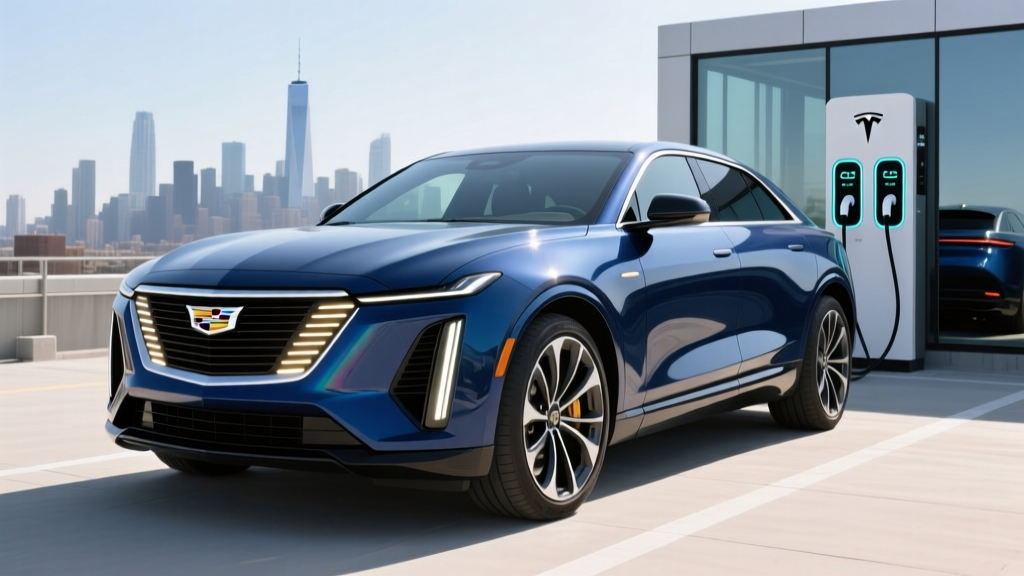
The Cadillac Lyriq occupies a narrow but important lane: a luxury midsize electric SUV that undercuts European rivals on price while delivering genuine premium materials, a usable 300-plus-mile range, and access to the Tesla Supercharger network. For 2026, the Lyriq carries over its Ultium platform hardware with minor trim and software updates, remaining one of the few luxury EVs where the base price still clears the IRS §30D MSRP cap for federal tax credit eligibility. We spent time with the Lyriq across city commuting, highway road trips, and DC fast-charging sessions to see how its spec sheet translates to ownership reality.
Quick Verdict: Who Should Buy the Cadillac Lyriq?
The Lyriq is best suited for luxury-minded buyers who prioritize ride comfort, cabin quietness, and distinctive design over sporty driving dynamics or segment-leading charging speed. It works well as a daily commuter and weekend road-tripper for couples or small families. If you need third-row seating, a frunk, or sub-4-second 0-60 performance, look elsewhere — the BMW iX, Tesla Model X, or Rivian R1S cover those needs. But if you want a refined, comfortable electric cruiser with real luxury presence at a price that still qualifies for federal incentives, the Lyriq is one of the strongest options in the segment.
Range, Efficiency, and Real-World Expectations
The 2026 Cadillac Lyriq is offered in rear-wheel-drive (RWD) and all-wheel-drive (AWD) configurations, with meaningful range differences between them.
| Trim / Drivetrain | EPA Range | MPGe (City/Hwy/Combined) | kWh/100 mi |
|---|---|---|---|
| Luxury RWD | 314 mi | 95 / 82 / 89 | 38 |
| Sport RWD | 314 mi | 95 / 82 / 89 | 38 |
| Luxury AWD | 307 mi | 91 / 79 / 85 | 40 |
| Sport AWD | 307 mi | 91 / 79 / 85 | 40 |
The EPA's 314-mile estimate for the RWD Lyriq assumes a mix of city and highway driving at moderate temperatures. In sustained 75 mph highway driving, expect approximately 260–280 miles before needing to charge. In freezing temperatures (below 32°F), range can drop an additional 15–25%, bringing realistic highway range down to roughly 210–240 miles. The Lyriq's heat pump helps mitigate cold-weather losses compared to resistive heating systems, but physics still applies — plan conservatively on winter road trips. City driving with regenerative braking recovers energy and can match or slightly exceed the EPA sticker.
Efficiency of 38–40 kWh/100 miles places the Lyriq in the middle of the luxury EV pack. The BMW iX xDrive50 achieves about 87 MPGe combined (39 kWh/100 mi), while the heavier Mercedes EQE SUV manages roughly 78 MPGe combined. The Lyriq's efficiency is acceptable given its 5,600-pound curb weight, but it's not class-leading. Source: fueleconomy.gov.
Battery, Platform, and Chemistry
The Lyriq rides on GM's Ultium BEV3 platform with a 102 kWh usable battery pack (approximately 106 kWh gross). The pack uses NMC (nickel manganese cobalt) lithium-ion chemistry in a pouch-cell configuration supplied by the GM-LG Energy Solution joint venture, Ultium Cells. NMC chemistry offers higher energy density than LFP (lithium iron phosphate), which helps the Lyriq achieve its 314-mile range without an excessively heavy or bulky pack. The trade-off is that NMC cells typically experience slightly faster long-term degradation than LFP and require more careful thermal management — though GM's active liquid cooling system addresses this.
The battery is covered by GM's standard EV warranty: 8 years or 100,000 miles, whichever comes first, against defects and capacity loss below a specified threshold (typically 60-70% of original capacity, though exact retention guarantees should be confirmed in your purchase documentation).
Charging Speed: DC Fast Charging and Home Level 2
Charging speed is one area where the Lyriq draws legitimate criticism. Its peak DC fast-charge rate of 190 kW trails competitors like the Hyundai Ioniq 5 (240 kW), Porsche Taycan (270 kW), and Lucid Air (300+ kW). On a road trip, this means longer stops.
| Charging Level | Power / Rate | Time or Miles Added |
|---|---|---|
| Level 1 (120V household) | ~1.4 kW | ~4 miles per hour |
| Level 2 (240V home/public) | 19.2 kW (max onboard) | ~52 miles per hour; full charge in ~5.5 hrs |
| DC Fast Charge (CCS/NACS) | 190 kW peak | 10–80% in ~33 minutes |
Charging curve reality: The Lyriq peaks at 190 kW only at low state of charge (roughly 5–20%) on a compatible 350 kW charger. As the battery fills, the rate tapers significantly — by 60% SoC, you're typically seeing 100–120 kW, and above 80%, the rate drops to under 50 kW to protect the NMC cells. This is why the 10–80% time of approximately 33 minutes is the meaningful metric, not the peak number. For comparison, the Hyundai Ioniq 5 achieves 10–80% in roughly 18 minutes thanks to its 800V architecture and flatter charge curve.
For the 2026 model year, the Lyriq ships with a NACS (North American Charging Standard) port, giving native access to Tesla Supercharger V3 and V4 stations without an adapter. This is a significant practical advantage over CCS-equipped vehicles that still require a CCS-to-NACS adapter for Supercharger access. You can also use Electrify America, EVgo, and ChargePoint networks via their respective NACS or CCS connectors.
At home, the Lyriq's 19.2 kW onboard charger is among the fastest in its class, meaning a properly wired Level 2 home station (hardwired 80-amp circuit) can add roughly 52 miles of range per hour or fully replenish the battery in about 5.5 hours. Most homeowners will install a 48-amp or 60-amp circuit, which delivers 11.5–14.4 kW and adds 31–39 miles per hour — still more than adequate for overnight charging. Note that a 19.2 kW home setup requires a 100-amp breaker and substantial panel capacity; consult a licensed electrician to verify your electrical panel can support it.
Performance: Powertrain, Acceleration, and Driving
| Configuration | Horsepower | Torque (lb-ft) | 0–60 mph | Drivetrain |
|---|---|---|---|---|
| RWD (single motor, rear) | 340 hp | 325 | 6.0 sec | Rear-wheel drive |
| AWD (dual motor) | 500 hp | 450 | 4.6 sec | All-wheel drive |
The RWD Lyriq delivers smooth, linear acceleration that feels effortless in daily driving. The 6.0-second 0–60 time isn't sportscar territory, but it's more than adequate for highway merging and passing. The AWD dual-motor variant's 500 hp and 4.6-second sprint give it genuine quickness, though the Lyriq's 5,600-pound mass is always perceptible through corners and under braking.
Ride quality is where the Lyriq earns its luxury badge. The five-link rear suspension and standard passive damping absorb road imperfections with composure, and the cabin remains impressively quiet at highway speeds — aided by acoustic laminated glass and active noise cancellation. Steering is light and accurate but not communicative; this is a grand touring SUV, not a sports sedan. Regenerative braking offers multiple levels selectable via steering-wheel paddles, and one-pedal driving mode is available for those who prefer it.
Interior, Cargo, and Technology
The Lyriq's cabin is genuinely premium, with materials and build quality that compete favorably with the BMW iX and Mercedes EQE SUV. The centerpiece is a 33-inch curved LED display that integrates the instrument cluster and infotainment touchscreen into a single unit running GM's Android-based infotainment system. It supports wireless Apple CarPlay and Android Auto, Google built-in (Maps, Assistant, Play Store), and over-the-air updates.
Cargo and passenger space:
- Cargo volume behind rear seats: 28.0 cu ft
- Cargo volume with rear seats folded: 60.9 cu ft
- Front legroom: 41.4 inches
- Rear legroom: 39.6 inches
- Front headroom: 38.6 inches
- Rear headroom: 38.1 inches
Notably, the Lyriq has no front trunk (frunk). GM used that space for HVAC and power electronics, which means all cargo goes in the rear. The 28 cu ft behind the second row is adequate for weekly groceries or two large suitcases, but rivals like the Rivian R1S and Tesla Model X offer more total cargo volume. Rear-seat passengers enjoy generous legroom and a flat floor, making the Lyriq comfortable for four adults on longer trips.
Driver assistance: The Lyriq comes standard with GM's Super Cruise on qualifying trims (Luxury and Sport with the appropriate package). Super Cruise is an SAE Level 2 hands-free driving system that operates on over 750,000 miles of mapped divided highways in the US and Canada. It uses a driver-facing camera to monitor attention and will alert and slow the vehicle if the driver looks away. Super Cruise is genuinely impressive for highway cruising, but it is not self-driving — you must remain attentive and ready to take over at all times. It does not handle city streets, construction zones, or unmapped roads. For 2026, GM continues to expand Super Cruise coverage and has added lane-change-on-confirmation functionality.
Super Cruise is an SAE Level 2 driver-assistance system. The driver must remain engaged, monitor the road, and keep hands available even when the system is active on compatible highways. It does not operate on surface streets, in heavy construction zones, or in severe weather. Never treat any Level 2 system as autonomous.
Pricing, Trims, and Federal Tax Credit
| Trim | Drivetrain | Base MSRP | §30D Credit Eligible? | Effective Price* |
|---|---|---|---|---|
| Luxury | RWD | $58,590 | Yes (if buyer qualifies) | ~$51,090 |
| Sport | RWD | $60,290 | Yes (if buyer qualifies) | ~$52,790 |
| Luxury | AWD | $62,090 | Yes (if buyer qualifies) | ~$54,590 |
| Sport | AWD | $63,790 | Yes (if buyer qualifies) | ~$56,290 |
*Effective price assumes full $7,500 §30D credit. Actual eligibility depends on buyer income, battery sourcing, and MSRP caps. Destination charge (~$1,395) not included.
The Lyriq's base MSRP of $58,590 for the Luxury RWD trim is significant because it sits below the IRS §30D MSRP cap of $80,000 for SUVs. This means every Lyriq trim qualifies on the vehicle-price side of the equation. However, eligibility for the full $7,500 federal tax credit depends on several buyer- and vehicle-specific factors:
- Buyer income caps: Modified adjusted gross income (MAGI) must not exceed $300,000 (married filing jointly), $225,000 (head of household), or $150,000 (single). Source: IRS §30D guidelines.
- Battery component and critical mineral sourcing: The credit is split into two $3,750 halves — one for battery component manufacturing (North America) and one for critical minerals (US or FTA-partner sourcing). GM has worked to localize Ultium Cells production in Tennessee and Michigan, but critical-mineral sourcing rules tighten annually. Verify current-year eligibility on fueleconomy.gov before purchasing.
- Point-of-sale transfer: As of 2024, buyers can transfer the credit to the dealer at the point of sale, reducing the purchase price directly rather than waiting for a tax refund. This applies in 2026 as well.
- Vehicle must be new, for personal use, and primarily used in the US.
As-tested pricing for a well-equipped Sport AWD with the AKG 19-speaker audio system, panoramic glass roof, and 22-inch wheels can reach $70,000–$73,000 before incentives — still comfortably under the $80,000 SUV cap.
Pros and Cons
Pros
- Genuinely premium interior materials and ride quality at a competitive price
- 314-mile EPA range (RWD) is practical for road trips
- Native NACS port for direct Tesla Supercharger access
- 19.2 kW onboard Level 2 charger — among the fastest for home charging
- Super Cruise hands-free highway driving is polished and expanding
- Base MSRP under $80,000 keeps all trims §30D tax-credit eligible
- Quiet cabin with effective active noise cancellation
Cons
- 190 kW peak DC fast-charge rate is slow for the class; 10–80% takes ~33 min
- No front trunk (frunk) — cargo capacity trails some rivals
- Heavy at ~5,600 lbs; handling feels more comfort-oriented than sporty
- Rear visibility is compromised by thick C-pillars and small rear window
- Infotainment system, while improved, can be laggy compared to Tesla or Lucid
- AWD range drops to 307 miles — a modest but real penalty
How the Lyriq Stacks Up Against Key Competitors
| Spec | Cadillac Lyriq (RWD) | BMW iX xDrive50 | Mercedes EQE 350+ SUV | Tesla Model Y LR |
|---|---|---|---|---|
| EPA Range | 314 mi | 324 mi | 279 mi | 330 mi |
| Battery (usable kWh) | 102 kWh (NMC) | 105.2 kWh (NMC) | 90.6 kWh (NMC) | 78.1 kWh (NMC) |
| DC Fast Charge (peak kW) | 190 kW | 200 kW | 170 kW | 250 kW |
| 10–80% Time | ~33 min | ~31 min | ~32 min | ~22 min |
| 0–60 mph | 6.0 sec | 4.4 sec | 6.4 sec | 4.8 sec |
| Base MSRP | $58,590 | $87,250 | $77,900 | $44,990 |
| §30D Credit Eligible | Yes | No (over MSRP cap) | Yes | Yes |
The Lyriq's strongest competitive argument is its price-to-luxury ratio. The BMW iX is dynamically superior and charges slightly faster, but starts $28,000 higher and exceeds the §30D MSRP cap — eliminating the federal credit. The Mercedes EQE SUV is similarly priced above the cap in most trims and offers less range. The Tesla Model Y Long Range is far cheaper, more efficient, and charges faster, but its interior quality and ride refinement don't match the Lyriq's luxury positioning. If you cross-shop the Lyriq, the Genesis Electrified GV70 and Audi Q8 e-tron are closer rivals in price and positioning.
Frequently Asked Questions
What is the real-world range of the Cadillac Lyriq?
The EPA rates the RWD Lyriq at 314 miles and the AWD at 307 miles. In real-world highway driving at 70–75 mph, expect approximately 260–280 miles. In cold weather (below freezing), highway range can drop to roughly 210–240 miles. City driving with regenerative braking can meet or slightly exceed the EPA estimate.
How fast does the Lyriq charge at home and on the road?
At home on a Level 2 charger, the Lyriq accepts up to 19.2 kW, adding about 52 miles of range per hour and fully charging in roughly 5.5 hours. On a DC fast charger, it peaks at 190 kW and achieves 10–80% in approximately 33 minutes. This is slower than the class best (Hyundai Ioniq 5 at ~18 minutes) but acceptable for most road trips with planned stops.
Does the Cadillac Lyriq qualify for the $7,500 federal EV tax credit?
The vehicle qualifies on the MSRP side — all trims are priced below the $80,000 SUV cap. However, the full $7,500 credit depends on the buyer's income (MAGI caps apply), battery component sourcing, and critical mineral requirements, which tighten annually. Verify current eligibility on fueleconomy.gov and consult a tax professional before relying on the credit.
Is the Lyriq worth buying over a BMW iX or Tesla Model Y?
It depends on priorities. The Lyriq offers the best balance of luxury, price, and tax-credit eligibility in its segment. The BMW iX is a better driver's SUV but costs significantly more and doesn't qualify for the federal credit. The Tesla Model Y is cheaper, faster-charging, and more efficient, but its interior doesn't match the Lyriq's premium feel. Choose the Lyriq if you want luxury comfort at a moderate price with federal incentive eligibility.
Does the Lyriq have a frunk (front trunk)?
No. GM packaged the HVAC system and power electronics under the hood, leaving no front cargo space. All storage is in the rear cargo area (28.0 cu ft behind the second row, 60.9 cu ft with seats folded).
What is the Lyriq's towing capacity?
The 2026 Lyriq is rated to tow up to 1,500 pounds when properly equipped. This is sufficient for a small utility trailer or a pair of dirt bikes, but not for a boat or camper. If you need serious towing, the Rivian R1S (up to 7,700 lbs) or Ford F-150 Lightning are better choices.
Is Super Cruise self-driving?
No. Super Cruise is an SAE Level 2 hands-free driver-assistance system. It operates on mapped divided highways and monitors driver attention via a camera, but the driver must remain alert and ready to take control at all times. It does not handle city streets, construction zones, or unmapped roads.