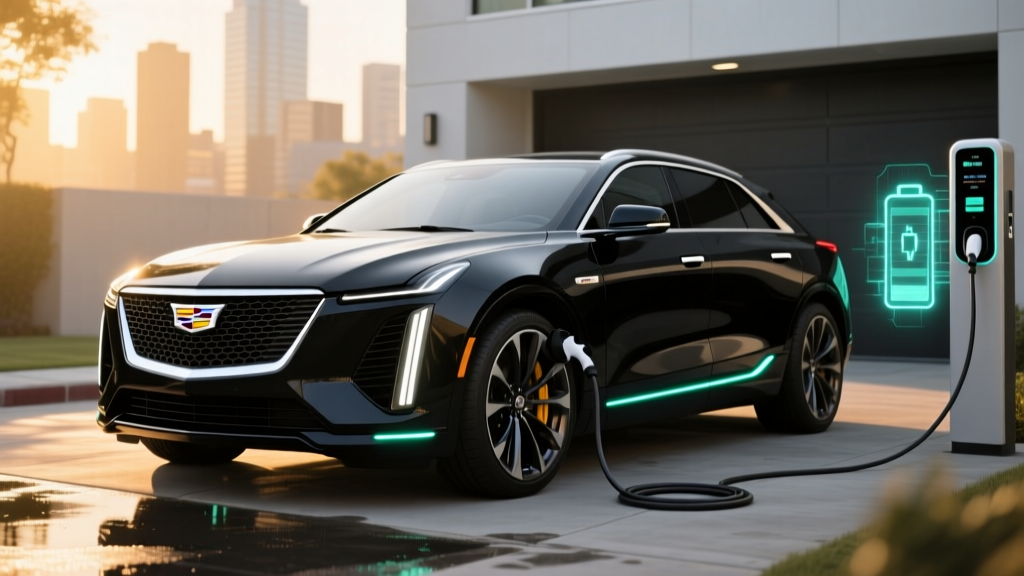
The Cadillac Lyriq occupies a specific niche in the luxury EV crossover segment: it prioritizes ride comfort, cabin quietness, and a premium infotainment experience over raw performance or class-leading range. For 2026, Cadillac has refined the lineup with updated pricing and continued availability of the federal EV tax credit, making the Lyriq's value proposition more compelling than its sticker suggests. This review dissects every number that matters — from the base MSRP to real-world highway range and DC fast-charge taper behavior.
The 2026 Cadillac Lyriq carries an EPA-estimated range of 314 miles (RWD Luxury trim on 20-inch wheels). AWD trims drop to approximately 307 miles EPA. In real-world mixed driving, expect 280–300 miles. Sustained highway speeds above 70 mph reduce range to roughly 250–270 miles, and cold-weather operation (below 32°F) can cut range by 15–25%, yielding as low as 220–240 miles on the RWD model without preconditioning.
2026 Cadillac Lyriq MSRP by Trim Level
Cadillac structures the Lyriq into three primary trims for 2026, with the choice between rear-wheel drive and dual-motor all-wheel drive creating additional price steps. Below is the current MSRP breakdown before any incentives or destination charges.
| Trim | Drivetrain | Base MSRP | Est. After §30D Credit* |
|---|---|---|---|
| Luxury | RWD | $58,590 | $51,090 |
| Luxury | AWD | $62,090 | $54,590 |
| Sport | RWD | $63,590 | $56,090 |
| Sport | AWD | $67,090 | $59,590 |
| Performance (V-Series) | AWD | $79,990 | $72,490 |
*Federal tax credit estimate assumes full $7,500 eligibility under IRS §30D. Actual credit depends on buyer income, battery critical-mineral sourcing, and MSRP caps. The Lyriq's MSRP falls well under the $80,000 SUV cap. Verify eligibility with a tax professional and the IRS clean vehicle credit page.
Tax Credit Eligibility Checklist
- MSRP cap: Vehicle must be under $80,000 (all Lyriq trims qualify)
- Buyer income cap: AGI ≤ $150,000 single / $225,000 head of household / $300,000 joint
- Battery sourcing: Critical minerals and battery components must meet phased percentage thresholds per §30D — confirm current-year compliance at purchase
- Point-of-sale transfer: Buyers can apply the credit at the dealership to reduce the purchase price directly
- Assembly: Final assembly must occur in North America (the Lyriq is built in Spring Hill, Tennessee)
Battery, Range, and Efficiency
The Lyriq rides on GM's Ultium platform with a large-format NMC (nickel manganese cobalt) lithium-ion battery pack. Usable capacity is approximately 102 kWh (gross capacity is higher, with a software buffer protecting the cells from full charge/discharge extremes).
| Specification | Value |
|---|---|
| Battery Chemistry | NMC (Ultium platform) |
| Usable Capacity | ~102 kWh |
| EPA Range (RWD) | 314 miles |
| EPA Range (AWD) | ~307 miles |
| Combined MPGe (RWD) | 89 MPGe |
| Efficiency | ~38 kWh/100 mi |
| Battery Warranty | 8 years / 100,000 miles |
Efficiency of roughly 38 kWh per 100 miles places the Lyriq in the middle of the luxury EV crossover pack — less efficient than the Tesla Model Y (28 kWh/100 mi) but comparable to the BMW iX and Audi Q8 e-tron. The 102 kWh usable pack compensates for middling efficiency with sheer capacity, delivering over 300 miles despite the vehicle's 5,700+ lb curb weight.
EPA fueleconomy.gov data confirms the 89 MPGe combined figure for the RWD configuration. Real-world efficiency degrades noticeably above 75 mph due to the Lyriq's frontal area and weight, so highway-heavy commuters should budget for 34–36 kWh/100 mi on flat terrain.
Charging Speed: DC Fast Charge and Home Level 2
Charging is where the Lyriq's Ultium architecture shows both its strengths and its compromises. The pack supports a peak DC fast-charge rate of 190 kW, which is competitive but not class-leading — the Hyundai Ioniq 5 peaks at 240 kW and the Porsche Macan EV at 270 kW.
| Charging Level | Power / Rate | Speed |
|---|---|---|
| Level 1 (120V household) | ~1.4 kW | ~3–4 miles per hour |
| Level 2 (240V, 48A) | 11.5 kW | ~31 miles per hour |
| Level 2 (240V, 80A — optional) | 19.2 kW | ~52 miles per hour |
| DC Fast Charge (peak) | 190 kW | 10–80% in ~30 minutes |
DC fast-charge reality check: The 190 kW figure is a peak, not a sustained rate. In practice, the Lyriq holds close to peak power from roughly 10% to 40% state of charge, then tapers progressively. From 60% to 80%, expect rates closer to 90–110 kW. A 10–80% session at a 350 kW Electrify America or EVgo station takes approximately 30 minutes under ideal battery-temperature conditions.
For home charging, the Lyriq's onboard charger supports up to 19.2 kW on Level 2 when equipped with the optional higher-capacity charger and paired with a hardwired 80-amp circuit. Most buyers installing a standard 48-amp Level 2 wallbox (requiring a 60-amp breaker) will see 11.5 kW — enough to replenish the full pack in about 9 hours, or roughly 31 miles of range per hour of charging. Overnight charging easily covers daily driving needs.
Note: kW (kilowatts) measures charging power — the rate of energy delivery. kWh (kilowatt-hours) measures battery energy capacity. A 190 kW charger delivers energy fast; a 102 kWh battery stores a large total amount.
Performance and Drivetrain
The Lyriq is tuned for comfort rather than sportiness, which is a deliberate positioning choice. The RWD model uses a single rear-mounted motor producing 340 horsepower and 325 lb-ft of torque, achieving a 0–60 mph time of approximately 6.0 seconds.
The dual-motor AWD configuration bumps output to 500 horsepower and 450 lb-ft of torque, dropping the 0–60 time to roughly 4.6 seconds. The Performance V-Series variant pushes this further with an estimated 615 horsepower and a sub-4-second 0–60 time.
Ride quality is where the Lyriq earns its luxury badge. The five-link rear suspension and available air suspension (on Sport and Performance trims) absorb road imperactions effectively, and cabin noise levels are among the lowest in the segment thanks to acoustic laminated glass and active noise cancellation. This is a cruiser, not a canyon carver — steering feel is light and body roll is present during aggressive cornering.
Interior, Cargo, and Technology
The Lyriq's interior centers on a 33-inch LED display that spans the dashboard, combining a driver information cluster and infotainment touchscreen into a single curved panel running Google Built-In (Google Maps, Google Assistant, and Play Store apps natively integrated). The system is responsive, though some users report that the reliance on touch controls for climate and seat functions — with no physical buttons — requires an adjustment period.
Dimensions and Space
- Cargo volume (rear seats up): 28.0 cu ft
- Cargo volume (rear seats folded): 60.9 cu ft
- Front legroom: 44.3 inches
- Rear legroom: 39.6 inches
- Front headroom: 39.8 inches
- Rear headroom: 38.4 inches
Cargo space is adequate for the segment but not exceptional — the BMW iX offers 35.5 cu ft behind the rear seats, and the Tesla Model X provides significantly more. The Lyriq has no front trunk (frunk), as GM allocated that space to HVAC components and structural bracing.
Driver Assistance
The Lyriq offers GM's Super Cruise on mapped divided highways, which provides hands-free driving with driver attention monitoring via an infrared camera on the steering column. Super Cruise is a Level 2 system per SAE classification — the driver must remain aware and ready to take over at all times. It is not autonomous driving. Coverage has expanded to over 750,000 miles of compatible roads in the US and Canada, and the system handles lane changes and speed adjustments competently on supported routes.
Super Cruise is a Level 2 driver-assist system. It operates only on pre-mapped divided highways and requires continuous driver attention. It does not handle construction zones, unmapped surface streets, or adverse weather conditions reliably. The driver is legally and operationally responsible for the vehicle at all times.
Who Should Buy the Cadillac Lyriq?
The Lyriq is best suited for buyers who prioritize cabin refinement, brand prestige, and comfortable highway cruising over maximum range or sporty dynamics. It's a strong fit for:
- Luxury brand loyalists transitioning from a Cadillac XT5 or XT6 who want EV running costs without sacrificing ride quality
- Commuters with home charging who drive 40–80 miles daily and value a quiet, tech-forward cabin
- Couples and small families who need two rows of comfortable seating and adequate cargo space for groceries and luggage
It is less ideal for buyers who:
- Need three rows of seating (consider the Cadillac Vistiq or Rivian R1S)
- Prioritize maximum fast-charging speed for frequent long road trips (the Ioniq 5 or Model Y charge faster)
- Want sporty handling dynamics (the BMW iX xDrive50 is more engaging)
- Need a frunk or maximum cargo volume
Look elsewhere if: You take frequent 400+ mile road trips and want the fastest possible DC charging, or you need three-row seating and maximum cargo utility.
Lyriq vs. Key Competitors
| Spec | Cadillac Lyriq (RWD) | BMW iX xDrive50 | Tesla Model Y LR | Hyundai Ioniq 5 Ltd |
|---|---|---|---|---|
| Base MSRP | $58,590 | $87,250 | $48,590 | $54,200 |
| EPA Range | 314 mi | 324 mi | 320 mi | 290 mi |
| Battery (usable) | ~102 kWh (NMC) | ~105 kWh (NMC) | ~75 kWh (NMC) | 77.4 kWh (NMC) |
| Peak DC Charge | 190 kW | 200 kW | 250 kW | 240 kW |
| 10–80% Time | ~30 min | ~31 min | ~22 min | ~18 min |
| 0–60 mph | 6.0 sec | 4.4 sec | 4.8 sec | 5.1 sec |
| Cargo (seats up) | 28.0 cu ft | 35.5 cu ft | 30.2 cu ft | 27.2 cu ft |
| Hands-Free Driving | Super Cruise | None (Highway Asst.) | Autopilot (L2) | None |
The Lyriq undercuts the BMW iX by nearly $30,000 while offering comparable range and a superior hands-free driving system. Against the Tesla Model Y, the Lyriq costs more but delivers a significantly quieter cabin, more traditional luxury materials, and Super Cruise capability. The Hyundai Ioniq 5 charges faster and costs less but lacks the premium positioning and Super Cruise.
Warranty and Ownership Costs
GM backs the Lyriq with the following warranty coverage:
- Battery & powertrain: 8 years / 100,000 miles (covers battery capacity retention below 70% of original)
- Bumper-to-bumper: 4 years / 50,000 miles
- Corrosion: 6 years / 70,000 miles
- Roadside assistance: 6 years / 70,000 miles
The battery warranty's 70% capacity retention threshold is standard for the industry. Based on NMC degradation data from other Ultium-platform vehicles and comparable packs, expect approximately 5–8% capacity loss over the first 100,000 miles under normal usage patterns — well within warranty tolerance. Avoiding repeated 100% charges and minimizing DC fast-charging frequency will extend long-term battery health.
Insurance premiums for the Lyriq tend to run 15–25% higher than equivalent gas-powered luxury crossovers, reflecting higher repair costs for EV-specific components. Get quotes before purchasing — premiums vary significantly by state and driving record.
Pros and Cons
Pros
- Class-leading cabin quietness and ride comfort
- Super Cruise hands-free highway driving (Level 2)
- Strong real-world range (280–300 mi mixed)
- 19.2 kW Level 2 onboard charging (optional)
- Falls under §30D MSRP cap for full $7,500 credit
- Google Built-In infotainment with native Maps
Cons
- No front trunk (frunk)
- Cargo space trails some competitors
- 190 kW DC peak is slower than Ioniq 5 or Model Y
- Touch-only climate controls require learning curve
- No third-row option
- Insurance premiums above segment average
Frequently Asked Questions
What is the real-world range of the 2026 Cadillac Lyriq?
In mixed driving conditions, expect 280–300 miles from the RWD model. Sustained highway driving at 70–80 mph reduces this to approximately 250–270 miles. Cold weather (below freezing) without battery preconditioning can push range down to 220–240 miles. The EPA sticker of 314 miles is achievable in mild weather with city-heavy driving and regenerative braking.
How fast does the Lyriq charge at home and on the road?
At home on a standard 48-amp Level 2 charger (240V), the Lyriq adds about 31 miles of range per hour at 11.5 kW — a full charge takes roughly 9 hours. With the optional 19.2 kW onboard charger and an 80-amp circuit, that drops to about 5.5 hours. On DC fast chargers, it peaks at 190 kW and reaches 10–80% in approximately 30 minutes, though the charge curve tapers significantly above 60% SoC.
Does the Cadillac Lyriq qualify for the federal EV tax credit?
The Lyriq is assembled in Tennessee and its MSRP falls under the $80,000 SUV cap, so it meets two key §30D requirements. Eligibility for the full $7,500 credit depends on your adjusted gross income (≤$300,000 joint filers), the battery's critical-mineral and component sourcing percentages (which shift annually), and purchasing from a compliant dealer. The credit can be transferred at point of sale to reduce your purchase price directly. Confirm current-year sourcing compliance with your dealer and consult a tax professional.
How much does the Lyriq cost after tax credits?
The base RWD Luxury trim starts at $58,590 MSRP. If you qualify for the full $7,500 federal credit applied at point of sale, your effective price drops to approximately $51,090 before state incentives, destination charges, or dealer fees. State-level rebates (such as California's CVRP or Colorado's innovative motor vehicle credit) can reduce the cost further — check your state's current programs.
Is the Cadillac Lyriq worth buying over competitors?
The Lyriq delivers strong value if you prioritize cabin refinement, Super Cruise capability, and Cadillac brand cachet. It undercuts the BMW iX by nearly $30,000 with similar range. However, if fast DC charging is your top priority for frequent road trips, the Hyundai Ioniq 5 (18-minute 10–80%) or Tesla Model Y (22 minutes) are more practical. If you need three rows, look at the Cadillac Vistiq or Rivian R1S instead.
What is the Lyriq's battery warranty?
GM covers the Lyriq's Ultium battery pack for 8 years or 100,000 miles, whichever comes first. The warranty guarantees the battery will retain at least 70% of its original capacity during that period. Real-world degradation for NMC packs of this size typically runs 5–8% over 100,000 miles with normal charging habits.
Sources: EPA fueleconomy.gov, IRS §30D Clean Vehicle Credit, Cadillac official specifications. Pricing and incentive rules reflect 2026 model-year data and are subject to change. Always verify with your dealer and tax advisor before purchase.