Quick Verdict: What Does the Cadillac Lyriq Actually Cost?
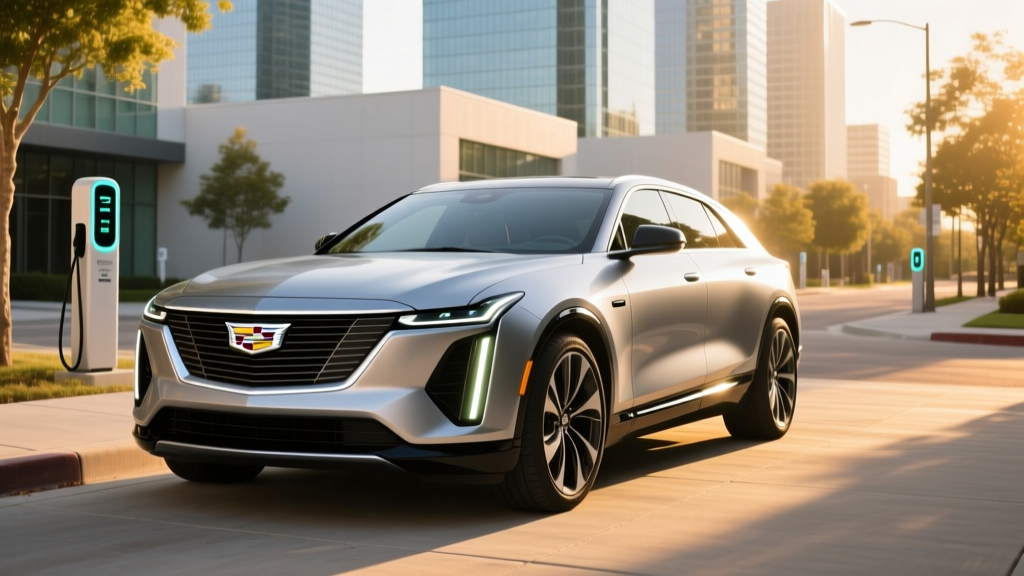
The 2026 Cadillac Lyriq starts at $58,590 (including destination) for the Luxury RWD trim and climbs to $65,090 for the Sport AWD variant. After the federal §30D tax credit — if you qualify — the effective price can drop to approximately $51,090, placing it in direct competition with the BMW iX, Audi Q8 e-tron, and Tesla Model X in the premium electric SUV segment.
But the sticker price is only part of the ownership equation. The Lyriq's 102 kWh usable battery (NMC chemistry), 190 kW peak DC fast-charging rate, and 314-mile EPA range define what you'll actually live with day to day. Below, we break down every cost factor — from trim-level pricing and tax-credit math to home charging installation and five-year total cost of ownership.
| Spec | Luxury RWD | Sport AWD |
|---|---|---|
| Base MSRP (incl. destination) | $58,590 | $65,090 |
| EPA Range | 314 mi | 307 mi |
| Battery (usable) | 102 kWh, NMC | 102 kWh, NMC |
| Horsepower | 340 hp | 500 hp |
| 0-60 mph | 6.0 sec | 4.6 sec |
| Drivetrain | Rear-wheel drive | Dual-motor AWD |
| Max DC Fast Charge | 190 kW | 190 kW |
| 10-80% DC Time | ~32 min | ~32 min |
| Level 2 Home Charge | 19.2 kW (52 mi/hr) | 19.2 kW (52 mi/hr) |
| MPGe (combined) | 89 MPGe | 88 MPGe |
| Efficiency | 38 kWh/100 mi | 39 kWh/100 mi |
| Battery Warranty | 8 yr / 100,000 mi | 8 yr / 100,000 mi |
Real-World Range vs. EPA Sticker: What to Expect
The EPA rates the 2026 Lyriq Luxury RWD at 314 miles and the Sport AWD at 307 miles. Those numbers come from the agency's mixed-cycle test, which blends city and highway driving at moderate temperatures.
EPA 314 mi (RWD) / 307 mi (AWD). Expect ~260-280 mi on sustained highway trips at 70-75 mph. In cold weather (below 30°F), plan for 220-250 mi of usable range due to battery resistance and cabin heating load. City driving with regenerative braking can match or slightly exceed the EPA figure.
The Lyriq's Ultium platform uses a nickel-manganese-cobalt (NMC) lithium-ion battery with 12 pouch cells arranged in 24 modules. NMC chemistry offers higher energy density than LFP (lithium iron phosphate), which is why a 102 kWh usable pack fits under the Lyriq's floor without compromising cabin space. The trade-off is that NMC batteries are more sensitive to sustained high state-of-charge storage and extreme heat — so daily charging to 80% rather than 100% will maximize long-term health.
According to fueleconomy.gov, the RWD Lyriq achieves 89 MPGe combined (38 kWh/100 mi). That efficiency figure is competitive with the BMW iX xDrive50 but trails the lighter Tesla Model X by roughly 5 MPGe. At the national average electricity rate of $0.17/kWh, you're looking at approximately $6.46 per 100 miles driven — roughly a third of what a comparable gas SUV costs at $3.50/gallon.
Charging Speed: DC Fast Charging and Home Level 2
The Lyriq supports a peak DC fast-charge rate of 190 kW via its CCS1 connector (a NACS adapter is available for Tesla Supercharger access). In practice, that peak rate is sustained only between roughly 10-40% state of charge before the charge curve tapers progressively. A 10-80% session takes approximately 32 minutes at a capable 200+ kW charger.
| Charging Level | Power | Speed | Notes |
|---|---|---|---|
| Level 1 (120V household) | 1.4 kW | ~4 mi/hr | Emergency/top-up only |
| Level 2 (240V, 48A) | 11.5 kW | ~31 mi/hr | Standard home charger |
| Level 2 (240V, 80A) | 19.2 kW | ~52 mi/hr | Requires 100A circuit; full overnight fill in ~6 hr |
| DC Fast Charge | Peak 190 kW | 10-80% in ~32 min | Tapers above 80%; preconditioning helps |
At home, the Lyriq's onboard charger is a standout: it accepts up to 19.2 kW on Level 2 (240V, 80 amps), which is among the highest in the luxury EV SUV class. Most competitors max out at 11.5 kW. The catch? A 19.2 kW setup requires a dedicated 100-amp circuit and hardwired EVSE (like the ChargePoint Home Flex or Tesla Wall Connector). Many homes need a panel upgrade to support this — budget $500-$2,500 for electrical work on top of the $500-$700 charger unit.
If you install a more common 48-amp Level 2 charger (11.5 kW), you'll add about 31 miles per hour of charging, which still covers a full overnight replenishment for most daily driving. The Lyriq includes a dual-level mobile charging cord (120V/240V) in the box, which is useful for travel or if you haven't yet installed a permanent home unit.
Preconditioning matters. When you navigate to a DC fast charger using the Lyriq's built-in navigation, the battery thermal management system begins warming the pack to optimal temperature. Skip preconditioning on a cold day and your peak charge rate could drop from 190 kW to under 100 kW, adding 15+ minutes to your stop.
Performance, Interior Space, and Technology
The RWD Lyriq delivers 340 hp and 325 lb-ft of torque from a single rear-mounted motor — enough for a 6.0-second 0-60 mph run that feels effortless in daily driving. The Sport AWD adds a front motor for 500 hp, 450 lb-ft, and a 4.6-second sprint. Both variants use GM's Ultium drive units with a fixed-ratio reduction gear.
Inside, the Lyriq's cabin is where Cadillac justifies its premium positioning. The centerpiece is a 33-inch LED curved display that spans the instrument cluster and infotainment screen as a single continuous panel. Google Built-in handles navigation, voice assistant, and app integration. Wireless Apple CarPlay and Android Auto are standard. The Super Cruise hands-free driving system (an SAE Level 2 driver-assist feature) is available on over 750,000 miles of mapped highways — and unlike Tesla Autopilot, it genuinely permits hands-off operation on compatible roads while monitoring driver attention via an infrared camera.
Super Cruise is a Level 2 driver-assistance system. You must remain alert, keep your eyes on the road, and be prepared to take over at any moment. It is not autonomous. Only Level 4 services like Waymo operate without a human driver.
Cargo space measures 28.0 cubic feet behind the second row and 60.9 cubic feet with the rear seats folded. There is no front trunk (frunk) — the space under the hood houses the power electronics and HVAC components. Rear legroom is a generous 39.6 inches, and headroom accommodates tall passengers comfortably thanks to the flat floor enabled by the Ultium battery platform.
| Dimension | Measurement |
|---|---|
| Cargo (rear seats up) | 28.0 cu ft |
| Cargo (rear seats folded) | 60.9 cu ft |
| Rear legroom | 39.6 in |
| Front legroom | 44.3 in |
| Front headroom | 39.8 in |
| Frunk | None |
Pricing, Trim Levels, and Federal Tax Credit Eligibility
The 2026 Lyriq is offered in three main configurations:
- Luxury RWD: $58,590 — includes Super Cruise capability, 33-inch display, 19.2 kW onboard charger, heated/ventilated front seats, power liftgate
- Luxury AWD: $62,090 — adds dual-motor AWD (500 hp), slightly reduced range (307 mi EPA)
- Sport AWD: $65,090 — blacked-out exterior trim, unique 22-inch wheels, sport-tuned suspension, same 500-hp powertrain
Options can add $3,000-$8,000 depending on packages (AKG 19-speaker audio, 22-inch wheels, panoramic fixed glass roof, Advanced Safety Package). A well-equipped Sport AWD can reach $70,000-$73,000 before incentives.
| Trim | MSRP | After §30D Credit | Effective Price |
|---|---|---|---|
| Luxury RWD | $58,590 | -$7,500 | $51,090 |
| Luxury AWD | $62,090 | -$7,500 | $54,590 |
| Sport AWD | $65,090 | -$7,500 | $57,590 |
Does the Lyriq Qualify for the §30D Federal Tax Credit?
The Cadillac Lyriq is assembled in Spring Hill, Tennessee, and its Ultium battery cells are manufactured in the U.S. through the Ultium Cells joint venture (GM + LG Energy Solution). As of the 2026 tax year, the Lyriq qualifies for the full $7,500 federal tax credit under IRS §30D — but eligibility depends on your situation, not just the vehicle:
- MSRP cap: The Lyriq is classified as an SUV, so the cap is $80,000. All trims clear this threshold.
- Buyer income cap: Modified AGI must not exceed $300,000 (married filing jointly), $225,000 (head of household), or $150,000 (single).
- Battery sourcing: The Lyriq's battery meets critical-mineral and component sourcing requirements for the full $7,500 ($3,750 for critical minerals + $3,750 for battery components).
- Point-of-sale transfer: You can transfer the credit to the dealer at purchase, reducing your out-of-pocket cost immediately rather than waiting to claim it on your tax return.
Always verify current eligibility on IRS.gov before purchasing, as sourcing requirements tighten annually. A tax professional can confirm your personal eligibility.
Warranty, Ownership Costs, and Long-Term Value
GM backs the Lyriq's battery and powertrain with an 8-year / 100,000-mile warranty that covers capacity loss below 70% of original capacity — a standard threshold for the industry. The bumper-to-bumper limited warranty runs 4 years / 50,000 miles, and roadside assistance is included for 6 years / 70,000 miles.
NMC batteries in the Ultium platform use an active liquid thermal management system that conditions the pack during charging and extreme temperatures. Based on degradation data from GM's earlier Ultium vehicles and industry averages for liquid-cooled NMC packs, expect roughly 8-12% capacity loss over 100,000 miles under normal use. Avoiding routine 100% charges and DC fast-charging in extreme heat without preconditioning will help minimize degradation.
Insurance for the Lyriq averages $2,200-$2,800/year depending on your state, driving record, and coverage level — roughly 15-25% higher than a comparable gas-powered Cadillac XT5 due to higher repair costs for EV-specific components.
Over five years and 75,000 miles, a Lyriq RWD owner charging primarily at home ($0.17/kWh national average) would spend approximately $4,850 on electricity versus roughly $10,500 on gasoline for a similarly sized gas SUV averaging 22 MPG at $3.50/gallon. That $5,650 fuel savings partially offsets the Lyriq's higher purchase price.
Lyriq vs. Key Competitors: Which Luxury Electric SUV Wins?
| Spec | Cadillac Lyriq RWD | BMW iX xDrive50 | Audi Q8 e-tron | Tesla Model X LR |
|---|---|---|---|---|
| Base MSRP | $58,590 | $87,250 | $75,595 | $79,990 |
| EPA Range | 314 mi | 324 mi | 285 mi | 335 mi |
| Battery | 102 kWh NMC | 111.5 kWh NMC | 114 kWh NMC | 100 kWh NMC |
| DC Fast Charge | 190 kW | 200 kW | 170 kW | 250 kW |
| 0-60 mph | 6.0 sec | 4.4 sec | 5.5 sec | 3.8 sec |
| Tax Credit | $7,500 | $0 (MSRP/import) | $0 (import) | $0 (MSRP cap) |
| After Credit | $51,090 | $87,250 | $75,595 | $79,990 |
The Lyriq's cost advantage after the tax credit is striking — it undercuts every competitor here by $24,000 or more while delivering comparable range and more interior space. The trade-offs? The BMW iX offers sharper handling and a more powerful powertrain. The Tesla Model X charges faster (250 kW peak) and has access to the Supercharger network natively (though a NACS adapter largely solves this for the Lyriq). The Audi Q8 e-tron has the most refined ride quality but the shortest range and no federal credit eligibility.
Pros
- Best value in luxury EV SUV after $7,500 credit
- Class-leading 19.2 kW Level 2 home charging
- 314-mile EPA range (RWD) covers most road trips
- Super Cruise hands-free highway driving
- Spacious cabin with 39.6" rear legroom
- U.S.-built; full §30D credit eligibility
Cons
- No front trunk (frunk) for extra cargo
- 190 kW DC peak trails Tesla/Hyundai at 250-350 kW
- AWD trims reduce range to 307 mi
- Infotainment learning curve (Google Built-in)
- No third-row seating option
- Insurance premiums 15-25% above gas equivalent
Who Should Buy the Cadillac Lyriq?
- You want a premium two-row EV SUV under $55,000 (after credit)
- You can install a Level 2 home charger and want the fastest overnight fill in the class
- You value hands-free highway driving (Super Cruise) for commuting or road trips
- You need rear-seat space for adults or car seats (39.6" legroom)
- You want U.S.-manufactured with straightforward tax-credit eligibility
- You need three rows (consider the Kia EV9 or Rivian R1S)
- You prioritize maximum DC charging speed for frequent long road trips (Tesla Model X at 250 kW)
- You want a sporty driving experience over comfort (BMW iX)
- You cannot install home charging and rely entirely on public DC fast charging
Frequently Asked Questions
What is the real-world range of the Cadillac Lyriq?
The EPA rates the RWD Lyriq at 314 miles and AWD at 307 miles. In real-world highway driving at 70-75 mph, expect 260-280 miles. In cold weather (below 30°F), plan for 220-250 miles. City driving with regenerative braking can match or slightly exceed the EPA estimate.
How fast does the Lyriq charge at home and on the road?
At a DC fast charger, the Lyriq peaks at 190 kW and charges from 10-80% in about 32 minutes. At home on a 240V/80A Level 2 charger, it adds 52 miles per hour (19.2 kW) — the fastest onboard charger in its class. A standard 48A Level 2 unit adds 31 miles per hour.
How much does the Cadillac Lyriq cost after tax credits?
The Luxury RWD starts at $58,590 and drops to approximately $51,090 after the full $7,500 federal §30D tax credit. Eligibility requires meeting income caps ($300K joint, $150K single), and the vehicle must meet battery-sourcing requirements — which the U.S.-built Lyriq currently satisfies. State incentives may reduce the cost further.
Is the Lyriq worth buying vs. the BMW iX or Tesla Model X?
If value is your priority, the Lyriq is the clear winner — it costs $24,000-$36,000 less after the tax credit while delivering comparable range and more interior space. The BMW iX is more engaging to drive; the Tesla Model X charges faster and has a frunk. For most luxury EV SUV buyers who don't need three rows, the Lyriq offers the strongest value proposition in 2026.
Does the Cadillac Lyriq have a frunk?
No. The Lyriq does not have a front trunk. The area under the hood is occupied by power electronics and HVAC components. All cargo goes in the rear, which offers 28.0 cu ft (seats up) and 60.9 cu ft (seats folded).
What is the Lyriq's battery warranty?
GM provides an 8-year / 100,000-mile battery and powertrain warranty that covers capacity degradation below 70% of original capacity. The bumper-to-bumper warranty is 4 years / 50,000 miles.
Can I use Tesla Superchargers with the Lyriq?
Yes. Cadillac offers a NACS adapter that allows the Lyriq (which uses a CCS1 port natively) to access the Tesla Supercharger network. GM has also committed to transitioning future models to the native NACS connector. Check with your dealer for adapter availability and compatibility with your model year.