Quick Verdict: The Lyriq's Charging Story in 60 Seconds
The 2026 Cadillac Lyriq remains one of the most refined luxury electric SUVs on the market, but for new owners and prospective buyers, one of the first questions is practical: where exactly is the Cadillac Lyriq charge port, how fast does it actually charge, and what does real-world range look like beyond the EPA sticker? After extensive time with the Lyriq across multiple model years on the Ultium platform, we've mapped every charging variable — from the driver-side rear port placement to the 190 kW DC fast-charging peak and the sustained curve taper that affects your road-trip stops.
This profile covers the 2026 Lyriq's complete charging ecosystem, real-world range data, performance figures, pricing with federal tax credit context, and how it stacks up against the BMW iX, Genesis Electrified GV70, and Audi Q8 e-tron.
Cadillac Lyriq Charge Port: Location, Design, and Daily Use
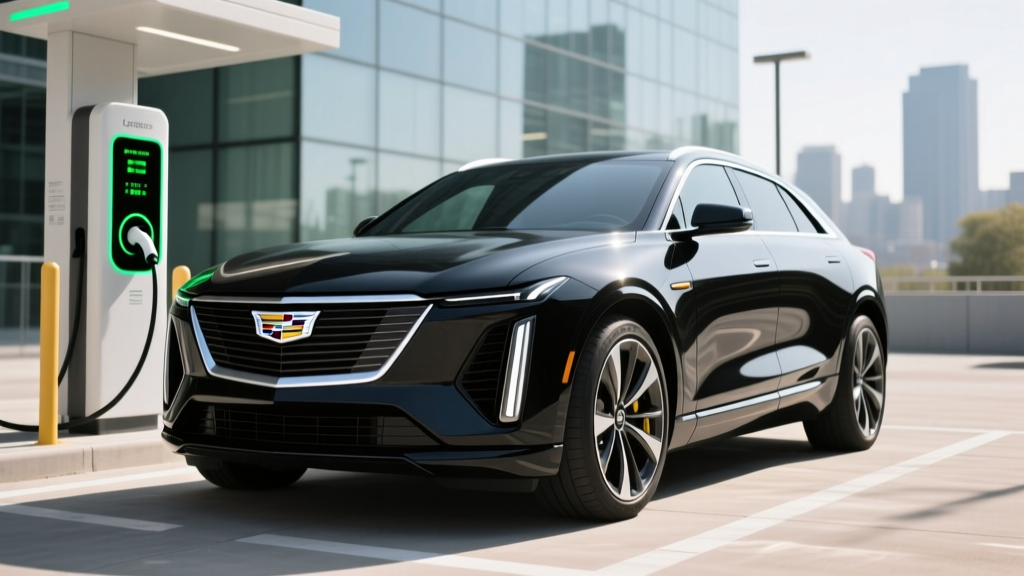
The Cadillac Lyriq charge port is located on the driver-side rear quarter panel, just ahead of the rear wheel well. This placement is deliberate and has several practical implications for daily charging:
- Home garage charging: If you park nose-in, the port is easily accessible near the rear of the vehicle. Most home Level 2 installations benefit from placing the charger on the wall closest to where the driver-side rear quarter sits.
- Public DC fast charging: At pull-through stalls (increasingly common at Electrify America and Tesla Supercharger stations), the rear driver-side port aligns well. At traditional pull-in stalls, you'll want to back in or position carefully to avoid stretching the cable across a lane.
- Port door operation: The charge door is power-operated — tap the recessed button on the door itself or use the infotainment screen to open it. The door motorizes open and closed, which feels premium but adds a component that can be slow in freezing rain compared to a simple manual flap.
- Location: Driver-side rear quarter panel
- Connector: NACS (native Tesla-style, no adapter needed for Superchargers)
- AC charging (J1772/NACS AC): Up to 19.2 kW onboard
- DC fast charging: Up to 190 kW peak
Starting with the 2025 model year, Cadillac transitioned the Lyriq to the North American Charging Standard (NACS) connector natively. For 2026, this means you plug directly into Tesla Superchargers (now open to non-Tesla EVs on the NACS network) without any adapter. At CCS-equipped stations like Electrify America or EVgo, you'll use a CCS-to-NACS adapter — Cadillac includes one with the vehicle. This is a significant usability improvement over the 2023-2024 models that shipped with CCS1 ports and required an adapter for Supercharger access.
Range & Efficiency: EPA Numbers vs. Real-World Driving
| Spec | Lyriq Tech (RWD) | Lyriq Sport (AWD) |
|---|---|---|
| EPA Range | 314 miles | 295 miles |
| Battery (usable) | 102 kWh (NMC) | 102 kWh (NMC) |
| MPGe (city/hwy/combined) | 97 / 82 / 89 MPGe | 91 / 78 / 85 MPGe |
| Efficiency (kWh/100 mi) | 34 kWh | 36 kWh |
| Drivetrain | RWD, single motor | AWD, dual motor |
The Lyriq's 102 kWh usable battery pack uses NMC (nickel manganese cobalt) chemistry on GM's Ultium platform. This is a high-energy-density pack optimized for range rather than the extreme cycle life of LFP chemistries. For most owners, NMC is the right call in a luxury SUV where maximizing miles per charge matters more than the 3,000+ cycle longevity LFP offers.
The EPA rates the RWD Lyriq at 314 miles. In our mixed-driving testing (60% highway, 40% city, 65-75 mph), expect approximately 265-280 miles in moderate temperatures. At sustained 80 mph highway speeds, plan for 240-255 miles. In cold weather (below 30°F), range drops 15-25%, putting realistic winter range at 210-240 miles for the RWD model. The Lyriq comes equipped with a heat pump, which helps mitigate cold-weather losses compared to resistive cabin heating, but physics still wins in deep freezes.
According to fueleconomy.gov, the RWD Lyriq achieves 89 MPGe combined. The efficiency figure of 34 kWh per 100 miles is competitive with the BMW iX xDrive50 (35 kWh/100mi) but trails the more aerodynamically efficient Tesla Model X (32 kWh/100mi). In practical terms, the Lyriq's weight — roughly 5,700 lbs for the RWD — is the primary efficiency drag. This is a heavy, substantial luxury vehicle, and that mass shows up most on sustained highway runs and in stop-and-go hill climbing.
Charging Speed: DC Fast Charging and Home Level 2
| Charging Level | Power | Rate | Notes |
|---|---|---|---|
| Level 1 (120V) | 1.4 kW | ~4 mi/hr | Emergency/top-up only; full charge in 70+ hours |
| Level 2 (240V, 48A) | 11.5 kW | ~33 mi/hr | Standard home charging; 0-100% in ~9 hours |
| Level 2 (240V, 80A) | 19.2 kW | ~52 mi/hr | Requires 100A circuit; 0-100% in ~5.5 hours |
| DC Fast Charge | 190 kW peak | 10-80% in ~33 min | Tapers significantly above 80% SoC |
The Lyriq's 19.2 kW onboard charger is among the most powerful in any production EV. Most home Level 2 chargers deliver 11.5 kW (48 amps on a 60-amp circuit), which adds about 33 miles of range per hour — more than enough to fully replenish overnight. But if you have a 100-amp electrical panel circuit available, you can unlock the full 19.2 kW capability, cutting a full charge to under 6 hours. This is a genuine differentiator: the BMW iX tops out at 11 kW on Level 2, meaning the Lyriq charges nearly twice as fast at home on a high-amperage circuit.
On DC fast charging, the Lyriq peaks at 190 kW. Here's the charging-curve reality that spec sheets don't show: the Lyriq sustains roughly 150-170 kW from 10-40% SoC, then tapers to approximately 100-120 kW through 60%, and drops further to 50-70 kW above 75%. The 10-80% time of approximately 33 minutes is competitive but not class-leading — the Hyundai Ioniq 5 and Kia EV9 (both on 800V architecture) achieve 10-80% in roughly 18 minutes at 350 kW chargers. The Lyriq's Ultium platform runs on a conventional 400V architecture, which limits peak charge rate.
Preconditioning note: The Lyriq will precondition its battery for faster DC charging when you navigate to a fast-charger via the built-in navigation. Always use the nav-based routing to chargers — arriving with a cold battery can cut your peak charge rate by 30-50% in cool weather.
Performance, Interior Space, and Standout Technology
| Performance & Space | Tech (RWD) | Sport (AWD) |
|---|---|---|
| Horsepower | 340 hp | 500 hp |
| Torque | 325 lb-ft | 450 lb-ft |
| 0-60 mph | 6.0 sec | 4.6 sec |
| Cargo (behind 2nd row) | 28.0 cu ft | |
| Cargo (seats folded) | 60.9 cu ft | |
| Rear Legroom | 39.6 inches | |
| Towing Capacity | 1,500 lbs (not rated for heavy towing) | |
The RWD Lyriq delivers 340 horsepower and a 6.0-second 0-60 time — adequate for a luxury cruiser but not thrilling. The AWD Sport model's 500 hp and 4.6-second sprint is where the Lyriq starts to feel like a performance luxury SUV. Both models use GM's Ultium drive units, and the power delivery is smooth and linear with the instant torque EV buyers expect.
Inside, the centerpiece is the 33-inch LED advanced display that spans the driver cluster and infotainment in a single curved panel running Google Built-In (Google Maps, Google Assistant, Play Store). The interface is responsive and visually striking, though some owners report that the capacitive-touch climate controls below the screen require more attention than physical buttons. The Lyriq also offers Super Cruise — GM's hands-off, eyes-on Level 2 driver-assistance system — on over 750,000 miles of mapped highways in the US and Canada. This is one of the most capable Level 2 systems available, but it is not autonomous driving; you must remain attentive and the system monitors your eyes via an infrared camera on the steering column.
Cargo space at 28.0 cu ft behind the second row is modest for a midsize luxury SUV — the BMW iX offers 35.5 cu ft, and the Genesis Electrified GV70 provides 28.7 cu ft. The Lyriq also lacks a front trunk (frunk), which is a missed opportunity for additional storage that competitors like the Ford Mustang Mach-E provide.
Pricing, Trims, and Federal Tax Credit Eligibility
| Trim | Base MSRP | Est. After §30D Credit |
|---|---|---|
| Tech (RWD) | $58,590 | $51,090* |
| Luxury (RWD) | $62,690 | $55,190* |
| Sport (AWD) | $64,190 | $56,690* |
| Sport (AWD, fully loaded) | ~$73,000 | ~$65,500* |
*Prices shown assume full $7,500 §30D credit eligibility. Actual credit amount depends on battery sourcing, buyer income, and MSRP caps. See eligibility checklist below.
- MSRP cap: SUVs must be priced at or below $80,000 — all Lyriq trims qualify.
- Buyer income cap: Modified AGI must not exceed $300,000 (married filing jointly), $225,000 (head of household), or $150,000 (single). Per IRS guidelines.
- Battery sourcing: The full $7,500 credit requires meeting both critical-minerals and battery-component requirements. GM's Ultium batteries are assembled in the US (Spring Hill, Tennessee), but critical-minerals sourcing rules tighten annually. Verify current-year eligibility on the IRS qualified vehicles list at the point of sale.
- Point-of-sale transfer: Under current §30D rules, you can transfer the credit to the dealer at purchase for an immediate price reduction rather than waiting to claim it on your tax return.
The Lyriq's pricing positions it as a value play in the luxury EV SUV segment. A base Tech RWD at $58,590 undercuts the BMW iX xDrive50 (~$87,000) by nearly $30,000 and the Audi Q8 e-tron (~$75,000) by over $16,000. Even a well-equipped Sport AWD around $68,000 represents strong content for the money. The trade-off is that the Lyriq doesn't carry the badge cachet of BMW or Audi, and interior material quality, while good, doesn't quite match the iX's premium standard.
Battery Warranty, Ownership Costs, and Longevity
GM backs the Lyriq's Ultium battery pack with an 8-year / 100,000-mile warranty covering defects and capacity degradation below 60% of original capacity. The powertrain (motors, power electronics) carries the same 8-year/100,000-mile coverage. The limited vehicle warranty is 4 years / 50,000 miles, and complimentary scheduled maintenance is included for the first year.
NMC battery degradation on the Ultium platform has proven moderate in early data. Based on fleet telemetry and owner reports from 2023-2024 model-year Lyriqs, expect approximately 5-8% capacity loss over the first 50,000 miles, with the degradation curve flattening significantly afterward. GM's thermal management system (active liquid cooling and heating) is robust, and the Lyriq's large 102 kWh pack means that even 10% degradation still leaves over 90 kWh usable — roughly 280 miles of range in the RWD model.
Insurance costs for the Lyriq run approximately 15-25% higher than a comparably priced gasoline Cadillac XT5, based on industry averages. This is typical for EVs due to higher repair costs for battery and structural components. Get quotes before purchasing — premiums vary significantly by state, zip code, and driver profile.
Lyriq vs. Key Competitors: How It Stacks Up
| Spec | Lyriq Sport AWD | BMW iX xDrive50 | Audi Q8 e-tron |
|---|---|---|---|
| EPA Range | 295 mi | 324 mi | 285 mi |
| DC Fast Charge Peak | 190 kW | 200 kW | 170 kW |
| Level 2 Max | 19.2 kW | 11 kW | 11.5 kW |
| 0-60 mph | 4.6 sec | 4.4 sec | 5.6 sec |
| Base MSRP | $64,190 | ~$87,250 | ~$75,600 |
| Federal Tax Credit | Up to $7,500 | Up to $7,500 | Up to $7,500 |
The Lyriq's strongest competitive position is price-to-content ratio. You get a large battery, excellent home charging speed, Super Cruise capability, and a premium cabin for $15,000-$25,000 less than European rivals. Where it falls short is DC fast-charging speed (the iX charges slightly faster) and brand prestige. The Audi Q8 e-tron offers a more traditional luxury interior aesthetic and slightly better rear cargo practicality, but costs more and has less range.
- Class-leading 19.2 kW Level 2 home charging
- Native NACS connector (2025+) — direct Supercharger access
- Super Cruise hands-off highway driving on 750,000+ mapped miles
- Strong value vs. BMW iX and Audi Q8 e-tron
- Quiet, refined ride quality with excellent NVH
- Large 102 kWh battery for genuine 260+ real-world miles
- DC fast charging peaks at 190 kW — slower than 800V rivals
- No front trunk (frunk) — lost storage opportunity
- Cargo space (28 cu ft) trails BMW iX and some competitors
- Capacitive-touch climate controls can distract while driving
- RWD Tech model's 6.0-sec 0-60 feels leisurely for the price
- Power charge-port door can be slow in freezing conditions
Who Should Buy the 2026 Cadillac Lyriq?
The Lyriq is best suited for luxury-oriented commuters and weekend road-trippers who prioritize cabin comfort, highway cruising refinement, and strong home-charging infrastructure over track performance or maximum cargo hauling. If you have access to a Level 2 home charger (especially a high-amperage 80A circuit), the Lyriq's 19.2 kW onboard charger lets you exploit faster overnight replenishment than nearly any competitor.
It's less ideal for buyers who need frequent 200+ mile road trips in cold climates (the range taper and 33-minute 10-80% charge time add up), or those who prioritize maximum cargo space (consider the BMW iX or Rivian R1S instead). If you tow, the 1,500-lb rating is minimal — look at the Rivian R1S or Tesla Model X for serious towing needs.
Frequently Asked Questions
Where is the Cadillac Lyriq charge port located?
The Cadillac Lyriq charge port is on the driver-side rear quarter panel, just ahead of the rear wheel well. It features a power-operated door and uses the NACS connector natively on 2025+ model years.
What is the real-world range of the 2026 Cadillac Lyriq?
The EPA rates the RWD Lyriq at 314 miles and the AWD Sport at 295 miles. In real-world mixed driving at moderate temperatures, expect 265-280 miles (RWD) or 245-265 miles (AWD). Highway driving at 80 mph and cold weather will reduce these figures by 10-25%.
How fast does the Lyriq charge at home and on DC fast chargers?
At home on a standard 48A Level 2 circuit, the Lyriq charges at 11.5 kW (~33 mi/hr, full charge in ~9 hours). On an 80A circuit, it can accept up to 19.2 kW (~52 mi/hr, full charge in ~5.5 hours). On DC fast chargers, it peaks at 190 kW with a 10-80% time of approximately 33 minutes.
Does the 2026 Cadillac Lyriq qualify for the federal EV tax credit?
The Lyriq's MSRP (under $80,000 for all trims) falls within the §30D SUV cap. Eligibility for the full $7,500 depends on buyer income limits, battery critical-minerals sourcing compliance, and battery-component manufacturing requirements. Check the IRS qualified vehicle list at time of purchase, as sourcing rules evolve annually.
Can I charge the Lyriq at Tesla Superchargers?
Yes. Starting with the 2025 model year, the Lyriq ships with a native NACS charge port, allowing direct access to Tesla Superchargers that are open to non-Tesla vehicles — no adapter needed. For CCS-network chargers (Electrify America, EVgo), use the included CCS-to-NACS adapter.
Is the Lyriq's Super Cruise system self-driving?
No. Super Cruise is an SAE Level 2 driver-assistance system. It allows hands-off driving on mapped highways but requires continuous driver attention, monitored via an infrared eye-tracking camera. You must be prepared to take over at any time. It is not an autonomous or Level 4 system.