Quick Verdict: The Lyriq 450e Balances Luxury and Practicality
The 2026 Cadillac Lyriq 450e occupies a specific niche in the premium midsize EV SUV segment: it prioritizes ride comfort, interior refinement, and design presence over outright performance or segment-leading range. Built on GM's Ultium platform with a 102 kWh usable battery pack, the rear-wheel-drive 450e delivers an EPA-estimated 314 miles of range — respectable for a 5,600-pound luxury crossover, though it trails the BMW iX xDrive50 and Tesla Model X in efficiency. Where the Lyriq earns its keep is in daily usability: a composed highway cruiser with a genuinely quiet cabin, a 33-inch curved LED display, and DC fast-charging capability that makes road trips viable if not class-leading.
After spending time with the 450e across mixed driving conditions, the picture that emerges is a well-executed first-generation EV from Cadillac that knows exactly what it is — and what it isn't. It's not a track car. It's not a range king. It's a comfortable, tech-forward luxury SUV that happens to be electric, and for the buyer cross-shopping a Genesis GV60, Audi Q8 e-tron, or Mercedes EQB, that distinction matters.
Range, Efficiency, and Real-World Expectations
EPA Estimated: 314 miles
Real-World Highway (70-75 mph): ~255–275 miles
Real-World Mixed Commuting: ~280–300 miles
Cold Weather (below 32°F): ~220–250 miles (20–30% reduction)
Actual range varies with temperature, terrain, driving style, and HVAC usage. Highway speeds above 70 mph significantly reduce efficiency in all EVs due to aerodynamic drag.
The Lyriq 450e's 314-mile EPA figure comes from its 102 kWh usable Ultium battery pack using NMC (nickel manganese cobalt) chemistry. This is a large pack by segment standards — larger than the Audi Q8 e-tron's 106 kWh gross (roughly 95 kWh usable) and comparable to the BMW iX's 105.2 kWh usable. The trade-off is weight: at approximately 5,660 pounds, the Lyriq carries its battery mass noticeably through corners and in stop-and-go efficiency.
The EPA rates the 450e at 89 MPGe combined (city 97 / highway 82), which translates to roughly 37 kWh per 100 miles. That's middling efficiency — the Tesla Model Y Long Range achieves 122 MPGe combined on a smaller battery, while the BMW iX xDrive50 lands at 86 MPGe despite having AWD. The Lyriq's boxy design and luxury-car weight work against it on the efficiency front, but the large battery compensates with raw capacity.
For context on what this means practically: a daily commuter driving 40 miles round-trip will use roughly 15 kWh per day and can comfortably go 5–6 days between charges. On a road trip averaging 70 mph in mild weather, plan for charging stops every 240–260 miles to keep the battery from dropping below 10%, which is where DC fast charging slows dramatically.
| Spec | Value |
|---|---|
| EPA Range | 314 miles |
| Battery (Usable) | 102 kWh, NMC chemistry |
| MPGe (Combined) | 89 MPGe (97 city / 82 hwy) |
| Efficiency | ~37 kWh/100 mi |
| Max DC Fast Charge | 190 kW peak |
| 10–80% DC Charge Time | ~33 minutes |
| Level 2 Home Charging | 19.2 kW (11.5 kW typical) / ~31 mi/hr at 19.2 kW |
| Horsepower | 340 hp |
| Torque | 325 lb-ft |
| 0–60 mph | 6.0 seconds |
| Drivetrain | Rear-wheel drive (single motor) |
| Curb Weight | ~5,660 lbs |
| Cargo Volume | 28.0 cu ft (rear seats up) / 60.9 cu ft (folded) |
| Base MSRP | $58,590 (Luxury trim) |
| Battery/Powertrain Warranty | 8 years / 100,000 miles |
Source: EPA / fueleconomy.gov
Charging: DC Fast, Level 2, and What to Expect
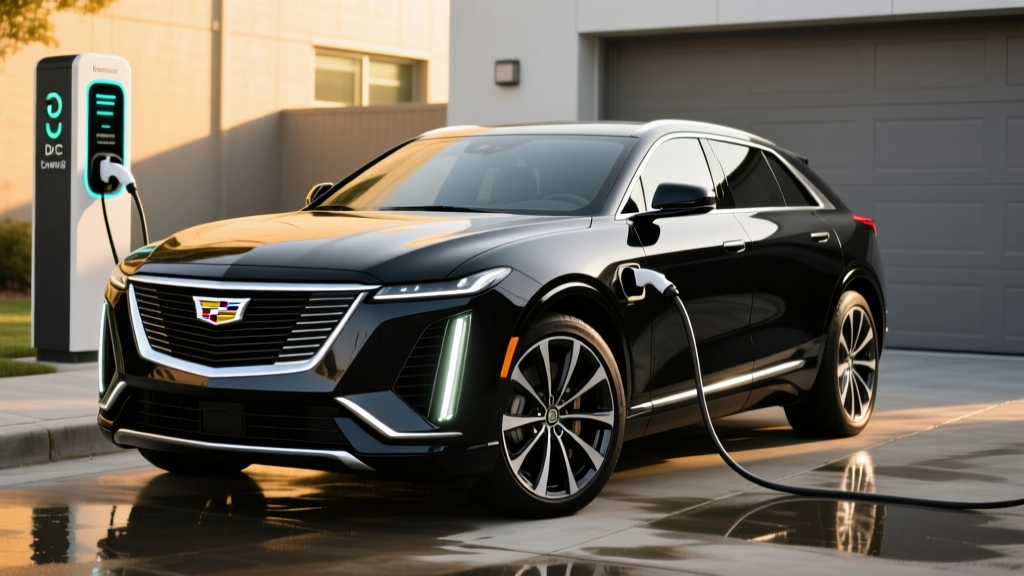
The Lyriq 450e supports up to 190 kW peak DC fast charging via its CCS1 connector. In practice, the charging curve tells the real story. The 450e sustains roughly 150–170 kW between 10% and 40% state of charge, then progressively tapers. From 60% to 80%, speeds drop to approximately 80–100 kW. The advertised 10–80% charge time of roughly 33 minutes assumes a capable 350 kW station — on a 150 kW charger (still common at many Electrify America and EVgo locations), expect 40–50 minutes for the same session.
This is the Lyriq's most notable competitive weakness. The Hyundai Ioniq 5 and Kia EV6, with their 800V architectures, hit 240–250 kW peaks and complete 10–80% in about 18 minutes. The Tesla Model Y on V3 Superchargers (250 kW) manages roughly 25–28 minutes. The Lyriq's 400V architecture and conservative charge curve place it squarely in the middle of the pack — adequate for road trips, but you'll notice the difference at crowded charging corridors during holiday travel.
| Level | Power | Miles Added per Hour | Full Charge Time |
|---|---|---|---|
| Level 1 (120V) | ~1.4 kW | ~3–4 mi/hr | ~72+ hours |
| Level 2 (240V, 48A) | 11.5 kW | ~22 mi/hr | ~9.5 hours |
| Level 2 (240V, 80A) | 19.2 kW | ~31 mi/hr | ~5.5 hours |
| DC Fast (150 kW station) | ~130 kW avg | ~200 mi/hr (peak) | 10–80% in ~42 min |
| DC Fast (350 kW station) | ~155 kW avg | ~240 mi/hr (peak) | 10–80% in ~33 min |
At home, the Lyriq's onboard charger supports up to 19.2 kW on Level 2 (requiring a hardwired 100-amp circuit and an 80-amp EVSE). This is among the fastest Level 2 rates available in any EV and means a full overnight charge in roughly 5.5 hours. Most home installations use a 48-amp circuit (11.5 kW), which still delivers a full charge in about 9.5 hours — sufficient for any daily driving pattern. Budget $800–$2,500 for a quality Level 2 home installation depending on panel capacity and wiring distance, or more if a 200-amp panel upgrade is needed.
One practical note: the Lyriq uses the CCS1 connector for DC fast charging. GM has committed to transitioning to the NACS (Tesla-style) connector for future models, and Cadillac has announced a NACS adapter for existing Ultium vehicles. As of 2026, Lyriq owners can access Tesla Supercharger stations using the provided adapter, significantly expanding the available DC fast-charging network. Confirm adapter availability with your dealer at purchase.
Performance and Driving Dynamics
The 450e designation denotes the rear-wheel-drive, single-motor configuration. It produces 340 horsepower and 325 lb-ft of torque, delivering a 0–60 mph time of approximately 6.0 seconds. That's adequate for merging and passing but not thrilling — the dual-motor 550e (AWD, 500 hp, 4.6 seconds to 60) exists for buyers who want more urgency.
Where the 450e shines is ride quality. GM's five-link rear suspension and continuous damping control (available on Sport and higher trims) deliver a genuinely plush, isolated ride that rivals the Mercedes EQE SUV and surpasses the Tesla Model Y in comfort. Road noise is minimal thanks to acoustic laminated glass and active noise cancellation. The steering is light and precise if not communicative — this is a luxury cruiser, not a sport-tuned handler.
Regenerative braking offers two modes: standard (coasting) and one-pedal driving with a steering-wheel paddle for adjustable regen intensity. The one-pedal mode is well-calibrated and can handle most daily driving without touching the friction brakes, though it doesn't bring the car to a complete hold without brake application at very low speeds.
Interior, Tech, and Cargo Space
The Lyriq's cabin is its strongest selling point against German rivals. The centerpiece is a 33-inch curved LED display that spans the driver cluster and infotainment screen in a single, continuous panel running Google Built-In (Google Maps, Google Assistant, Play Store). The system is responsive, visually crisp, and logically organized — a significant improvement over Cadillac's previous CUE system.
Physical controls remain for climate, volume, and drive modes, which is a welcome decision. Material quality is high: available semi-aniline leather, open-pore wood, and laser-etched door panel designs give the Lyriq a distinctively American luxury feel that differentiates it from the minimalist approach of Tesla or the clinical precision of Audi.
Cargo space measures 28.0 cubic feet behind the rear seats and 60.9 cubic feet with the 60/40 split rear seats folded. There is no front trunk (frunk) — the space is occupied by HVAC and power electronics. Rear-seat legroom is generous at 39.6 inches, and the flat floor (no transmission tunnel) makes the middle seat usable for a third adult on shorter trips.
Driver assistance comes via GM's Super Cruise system on equipped trims — a SAE Level 2 hands-free driving system that operates on over 750,000 miles of mapped divided highways in the US and Canada. Super Cruise uses a driver-attention camera to monitor eye gaze and requires the driver to remain alert and ready to take over at all times. It is not autonomous driving. When available, Super Cruise is genuinely excellent for long highway stretches, reducing fatigue significantly. It does not function on surface streets, in construction zones, or in adverse weather conditions where lane markings are obscured.
Super Cruise and all current consumer driver-assist systems require continuous driver supervision. The driver must remain engaged, monitor the road, and be prepared to take control immediately. This is not self-driving. Level 4 driverless operation is currently limited to geofenced robotaxi services (Waymo, Zoox) in select cities.
Pricing, Trims, and Federal Tax Credit Eligibility
The 2026 Lyriq 450e is offered in three trims for the RWD configuration:
| Trim | MSRP | Key Features |
|---|---|---|
| Luxury | $58,590 | 33" display, 19" wheels, power liftgate, heated front seats |
| Premium Luxury | $63,590 | Adds Super Cruise, 20" wheels, ventilated seats, panoramic roof |
| Sport | $65,590 | Sport appearance, adaptive damping, black accent package |
All trims fall under the $80,000 MSRP cap for SUVs set by the IRS for federal EV tax credit eligibility under §30D. However, qualifying for the full credit is not automatic. Buyers must meet several requirements:
- Income caps: Modified adjusted gross income must not exceed $150,000 (single), $225,000 (head of household), or $300,000 (married filing jointly)
- Battery sourcing: A percentage of critical minerals and battery components must be sourced from the US or free-trade-agreement countries — these thresholds increase annually and affect the credit amount ($3,750 for minerals + $3,750 for components = up to $7,500 total)
- Point-of-sale transfer: As of 2024, buyers can transfer the credit to the dealer at purchase, reducing the vehicle price directly rather than waiting for a tax refund
- Vehicle assembly: The Lyriq is assembled in Spring Hill, Tennessee, satisfying the North American assembly requirement
The Lyriq's battery sourcing compliance has varied by model year as GM adjusts its supply chain. For the 2026 model year, check the latest eligibility on IRS.gov or confirm with your dealer before purchase — the credit amount may be $3,750 or $7,500 depending on current mineral and component sourcing thresholds. State incentives (California, Colorado, Massachusetts, and others) may stack on top but vary by jurisdiction — consult your state's energy office for current programs.
Ownership Costs, Warranty, and Long-Term Outlook
GM backs the Lyriq's battery and powertrain with an 8-year / 100,000-mile warranty, with a capacity retention threshold of 70% — meaning GM will repair or replace the battery if it degrades below 70% of original capacity within the warranty period. The bumper-to-bumper warranty is 4 years / 50,000 miles. These terms are competitive with BMW (8/80,000) and slightly below Hyundai's industry-leading 10/100,000 battery warranty.
NMC battery chemistry in the Ultium pack has shown promising early degradation data. Based on GM's testing and early owner reports, expect approximately 8–12% capacity loss over the first 100,000 miles under normal use patterns. The pack includes active thermal management (liquid cooling and heating), which is critical for longevity — preconditioning the battery before DC fast charging (the Lyriq does this automatically when a charger is set as a navigation destination) helps minimize degradation from high-power charging sessions.
Insurance costs for the Lyriq run approximately 15–25% higher than a comparable gas-powered Cadillac XT5, reflecting the higher repair costs and parts pricing common to EVs. Expect annual premiums in the $2,200–$3,000 range depending on location, driving record, and coverage level.
Maintenance costs are significantly lower than gas equivalents: no oil changes, no transmission fluid, no spark plugs. Expect to pay for cabin air filter replacement ($50–$80 annually), tire rotation, and brake fluid checks. The regenerative braking system dramatically extends friction brake life — many EV owners go 80,000+ miles before needing pad replacement.
Lyriq 450e vs. the Competition
- Ride comfort and cabin quietness rival Mercedes/Audi
- 33-inch display with Google Built-In is excellent
- Super Cruise on 750k+ miles of highway
- 19.2 kW Level 2 onboard charger (fast home charging)
- Strong design presence; looks more expensive than it is
- US-assembled; eligible for up to $7,500 federal credit
- DC fast charging (190 kW peak) trails Ioniq 5, Model Y
- No front trunk (frunk)
- 89 MPGe is below segment efficiency leaders
- Rear visibility is limited; relies heavily on cameras
- Touch-sensitive steering wheel controls can be finicky
- Single-motor 450e feels merely adequate for the weight
The Lyriq 450e's closest competitors tell different stories. The BMW iX xDrive50 ($87,250) offers AWD, 324 miles of range, and superior driving dynamics but costs significantly more. The Tesla Model Y Long Range ($48,990) delivers better efficiency, faster charging, and access to the Supercharger network natively, but its interior quality and ride comfort don't match the Cadillac. The Genesis GV60 ($53,350) has an 800V architecture for faster charging and a more distinctive interior, but offers only 248 miles of range. The Audi Q8 e-tron ($74,400) is a closer match in luxury feel but costs more and delivers less range (285 miles EPA).
Choose the Lyriq 450e if: You prioritize ride comfort, cabin refinement, and American-built luxury over performance metrics. You mostly charge at home and take road trips 2–4 times per year. You want Super Cruise for highway commuting.
Look elsewhere if: Fast DC charging is critical (consider Ioniq 5 or EV6). You need maximum cargo space or a frunk. You want AWD for snow-belt driving (step up to the 550e or consider the BMW iX). Efficiency is a top priority (Model Y or Ioniq 5 are significantly more efficient).
Who Should Buy the Lyriq 450e?
The Lyriq 450e is best suited for the luxury-oriented commuter and weekend traveler who charges primarily at home and values a serene driving experience over 0–60 times. It's an excellent choice for empty nesters downsizing from a full-size SUV, professionals who want a refined daily driver with visible EV credentials, and families who need comfortable seating for four adults with adequate cargo for weekend trips.
It is not the right choice for buyers who regularly tow (the 450e is rated for only 1,500 pounds), who live in areas with limited home-charging access and rely on public DC fast charging (the 190 kW peak will frustrate at busy corridors), or who want the latest in autonomous driving capability (Super Cruise is excellent but geofenced to divided highways).
Frequently Asked Questions
What is the real-world range of the Cadillac Lyriq 450e?
The EPA rates the 450e at 314 miles, but real-world highway driving at 70–75 mph typically yields 255–275 miles. Mixed city/highway commuting returns closer to 280–300 miles. In cold weather below freezing, expect a 20–30% reduction, bringing range down to approximately 220–250 miles. These figures assume normal HVAC usage and standard driving habits.
How fast does the Lyriq 450e charge at home and on the road?
At home on a 240V Level 2 charger, the Lyriq supports up to 19.2 kW (with an 80-amp circuit), adding roughly 31 miles of range per hour and completing a full charge in about 5.5 hours. On a typical 48-amp home charger (11.5 kW), expect about 22 miles per hour. For DC fast charging, the 450e peaks at 190 kW and charges from 10–80% in approximately 33 minutes on a 350 kW-capable station, or 40–50 minutes on a 150 kW station.
How much does the Lyriq 450e cost after the federal tax credit?
The base Luxury trim starts at $58,590. If you qualify for the full $7,500 federal tax credit under IRS §30D (meeting income caps, battery sourcing requirements, and the $80,000 SUV MSRP cap), the effective price drops to approximately $51,090. However, credit eligibility depends on current battery mineral and component sourcing rules, which change annually. The credit can be transferred to the dealer at point of sale as a purchase-price reduction. Always verify eligibility on IRS.gov before purchasing.
Does the Lyriq 450e qualify for the $7,500 federal EV tax credit?
The Lyriq qualifies for the credit in principle — it's assembled in North America (Spring Hill, TN), falls under the $80,000 MSRP cap for SUVs, and is a qualifying BEV. However, the actual credit amount ($3,750 or $7,500) depends on whether the battery's critical minerals and components meet the escalating sourcing thresholds set by the Inflation Reduction Act. Buyer income must also fall within §30D limits ($150K single / $300K married filing jointly). Check current-year eligibility on IRS.gov or with your tax professional, as sourcing compliance can change by model year.
Is the Lyriq 450e worth buying over the Tesla Model Y or BMW iX?
It depends on your priorities. The Lyriq 450e wins on ride comfort, cabin luxury, and design presence at its price point. The Model Y wins on efficiency, charging speed, cargo space, and value. The BMW iX wins on driving dynamics and technology but costs $25,000+ more. If luxury feel per dollar is your primary metric and you charge mostly at home, the Lyriq makes a compelling case. If fast public charging and maximum efficiency matter more, the Model Y or Ioniq 5 are stronger picks.
What is the Lyriq's battery warranty and expected lifespan?
GM provides an 8-year / 100,000-mile battery and powertrain warranty with a 70% capacity retention threshold. The NMC Ultium battery pack features active liquid thermal management. Based on early data and GM's testing protocols, expect 8–12% degradation over 100,000 miles under normal use. Battery replacement cost (out of warranty) is estimated at $15,000–$22,000 based on current Ultium pack pricing, though costs are expected to decline as the platform matures.