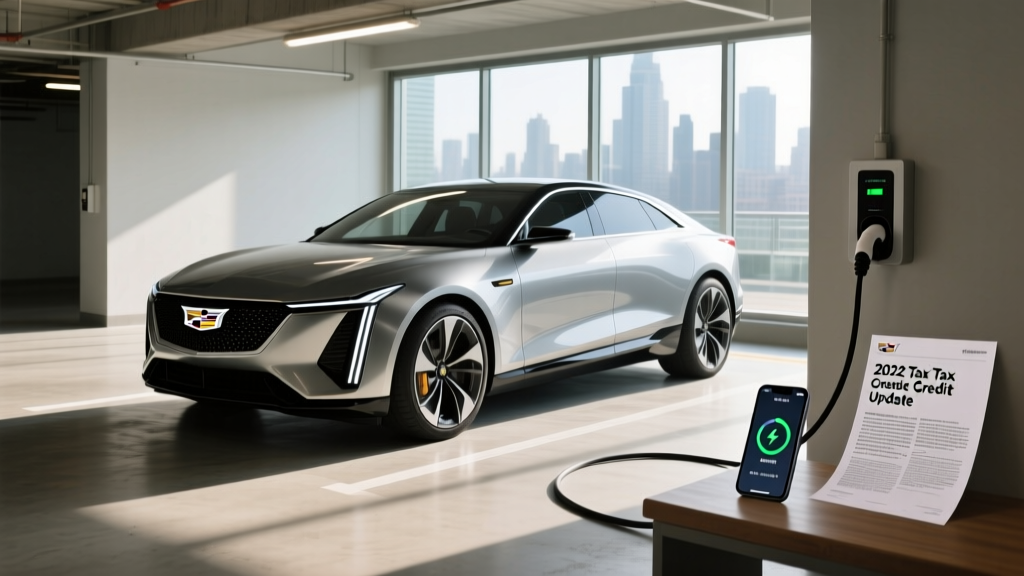
When the IRS tightened battery-sourcing and critical-mineral requirements under §30D, General Motors' luxury division had to recalibrate its electric-vehicle pricing strategy almost overnight. The resulting Cadillac EV tax credit elimination response—a mix of lease-based workarounds, price adjustments on the Optiq and Lyriq, and dealer-level incentives—has left many 2026 buyers wondering whether a Cadillac EV still pencils out over five years of ownership. This guide breaks down the real numbers: purchase price after credits, charging versus gasoline costs, insurance premiums, maintenance savings, and depreciation trends across the current Cadillac EV lineup.
The 2026 Cadillac EV Lineup and Credit Eligibility at a Glance
Cadillac currently sells three battery-electric models in the United States, each riding on GM's Ultium platform with NMC (nickel-manganese-cobalt) chemistry and an 8-year/100,000-mile battery warranty (60% minimum capacity retention threshold).
| Model | Battery (kWh usable) | EPA Range | Peak DC kW | 10–80% Time | 0–60 mph | Base MSRP | §30D Eligible? |
|---|---|---|---|---|---|---|---|
| Optiq AWD | 85 kWh | 303 mi | 150 kW | ~27 min | 5.8 s | $53,990 | Partial (lease workaround) |
| Lyriq AWD | 102 kWh | 314 mi | 190 kW | ~24 min | 5.4 s | $62,690 | No (MSRP cap) |
| Vistiq AWD | 120 kWh | 305 mi | 200 kW | ~25 min | 5.0 s | $78,790 | No (MSRP cap) |
How Cadillac Responded to Stricter §30D Rules
The §30D federal tax credit offers up to $7,500 for qualifying new EVs, split into two $3,750 halves: one for battery-component sourcing (North America) and one for critical-mineral sourcing (U.S. or FTA-partner nations). Beginning in 2024 and tightening through 2025–2026, the IRS excluded vehicles with any battery components or critical minerals from a "foreign entity of concern" (FEOC)—effectively disqualifying many Ultium-based models due to supply-chain dependencies.
Cadillac's three-pronged response:
- Lease loophole (§45W commercial credit): Because leased EVs are classified as commercial vehicles, the lessor (GM Financial) can claim a $7,500 credit and pass it as a capitalized-cost reduction. This remains available on all three models regardless of buyer income or MSRP caps.
- Price cuts on the Optiq: Cadillac lowered the Optiq's starting MSRP to $53,990 for 2026, keeping it below the $55,000 SUV cap for §30D purchase eligibility—though critical-mineral sourcing still limits the credit to $3,750 on qualifying builds.
- Dealer cash and loyalty bonuses: Select markets offer $1,500–$3,000 in dealer cash or existing-GM-owner loyalty incentives to offset the missing credit on Lyriq and Vistiq purchases.
- Vehicle MSRP ≤ $80,000 (vans/SUVs/pickups) or ≤ $55,000 (sedans/other) — Lyriq and Vistiq exceed the SUV cap at higher trims
- Buyer AGI ≤ $300K (joint), $225K (head of household), $150K (single)
- Battery components ≥ 100% North American manufactured (2026 threshold)
- Critical minerals ≥ 80% U.S. or FTA-partner sourced (2026 threshold)
- No FEOC-sourced components or minerals in the battery
- Point-of-sale transfer available at time of purchase (reduces amount financed)
- Vehicle assembled in North America (VIN check required)
Source: IRS §30D Clean Vehicle Credit. Rules subject to change; consult a tax professional.
Five-Year Total Cost of Ownership: Cadillac EV vs. Gasoline SUV
To answer the core question—how much does it really cost to own a Cadillac EV over five years—we modeled the 2026 Lyriq AWD ($62,690 MSRP, lease with $7,500 cap-cost reduction) against the 2026 Cadillac XT5 AWD (gasoline baseline, ~$50,000 MSRP, 24 MPG combined). Assumptions: 15,000 miles/year, 75,000 miles total, home Level 2 charging at $0.14/kWh national average, premium gasoline at $4.10/gallon.
| Cost Category | Lyriq AWD (EV) | XT5 AWD (Gas) |
|---|---|---|
| Purchase / Effective Price | $55,190 (after lease credit) | $50,000 |
| Fuel / Charging | $4,725 | $12,813 |
| Insurance (5-yr total) | $12,500 | $9,800 |
| Maintenance | $1,400 | $3,900 |
| Estimated Depreciation | $28,500 | $22,000 |
| Total 5-Year Cost | $102,315 | $98,513 |
The Lyriq costs roughly $3,800 more over five years under these assumptions. However, the gap narrows—or reverses—depending on three variables: your local electricity rate (sub-$0.10/kWh in some utility territories), whether you qualify for the full §30D credit via lease, and your annual mileage (higher miles amplify fuel savings).
Charging vs. Gasoline: Cost-Per-Mile Math
The Lyriq AWD achieves approximately 2.8 miles per kWh (roughly 89 MPGe combined per fueleconomy.gov). At $0.14/kWh, that translates to $0.05 per mile on home charging. The XT5 at 24 MPG combined and $4.10/gallon costs $0.17 per mile.
| Scenario | Lyriq ($/mile) | XT5 ($/mile) | Savings per 15K mi |
|---|---|---|---|
| 100% home Level 2 ($0.14/kWh) | $0.05 | $0.17 | $1,800 |
| 50% home / 50% DC fast ($0.40/kWh) | $0.10 | $0.17 | $1,050 |
| 100% DC fast charging ($0.48/kWh avg) | $0.17 | $0.17 | $0 |
The takeaway: EV fuel savings are real but depend heavily on home-charging access. If you rely exclusively on public DC fast chargers at $0.40–$0.48/kWh, the Lyriq's per-mile cost matches or exceeds gasoline. Install a Level 2 home charger (typically $800–$2,200 including panel assessment) and the annual fuel savings reach $1,600–$1,800.
Maintenance Savings: Where EVs Genuinely Win
Electric motors have roughly 20 moving parts versus 200+ in a turbocharged V6. No oil changes, no transmission fluid, no spark plugs, and regenerative braking extends pad life to 80,000–100,000+ miles in typical driving.
| Service Item | Lyriq (5-yr cost) | XT5 (5-yr cost) |
|---|---|---|
| Oil changes | $0 | $650 |
| Brake pads/rotors | $0 (regen-saved) | $800 |
| Transmission fluid | $0 | $250 |
| Cabin air filter, wipers, tires | $900 | $900 |
| Coolant / misc. fluids | $200 | $400 |
| Unexpected repairs | $300 | $900 |
| Total | $1,400 | $3,900 |
Net maintenance savings: approximately $2,500 over five years. The largest variable is tire wear—EVs are heavier and produce instant torque, which can accelerate tire replacement by 10,000–15,000 miles versus a comparable gas SUV.
Insurance Premiums: The Cost Cadillac Can't Engineer Away
EVs typically cost 20–30% more to insure than equivalent gasoline vehicles. The reasons are structural:
- Higher repair costs: Battery packs require specialized handling after collision; aluminum and mixed-material body panels demand certified body shops.
- Higher replacement value: A total-loss Lyriq battery alone costs $25,000–$30,000 to replace.
- Parts scarcity: Ultium-specific components have longer lead times, increasing rental-reimbursement exposure for insurers.
- ADAS calibration: Super Cruise hardware (LiDAR, cameras, radar) adds $2,000–$4,000 to windshield or front-clip repairs.
In our model, the Lyriq averaged $2,500/year for full coverage (good driver, 35-year-old, suburban ZIP), versus $1,960/year for the XT5—a $2,700 five-year gap. Shop multiple carriers; some (like Progressive and EV-specific programs) offer 5–10% EV discounts that partially close the spread.
Depreciation and Resale Value Trends
EV depreciation has been steeper than gasoline counterparts since 2023, driven by aggressive price cuts from Tesla, rapid battery-chemistry improvements, and lingering buyer uncertainty about long-term battery health. According to iSeeCars and industry data, luxury EVs lose roughly 50–55% of value over five years versus 40–45% for luxury gasoline SUVs.
For the Lyriq at $62,690, expect a five-year residual value of approximately $28,000–$34,000 (depending on mileage, condition, and whether battery health exceeds 85%). Cadillac's 8-year/100,000-mile battery warranty provides a floor, but the market has not yet fully priced in Ultium long-term reliability data.
Federal credits are only part of the equation. Depending on your location, additional savings may apply:
- California: CVRP rebate up to $2,000 (income-dependent); utility rebates of $500–$1,500 for Level 2 charger installation
- Colorado: State tax credit up to $5,000 for EVs under $80,000 MSRP
- New York: Drive Clean Rebate up to $2,000 (point-of-sale)
- Utility rebates (varies): Off-peak charging credits, free Level 2 equipment, or $300–$800 installation stipends
Check your state energy office and local utility for current programs. Amounts and eligibility vary by jurisdiction and change annually.
Decision Framework: Who Should Buy a Cadillac EV in 2026?
Choose a Cadillac EV (Lyriq, Optiq, or Vistiq) if:
- You can lease and capture the $7,500 §45W commercial credit passed through by GM Financial
- You have home Level 2 charging access (garage or driveway with 240V/40A+ circuit)
- You drive 15,000+ miles/year, amplifying fuel-cost savings
- You value Super Cruise (Level 2 hands-free highway driving on 400,000+ mapped miles) and Ultium ride quality
Stick with a gasoline or hybrid Cadillac (XT5, XT6) if:
- You lack reliable home charging and would depend on public DC fast charging
- You plan to own for 3 years or fewer (steeper EV depreciation hurts short-term owners)
- Your insurance quotes exceed $3,000/year and you cannot offset with other savings
- You tow frequently (EV towing range drops 40–50% under load)
Frequently Asked Questions
How much does it really cost to own a Cadillac EV over 5 years?
Our Lyriq AWD model shows a 5-year total cost of approximately $102,000 at 75,000 miles—roughly $3,800 more than the gasoline XT5 under national-average assumptions. The gap narrows to near parity with cheap home electricity ($0.10/kWh or less), higher annual mileage, or state incentives like Colorado's $5,000 credit.
Do I qualify for the federal tax credit on a Cadillac EV?
For outright purchase, the Optiq qualifies for a partial $3,750 credit if your AGI is within limits ($150K single / $300K joint) and the specific VIN's battery sourcing passes FEOC checks. The Lyriq and Vistiq exceed MSRP caps at most trims. However, leasing any Cadillac EV allows GM Financial to claim the $7,500 commercial credit and pass it as a cap-cost reduction—no income or MSRP caps apply to the lessee.
How much do I save on fuel and maintenance?
Combined fuel and maintenance savings average $2,300–$2,500 per year with home Level 2 charging, totaling roughly $10,500–$12,500 over five years. Without home charging (100% DC fast charging), fuel savings drop to near zero, leaving only the ~$2,500 maintenance advantage.
Are Cadillac EVs more expensive to insure?
Yes. Expect premiums 20–30% higher than a comparable gasoline Cadillac SUV. The Lyriq averaged $2,500/year in our model versus $1,960 for the XT5. Higher repair costs, battery replacement value, and ADAS hardware drive the difference. Shop at least three carriers and ask about EV-specific discounts.
How well do Cadillac EVs hold their value?
Luxury EVs currently depreciate faster than gasoline counterparts—roughly 50–55% over five years versus 40–45% for gas SUVs. The Lyriq is expected to retain $28,000–$34,000 after 75,000 miles. Cadillac's 8-year/100,000-mile battery warranty provides some residual-value support, but the segment is still establishing long-term resale patterns.
Is Super Cruise self-driving?
No. Super Cruise is an SAE Level 2 driver-assistance system. It enables hands-free driving on compatible divided highways (400,000+ mapped miles in North America), but the driver must remain attentive, eyes on the road, and ready to take over immediately. It does not handle city streets, construction zones, or unmapped roads. Only Level 4 services like Waymo operate without a human driver in defined areas.