The Short Answer: Which Cadillac EV SUV Fits You?
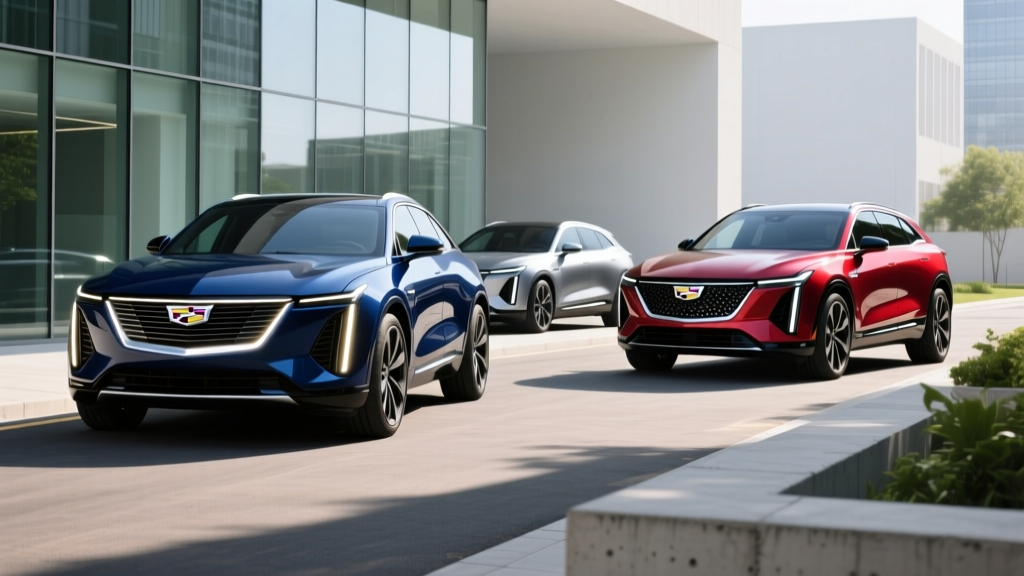
If you're shopping for a Cadillac EV SUV in 2026, you have three distinct choices. The Cadillac Lyriq (midsize, 2-row, from ~$58,590) delivers 314 miles EPA range and is the volume seller. The Cadillac Optiq (compact, 2-row, from ~$53,990) targets urban buyers with ~300 miles of range in a smaller footprint. The Cadillac Vistiq (large, 3-row, from ~$79,590) offers family hauling with ~300 miles and seating for up to seven. All three ride on GM's Ultium platform, support DC fast charging up to 190–200 kW, and use the NACS connector for native Tesla Supercharger access. Federal tax credit eligibility varies by trim and sourcing — check current IRS §30D rules before assuming the full $7,500.
2026 Cadillac EV SUV Lineup at a Glance
GM has rolled out three Cadillac-badged battery-electric SUVs built on the Ultium architecture. Each targets a different buyer profile, but they share core DNA: NMC (nickel manganese cobalt) battery chemistry, rear-wheel-drive or dual-motor all-wheel-drive layouts, and Google-built-in infotainment with native Supercharger routing.
| Spec | 2026 Lyriq | 2026 Optiq | 2026 Vistiq |
|---|---|---|---|
| Segment | Midsize 2-row | Compact 2-row | Large 3-row |
| Battery (usable) | 102 kWh (NMC) | ~85 kWh (NMC) | ~102 kWh (NMC) |
| EPA Range (max) | 314 mi (RWD) | ~300 mi (AWD) | ~300 mi (AWD) |
| Drivetrain | RWD or AWD | AWD | AWD |
| Horsepower | 340 (RWD) / 500 (AWD) | ~400 (AWD) | ~615 (AWD) |
| 0–60 mph | 6.0s (RWD) / 4.6s (AWD) | ~5.0s | ~3.7s |
| Max DC Fast Charge | 190 kW | ~150 kW | ~200 kW |
| 10–80% DC Time | ~34 min | ~30 min | ~28 min |
| Level 2 (240V) | 11.5 kW / 19.2 kW | 11.5 kW | 11.5 kW / 19.2 kW |
| Connector | NACS | NACS | NACS |
| Base MSRP | $58,590 | $53,990 | $79,590 |
| Battery Warranty | 8 yr / 100,000 mi | 8 yr / 100,000 mi | 8 yr / 100,000 mi |
Sources: Cadillac Lyriq specs, EPA fueleconomy.gov. Optiq and Vistiq figures are manufacturer-estimated; final EPA certification may vary.
Real-World Range: What the EPA Sticker Doesn't Tell You
Lyriq RWD: EPA 314 mi → Expect ~255–275 mi at sustained 75 mph highway speeds; ~220–245 mi in sub-freezing temperatures.
Optiq AWD: EPA ~300 mi → Expect ~240–260 mi highway; ~200–230 mi in cold weather.
Vistiq AWD: EPA ~300 mi → Expect ~245–265 mi highway; ~210–230 mi in cold weather (larger frontal area and 5,900+ lb curb weight increase consumption).
The Ultium platform includes a heat pump on all three models, which mitigates some cold-weather range loss compared to resistive heating. However, NMC chemistry loses 15–25% range in sustained sub-30°F conditions — this is physics, not a defect. If you live in Minnesota or Maine and commute 80+ miles round-trip in winter, plan for 200 miles of usable cold-weather range on the Lyriq and size your charging routine accordingly.
On the charging curve front, Cadillac's peak 190 kW rate on the Lyriq is sustained roughly from 10–40% state of charge. Above 60%, the rate tapers to ~90 kW, and above 80%, it drops further to protect battery longevity. That 34-minute 10–80% claim assumes a preconditioned battery and a 350 kW-capable DC station (like a Tesla Supercharger V4 or Electrify America 350 kW stall). At a 50 kW CHAdeMO or older CCS station, expect 90+ minutes for the same session.
Cadillac EV SUV vs. Gas and Hybrid Alternatives: Cost Comparison
Let's put the numbers to the test. Below is a 5-year cost comparison between the Lyriq AWD ($62,590 MSRP, Luxury trim), the BMW X5 xDrive40i (gas, ~$66,000), and the BMW X5 xDrive50e (PHEV, ~$72,000). Assumptions: 15,000 miles/year, $0.14/kWh home charging, $3.50/gallon gas, and no state incentives.
| 5-Year Cost Factor | Cadillac Lyriq AWD | BMW X5 Gas | BMW X5 PHEV |
|---|---|---|---|
| Purchase Price | $62,590 | $66,000 | $72,000 |
| Est. Federal Tax Credit | $0–$7,500* | $0 | $0–$7,500* |
| Fuel/Energy (5 yr) | $5,250 | $13,125 | $7,500 |
| Maintenance (5 yr) | $1,800 | $4,500 | $3,800 |
| Insurance (5 yr est.) | $11,500 | $9,800 | $10,500 |
| Total (before credit) | $81,140 | $93,425 | $93,800 |
| Total (max credit) | $73,640 | $93,425 | $86,300 |
*Federal §30D credit eligibility depends on MSRP caps (SUVs: $80,000), buyer AGI limits ($150K single / $300K joint), and battery critical-mineral/battery-component sourcing. The Lyriq's credit status has fluctuated — verify at IRS.gov §30D or use the point-of-sale transfer tool at purchase. Credit shown as range because sourcing compliance varies by production batch.
The Lyriq wins on fuel and maintenance costs decisively. No oil changes, no transmission fluid, no spark plugs, and regenerative braking extends pad life to 80,000+ miles. However, EV insurance premiums run 10–20% higher than gas equivalents due to battery replacement costs in collision claims. Factor this in.
Home Charging, Public Networks, and the NACS Advantage
All three Cadillac EV SUVs ship with the NACS (North American Charging Standard) connector, meaning native access to Tesla's 17,000+ Supercharger stalls without an adapter. This is a significant reliability advantage: Tesla Superchargers consistently post 95%+ uptime, while third-party CCS networks (Electrify America, EVgo) average 75–85% in independent audits.
| Charging Level | Power | Miles Added/Hour | Typical Use Case |
|---|---|---|---|
| Level 1 (120V) | ~1.4 kW | ~4–5 mi/hr | Overnight top-off, emergency |
| Level 2 (240V, 48A) | 11.5 kW | ~35–40 mi/hr | Home daily charging |
| Level 2 (240V, 80A) | 19.2 kW | ~55–65 mi/hr | Home, Lyriq/Vistiq optional |
| DC Fast (150 kW) | 150 kW | ~450 mi/hr (peak) | Public road-trip charging |
| DC Fast (190–200 kW) | 190–200 kW | ~600 mi/hr (peak) | Supercharger V3/V4, EA 350 |
Home charging reality check: A Level 2 home installation (240V, 48-amp circuit with a Wallbox Pulsar Plus or ChargePoint Home Flex) costs $800–$2,500 total — equipment ($400–$700) plus electrician labor ($400–$1,800). If your home's electrical panel needs an upgrade from 100A to 200A service, add $1,500–$3,500. If you live in a condo or apartment without dedicated parking and charging access, public-only charging will cost $0.30–$0.50/kWh (roughly double home rates) and requires weekly time investment of 45–90 minutes. This is the single biggest ownership variable.
Federal Tax Credit Eligibility: What Actually Applies in 2026
IRS §30D Requirements for New Clean Vehicles
- MSRP Cap: SUVs must be ≤$80,000. Lyriq and Optiq qualify on MSRP; Vistiq base qualifies, but fully loaded trims may exceed the cap.
- Buyer Income Cap: AGI ≤$150,000 (single), ≤$225,000 (head of household), ≤$300,000 (joint).
- Battery Sourcing: Critical minerals and battery components must meet phased-in domestic/free-trade-agreement percentages. These thresholds tighten annually.
- Final Assembly: Must occur in North America (all three Cadillacs are assembled in Spring Hill, TN or Lansing, MI).
- Point-of-Sale Transfer: You can transfer the credit to the dealer at purchase for an immediate price reduction, rather than waiting for tax filing.
The Lyriq's credit eligibility has been inconsistent due to battery-component sourcing rules that tightened in 2024–2025. GM has worked to reshore supply chains, but always confirm the specific VIN's eligibility via the IRS clean vehicle report at the dealership. The Optiq, as a newer entry, may have different sourcing status. The Vistiq, assembled in Lansing, meets the assembly requirement, but high-trim MSRPs can push it over the $80,000 SUV cap.
Common Misconceptions About Cadillac's EV SUVs
| Myth | Fact |
|---|---|
| "The battery will need replacing in 5 years." | GM's Ultium batteries carry an 8-year/100,000-mile warranty against capacity loss below 60%. Real-world degradation data from GM's Bolt EV fleet shows ~8–12% loss over 150,000 miles. Expect 90%+ capacity at 100K miles. |
| "Super Cruise means I don't have to pay attention." | Super Cruise is an SAE Level 2 system. It requires driver eyes-on supervision at all times, monitored by an infrared camera on the steering column. It operates only on ~400,000+ miles of mapped divided highways. You are legally responsible. |
| "EVs cost more to own long-term." | Higher purchase price and insurance are offset by dramatically lower fuel and maintenance costs. Break-even typically occurs at 40,000–60,000 miles with home charging. See cost table above. |
| "I can't road-trip in an EV." | With native NACS Supercharger access and 300+ mile range, a Lyriq can cover LA-to-Vegas or NYC-to-DC with one 25-minute stop. The constraint is rural routes with sparse chargers — plan ahead using the in-dash Google Maps EV routing. |
| "Cold weather makes EVs useless." | Cold reduces range 15–25%, but preconditioning the battery while plugged in (using the Cadillac app's scheduled departure feature) recovers much of that loss and enables faster DC charging. |
Super Cruise: Level 2, Not Self-Driving
Cadillac's Super Cruise (available on all three models, standard on higher trims) is among the best Level 2 driver-assist systems available. It enables hands-free driving on compatible highways with automatic lane centering and adaptive cruise. However, it is not autonomous. You must remain alert, keep your eyes on the road, and be prepared to take over instantly. Lane changes, construction zones, and unmapped roads require manual control. For context, only Waymo's Level 4 robotaxi service operates without a human driver — and only in geofenced urban areas.
Decision Framework: Which Cadillac EV SUV Should You Buy?
Choose the Cadillac Lyriq if:
- You want the best range (314 mi EPA) and most proven Ultium platform track record.
- You need a comfortable 2-row cruiser for commuting and road trips.
- Your budget is $58,000–$72,000 and you want the highest likelihood of §30D credit eligibility.
- You value Super Cruise hands-free highway driving on mapped routes.
Choose the Cadillac Optiq if:
- You live in a city or dense suburb where a smaller footprint matters for parking.
- You want the lowest entry price (~$53,990) in Cadillac's EV lineup.
- Your daily driving is under 60 miles and you charge at home nightly.
- You don't need 3 rows or maximum cargo space.
Choose the Cadillac Vistiq if:
- You need 3-row seating for family or group transport.
- You want performance (615 HP, sub-4-second 0–60) in a luxury electric hauler.
- Your budget exceeds $79,000 and you accept that loaded trims may exceed the §30D MSRP cap.
- You tow occasionally (Vistiq is rated up to ~5,000 lbs with the towing package).
Skip the Cadillac EV lineup entirely if:
- You lack access to home or workplace Level 2 charging AND your area has sparse public DC infrastructure.
- You regularly drive 400+ miles in single stretches through rural charging deserts (western Nebraska, rural Nevada).
- You need a truck bed — wait for the Cadillac Escalade IQ-based pickup variant or consider the Silverado EV.
Frequently Asked Questions
Does the Cadillac Lyriq qualify for the $7,500 federal tax credit in 2026?
It depends on the specific VIN's battery sourcing compliance and your income. The Lyriq meets the MSRP cap ($80,000 for SUVs) and North American assembly requirement. However, critical-mineral and battery-component sourcing thresholds tighten annually under §30D. Always verify eligibility through the dealer's IRS clean vehicle report before purchase. You can transfer the credit at point of sale for an immediate price reduction.
How long does it take to charge a Cadillac EV SUV at home?
On a 240V Level 2 home charger at 11.5 kW, a Lyriq (102 kWh battery) charges from 10–100% in approximately 9 hours. On a 19.2 kW charger (requires an 80-amp circuit and compatible onboard charger), that drops to ~5.5 hours. Most owners plug in nightly and wake up with a full battery — the "refueling" happens while you sleep.
Can I use Tesla Superchargers with a Cadillac EV?
Yes. All 2026 Cadillac EV SUVs come with the native NACS port, meaning direct access to Tesla's Supercharger network without an adapter. The in-dash Google Maps system routes you through Superchargers and can precondition the battery for optimal charge speed on arrival.
What happens if the Ultium battery degrades significantly?
GM warrants the battery for 8 years or 100,000 miles against capacity loss below 60% of original. If degradation exceeds 40% within that window, GM will repair or replace the battery at no cost. Independent fleet data suggests Ultium and prior-generation GM batteries typically retain 88–92% capacity at 100,000 miles under normal use.
Is Super Cruise included or does it cost extra?
Super Cruise availability varies by trim. On the Lyriq, it's standard on Sport and higher trims and available as a $2,500 package on Luxury. It includes 3 years of connectivity for the mapping and eye-monitoring system; after that, a ~$25/month subscription is expected to maintain the service.
How does a Cadillac EV SUV handle towing?
The Lyriq is rated for up to 3,500 lbs (AWD) and the Vistiq up to ~5,000 lbs with the factory tow package. Be aware: towing at max capacity reduces range by 30–50% depending on trailer aerodynamics and terrain. Plan charging stops accordingly and use the Cadillac app's tow-mode route planner.