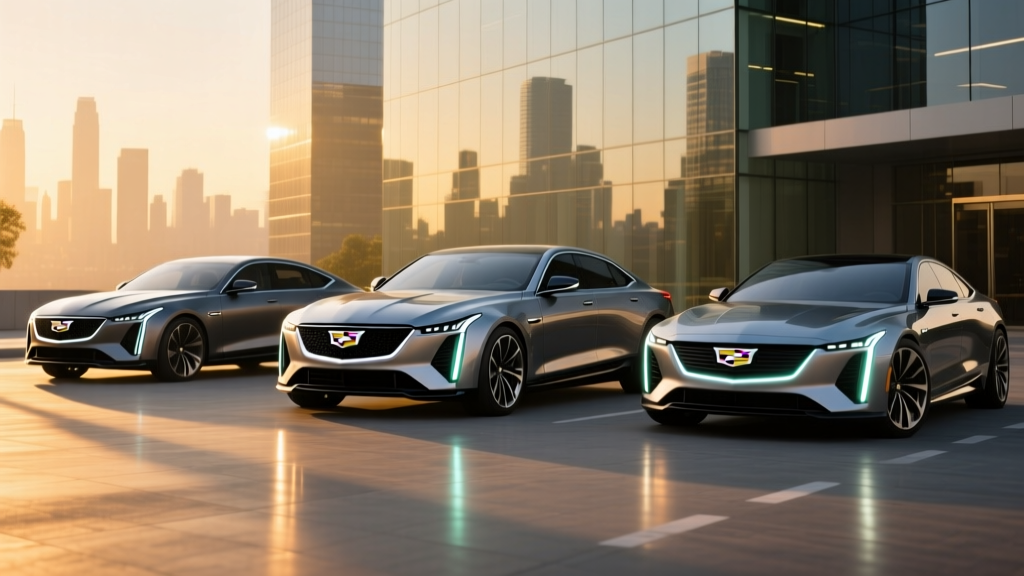
Quick Answer: As of 2026, Cadillac offers one production EV sedan: the ultra-luxury Celestiq, a hand-built, ~$340,000 flagship with an EPA-estimated 300+ miles of range and an Ultium battery platform. A more accessible Cadillac EV sedan — widely expected to be an electric successor to the CT5 — has been announced for the 2026–2027 timeframe but is not yet available for purchase. Buyers seeking a mainstream-priced Cadillac electric sedan will need to wait or consider the Lyriq (SUV) in the interim.
The Current Cadillac EV Sedan Lineup: What's Actually Available
Cadillac's electrification strategy has leaned heavily on SUVs so far. The Lyriq (midsize crossover) and the Optiq (compact crossover) are the brand's volume electric sellers. For sedan buyers, the picture is narrower — and far more expensive.
The Cadillac Celestiq is the sole electric sedan in production. It is not a mass-market vehicle. Cadillac positions it as a bespoke, coachbuilt flagship competing with the Rolls-Royce Spectre and Bentley's electric ambitions. Production is limited to a few hundred units annually, with each car tailored to its buyer.
For the vast majority of shoppers searching for "Cadillac EV sedans," the realistic question is: when will a mainstream electric sedan arrive, and should I wait?
Cadillac Celestiq: Specs, Range, and Real-World Ownership
| Specification | Cadillac Celestiq (2026) |
|---|---|
| Base MSRP | ~$340,000 (bespoke pricing varies) |
| Battery (usable) | ~111 kWh, NMC (Ultium platform) |
| EPA Range (est.) | 300+ miles |
| Real-World Range Expectation | ~250–280 mi highway; ~220–250 mi in cold weather |
| Drivetrain | Dual-motor AWD |
| Horsepower | ~600 hp |
| 0–60 mph | ~3.8 seconds |
| Max DC Fast Charge | ~200 kW (peak) |
| 10–80% DC Charge Time | ~30 minutes (est.) |
| Level 2 Charging | 19.2 kW ( onboard) |
| Battery/Powertrain Warranty | 8 years / 100,000 miles |
| Federal Tax Credit (§30D) | Not eligible — exceeds $55,000 MSRP cap for sedans |
Real-World Range Reality: The Celestiq's EPA estimate of 300+ miles assumes mixed driving at moderate temperatures. On sustained highway trips at 75+ mph, expect closer to 250–280 miles. In sub-freezing conditions, NMC batteries typically lose 20–30% of range — putting realistic cold-weather range around 220–250 miles. The Celestiq's large battery and thermal management system help mitigate this, but physics applies regardless of price point.
Charging the Celestiq: What Owners Need
The Celestiq uses the Ultium platform's electrical architecture, supporting DC fast charging at up to roughly 200 kW. That's competitive but not class-leading — the Hyundai Ioniq 5 and Kia EV6 can peak above 240 kW on 800V architectures. At 200 kW peak (which tapers significantly above 60% state of charge), a 10–80% session takes approximately 30 minutes at a capable charger.
At home, the Celestiq's 19.2 kW onboard charger is a standout — it can replenish roughly 50–55 miles of range per hour on a properly installed Level 2 circuit. That requires a 100-amp dedicated circuit and a hardwired wall connector, which means a panel upgrade for many homes. Expect $2,500–$5,000+ for a professional Level 2 installation at this power level, depending on your electrical panel capacity and conduit runs.
Upcoming Cadillac EV Sedans: The CT5 Successor
GM has confirmed that Cadillac will eventually offer an electric sedan to succeed the CT5, built on the Ultium platform. As of early 2026, this model has been announced but is not yet available for purchase or reservation. Here's what is known or reasonably projected:
- Platform: Ultium (BEV3 architecture)
- Expected Range: 300–350 miles EPA (based on Ultium sedan capabilities seen in the Chevrolet Blazer EV and Lyriq)
- Expected Price: $55,000–$70,000 (to compete with the BMW i5, Mercedes EQE, and Tesla Model S)
- Charging: Likely 150–200 kW DC peak; 11.5–19.2 kW Level 2
- Tax Credit: If MSRP stays at or below $55,000 for the sedan cap under IRS §30D rules, base trims could qualify — subject to income limits, battery sourcing requirements, and point-of-sale transfer availability
Until GM releases official specs and opens orders, treat these figures as preliminary. We'll update this guide when confirmed data is available.
Cadillac EV Sedan vs. Gas Sedan: The Cost and Ownership Comparison
For buyers cross-shopping a future Cadillac electric sedan against the current gas-powered CT5, here's a five-year ownership projection. We'll use an estimated $60,000 EV sedan vs. a $50,000 CT5 (loaded) as representative figures.
| Cost Factor (5 Years) | Est. Cadillac EV Sedan ($60K) | Cadillac CT5 Gas ($50K) |
|---|---|---|
| Purchase Price (after incentives) | ~$55,500 (if §30D eligible) | $50,000 |
| Fuel / Energy (75K miles) | ~$4,500 (home charging at $0.14/kWh) | ~$9,750 (25 MPG avg, $3.25/gal) |
| Maintenance | ~$1,200 (no oil changes, fewer wear items) | ~$3,500 (oil, filters, belts, brakes) |
| Insurance (avg annual) | ~$2,800/yr (EV premium) | ~$2,200/yr |
| Depreciation (est. 5-yr) | ~$24,000 | ~$20,000 |
| Total 5-Year Cost | ~$100,500 | ~$96,450 |
The takeaway: The EV sedan saves significantly on fuel and maintenance — roughly $7,500 over five years. But higher insurance premiums and steeper depreciation (EVs have historically depreciated faster than gas counterparts, though this is narrowing) erode much of that advantage. The break-even point depends heavily on your local electricity rates, annual mileage, and whether you qualify for the federal tax credit. According to fueleconomy.gov, electric vehicles typically cost $0.04–$0.06 per mile in electricity vs. $0.12–$0.15 per mile in gasoline for comparable sedans.
What About Charging Without a Garage?
Not every buyer has access to home Level 2 charging. If you're relying on public DC fast charging exclusively, your costs rise substantially — typically $0.30–$0.48 per kWh at networks like Electrify America or EVgo. That pushes the five-year fuel cost to roughly $8,000–$10,000, nearly erasing the gas-vs-electric savings. Public charging reliability remains inconsistent in many metro areas, and apartment dwellers without workplace charging face real logistical friction.
If you cannot install a Level 2 charger at home or work, a PHEV or gas sedan remains a more practical choice until public infrastructure matures in your area.
Common Misconceptions About Cadillac EVs
| Myth | Fact |
|---|---|
| "All Cadillacs qualify for the $7,500 tax credit" | Federal §30D credits have an MSRP cap of $55,000 for sedans and $80,000 for SUVs/vans/pickups. The Celestiq (~$340K) does not qualify. Future sedan eligibility depends on pricing and battery sourcing — check IRS.gov for current rules. |
| "EV batteries need replacing every few years" | GM's Ultium batteries carry an 8-year/100,000-mile warranty with a capacity retention threshold (typically 70%). Real-world data from earlier GM EVs shows most batteries retain 85–90%+ capacity at 100K miles. Full replacement, if ever needed, runs $15,000–$25,000 out of warranty. |
| "The Celestiq is the only Cadillac EV" | The Lyriq and Optiq crossovers are in full production. The electric CT5 successor is announced but not yet on sale. |
| "Cadillac's Super Cruise is self-driving" | Super Cruise is an SAE Level 2 driver-assistance system. It requires the driver to remain attentive and hands-free only on pre-mapped divided highways. It is not autonomous driving. |
| "EVs don't work in cold climates" | Cold weather reduces range by 20–30%, but modern thermal management systems (standard on Ultium) mitigate this. Preconditioning the battery while plugged in recovers significant efficiency. Owners in Minnesota and Maine drive EVs year-round — they just plan for reduced range. |
Decision Framework: Should You Buy a Cadillac EV Sedan?
Choose the Celestiq if:
- You're in the ultra-luxury market ($300K+) and want a bespoke American EV flagship
- You have guaranteed Level 2 home charging (ideally 19.2 kW capable)
- Tax credits are irrelevant at this price point
- You value exclusivity and hand-built craftsmanship over mass-market practicality
Wait for the upcoming Cadillac electric sedan if:
- You want a $55,000–$70,000 luxury EV sedan to compete with the BMW i5 or Mercedes EQE
- Federal tax credit eligibility matters to your purchase decision
- You want a mainstream-production vehicle with dealer service and parts availability
Consider the Lyriq SUV instead if:
- You need a Cadillac EV now and can accept a crossover body style
- You want 300+ miles of EPA range at a $58,000–$65,000 price point
- You want access to the Tesla Supercharger network via NACS adapter (now supported on GM Ultium vehicles)
Stick with the gas CT5 or consider a PHEV if:
- You lack reliable home or workplace Level 2 charging
- You regularly drive 400+ miles in a single day through areas with sparse DC fast charging
- You live in an extreme cold climate and cannot accommodate the 20–30% winter range reduction
First-Time EV Buyer Checklist for Cadillac Shoppers
- Audit your charging access. Can you install a 240V Level 2 charger at home? Get a quote from a licensed electrician — a 60-amp circuit install typically runs $800–$2,500, but panel upgrades can add $2,000–$5,000 if your home has a 100-amp service.
- Calculate your real daily mileage. The average American drives ~37 miles per day (FHWA data). Even with cold-weather range loss, a 300-mile EPA sedan covers a week of commuting with margin.
- Verify tax credit eligibility before committing. The §30D credit has income caps ($150K single / $300K joint), MSRP caps ($55K sedans / $80K SUVs), and battery mineral sourcing requirements. Use the IRS's official tool and consult a tax professional.
- Test the charging ecosystem. Download the Electrify America, EVgo, and ChargePoint apps. Map the DC fast chargers along your most common road-trip routes. NACS adapter access to Tesla Superchargers significantly expands the network for GM Ultium vehicles.
- Budget for insurance. EVs typically cost 15–25% more to insure than comparable gas vehicles. Get quotes before purchasing — the premium varies significantly by state and insurer.
Frequently Asked Questions
Does Cadillac make an affordable electric sedan?
Not yet. The only current Cadillac EV sedan is the Celestiq at ~$340,000. An electric CT5 successor is announced for the 2026–2027 timeframe and is expected in the $55,000–$70,000 range, but it is not available for purchase as of early 2026.
What is the range of the Cadillac Celestiq?
The Celestiq targets 300+ miles of EPA-estimated range with its ~111 kWh Ultium NMC battery. Real-world highway range is closer to 250–280 miles, and cold-weather range drops to approximately 220–250 miles.
Will Cadillac EV sedans use the Tesla Supercharger network?
Yes. GM vehicles equipped with NACS ports or using the GM-approved NACS adapter can access Tesla Superchargers (V3 and V4). This significantly expands fast-charging options, especially on highways where Supercharger stations are more prevalent than Electrify America or EVgo locations.
How does Super Cruise differ from full self-driving?
Super Cruise is an SAE Level 2 system — it handles steering, acceleration, and braking on pre-mapped divided highways, but the driver must remain attentive and ready to take over immediately. It uses a driver-monitoring camera to ensure your eyes are on the road. It is not Level 4 autonomous driving and does not operate on unmapped local streets.
What does it cost to charge a Cadillac EV sedan at home?
At the US average residential rate of ~$0.14–$0.17 per kWh, fully charging a ~100 kWh battery costs roughly $14–$17. For a driver covering 12,000 miles per year at 3 mi/kWh efficiency, annual home charging costs approximately $560–$680 — compared to $1,500–$2,000 for gasoline at 25 MPG.
Is the Ultium battery reliable long-term?
GM warranties Ultium batteries for 8 years or 100,000 miles against defects and excessive capacity loss (typically below 70% state of health). Early data from Lyriq owners and GM's broader EV fleet suggests typical degradation of 5–10% over the first 100,000 miles, with NMC chemistry showing predictable, linear decline rather than sudden cliff-drop failures.