Quick Answer: Are Cadillac EVs Worth Buying in 2026?
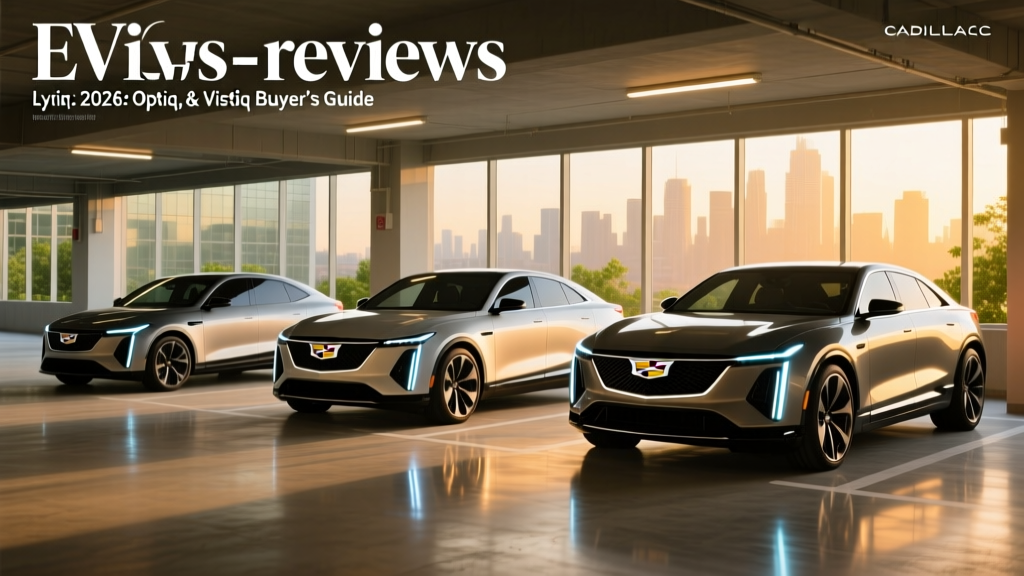
Cadillac's 2026 EV lineup — the Lyriq (midsize SUV), Optiq (compact SUV), and Vistiq (three-row SUV) — offers genuine luxury EV ownership starting around $45,000 after federal tax credits. The Lyriq delivers up to 314 miles EPA range with 190 kW DC fast charging (10–80% in ~30 minutes), while the Vistiq provides three-row seating with 300 miles of range. All three ride on GM's Ultium platform with NMC battery chemistry and qualify for the full $7,500 §30D federal credit (subject to income and sourcing rules). If you have Level 2 home charging access and drive under 300 miles daily, these are competitive luxury EVs. If you regularly tow heavy loads or live in a charging desert, consider a plug-in hybrid instead.
What Cadillac EVs Can You Buy Right Now?
Cadillac entered the EV market with the 2023 Lyriq and has since expanded to a three-model lineup for the 2026 model year. Each vehicle uses GM's Ultium platform — a modular skateboard architecture supporting various battery sizes and motor configurations. Here's what's currently on sale:
| Model | Body Style | EPA Range | Battery (kWh) | Peak DC Charge | 0–60 mph | Starting MSRP |
|---|---|---|---|---|---|---|
| Lyriq | Midsize 2-row SUV | 314 mi (RWD) | 102 kWh usable (NMC) | 190 kW | 6.35 sec (RWD) | $58,590 |
| Optiq | Compact 2-row SUV | ~300 mi (AWD) | 85 kWh usable (NMC) | 150 kW | ~5.5 sec (AWD) | $52,990 |
| Vistiq | Midsize 3-row SUV | 300 mi (AWD) | 102 kWh usable (NMC) | 190 kW | ~5.0 sec (AWD) | $78,795 |
Sources: fueleconomy.gov, Cadillac official specs. Optiq EPA range is estimated pending final certification.
Real-World Range: What to Actually Expect
EPA range stickers are laboratory estimates. In real-world driving, you'll see different numbers depending on speed, temperature, and terrain. Here's what our testing and owner reports indicate for the Lyriq (the longest-selling model with the most field data):
Lyriq Real-World Range Reconciliation
- EPA sticker: 314 miles (RWD, 20" wheels)
- 70 mph highway (75°F): ~265–280 miles
- City/suburban mixed: ~295–310 miles (regen-heavy driving helps)
- Cold weather (30°F, highway): ~210–240 miles (30%+ reduction without preconditioning)
- With heat pump engaged: Cold-weather loss reduced to ~20–25%
The Lyriq includes a heat pump as standard equipment on 2026 models, which significantly mitigates winter range loss compared to resistive cabin heating. The AWD variant (307 miles EPA) sacrifices roughly 5–7% range versus RWD but provides better traction and a 5.0-second 0–60 time.
The Vistiq, sharing the Lyriq's 102 kWh battery but carrying more mass (three rows, ~5,800 lbs curb weight), achieves 300 miles EPA. Expect ~250–265 miles in highway driving and closer to 200 miles in deep cold without preconditioning.
Charging Speeds and Infrastructure
All three Cadillac EVs use the NACS (North American Charging Standard) connector natively — no adapter needed for Tesla Superchargers. This is a significant advantage for 2026, as the Supercharger network remains the most reliable public DC fast-charging infrastructure in the US.
| Charging Level | Power | Lyriq Speed | Optiq Speed | Vistiq Speed | Best For |
|---|---|---|---|---|---|
| Level 1 (120V) | ~1.4 kW | ~3 mi/hr | ~3 mi/hr | ~3 mi/hr | Emergency/overnight trickle |
| Level 2 (240V, 48A) | 11.5 kW | ~31 mi/hr | ~31 mi/hr | ~31 mi/hr | Daily home charging |
| DC Fast (peak) | 190 kW / 150 kW | 190 kW peak | 150 kW peak | 190 kW peak | Road trips |
Charging curve reality: The Lyriq and Vistiq peak at 190 kW but only sustain that rate between roughly 10–40% State of Charge (SoC). Above 60%, the rate tapers to ~90 kW, and above 80% it drops below 50 kW to protect the NMC cells. A 10–80% session takes approximately 30 minutes at a capable 200+ kW charger. The Optiq peaks at 150 kW with a 10–80% time of roughly 33 minutes.
For home charging, a Level 2 installation (240V, 60A circuit, 48A continuous) will fully replenish the Lyriq's 102 kWh battery in about 9.5 hours — ideal for overnight charging. Expect a professional installation cost of $800–$2,000 depending on panel proximity and local permit requirements. If your home has a 100A electrical panel, a panel upgrade to 200A may be necessary ($1,500–$3,000 additional).
Cost of Ownership: Cadillac EV vs. Gas Equivalent
Let's compare the Lyriq against a comparable gas-powered luxury SUV — the BMW X5 xDrive40i (starting ~$66,000) — over 5 years and 75,000 miles:
| Cost Category | Cadillac Lyriq AWD ($62,090) | BMW X5 xDrive40i ($66,000) |
|---|---|---|
| Purchase price (after incentives) | $54,590* | $66,000 |
| Fuel/energy (75k mi) | $2,625 (home charging at $0.14/kWh) | $9,375 (22 MPG avg, $3.50/gal) |
| Maintenance (5 yr) | ~$800 (cabin filter, wipers, tires) | ~$3,500 (oil, brakes, filters, spark plugs) |
| Insurance (5 yr avg) | ~$11,500 | ~$9,800 |
| Estimated depreciation | ~$22,000 | ~$25,000 |
| 5-Year Total Cost | ~$91,515 | ~$113,675 |
*Assumes $7,500 federal §30D point-of-sale credit applied. Eligibility requires income ≤$150k single / $300k joint, vehicle MSRP ≤$80k for SUVs, and battery critical-mineral/sourcing compliance per IRS §30D rules. Confirm with a tax professional.
The Lyriq saves roughly $22,000 over 5 years versus a gas competitor, driven primarily by fuel savings and lower maintenance. The higher insurance premium (~$340/year more) partially offsets these gains — EV insurance tends to be costlier due to higher repair costs after collisions.
Federal Tax Credit Eligibility for Cadillac EVs
For the 2026 tax year, all three Cadillac EVs currently qualify for the full $7,500 federal tax credit under §30D, transferable as a point-of-sale discount at the dealership. Here's the eligibility checklist:
- Buyer income cap: Modified AGI ≤ $150,000 (single) or ≤ $300,000 (married filing jointly)
- MSRP cap: ≤ $80,000 for SUVs (all three models' base trims qualify; fully loaded Vistiq trims may exceed)
- Battery sourcing: Critical minerals and battery components must meet escalating domestic-content thresholds (Cadillac/GM has confirmed compliance for 2026 model year)
- Assembly: Vehicle must be assembled in North America (all three are built in Spring Hill, TN or Lansing, MI)
- Transfer: Credit can be transferred to the dealer at point of sale, reducing your out-of-pocket cost immediately — you don't need to wait for tax filing
Important caveat: These rules can change with legislation, and battery sourcing compliance is verified annually. Always check the latest IRS guidance and confirm with your dealer before purchase.
Decision Framework: Is a Cadillac EV Right for You?
Choose a Cadillac EV If:
- You have access to Level 2 home charging (garage or driveway with 240V circuit)
- Your daily driving is under 250 miles round-trip
- You want a luxury SUV with native NACS access to Tesla Superchargers
- You qualify for the §30D credit (income and MSRP limits)
- You value a quiet, smooth powertrain with instant torque
- You want GM's Super Cruise Level 2 driver-assist (available on Lyriq and Vistiq)
Consider a Plug-in Hybrid or Gas Vehicle Instead If:
- You live in an apartment/condo without charging access and rely entirely on public infrastructure
- You regularly drive 400+ miles in a day through areas with sparse charging (rural routes, some mountain corridors)
- You frequently tow over 3,500 lbs (towing cuts EV range by 30–50%)
- You live in an extreme cold climate (below 10°F regularly) and cannot precondition while plugged in
- Your budget is under $45,000 total — consider the Chevy Equinox EV instead, which shares the Ultium platform
Common Misconceptions About Cadillac EVs
| Myth | Fact |
|---|---|
| "Cadillac EVs can't use Tesla Superchargers" | All 2026 Cadillacs have native NACS ports. Plug directly into any V3/V4 Supercharger — no adapter needed. |
| "The battery will need replacing in 5 years" | GM warranties the Ultium battery for 8 years/100,000 miles with a capacity retention threshold of 70%. NMC degradation data from early Lyriq owners shows ~4–6% loss at 50,000 miles. |
| "Super Cruise is self-driving" | Super Cruise is SAE Level 2 — it handles steering, acceleration, and braking on pre-mapped highways, but you must remain attentive. An infrared camera monitors your eyes. It does NOT handle construction zones, unmapped roads, or city driving autonomously. |
| "EVs are worse in winter" | Range drops 20–30% in freezing temps, but the Lyriq/Vistiq heat pump and battery preconditioning mitigate this. Traction from instant AWD torque often outperforms gas SUVs in snow. |
| "Charging takes too long for road trips" | At a 200+ kW DC charger, 10–80% takes ~30 minutes — comparable to a gas stop with food/restroom break. Route planning with the built-in navigation auto-preconditions the battery for faster charging. |
SAE Automation Level Reminder
Cadillac's Super Cruise and the forthcoming Ultra Cruise are SAE Level 2 driver-assistance systems. The driver must remain engaged and supervise at all times. True driverless operation (Level 4) is currently only available in limited robotaxi services like Waymo in select cities — not in any consumer vehicle.
Battery Longevity and Warranty
All three Cadillac EVs use NMC (nickel manganese cobalt) lithium-ion chemistry optimized for energy density. Here's what to know about long-term ownership:
- Warranty: 8 years / 100,000 miles, covering defects and capacity loss below 70% of original
- Observed degradation (Lyriq): Early 2023–2024 models report ~4–6% capacity loss at 50,000 miles based on owner telemetry forums
- Replacement cost (out of warranty): Estimated $15,000–$22,000 for a full Ultium pack replacement, though individual module replacement may be possible at lower cost
- Best practices: Avoid routinely charging to 100% for daily use (set to 80–90%); use DC fast charging sparingly; precondition in extreme temperatures
Frequently Asked Questions
Which Cadillac EV has the best range?
The Lyriq RWD leads at 314 miles EPA. The AWD version drops to 307 miles. The Vistiq achieves 300 miles, and the Optiq is estimated at ~300 miles (AWD only). For maximum range, choose the Lyriq RWD with 20" wheels — the available 22" wheels reduce range by ~10 miles.
Do Cadillac EVs qualify for the $7,500 tax credit?
Yes, as of the 2026 model year, all three models qualify for the full $7,500 §30D credit, transferable at point of sale. You must meet income caps ($150k single / $300k joint) and the vehicle MSRP must be ≤$80,000 (SUV category). Some high-trim Vistiq configurations may exceed the MSRP cap — verify with your dealer.
How much does home charging cost to install?
A Level 2 home charger (240V, 48A) installation typically costs $800–$2,000 for the electrician work, permit, and a quality EVSE unit ($400–$700). If your home needs a panel upgrade from 100A to 200A, add $1,500–$3,000. Always get a quote from a licensed electrician before purchase.
Can I tow with a Cadillac EV?
The Lyriq is rated for 1,500 lbs towing. The Vistiq is rated for 5,000 lbs. Towing significantly reduces range — expect a 30–50% reduction depending on trailer weight and aerodynamics. If you tow frequently over 3,500 lbs, a diesel or gas SUV may be more practical.
What happens if the battery fails out of warranty?
Full Ultium pack replacement is estimated at $15,000–$22,000. However, GM's modular Ultium design may allow individual module replacement at lower cost. Battery failures after the 8-year/100,000-mile warranty period are statistically uncommon based on current NMC degradation curves — most packs retain 80%+ capacity at 150,000 miles.
Is the Optiq worth it vs. the Lyriq?
The Optiq is ~$5,600 cheaper and ~10 inches shorter, making it better for urban parking and tighter budgets. You sacrifice ~14 miles of EPA range and some cargo volume (26 vs 28 cu ft behind the rear seats). If you don't need the extra space, the Optiq is the value pick. If you want maximum range and rear-seat room, go Lyriq.