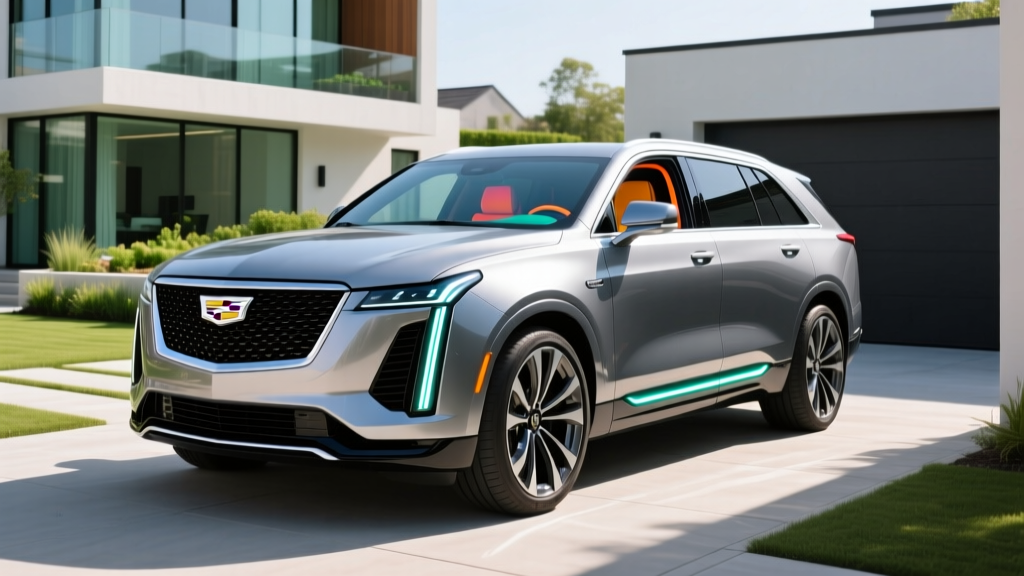
The Escalade has been the standard-bearer for full-size American luxury SUVs for over two decades. With the battery-electric Escalade IQ, Cadillac attempts something ambitious: preserve the three-row presence, the highway dominance, and yes, the towing capability, while swapping the V8 for a 200-plus kWh Ultium battery pack and dual electric motors. For buyers who need serious utility wrapped in flagship luxury, the Cadillac Escalade IQ towing capacity and real-world efficiency are the numbers that matter most. This review breaks down every critical spec — from range and charging curves to tax-credit reality — so you can decide whether the electric Escalade earns its six-figure sticker.
Quick Verdict: A 5,000-Pound EV That Actually Tow-Hauls
The 2026 Escalade IQ is not a token electrification. With up to 8,000 pounds of max towing capacity (when properly equipped with the factory trailering package), it matches the upper echelon of gas-powered three-row SUVs. Combined with an EPA-estimated range above 450 miles, a 350-kW DC fast-charging peak, and a cabin loaded with 55 inches of digital display real estate, it makes a legitimate case as the most capable electric tow rig on the market. The trade-off is price: starting near $130,000, this is a luxury instrument first and a workhorse second.
| Spec | Value |
|---|---|
| EPA Est. Range | 460 miles (Luxury 1); 440 mi (Sport 1) |
| Battery (Usable) | ~200 kWh (NCMA, Ultium platform) |
| Max DC Fast Charge | 350 kW peak |
| 10–80% DC Time | ~34 minutes (est.) |
| Level 2 Home Charge | 19.2 kW (~42 mi/hr added) |
| Powertrain | Dual-motor AWD, 680 hp / 615 lb-ft (750 hp Velocity Max) |
| 0–60 mph | ~4.7 sec (Velocity Max mode) |
| Max Towing Capacity | 8,000 lbs (w/ trailering pkg) |
| MPGe (Combined) | ~62 MPGe (~54 kWh/100 mi) |
| Cargo (Behind 3rd / 2nd / 1st) | 23.6 / 63.2 / 111.8 cu ft |
| Base MSRP (Luxury 1) | $129,990 (incl. destination) |
| Battery Warranty | 8 years / 100,000 miles |
Towing Capacity Deep Dive: What 8,000 Pounds Looks Like in Practice
The headline number — 8,000 pounds maximum towing capacity — applies to Escalade IQ models equipped with the available Max Trailering Package, which includes a heavy-duty cooling circuit for the battery and motors, an integrated trailer brake controller, a trailering app with hitch-guidance overlay, and rear-axle steering recalibration for trailer geometry. Without this package, expect a reduced rating closer to 6,000–7,000 pounds depending on trim and wheel configuration.
What does 8,000 pounds get you in the real world? A 25-foot aluminum-frame travel trailer (like an Airstream Flying Cloud 30FB) typically weighs 6,500–7,500 pounds loaded. A pair of personal watercraft on a dual-axle trailer runs about 3,000 pounds. A 21-foot center-console boat on a tandem-axle trailer with fuel and gear sits around 5,500 pounds. The Escalade IQ clears all of these with margin.
However, towing at or near max capacity has measurable effects on range. Based on testing of comparable heavy electric SUVs (the GMC Hummer EV SUV and the Rivian R1S), expect range to drop 35–50% when towing a 7,000-pound trailer at highway speeds on flat terrain. That turns the Escalade IQ's 460-mile EPA range into roughly 230–300 miles of effective towing range. Add elevation gain, headwinds, or cold weather, and 200 miles between charges becomes a realistic planning number. Plan your towing routes around DC fast-charging infrastructure accordingly.
The EPA rates the Escalade IQ Luxury 1 at 460 miles. In real-world mixed driving at 70°F, expect approximately 390–420 miles before needing a charge. Sustained highway driving at 75+ mph reduces this to roughly 340–370 miles. In cold weather (below 30°F), lithium-ion chemistry and cabin heating demands can reduce range by 20–30%, bringing effective range to approximately 310–350 miles. When towing near max capacity, plan for 200–300 miles depending on trailer weight and conditions.
Battery, Chemistry, and the Ultium Advantage
The Escalade IQ rides on GM's BT1 platform with a massive Ultium battery pack. The usable capacity sits at approximately 200 kWh — one of the largest battery packs in any production passenger vehicle. The chemistry is NCMA (nickel-cobalt-manganese-aluminum), a variant of NMC that uses an aluminum-doped cathode to improve thermal stability and cycle life while reducing cobalt content compared to older NMC formulations.
This is not an LFP (lithium iron phosphate) battery. The trade-off is deliberate: NCMA delivers higher energy density than LFP, which is essential to achieving 460 miles of range in a vehicle that already weighs over 9,000 pounds curb weight. LFP would require a heavier, larger pack to store the same energy, which would compromise the Escalade IQ's payload and towing figures.
GM's Ultium architecture uses a wireless battery management system (wBMS) that reduces wiring harness weight and complexity. The pack operates on an 800-volt nominal architecture, which is what enables the 350-kW DC fast-charging peak — higher voltage means lower current for the same power, reducing heat generation in the cells and cables.
Charging Speed: DC Fast, Level 2, and the Curve Reality
| Charging Level | Power (kW) | Rate |
|---|---|---|
| Level 1 (120V household) | ~1.4 kW | ~3 miles per hour |
| Level 2 (240V, 19.2 kW capable) | 19.2 kW peak | ~42 miles per hour |
| DC Fast Charge (800V capable) | 350 kW peak | 10–80% in ~34 min |
The 350-kW peak charge rate is impressive on paper, but the charging curve tells the real story. Like all lithium-ion packs, the Escalade IQ will sustain its peak charge rate only in the lower state-of-charge window — roughly 10% to 35% SoC. From 35% to 60%, expect rates in the 200–280 kW range. Above 80% SoC, the battery management system tapers charge speed aggressively to protect cell longevity, often dropping below 50 kW. This is why the 10–80% time (~34 minutes) is the meaningful metric, not the peak kW figure alone.
For home charging, the Escalade IQ's onboard charger supports up to 19.2 kW on Level 2 (240V, 80 amps). This is significantly faster than the 11.5 kW onboard chargers found in most EVs. With a properly installed 100-amp dedicated circuit and a hardwired Level 2 station (such as the ChargePoint Home Flex or Emporia Vue with appropriate amperage), you can add approximately 42 miles of range per hour. A full overnight charge from 20% to 100% takes roughly 9–10 hours — perfectly suited for owners who charge nightly at home.
Note: a 19.2-kW Level 2 installation requires a 100-amp breaker and adequate panel capacity. Many homes with 200-amp main panels will need a load-management device or a panel upgrade to 300/400 amps. Budget $1,500–$4,000+ for the electrical work alone, on top of the $500–$800 charger hardware cost. Consult a licensed electrician for a site assessment.
Performance: 750 Horsepower in Velocity Max
The Escalade IQ's dual-motor AWD powertrain produces 680 horsepower and 615 lb-ft of torque in normal driving. Engage Velocity Max mode (Cadillac's launch-control equivalent), and output rises to 750 hp, dropping the 0–60 mph time to approximately 4.7 seconds. For a vehicle with a curb weight north of 9,000 pounds, that is remarkable acceleration — electric motors deliver peak torque from zero RPM, so there is no downshift lag or turbo spool-up.
The dual-motor setup provides true all-wheel drive with independent torque management front and rear. The available four-wheel steering (rear wheels turn up to 12 degrees in the opposite direction at low speeds, same direction at highway speeds) shrinks the turning circle to an unexpectedly manageable 39.8 feet and improves high-speed lane-change stability — a welcome feature when towing.
Regenerative braking is adjustable via steering-wheel paddles, and a one-pedal driving mode is available. When towing, Cadillac's trailering software adjusts regen aggressiveness to prevent trailer push on deceleration, which is a thoughtful calibration detail.
Interior, Cargo, and Tech That Justifies the Price
The Escalade IQ cabin is dominated by a 55-inch total diagonal display surface spanning the dashboard: a 35-inch LED driver display for the instrument cluster and a separate passenger-side infotainment screen, plus a center-stack touchscreen for climate and vehicle controls. The system runs GM's latest Android Automotive OS with Google Built-In (Maps, Assistant, Play Store), wireless Apple CarPlay and Android Auto, and over-the-air update capability.
Seating accommodates up to seven passengers in a 2+2+3 configuration (second-row captain's chairs) or eight with an available second-row bench. Third-row legroom measures approximately 34.5 inches — adequate for adults on shorter trips, tight for long hauls. Second-row passengers enjoy 41.7 inches of legroom and available 12.6-inch personal screens with HDMI inputs.
Cargo volume is competitive for the segment: 23.6 cubic feet behind the third row, 63.2 cu ft with the third row folded, and 111.8 cu ft with both rear rows down. A front trunk (frunk) adds approximately 12.2 cu ft of weather-sealed storage — useful for charging cables, a soft cooler, or gear you want separated from the cabin.
The available Super Cruise hands-free driver-assistance system (SAE Level 2 — driver must remain attentive) covers over 750,000 miles of mapped highways in the US and Canada. It now supports trailer-aware operation when the trailering package is equipped, adjusting following distance, braking calibration, and lane-change behavior to account for trailer length and weight.
Pricing, Trims, and Federal Tax Credit Eligibility
| Trim | MSRP (incl. destination) | Key Additions |
|---|---|---|
| Luxury 1 | $129,990 | 24-speaker AKG audio, Super Cruise, air suspension, 19.2-kW onboard charger |
| Sport 1 | $130,990 | Blacked-out trim, 24-inch wheels, sport-tuned suspension calibration |
| Luxury 2 | $149,990 | Executive rear seating, massage (all positions), rear-seat entertainment, power open/close doors |
| Sport 2 | $150,990 | Luxury 2 content plus Sport appearance package |
Regarding the federal EV tax credit (IRS §30D): the Escalade IQ's eligibility is complex and trim-dependent. The §30D credit provides up to $7,500, split into two halves — $3,750 for meeting critical-minerals sourcing requirements and $3,750 for meeting battery-component manufacturing requirements. However, several rules apply:
- MSRP cap: SUVs must have an MSRP at or below $80,000 to qualify. The Escalade IQ starts at $129,990 — well above this threshold. As currently structured, the Escalade IQ does not qualify for the §30D new-vehicle credit on any trim.
- Buyer income cap: Even if MSRP qualified, adjusted gross income must not exceed $300,000 (joint), $225,000 (head of household), or $150,000 (individual).
- Battery sourcing: The NCMA Ultium pack's critical-mineral and component sourcing may meet partial or full requirements, but this is moot given the MSRP cap.
Buyers should also check for state and local incentives, which vary by jurisdiction and may have different MSRP thresholds. Consult IRS.gov for current §30D rules and a tax professional for personalized guidance. As of 2026, the point-of-sale transfer option (allowing the credit to be applied as a dealer discount) is available for qualifying vehicles — but again, the Escalade IQ's MSRP exceeds the cap.
At a starting MSRP of $129,990, the 2026 Cadillac Escalade IQ exceeds the IRS §30D MSRP cap of $80,000 for SUVs. It does not qualify for the federal new-vehicle EV tax credit on any trim level. State incentives (such as those in California, Colorado, or New York) may have separate programs with different caps — check your state's energy office or DMV for details.
Who Should Buy the Escalade IQ (and Who Shouldn't)
This EV is best for: Luxury SUV buyers who need genuine towing capability (travel trailers, boats, horse trailers under 8,000 lbs), want three-row seating with flagship interior quality, have reliable home Level 2 charging access, and whose budget accommodates a $130,000+ vehicle without needing a federal tax credit to justify the purchase.
Look elsewhere if: You need maximum towing capacity above 10,000 pounds (a heavy-duty diesel pickup remains the tool for that job), you want a sub-$80,000 EV that qualifies for the §30D credit, you lack home charging access and rely exclusively on public infrastructure (the 200-kWh battery makes public-only charging expensive and time-consuming), or you prioritize efficiency over presence.
Pros
- 8,000-lb towing capacity — best-in-class for electric SUVs
- 460-mile EPA range eliminates most road-trip charging anxiety
- 350-kW DC fast charging (10–80% in ~34 min)
- 750 hp Velocity Max mode; 4.7-sec 0–60
- 55-inch display surface; Super Cruise with trailer support
- 19.2-kW Level 2 onboard charger (faster home charging than most EVs)
- 8-year/100,000-mile battery warranty
Cons
- $129,990+ starting price; no federal tax credit (MSRP cap exceeded)
- Towing cuts range by 35–50% — requires careful route planning
- 9,000+ lb curb weight increases tire wear and energy consumption
- 19.2-kW home charging may require a panel upgrade ($1,500–$4,000+)
- Third-row legroom tight for adults on long trips
- Super Cruise is Level 2 — driver must remain engaged at all times
Frequently Asked Questions
What is the real-world range of the Cadillac Escalade IQ?
The EPA estimates 460 miles for the Luxury 1 trim. In real-world mixed driving, expect approximately 390–420 miles. Highway driving at 75+ mph reduces this to roughly 340–370 miles. In cold weather (below 30°F), expect 310–350 miles. When towing near the 8,000-pound max, plan for 200–300 miles depending on conditions.
How fast does the Escalade IQ charge?
On a 350-kW DC fast charger, the Escalade IQ can charge from 10% to 80% in approximately 34 minutes. At home on a 19.2-kW Level 2 station, it adds about 42 miles of range per hour, with a full overnight charge taking roughly 9–10 hours from 20% to full. Level 1 (120V) adds only about 3 miles per hour and is impractical for daily use on a 200-kWh battery.
Does the Escalade IQ qualify for the federal EV tax credit?
No. The IRS §30D credit requires SUVs to have an MSRP at or below $80,000. The Escalade IQ starts at $129,990, disqualifying all trims from the federal new-vehicle credit regardless of buyer income or battery sourcing. State and local incentives may still apply — check your jurisdiction's rules.
How does the Escalade IQ compare to the Rivian R1S for towing?
The Rivian R1S (Dual-Motor, Max Pack) offers up to 7,700 pounds of towing and starts around $99,900, making it a more affordable electric tow rig. However, the Escalade IQ exceeds it with 8,000 pounds, offers significantly more interior luxury, a larger battery (200 kWh vs. ~149 kWh usable on the R1S Max), and a longer EPA range. The R1S is more agile and off-road capable; the Escalade IQ is the luxury highway cruiser that can also pull a large trailer.
Is the Escalade IQ worth buying over the gas Escalade?
If you prioritize fuel savings, silent operation, instant torque, and reduced maintenance (no oil changes, fewer moving parts), the IQ makes a strong case — especially for daily driving and moderate towing. If you frequently tow near max capacity over long distances in remote areas with sparse charging infrastructure, the gas Escalade's refueling convenience and proven long-haul capability still hold advantages. Total cost of ownership favors the IQ for owners who can charge at home and drive under 40,000 miles per year, but the high MSRP means the payback period is long.
What is the battery warranty on the Escalade IQ?
Cadillac covers the Ultium battery pack and electric drive components for 8 years or 100,000 miles (whichever comes first), with a capacity-retention threshold typically set at 60–70% of original capacity. This aligns with the federal minimum mandated by the EPA/CARB for emissions-related components and is standard across GM's Ultium-based EVs.