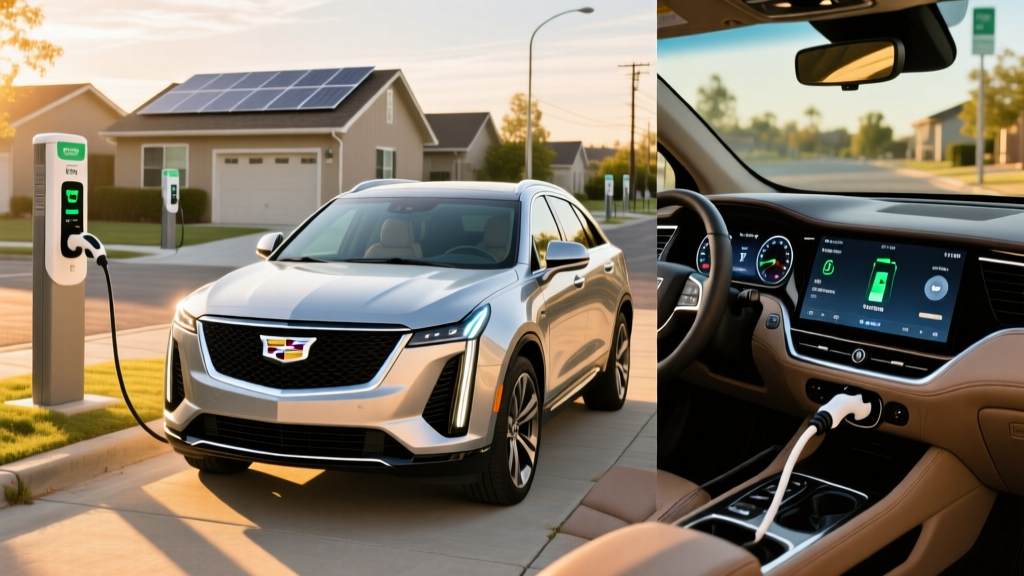
The Cadillac Escalade IQ arrives as General Motors' answer to ultra-premium electric SUVs, positioning itself against the Tesla Model X, Mercedes-Benz EQS SUV, and Rivian R1S in the six-figure electric luxury segment. Built on GM's dedicated BT1 battery-electric platform — the same architecture underpinning the Chevrolet Silverado EV and GMC Sierra EV — the Escalade IQ brings a massive battery, serious towing capability, and Cadillac's most opulent interior to date. For 2026, the Luxury trim serves as the entry point into the IQ lineup, though "entry" is relative when the starting price brushes $130,000. Here is everything you need to know about range, charging, performance, and whether the math works for your garage.
Quick Verdict: Who the Escalade IQ Luxury Is For
The Escalade IQ Luxury targets buyers who want full-size, three-row SUV space without the fuel bill of a 6.2-liter V8, and who can charge at home. It excels as a daily family hauler, long-distance cruiser, and light-to-moderate tow rig. The 460-mile EPA range is class-leading for a vehicle this size, and the 200-kW DC fast-charging capability means road trips are viable — not just theoretically, but practically. The trade-off is a high purchase price, large physical footprint that complicates urban parking, and a charging curve that tapers noticeably past 80% State of Charge (SoC).
Buy the Escalade IQ Luxury if: You need three rows, 400+ miles of range, premium materials, and have access to Level 2 home charging.
Look elsewhere if: You primarily drive in dense urban environments, cannot install a home charger, or need a sub-$100,000 price point.
Range and Efficiency: EPA vs. Real World
| Specification | Value |
|---|---|
| EPA Estimated Range | 460 miles |
| Battery Capacity (Usable) | ~200 kWh (NMC) |
| Battery Chemistry | Nickel Manganese Cobalt (NMC) |
| EPA Efficiency | ~58 MPGe combined |
| Energy Consumption | ~58 kWh/100 miles |
| Drivetrain | Dual-motor AWD (eAWD) |
Real-World Range Expectations: The EPA rates the Escalade IQ at 460 miles. In real-world highway driving at 70-75 mph, expect approximately 380-410 miles on a full charge. In cold weather (below 32°F), range can drop to 320-360 miles due to cabin heating demands and reduced battery efficiency, even with the standard heat pump system. City driving with frequent regenerative braking can push range closer to or slightly above the EPA figure.
The Escalade IQ's roughly 200 kWh usable battery pack is among the largest ever fitted to a production passenger vehicle. GM uses Ultium-format pouch cells with NMC chemistry, chosen for its higher energy density compared to LFP (lithium iron phosphate). This enables the 460-mile range figure despite the Escalade IQ's substantial curb weight of over 8,600 pounds. The trade-off with NMC chemistry is a slightly faster degradation curve over very high mileage compared to LFP, though GM's battery management system and warranty provide substantial protection (more on this below).
Efficiency, measured in kWh per 100 miles, will vary significantly with driving style and conditions. Aggressive acceleration, sustained highway speeds above 80 mph, and towing will push consumption toward 65-75 kWh/100 miles. Gentle suburban driving can bring it into the low 50s. For context, charging at $0.15/kWh (a national average for home electricity), driving 1,000 miles per month costs approximately $87 — roughly one-third the fuel cost of a gasoline Escalade at 16 MPG combined and $3.50/gallon.
Charging Speed: DC Fast Charge and Home Level 2
| Charging Level | Power | Speed (Miles Added) | Time Estimate |
|---|---|---|---|
| Level 1 (120V, 12A) | ~1.4 kW | ~3 miles/hour | Not practical for full charge |
| Level 2 (240V, 48A) | 11.5 kW | ~22 miles/hour | ~21 hours (10-100%) |
| Level 2 (240V, 80A) | 19.2 kW | ~37 miles/hour | ~12 hours (10-100%) |
| DC Fast Charge (Peak) | 200 kW | ~100 miles in ~10 min | 10-80% in ~40 min |
The Escalade IQ supports DC fast charging at a peak rate of 200 kW via the CCS1 connector (or NACS, depending on production timeline and adapter availability — GM has committed to NACS adoption across its EV lineup). At peak rate, the IQ can recover approximately 100 miles of range in 10 minutes. The 10-80% charge takes approximately 40 minutes under ideal conditions (battery preconditioned, moderate ambient temperature, charger capable of sustained output).
Charging curve reality: The 200 kW figure is a peak, not a sustained rate. Expect the IQ to hold close to peak power between roughly 10-40% SoC, then taper progressively. Between 60-80%, the rate drops to approximately 120-140 kW, and above 80% it falls sharply to protect battery longevity. This is standard behavior for NMC packs, but with a 200 kWh battery, even the taper phase adds meaningful range per minute.
For home charging, the Escalade IQ accepts up to 19.2 kW on Level 2 (240V at 80 amps), which is among the highest onboard charger capacities available. At 19.2 kW, you gain approximately 37 miles of range per hour — enough to fully replenish a day's worth of driving overnight. However, an 80-amp circuit requires a 100-amp breaker and substantial panel capacity. Many homes will need a panel upgrade (typically $1,500-$3,000) to support this. The more common 48-amp Level 2 setup (11.5 kW) delivers about 22 miles per hour and is compatible with most 200-amp residential panels. Consult a licensed electrician for your specific situation.
Performance and Drivetrain
| Performance Metric | Value |
|---|---|
| Horsepower | 750 hp (estimated, dual-motor AWD) |
| Torque | ~785 lb-ft |
| 0-60 mph | ~4.5 seconds (estimated) |
| Drivetrain | Dual-motor eAWD |
| Towing Capacity | Up to 8,000 lbs (when properly equipped) |
| Adaptive Air Suspension | Standard |
The Escalade IQ Luxury uses a dual-motor all-wheel-drive configuration producing an estimated 750 horsepower and approximately 785 lb-ft of torque. The 0-60 mph sprint takes roughly 4.5 seconds — remarkable for a vehicle exceeding 8,600 pounds. The instant torque delivery characteristic of electric motors makes the IQ feel even quicker in real-world passing scenarios than the 0-60 figure suggests.
The standard adaptive air suspension provides up to 2 inches of ride-height adjustment, improving both highway aerodynamics (lowered) and rough-road clearance (raised). Four-wheel steering, branded as "4-Steer" by GM, reduces the turning circle despite the IQ's 220+ inch overall length, making it surprisingly manageable in parking structures and tight suburban streets.
Towing capacity reaches 8,000 pounds when properly equipped with the available tow package. Towing will significantly impact range — expect a 40-50% reduction depending on trailer weight and aerodynamic profile. A 4,000-pound enclosed trailer at highway speeds could cut range to approximately 230-260 miles.
Interior, Technology, and Cargo
The Escalade IQ's cabin represents Cadillac's most ambitious interior execution. The dashboard is dominated by a pillar-to-pillar 55-inch diagonal LED display spanning the full width of the instrument panel, combining the driver instrument cluster, central infotainment, and passenger entertainment screen into one seamless surface. The system runs GM's latest Ultifi software platform with Google built-in (Google Maps navigation, Google Assistant, and Play Store apps).
Passenger space:
- First-row headroom: ~42.0 inches | legroom: ~44.5 inches
- Second-row headroom: ~39.5 inches | legroom: ~41.0 inches (captain's chairs standard)
- Third-row headroom: ~38.0 inches | legroom: ~34.0 inches
Cargo volume:
- Behind third row: ~25 cu ft
- Behind second row (third row folded): ~65 cu ft
- Behind first row (all rear rows folded): ~120 cu ft
- Front trunk (frunk): ~12 cu ft
The frunk (front trunk) is a notable addition that the gasoline Escalade cannot offer, providing secure, weatherproof storage for charging cables, groceries, or luggage. However, the IQ's overall cargo volumes trail the gasoline Escalade slightly due to the floor-mounted battery pack raising the load floor.
Driver assistance: The Escalade IQ comes standard with GM's Super Cruise hands-free driving system on compatible mapped roads (over 750,000 miles of divided highways in North America as of 2026). Super Cruise is an SAE Level 2 system — the driver must remain attentive and ready to take over at all times, despite the hands-free capability. The available Ultra Cruise expands hands-free operation to virtually all roads, though it remains a Level 2 system requiring driver supervision. This is not autonomous driving; it is advanced driver assistance.
Important: Super Cruise and Ultra Cruise are SAE Level 2 driver-assistance systems. You must keep your eyes on the road and remain prepared to take control instantly. These systems do not make the Escalade IQ self-driving. Hands-free does not mean attention-free.
Pricing, Trims, and Federal Tax Credit Eligibility
| Trim | Base MSRP | Est. As-Tested | §30D Credit Eligible? |
|---|---|---|---|
| Luxury | $129,990 | $135,000-$140,000 | See below |
| Premium Luxury | $139,990 | $150,000-$160,000 | See below |
| Sport | $139,990 | $148,000-$158,000 | See below |
| Premium Luxury Platinum | $149,990 | $160,000+ | See below |
The Escalade IQ Luxury starts at $129,990 (including destination). Options such as enhanced paint, larger wheels, the Executive Second Row seating package, and the tow package can push as-tested pricing to $135,000-$140,000 for the Luxury trim.
Federal tax credit (§30D) eligibility: This is where the Escalade IQ faces its biggest regulatory hurdle. The IRS §30D clean vehicle credit has an MSRP cap of $80,000 for SUVs. At $129,990 base, the Escalade IQ does not qualify for the $7,500 federal purchase credit regardless of your income or the battery sourcing. Additionally, buyer income caps ($300,000 joint / $150,000 single for new vehicles) and critical mineral / battery component sourcing requirements further limit eligibility for luxury EVs above the MSRP threshold. Always verify current rules at IRS.gov and consult a tax professional before relying on any credit for purchase planning.
For buyers who might consider a pre-owned Escalade IQ in future model years, the used EV credit (§25E) offers up to $4,000 or 30% of the sale price (whichever is less) on vehicles priced under $25,000 — a threshold the IQ is unlikely to reach for many years given depreciation curves.
State and local incentives vary widely and are not subject to the federal MSRP cap. Some states offer rebates, HOV lane access, or reduced registration fees for EVs regardless of price. Check your state's energy or environmental agency website for current programs.
Warranty and Battery Longevity
| Coverage | Term |
|---|---|
| Limited Vehicle Warranty | 4 years / 50,000 miles |
| Powertrain Warranty | 6 years / 70,000 miles |
| Battery Pack Warranty | 8 years / 100,000 miles |
| Battery Capacity Retention Threshold | 70% of original capacity |
GM backs the Escalade IQ's Ultium battery pack with an 8-year / 100,000-mile warranty guaranteeing at least 70% capacity retention. If the pack degrades below 70% of its original usable capacity within this period, GM will repair or replace it at no cost. Based on data from earlier Ultium-platform vehicles and industry-wide NMC degradation studies, most owners can expect 85-90% capacity retention at 100,000 miles under normal use patterns (avoiding frequent 100% charges, minimizing DC fast charging to above 90% SoC, and using preconditioning).
Battery replacement cost outside of warranty is significant — industry estimates for a pack of this size range from $25,000 to $35,000 including labor. However, complete pack failures are rare; more commonly, individual modules can be serviced. GM's Ultium architecture is designed with modular serviceability in mind.
Escalade IQ vs. Key Competitors
| Attribute | Cadillac Escalade IQ Luxury | Tesla Model X Plaid | Mercedes EQS 580 SUV | Rivian R1S (Tri Motor) |
|---|---|---|---|---|
| EPA Range | 460 mi | 326 mi | 305 mi | ~390 mi (est.) |
| Battery (Usable) | ~200 kWh | ~95 kWh | ~108 kWh | ~149 kWh |
| Peak DC Charge | 200 kW | 250 kW | 200 kW | 200+ kW |
| 0-60 mph | ~4.5 sec | 2.5 sec | 4.4 sec | ~3.5 sec |
| Rows / Seats | 3 / 7 | 3 / 6-7 | 3 / 7 | 3 / 7 |
| Base MSRP | $129,990 | $109,990 | $127,350 | $99,900 |
| §30D Credit | No (over MSRP cap) | No (over MSRP cap) | No (over MSRP cap) | Yes (select trims) |
| Towing | 8,000 lbs | 3,500 lbs | 3,500 lbs | 7,700 lbs |
The Escalade IQ's standout advantage is range and towing. No competitor in this segment offers 460 miles EPA-rated combined with 8,000-pound towing. The Model X is quicker but trails significantly in range and towing. The EQS SUV is quieter and more refined on smooth highways but has considerably less range and cargo space. The Rivian R1S offers the best value proposition and off-road capability but cannot match the IQ's interior luxury or range.
Pros and Cons
Pros
- Class-leading 460-mile EPA range for a full-size luxury SUV
- 19.2 kW Level 2 home charging — fastest in segment
- 8,000-lb towing capacity exceeds most competitors
- Super Cruise / Ultra Cruise hands-free driving on 750,000+ mapped miles
- Pillar-to-pillar 55-inch display with Google built-in
- Spacious three-row seating with genuine adult-sized third row
- Frunk adds practical cargo flexibility
- Air suspension and 4-wheel steering improve ride and maneuverability
Cons
- $129,990+ starting price; no federal §30D tax credit eligibility
- 10-80% DC fast charge takes ~40 minutes — longer than some rivals
- Massive size (220+ inches long) complicates urban parking and garages
- Real-world highway range drops to ~380-410 miles; cold weather reduces further
- 80-amp home charging may require electrical panel upgrade ($1,500-$3,000)
- NMC battery chemistry degrades slightly faster than LFP over very high mileage
- Cargo volume slightly less than gasoline Escalade due to battery floor
- Insurance premiums likely $3,500-$5,000+ annually for this price class
Ownership Costs: 5-Year Estimate
| Cost Category | 5-Year Estimate | Notes |
|---|---|---|
| Purchase Price (Luxury) | $132,000 | With typical options, before any incentives |
| Depreciation | -$52,000 to -$60,000 | Estimated 40-45% over 5 years |
| Electricity (Home Charging) | $5,200 | ~12,000 mi/yr at $0.15/kWh |
| Insurance | $20,000-$25,000 | $4,000-$5,000/yr estimated |
| Maintenance | $2,500-$3,500 | No oil changes; tire rotation, cabin filter, fluid top-offs |
| Tires | $3,000-$4,000 | Heavy EV wear; expect 30,000-40,000 mi per set |
| Home Charger Install | $1,500-$4,000 | Level 2 equipment + electrician; panel upgrade if needed |
The Escalade IQ's total cost of ownership is heavily driven by depreciation and insurance. Electricity costs are a fraction of what a gasoline Escalade would consume — approximately $5,200 in electricity over 5 years versus $15,000-$18,000 in gasoline for the ICE equivalent. However, tire wear on a 8,600-pound EV with 785 lb-ft of torque will be noticeably higher than on lighter vehicles. Budget for premium tire replacements every 30,000-40,000 miles.
Frequently Asked Questions
What is the real-world range of the Cadillac Escalade IQ?
The EPA rates the Escalade IQ at 460 miles. In real-world highway driving at 70-75 mph, expect 380-410 miles. Cold weather (below 32°F) can reduce range to 320-360 miles. City driving with regenerative braking may approach or slightly exceed the EPA figure.
How fast does the Escalade IQ charge?
On DC fast charging, the IQ peaks at 200 kW, achieving a 10-80% charge in approximately 40 minutes. At home on Level 2 (240V), it accepts up to 19.2 kW (80 amps), adding about 37 miles of range per hour. A standard 48-amp Level 2 charger delivers 11.5 kW and about 22 miles per hour.
Does the Cadillac Escalade IQ qualify for the federal EV tax credit?
No. The IRS §30D credit has an $80,000 MSRP cap for SUVs. At $129,990 base, the Escalade IQ exceeds this cap and is not eligible for the $7,500 federal credit regardless of buyer income. Always verify current rules at IRS.gov. State incentives may still apply.
How much does it cost to charge the Escalade IQ at home?
At the national average residential electricity rate of $0.15/kWh, a full charge of the ~200 kWh battery costs approximately $30. Driving 12,000 miles per year costs roughly $1,040 in electricity — about one-third the fuel cost of a gasoline Escalade.
Is the Escalade IQ worth buying over a Tesla Model X or Rivian R1S?
It depends on your priorities. The Escalade IQ wins on range (460 vs. 326 miles for the Model X) and towing (8,000 vs. 3,500 lbs). The Model X is significantly quicker (2.5 vs. ~4.5 seconds 0-60) and offers access to the Tesla Supercharger network natively. The Rivian R1S is $30,000+ cheaper, offers better off-road capability, and may qualify for the federal tax credit on certain trims. Choose the IQ if range, towing, and traditional luxury are paramount.
Can I tow with the Escalade IQ?
Yes. The Escalade IQ has a maximum towing capacity of 8,000 pounds when properly equipped. However, towing significantly reduces range — expect a 40-50% reduction depending on trailer weight and aerodynamics. Plan charging stops accordingly when towing long distances.
What battery chemistry does the Escalade IQ use?
The Escalade IQ uses GM's Ultium battery platform with NMC (Nickel Manganese Cobalt) chemistry in pouch-format cells. NMC offers higher energy density than LFP, enabling the 460-mile range, but with slightly faster long-term degradation. The 8-year/100,000-mile battery warranty with a 70% capacity retention guarantee provides protection.
Do I need to upgrade my electrical panel for home charging?
Possibly. The Escalade IQ's maximum 19.2 kW (80-amp) Level 2 charging requires a 100-amp breaker. Homes with 200-amp service and limited existing load may accommodate this, but many will need a panel upgrade ($1,500-$3,000). A 48-amp Level 2 setup (11.5 kW) is more universally compatible and still provides adequate overnight charging. Always consult a licensed electrician.
Sources: EPA range and efficiency data from fueleconomy.gov; Cadillac Escalade IQ specifications from Cadillac.com; federal tax credit rules from IRS.gov. Specifications reflect 2026 model year information available at time of publication. Always verify with your dealer for the latest pricing and availability.