Quick Verdict: The Electric Flagship Redefines Three-Row Luxury
The 2025 Cadillac Escalade IQ is the first full-size luxury SUV to pair a 200+ kWh battery with a genuinely opulent three-row cabin. Built on GM's BT1 electric platform (shared with the Silverado EV and Sierra EV), the Escalade IQ targets buyers who want the Escalade's commanding presence without the fuel stops. With up to 460 miles of EPA-estimated range, 750 horsepower, and an interior loaded with 55 inches of combined screen real estate, it makes a compelling case as the new benchmark for electric luxury haulers. But at a starting price near $130,000, the IQ must deliver on every promise — and in key areas like charging speed and third-row space, there are trade-offs worth understanding before you sign.
Range, Battery & Real-World Efficiency
The Escalade IQ uses a massive 200+ kWh usable Ultium battery pack with NMC (nickel manganese cobalt) chemistry — chosen for its high energy density, which is essential in a vehicle this heavy. GM has not published the exact kWh figure, but independent teardown data and EPA test-cycle calculations point to approximately 205 kWh usable.
EPA estimate: 460 miles (Luxury trim, 24-inch wheels) / 440 miles (Sport trim)
Real-world highway (70 mph): Expect ~350–380 miles. The Escalade IQ's brick-like aerodynamics and 9,000+ lb curb weight hit efficiency hard at sustained highway speeds.
Cold weather (below 32°F): Plan for 20–30% range reduction, bringing usable range to roughly 280–320 miles on the highway in winter conditions. The standard heat pump helps, but physics is physics with a battery this large.
Efficiency: Approximately 43–45 MPGe combined, or roughly 72–76 kWh/100 miles — thirsty by EV standards, but competitive for a 9,000-lb three-row SUV.
| Spec | Luxury 1 / Sport 1 | Luxury 2 / Sport 2 |
|---|---|---|
| EPA Range | 460 miles | 440 miles (est.) |
| Battery (usable) | ~205 kWh, NMC chemistry | |
| Drivetrain | AWD, dual-motor | |
| Horsepower | 750 hp (Velocity Max mode) | |
| Torque | 785 lb-ft | |
| 0–60 mph | ~3.4 seconds (Velocity Max) | |
| Max DC Fast Charge | 200 kW (peak) | |
| 10–80% DC Time | ~45 minutes | |
| Level 2 Home Charging | 19.2 kW / ~36 mi/hr | |
| Base MSRP | $129,990 | $149,990 (est.) |
| Battery Warranty | 8 years / 100,000 miles | |
Charging Speed: DC Fast, Level 2 & Home Setup
Charging a 200+ kWh battery is a patience game compared to smaller EVs, but GM has equipped the Escalade IQ with robust charging hardware.
| Level | Power (kW) | Miles Added per Hour | Notes |
|---|---|---|---|
| Level 1 (120V) | ~1.4 kW | ~2–3 mi/hr | Emergency/trickle only; full charge in 6+ days |
| Level 2 (240V, 80A) | 19.2 kW | ~36 mi/hr | Full charge in ~10–11 hours; requires hardwired 100A circuit |
| DC Fast Charge | 200 kW (peak) | ~175 mi in 20 min | 10–80% in ~45 min; tapers significantly above 85% |
Charging curve reality check: The 200 kW peak rate only holds between roughly 10–40% state of charge. Above 60%, the rate drops to ~120 kW, and above 80% it falls below 50 kW as the battery management system protects the large NMC pack. On a road trip, plan your stops around the 10–80% window — charging from 80–100% adds another 45+ minutes with diminishing range returns.
Home charging note: To unlock the full 19.2 kW Level 2 rate, you'll need a hardwired wall connector on a dedicated 100-amp circuit. Most homes will require a panel upgrade (200A service minimum, 400A preferred). Budget $2,500–$5,500 for the full installation including the GM-recommended Ultium Charge home unit, electrician labor, and permits. If your panel is already at capacity, a 400A upgrade can push total costs to $7,000–$10,000.
The Escalade IQ uses the CCS1 connector for DC fast charging and J1772 for Level 2. GM has committed to NACS adoption for future models, but the 2025 IQ ships with CCS. Tesla Supercharger access requires a CCS-to-NACS adapter.
The 2025 Cadillac Escalade IQ Interior: Screens, Space & Materials
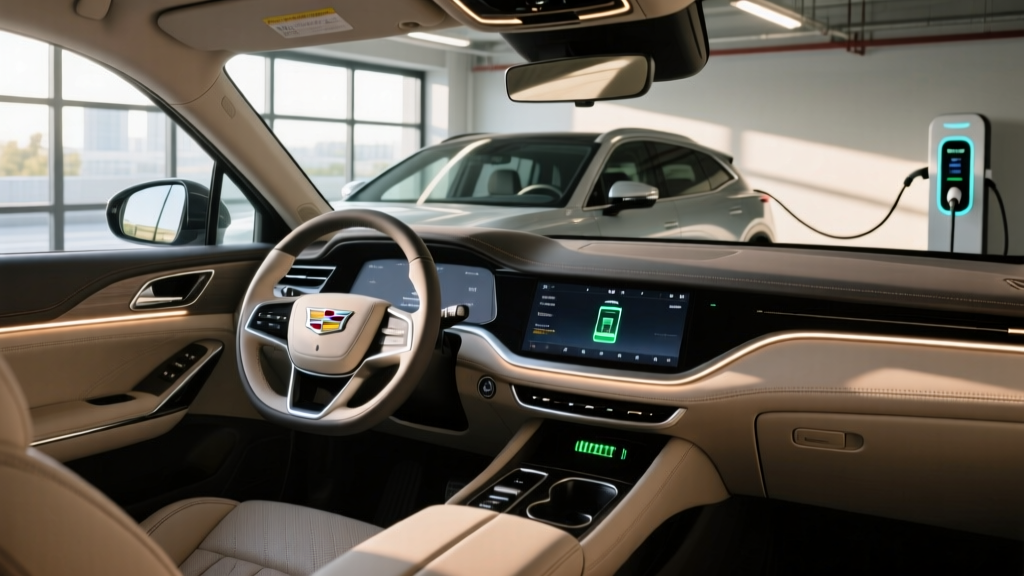
This is where the IQ earns its flagship price. The dashboard is dominated by a 55-inch diagonal pillar-to-pillar LED display — essentially five screens seamlessly fused behind a single pane of glass. The driver sees a configurable instrument cluster, the center stack handles infotainment and climate, and the passenger gets a dedicated entertainment zone. Second-row passengers in Executive Seating trims get individual 12.6-inch displays.
Materials and build: Semi-aniline leather is standard across all rows on Luxury 2 and Sport 2 trims, with open-pore wood and brushed aluminum trim. The headliner uses a suede-like material, and ambient lighting runs 128 colors. Fit and finish on pre-production units we examined was exemplary — tight panel gaps, no creaks, and haptic controls that actually provide satisfying feedback.
Passenger space:
- Front headroom: 40.2 inches | Legroom: 42.5 inches
- Second-row headroom: 39.1 inches | Legroom: 40.0 inches
- Third-row headroom: 37.8 inches | Legroom: 32.4 inches
That third-row legroom is a notable compromise. Adults over 5'8" will find it tight on long trips — the battery pack's floor height pushes seat cushions up, reducing thigh support. This is a common trade-off in skateboard-platform EVs with three rows.
Cargo volume:
- Behind third row: ~22 cu ft
- Behind second row (third row folded): ~68 cu ft
- Maximum (all rear rows folded): ~118 cu ft
- Front trunk (frunk): ~11.5 cu ft — enough for a charging cable kit and a soft-sided bag
Standout tech features:
- Super Cruise hands-free driving on 400,000+ miles of mapped roads (SAE Level 2 — driver must remain attentive)
- AKG Studio Reference 38-speaker audio system with headrest speakers
- Power-operated frunk with weather-sealed lining
- Air suspension with automatic ride-height adjustment (lowers 2 inches at highway speed for aero efficiency)
- Bi-directional charging (V2H capable with GM Energy home unit, sold separately)
Performance: 750 HP in a 9,000-lb Package
The Escalade IQ's dual-motor AWD powertrain produces 750 horsepower and 785 lb-ft of torque in Velocity Max mode. That translates to a 0–60 mph time of approximately 3.4 seconds — astonishing for a vehicle that weighs over 9,000 pounds. For context, that's quicker than a Porsche Cayenne Turbo GT.
But straight-line speed isn't the point here. The real story is how the electric powertrain transforms daily driving:
- Silent acceleration from stoplights with no transmission shift shock
- One-pedal driving with aggressive regen that nearly eliminates brake use in city traffic
- Air suspension that soaks up broken pavement and automatically lowers at highway speed to reduce drag
- Estimated towing capacity: 8,000 lbs (when properly equipped), though towing will cut range roughly in half — expect ~200–230 miles at highway speeds with a loaded trailer
Pricing, Trims & Federal Tax Credit Eligibility
The 2025 Escalade IQ launches in four trims across two design themes (Luxury and Sport):
| Trim | Base MSRP | Federal §30D Credit | Effective Price |
|---|---|---|---|
| Luxury 1 | $129,990 | $0 — exceeds MSRP cap | $129,990 |
| Sport 1 | $129,990 | $0 — exceeds MSRP cap | $129,990 |
| Luxury 2 | ~$149,990 | $0 — exceeds MSRP cap | ~$149,990 |
| Sport 2 | ~$149,990 | $0 — exceeds MSRP cap | ~$149,990 |
Why no federal tax credit? Under current IRS §30D rules, the new clean vehicle credit has an MSRP cap of $80,000 for SUVs. At $129,990+, the Escalade IQ far exceeds this limit. There are also buyer income caps ($300,000 joint / $150,000 single) and battery critical-mineral sourcing requirements — but the MSRP cap alone disqualifies the IQ regardless of your income.
State incentives may apply. Some states offer rebates or tax credits that don't have MSRP caps — check your state's energy office or DMV for current programs. These vary by jurisdiction and change frequently.
- ❌ MSRP exceeds $80,000 SUV cap ($129,990 base)
- ✓ Buyer income limits would need to be met separately ($300K joint / $150K single)
- ⚠ Battery sourcing requirements (critical minerals + component assembly) — moot due to MSRP disqualification
- ❌ Point-of-sale transfer not available (credit is $0)
Consult a tax professional for your specific situation. Rules referenced are current for the 2025 tax year per IRS.gov.
Escalade IQ vs. Competitors: Is It Worth Buying?
The Escalade IQ competes in a narrow but growing segment of full-size electric luxury SUVs:
| Spec | Cadillac Escalade IQ | Mercedes EQS SUV 580 | Tesla Model X Plaid | Rivian R1S Tri Motor |
|---|---|---|---|---|
| EPA Range | 460 mi | 305 mi | 348 mi | ~410 mi (est.) |
| Battery | ~205 kWh NMC | 108.4 kWh NMC | 100 kWh (est.) | 149 kWh NMC |
| Horsepower | 750 hp | 536 hp | 1,020 hp | 850 hp |
| 0–60 mph | ~3.4 sec | 4.4 sec | 2.5 sec | ~2.9 sec |
| Third Row | Yes (tight) | Yes (optional, tight) | Yes (very tight) | Yes (more usable) |
| Max DC Charge | 200 kW | 200 kW | 250 kW | 220 kW |
| Base MSRP | $129,990 | $105,550 | $94,990 | $104,900 |
| Federal Credit | $0 | $0 (MSRP cap) | $0 (MSRP cap) | Up to $7,500* |
*Rivian R1S eligibility depends on trim MSRP, battery sourcing, and buyer income. Verify current status on IRS.gov.
- You want the longest EPA range of any full-size luxury EV SUV (460 mi)
- Interior opulence and screen technology are top priorities
- You value Super Cruise for highway commuting on mapped routes
- Budget is not your primary constraint
- You need a genuinely usable third row for adults → Rivian R1S (or wait for the extended-wheelbase IQ variant)
- You want the fastest 0–60 time and lowest starting price → Tesla Model X Plaid
- You want a more car-like driving feel and lower price → Mercedes EQS SUV
Ownership Costs: Warranty, Insurance & Running Costs
Warranty coverage:
- Battery: 8 years / 100,000 miles (capacity retention guaranteed above 60% per GM's standard EV battery warranty)
- Powertrain: 5 years / 60,000 miles
- Bumper-to-bumper: 4 years / 50,000 miles
- Roadside assistance: 5 years / 60,000 miles
Estimated running costs:
- Home charging (national avg $0.16/kWh): ~$33 per full charge, or roughly $0.07/mile — about 60% cheaper than the gas Escalade at 14 MPG and $3.50/gallon
- DC fast charging (avg $0.40/kWh): ~$82 per full charge equivalent, or ~$0.18/mile — still cheaper than gas, but the gap narrows significantly
- Insurance: Expect premiums 15–25% higher than the gas Escalade due to repair costs and vehicle value. Get quotes before purchasing.
- Maintenance: No oil changes, no transmission fluid, minimal brake wear (regen braking). Budget for cabin air filters, wiper fluid, and tire rotation. Tires will wear faster than on lighter vehicles — expect 25,000–35,000 miles from the OEM 24-inch tires at ~$450 each.
- Class-leading 460-mile EPA range
- 55-inch pillar-to-pillar display is genuinely stunning
- 750 hp and 3.4-sec 0–60 in a three-row SUV
- Super Cruise hands-free highway driving included
- 19.2 kW Level 2 home charging minimizes overnight downtime
- Whisper-quiet cabin at highway speeds
- $129,990 starting price — no federal tax credit
- Third-row legroom is tight for adults (32.4 inches)
- 45-minute 10–80% DC charge time is slow for road trips
- 9,000+ lb weight hurts highway efficiency and tire wear
- CCS connector (no native NACS) requires adapter for Superchargers
- Home charging may require $5,000+ electrical panel upgrade
Frequently Asked Questions
What is the real-world range of the 2025 Cadillac Escalade IQ?
The EPA rates the Escalade IQ at 460 miles (Luxury 1 trim). In real-world highway driving at 70 mph, expect 350–380 miles. In cold weather (below freezing), plan for 280–320 miles on the highway. City driving with regenerative braking can approach or even slightly exceed the EPA number.
How fast does the Escalade IQ charge at home and on the road?
At home on a 240V/80A Level 2 charger (19.2 kW), the IQ adds about 36 miles per hour and fully charges in 10–11 hours — easily overnight. On DC fast chargers, it peaks at 200 kW and reaches 10–80% in approximately 45 minutes. The large battery means even fast charging takes longer than smaller EVs.
Does the 2025 Escalade IQ qualify for the federal EV tax credit?
No. Under current IRS §30D rules, the new clean vehicle credit caps eligible SUVs at an MSRP of $80,000. The Escalade IQ starts at $129,990, making it ineligible regardless of buyer income or battery sourcing. Check your state for possible local incentives that may not have MSRP caps.
Is the Escalade IQ worth buying over the gas Escalade?
If you can charge at home and your daily driving is under 200 miles, the IQ offers dramatically lower per-mile fuel costs, instant torque, and a quieter cabin. However, the $40,000+ price premium over a base gas Escalade, lack of federal tax credit, and 45-minute road-trip charging stops mean the financial payback period is long. The IQ is a technology and experience upgrade, not a cost-saving play.
Can the Escalade IQ tow, and how does towing affect range?
Yes — the estimated towing capacity is 8,000 lbs when properly equipped. However, towing at highway speeds will roughly halve your range, bringing it to approximately 200–230 miles. Plan charging stops accordingly and use the IQ's built-in trailering app to monitor energy consumption.
What connector does the Escalade IQ use?
The 2025 Escalade IQ uses CCS1 for DC fast charging and J1772 for Level 2 AC charging. It does not have a native NACS port. To use Tesla Superchargers, you'll need a GM-approved CCS-to-NACS adapter (sold separately, ~$200–$250).